India at 80: Freedom of Movement Must Also Mean Freedom to Move Safely
As India marks its 80th Independence Day, the idea of freedom extends beyond the rights and institutions that define a democracy to something far more fundamental: the freedom to move safely. Every day, millions of Indians walk, cycle, ride two-wheelers, use public transport or drive to reach work, school, healthcare and other essential services. Yet for many, mobility comes with an unacceptable risk of injury or death.
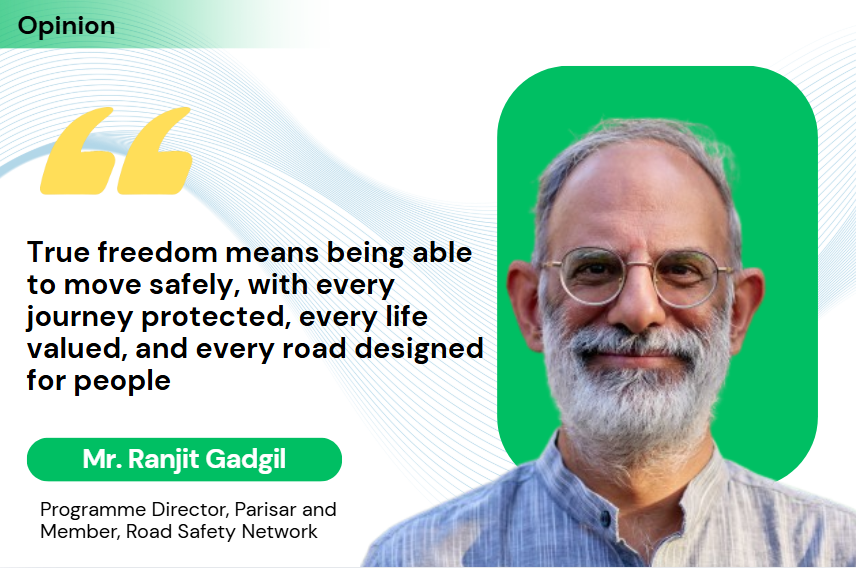
In this article, Ranjit Gadgil, Programme Director, Parisar and Member, Road Safety Network, examines why road safety must be treated as a public health and development priority rather than simply an issue of individual responsibility. Drawing on the Safe System Approach, he looks at how safer street design, scientific speed management and people-centred urban planning can protect vulnerable road users and make mobility more inclusive. On a day that commemorates India's freedom struggle, he also revisits the symbolism of walking — from the Dandi March to the everyday journeys of millions — and asks what it would take to make the freedom to move safely a reality for everyone.
On this 80th Independence Day, as we take stock of the progress we have made as a nation, our ability to travel through the length and breadth of this vast country stands out. So does the connectivity and ease with which we transport people and goods — by rail, road and air — and the enormous economic benefits that have followed. Yet we have also paid a heavy price for this progress, in the form of a ballooning number of road crash deaths and injuries. In the last 10 years alone, almost 16 lakh people have died and 50 lakh injured in road crashes (1). And these are not just numbers. They represent families losing breadwinners, children losing parents, parents losing children, and people living with long-term disability and economic hardship. For any country, this represents a grave calamity.
Road Safety Is a Public Health Issue
Just as development must take into account its impact on the environment, so too must it consider the safety of people. If the role of a public health system is to safeguard lives, enable people to live healthy and productive lives, and prevent death, injury and disability, then surely road crash deaths and injuries must be recognised as a public health issue and addressed with the same seriousness with which we address disease.
One of the distinguishing features of road crash deaths and injuries is that they predominantly affect healthy and robust individuals, who would otherwise have very low mortality rates from disease. And while crashes seemingly recognise no boundaries of caste or gender, they do disproportionately affect those with fewer resources. The data tells us that if you walk, cycle or ride a two-wheeler, you are far more likely to be killed or injured in a crash. Recent data shows that seven out of every ten road crash fatalities belong to these groups (2). (Source: Ministry of Road Transport and Highways, Government of India, Road Accidents in India 2024)
In other words, you are safer if you are inside a vehicle, particularly a car. People who depend on walking disproportionately include women, children, the elderly, persons with disabilities, and people from economically weaker sections — people unlikely to afford to drive, or may simply be unable to do so.
Moving from Individual Blame to Systemic Solutions
A public healthcare system does not blame an individual for falling sick. Instead, it focuses on nutrition, sanitation, medical care and preventive measures such as vaccination to ensure that the population as a whole remains safe and healthy. The modern approach to road safety must similarly recognise the factors that put people at risk and address them through systemic measures, so that society as a whole becomes safer.
This is the essence of the Safe System Approach (3). (Source: World Health Organization, South-East Asia Region, “Strengthening Safe Mobility”) It starts with two simple realities: human beings are vulnerable, and people will inevitably make mistakes. But those mistakes should not result in death or serious injury. The system — its roads, vehicles, speeds, laws and institutions — must be designed to be forgiving, so that when errors occur, people are protected from their potentially fatal consequences.
Building a Safer Road System
In practice, this means that roads must be designed and built to appropriate safety standards. Flaws must be identified and anticipated proactively through processes such as multi-stage road safety audits. Speed limits must take into account the context and be set at levels that are safe for the people using the road. Street design should reinforce those speeds rather than simply rely on signs and enforcement. Safety devices such as seat belts and helmets must be mandatory and effectively enforced. Vehicles, too, must continually adopt technologies and design features that protect their occupants and other road users as well.
This requires all the components of a safe road system to be in place and to complement one another. Every agency responsible for its part of the system — lawmakers for making the right laws, the police for enforcing them, RTOs for ensuring firm and fair licensing and vehicle inspection, road agencies for adopting the latest safety standards and designs, and the health system for providing high-quality post-crash care — must work efficiently and diligently. No agency can afford to point fingers at another, and no part of the system should blame the victim for its failures. In cities, where vehicles and people mix, this places an added responsibility on urban local bodies — Municipal Corporations and Development Authorities — to create well designed roads with high quality footpaths and cycle tracks.
Walking: The Foundation of Safe and Inclusive Mobility
In particular, we must pay attention to those who walk. Walking is not merely a basic right, as underscored by several recent judgments of the Supreme Court (4). (Source: Supreme Court Observer, Maniyar Iliyaz Shaik Riyaz v. P. Ayyappan) It is also a way to remain active and healthy, and a mode of travel with virtually no environmental impact. Children who do not walk are more likely to be overweight, with consequences for their health early in life. The elderly depend on walking to remain active and socially connected. Women in urban and rural areas overwhelmingly rely on walking to access work and carry out household responsibilities, including caregiving.
And we should remember, on this day, the humble act of walking that marked one of the most powerful chapters in our freedom struggle. The Dandi March demonstrated how something as simple as walking could become an act of resistance and a symbol of freedom. Today, we must reaffirm our commitment to making that simple act safe for everyone. Safe walking is indeed the foundation upon which safe, inclusive, livable and sustainable cities are built - extending this to being able to cycle, use public transport or drive safely.
Making the Freedom to Move Safely a Reality
There are many freedoms that we fought for — not just freedom from the British Raj, but the freedom to express ourselves, to practise our faith, to choose our occupations and, equally, our freedom of movement across this land.
But freedom of movement means little if moving from one place to another comes with an unacceptable risk of death or serious injury. Our freedom must therefore include the freedom to move safely — the right of every person to travel, walk, cycle or ride without fear, and to reach their destination alive and well.