
ILSS on Building a Purpose-Driven Leadership Ecosystem for India’s Social Sector
The growing interest among experienced professionals in pursuing purpose-driven careers is bringing renewed attention to the leadership and institutional capabilities required to strengthen the social sector. Beyond attracting corporate talent, the challenge lies in enabling professionals to adapt their expertise to the complexities of development work, understand community needs and contribute to sustainable institutional growth. This calls for a more considered approach to leadership development, one that balances professional excellence with contextual understanding, empathy and accountability.
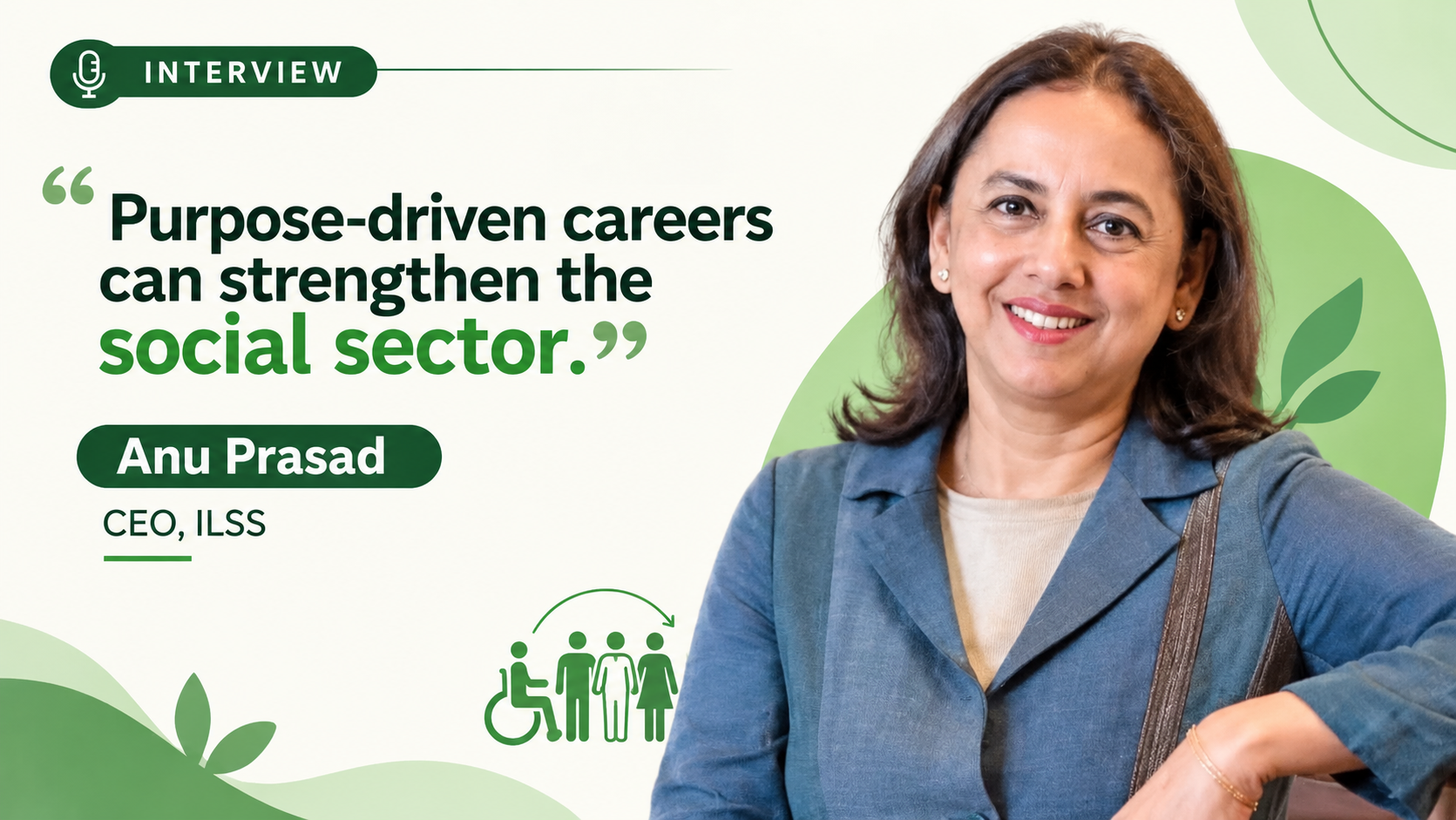
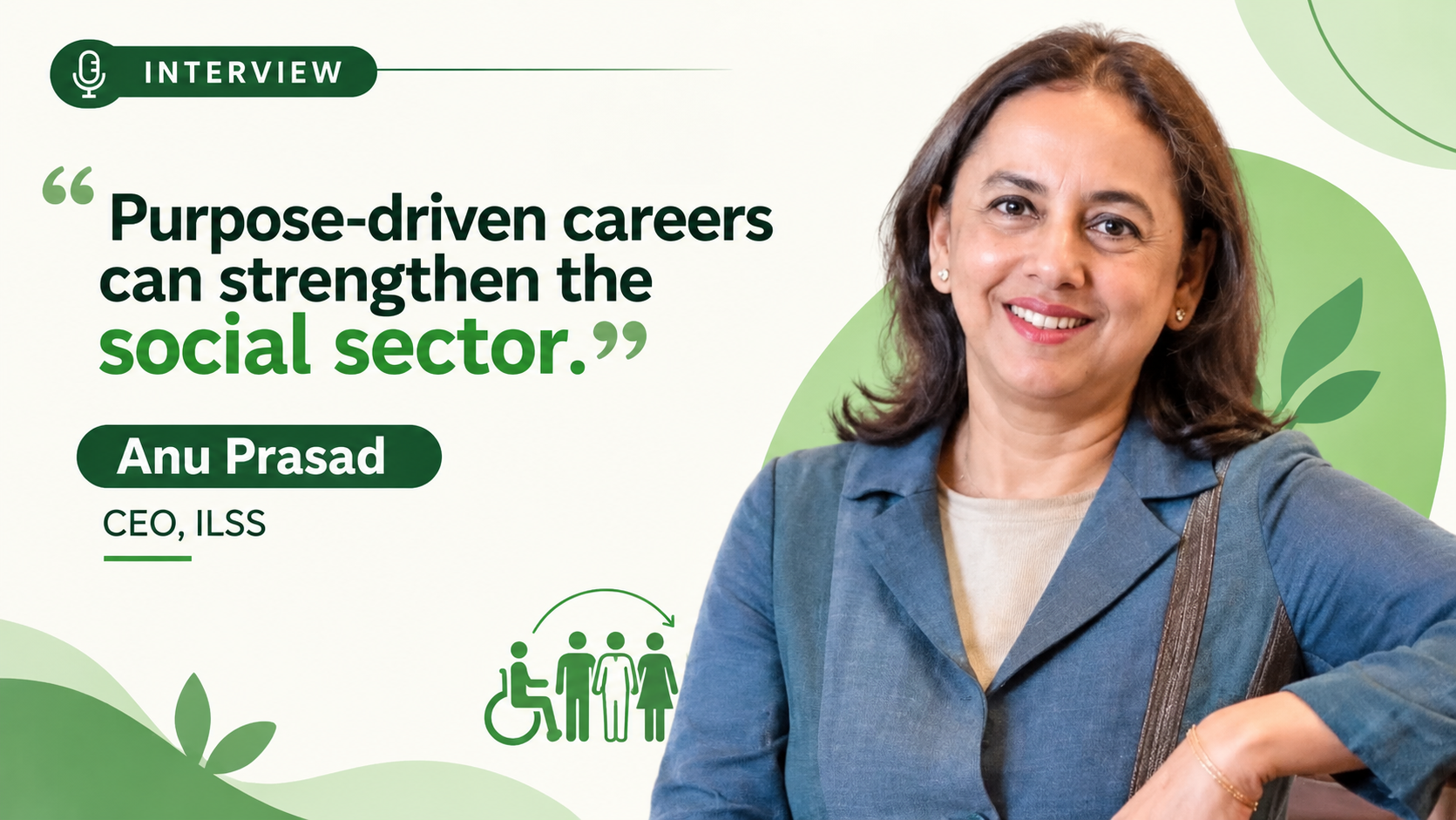
At the intersection of talent development and social impact, ILSS is working to bridge this gap by preparing professionals for meaningful transitions and strengthening the leadership capacities of social purpose organisations. In this interview, Anu Prasad, CEO of ILSS, discusses the evolving motivations behind purpose-led careers, the capabilities corporate professionals bring to the development ecosystem, and the importance of building institutional cultures that support long-term leadership. She also reflects on the need for stronger leadership pipelines, sustained transition support and an ecosystem that recognises talent development as fundamental to lasting social impact.
Scroll down to read the full interview:
Q. How do you think the meaning of a successful career is evolving as professionals place greater emphasis on purpose, social contribution and personal fulfilment alongside conventional measures of professional achievement?
A. I think the idea of a successful career is becoming more expansive. For a long time, success was largely defined through conventional markers such as designation, compensation, scale of responsibility and professional recognition. These remain important, but they no longer tell the whole story for many people. Increasingly, professionals are asking whether their work reflects their values, whether it contributes to something larger than themselves, and whether it gives them a sense of meaning and fulfilment. I see this as an attempt to align ambition with purpose. The social sector offers a meaningful avenue for people to bring their experience to challenges that affect communities and the country. But purpose alone is not enough; the work also calls for rigour, resilience, humility and a willingness to learn. A successful transition is therefore not simply about changing sectors or finding a more fulfilling role. It is about understanding where one’s skills can be useful, being open to a different context, and measuring success through both organisational effectiveness and the quality and sustainability of impact. Purpose and professional excellence need not be in conflict; ideally, they strengthen each other.
Q. What should organisations understand about the relationship between employee purpose, workplace culture and the growing desire among experienced professionals to pursue careers in the social sector?
A. Purpose, culture and career choices are closely connected, but purpose cannot compensate for a poor workplace. Professionals may be drawn to an organisation because its mission resonates with them, yet their ability to contribute meaningfully depends on whether the culture enables them to do so. Clarity of roles, trust, good people management, accountability and opportunities to learn are as important in a social purpose organisation as they are anywhere else. Experienced professionals considering the social sector are not necessarily looking to leave their expertise behind. They want to use it in a context where it can contribute to meaningful change. Organisations need to recognise this motivation while being honest about the realities of the work: resource constraints, complex stakeholders and outcomes that may take time to emerge. Our work at ILSS has shown us that successful transitions require more than matching a candidate to a vacancy. There must be alignment between the person’s values and aspirations, the organisation’s needs and culture, and the expectations of the role. Organisations that invest in their people, provide space for reflection and build a culture of purpose with accountability are better placed to attract and retain experienced talent.
Q. How can the social sector create an environment that attracts experienced corporate talent while retaining the values, motivations and perspectives that are essential to development work?
A. The social sector should not try to replicate corporate workplaces, nor should it assume that people joining from business will automatically understand its context. It needs to build an environment where professional capability and development values can work together. That begins with clear role design, realistic expectations, strong onboarding, supportive managers and a culture that values listening, collaboration and learning. Organisations also need to recognise that experienced professionals are making a transition, not simply changing employers. They may bring valuable skills, but they need opportunities to understand communities, the development ecosystem, funding relationships and the realities of implementation. Mentoring, exposure to field contexts, peer learning and regular conversations between the individual and the organisation can help make that adjustment more thoughtful. Retention depends on the quality of the experience after joining. People need meaningful responsibility, feedback, opportunities to grow and clarity on how their work contributes to the mission. At the same time, organisations must protect the values and lived knowledge that have shaped their work. The aim is to combine useful professional practices with local knowledge, empathy and accountability. When this happens, the transition can strengthen both the individual leader and the institution.
Q. Which capabilities from the corporate world can meaningfully strengthen social-sector organisations, and where do professionals often discover that their existing approaches need to change?
A. Corporate professionals can bring capabilities that many social purpose organisations need: strategic planning, financial management, operational discipline, communications, technology, data use, partnership development and the ability to build systems as organisations grow. These capabilities can help organisations move beyond dependence on individual founders and strengthen their ability to deliver and sustain impact. But skills do not transfer unchanged from one context to another. In development work, problems are interconnected, outcomes are rarely linear, and the people most affected by a decision may not be the people funding it. Professionals need to learn how to work with multiple stakeholders, understand community priorities and adapt their approaches to resource constraints and local realities. The most important shift is from assuming that a proven solution can simply be applied elsewhere to asking what the context requires. Corporate rigour is valuable, but it must be accompanied by curiosity, humility and a willingness to listen. Technology, metrics and processes are means, not ends. Their value lies in whether they help an organisation serve communities better. The strongest leaders combine professional expertise with contextual understanding and the ability to learn alongside the people they work with.
Q. What are some of the most important things corporate professionals need to unlearn when transitioning into social-sector leadership, particularly around decision-making, timelines and definitions of success?
A. One of the most important things to unlearn is the expectation that a good strategy will produce quick, predictable results. Social change is complex. Progress can be uneven, and outcomes often depend on factors beyond an organisation’s direct control. The work requires patience without losing a sense of urgency, and adaptability without losing sight of the mission. Professionals also need to rethink how they make decisions. In a corporate setting, a decision may be guided by customer needs, business performance and organisational priorities. In the social sector, leaders must also listen to communities, consider unequal power relationships and understand the perspectives of government, funders, frontline teams and other stakeholders. Consultation is not a delay to the work; it can be essential to making the work effective. A third shift is to distinguish activity from impact. Delivering a program or meeting a target is not the same as achieving sustained change. Leaders must be willing to question assumptions, learn from evidence and adjust course. Above all, they need the humility to recognise that their previous experience is an asset, not proof that they already have all the answers. Listening and learning are as important as execution.
Q. How can leadership-development programs bridge the gap between professional expertise and the contextual understanding required to work effectively with communities and social-sector organisations?
A. Leadership-development programs need to do more than teach management frameworks. They must help professionals understand the context in which social purpose organisations operate and give them opportunities to apply their learning to real challenges. At ILSS, we see leadership and management as connected capabilities: leaders need to set direction and build trust, while also managing people, resources, systems and execution. A strong program therefore combines practical learning with exposure to the realities of the sector. Case studies rooted in Indian nonprofit contexts, conversations with practitioners, field exposure, peer exchange, mentoring and reflective practice can help participants examine their assumptions and understand how change happens across communities and institutions. Fundraising, finance, compliance, stakeholder engagement, monitoring and evaluation, and digital readiness need to sit alongside strategy, people management and organisational culture. The learning environment matters, too. Professionals should have the space to ask questions, reflect on their leadership style and learn from others who face similar challenges. This cannot be a one-time orientation. Continued mentoring and support during a transition can help bridge the gap between learning and practice. The goal is not simply to prepare individuals for new roles, but to help them contribute effectively and responsibly over time.
Q. ILSS works across areas such as leadership, fundraising, technology, governance and management practices. How do you determine which capabilities are most urgently required to strengthen the institutional capacity of India’s social sector?
A. We start by listening to the sector and understanding where organisations are struggling to sustain and scale their work. ILSS’s 2025 research for the Advanced Nonprofit Leadership and Management Program involved conversations with more than 40 ecosystem stakeholders, including nonprofit CEOs and founders, prospective participants and senior leaders, sector experts, philanthropists and government officials. The findings reinforced that leadership and management challenges are interconnected. Organisations need leaders who can maintain strategic alignment, build strong teams, and create cultures of accountability. They also need capabilities in fundraising, financial management, regulatory compliance, communication, stakeholder engagement, monitoring, evaluation and learning, and digital transformation. The urgency varies by organisation, depending on its size, stage, geography and mission. That is why we do not see capacity building as a standard checklist. We look at both organisational needs and the wider context in which an organisation operates. Our Centres of Excellence across Leadership and Talent, Fundraising, Board and Governance, and AI & Digital Transformation respond to these connected needs. The larger objective is to strengthen institutions, not simply fill immediate skill gaps. Stronger leadership systems allow organisations to carry their mission forward beyond the tenure or capabilities of any one individual.
Q. From ILSS’s experience, what patterns are you seeing among professionals making this transition, and could you share any data on the scale, backgrounds or career stages of participants entering your programs from the corporate sector?
A. We are seeing growing interest among experienced professionals who want to bring their expertise to work with a clearer social purpose. At the same time, the transition is rarely straightforward: people need guidance, exposure to the sector, relevant networks and support in identifying roles that fit both their capabilities and motivations. ILSS’s Career Advancement Report for FY 2025–26 provides a snapshot of the scale of this work. During the year, ILSS supported over 100 alumni; more than 44 were placed or engaged, including 24 full-time transitions and over 20 part-time, mentoring or advisory engagements. ILSS engaged with more than 60 organisations, and the report records 98 mandates fulfilled. Of the mandates, 45% were for CXO and N-1 roles, while 55% were management roles. Fundraising, partnerships and technology accounted for 30% of mandates. These figures indicate that organisations need leadership at different levels and across functions, not only at the top. What is clear is that experienced talent can contribute in multiple ways, including full-time roles, advisory work, mentoring and part-time engagement.
Q. How can organisations ensure that the movement of corporate professionals into the social sector translates into sustained institutional capacity rather than simply a short-term career transition?
A. A successful transition cannot be measured by whether a professional accepts an offer. It must be measured by whether the individual and the organisation are able to work effectively together over time, and whether that strengthens the organisation’s ability to deliver on its mission. This requires attention at every stage of hiring. Organisations need to define the role clearly, understand the capabilities they actually need, and assess candidates for values alignment and contextual readiness as well as technical skills. New leaders need a realistic orientation to the organisation, its communities, funding relationships, culture and decision-making processes. Teams need support to integrate a new leader. At ILSS, our transition approach includes preparation, alignment, strategic matching, transition support and integration. The Career Advancement initiative also stays engaged beyond the offer letter, with structured check-ins at one, three, six, nine and twelve months to help leaders and organisations reflect, address challenges and course-correct. Mentoring, feedback and peer networks can make the difference between a short-term career move and a lasting contribution. Ultimately, retention is a shared responsibility: the professional must remain open to learning, and the organisation must invest in the conditions that allow leadership to succeed.
Q. Looking ahead, what kind of leadership ecosystem does India’s social sector need to build if it is to attract, develop and retain professionals capable of taking organisations and social-impact initiatives to the next level?
A. India’s social sector needs a leadership ecosystem that treats talent and institutional capacity as essential infrastructure for impact. As organisations take on complex challenges and work with government and other partners, leadership cannot depend only on founders. Institutions need strong second-line leaders, clear succession pathways, capable boards, effective people systems and a culture that enables teams to learn and grow. This requires action from several parts of the ecosystem. Social purpose organisations must invest in leadership development, role clarity and supportive workplace cultures. Funders need to recognise that organisational resilience depends on more than program delivery; flexible, longer-term support for people, systems and leadership pipelines is equally important. Sector networks must create opportunities for practical learning, mentoring and peer exchange. At ILSS, our work across leadership, fundraising, board and governance, and digital transformation reflects this interconnected need. We want to help professionals enter the sector thoughtfully, support organisations in making the right leadership choices, and remain engaged beyond placement so transitions can succeed. The goal is not simply to move more people into social-impact roles. It is to build a deeper, more diverse and contextually grounded pool of leaders who can strengthen institutions and help sustain meaningful change.