
Beyond Compliance: Embedding Accessibility and Universal Design Across India’s Systems
Accessibility is essential to ensuring that every individual can participate in society with dignity, independence and equal opportunity. Despite India’s progress in strengthening its disability rights framework, a significant gap remains between policy commitments and their implementation across public spaces, digital platforms, workplaces and services. The need is to move beyond treating accessibility as an additional requirement and recognise it as a fundamental principle of inclusive development.
Initiatives such as the Universal Design Awards and the Assistive Technology Hub are bringing greater visibility to accessibility and recognising efforts towards inclusive design. The 17th Universal Design Awards, which recognised 14 individuals and organisations across four categories, highlight the expanding scope of accessibility across infrastructure, technology, healthcare, employment and services. However, scaling such efforts requires stronger enforcement, institutional accountability and meaningful participation of persons with disabilities.
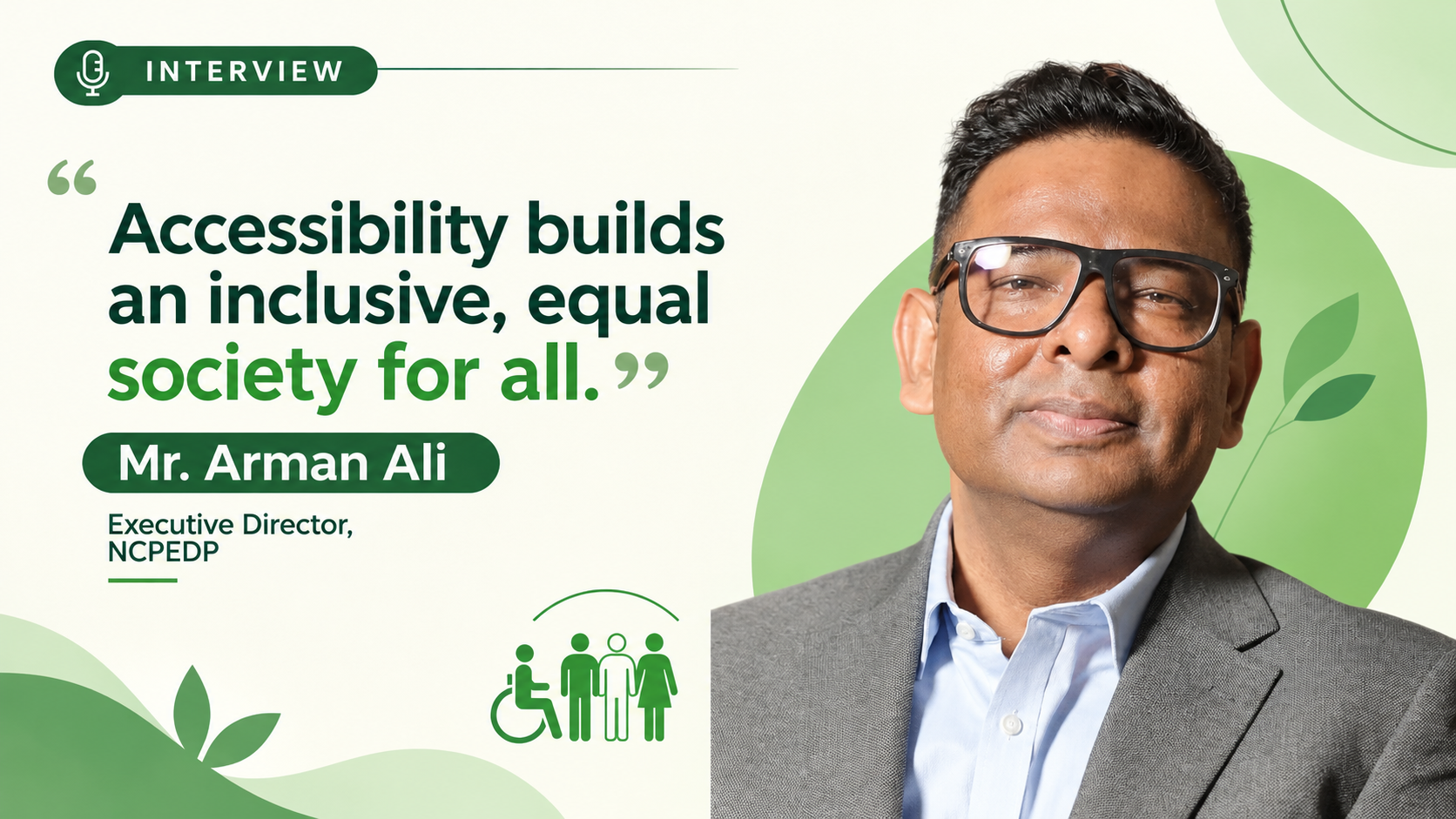
In this exclusive email interview with TheCSRUniverse, Mr. Arman Ali, Executive Director, NCPEDP, discusses the gaps between disability rights legislation and its implementation in India. He shares perspectives on integrating accessibility into organisational planning, making disability inclusion part of core business practices, and ensuring that persons with disabilities actively shape policies, products and services.
Read the full interview below to explore how accessibility can become a shared responsibility and an integral part of inclusive development:
Q. Accessibility is increasingly being recognised as a fundamental right. What are some of the biggest gaps that still exist between India’s disability rights framework and its implementation on the ground?
A. Accessibility is still treated as a retrofit rather than a starting principle. Building design, digital platforms, products and services first and consider accessibility later, which makes the process costlier and poses more limitations.
This stems from several root issues, including low awareness of Universal Design principles among architects, engineers and product teams; the limited participation of persons with disabilities in design and testing teams; and weak enforcement of existing standards under the Rights of Persons with Disabilities Act, 2016 and the Harmonised Guidelines 2021 for built environment. Any infrastructure project involves many stakeholders, so coordination and adherence to accessibility standards needs to be ensured throughout. It cannot depend on individual champions or exceptional projects.
The budget for retrofitting is often cited as a barrier, but very few Indian institutions train professionals in inclusive design. Without awareness on how people with different disabilities use a space or service, accessibility is often reduced to a ramp or a screen-reader tag.
Accessibility must be embedded into government tenders, procurement criteria, building codes, technology architecture, educational systems and service-delivery frameworks. When universal design is built into systems from the outset, it is more effective, more cost-efficient and benefits a much wider range of users.
Q. The 17th Universal Design Awards have recognised 14 individuals and organisations. What does this year’s cohort tell us about the changing landscape of accessibility and inclusive design in India?
A. This year’s cohort demonstrates that accessibility in India is steadily becoming a mainstream subject. The conversation now includes digital assessment services, access to information, healthcare, employment, and consumer products. The 14 awardees recognised across four categories represent the growing diversity of leaders driving this change, including persons with disabilities, working professionals, companies, institutions, civil society organisations, policy advocates and even content creators. Their work highlights the fact that the idea of accessibility, and the sector itself are also evolving with the trends towards increased visibility and innovation
What is particularly encouraging is that these awardees demonstrate a shift from designing for a specific group to designing for everyone. Universal Design is proving that solutions that work for persons with disabilities often improve usability and convenience for all users. This reflects a broader understanding that accessibility is a marker of good design, good governance, and good service delivery.
At the same time, the Awards remind us that progress remains uneven. Strong examples exist, but they are often isolated. The challenge now is to move from recognising good practices to replicating and scaling them. The Awards are now a cultural milestone in the sector, but such initiatives too need more support to create more opportunities for winners and contribute to sustained large scale impact.
Q. The Universal Design Awards have evolved significantly over the years, alongside initiatives such as the Assistive Technology Hub. How have these efforts contributed to building greater awareness and strengthening the accessibility ecosystem in India?
A. When the Universal Design Awards were launched in 2010, accessibility was largely absent from policy, business, education, and design. Over the past seventeen editions, the Awards have helped bring these issues into public discourse by recognising individuals and organisations that are demonstrating what inclusion can look like in practice.
One of the Awards' most important contributions has been visibility. By celebrating leadership across government, industry, startups, academia, civil society, and disability rights movements, the Awards have shown that accessibility is not confined to a single sector. Universal design incudes infrastructure, transport, digital inclusion, education, employment, communication, assistive technology, and public services. The award ceremony itself creates a platform where users, innovators, researchers, startups, policymakers, investors, and industry leaders can engage, collaborate to co-create solutions in the same room.
At the same time, initiatives such as the Assistive Technology Hub came to be because of the diverse nominations we have received from companies and organisations over the years. From recognition in the awards, The Hub has now created an ecosystem sustaining and supporting such efforts. Through media coverage, promotional material and talks with dignitaries, the Awards has also opened policy dialogue, emerging accessibility standards, innovation pipelines, and growing private-sector interest in accessibility as an area of investment and innovation.
Q. From NCPEDP’s experience of working on disability rights and accessibility, what are the most common challenges organizations face when trying to incorporate accessibility at the design and planning stage?
A. India has developed a legal and policy foundation for disability rights and accessibility. The Rights of Persons with Disabilities Act, 2016 recognizes 21 categories of disability, mandates universal accessibility, and provides for reservation in government employment and higher education. The Supreme Court has also affirmed accessibility as a fundamental right for persons with disabilities. Yet, audits across major Indian cities have found that up to 65% of newly installed accessibility features including ramps, handrails and accessible toilets fail basic gradient and usability standards even when they satisfy paperwork requirements. This is compliance on paper without meaningful accessibility in practice.
The rural gap is even sharper. An estimated 18 million persons with disabilities live in rural areas, where access to assistive technology, accessible infrastructure and awareness remain severely limited. Accessing entitlements is itself a barrier: NCPEDPs studies on access to health insurance and access to justice highlight how applications are rejected solely because of one’s disability, or even reaching a police station is a challenge. Accessibility must now be treated as a non-negotiable obligation across every public system,
Q. How can corporates move beyond treating disability inclusion as a CSR initiative and instead integrate accessibility and inclusion into their core business practices, products, services, workplaces and customer experiences?
A. Inclusion becomes sustainable only when it becomes part of the policy or business strategy itself. That means treating persons with disabilities as employees, customers, and stakeholders, not just passive beneficiaries. Concretely, this looks like building accessibility into product and service design from the outset, equal opportunity hiring, physical infrastructure, and awareness among customer service channels; recognizing the commercial case wherein persons with disabilities represent a significant, underserved consumer base globally.
Crucially, this requires cross-functional ownership such as design, HR, marketing, and operations all need accessibility built into their own metrics, rather than delegating it entirely to a CSR or diversity team. The Universal Design Awards categories spanning built environment, ICT, transport, services, and workplaces reflect this broader view that accessibility isn't one initiative but a lens that should run through every part of how a business operates.
Q. How important is the direct participation of persons with disabilities in shaping policies, products and services? What can organizations do to ensure that the principle of “Nothing About Us Without Us” is meaningfully reflected in decision-making?
A. "Nothing About Us Without Us" means that persons with disabilities shouldn’t be an afterthought in the policy or design process, but a part in all decision making. Solutions designed rarely ever factor in the experiences or needs of persons with disabilities, and you see this everywhere. Today you can buy a phone or car instantly with a few clicks, but not a prosthetic, hearing aid or wheelchair. People cannot be dependent on periodic CSR grants for their daily life and need to be institutionally supported for long-term independence and empowerment. Meaningful participation means Organizations need to involve us from throughout design, testing, and evaluation as employees, advisors, and decision-makers, not only as end-users surveyed after the fact. Representation across different disability types matters too such as the needs of a wheelchair user, a person with low vision, and a person with a hearing or psychosocial disability are distinct, and a single voice cannot represent all of them.