
Bharat Forge’s Human Engineering Approach to Building Self-Reliant and Resilient Communities
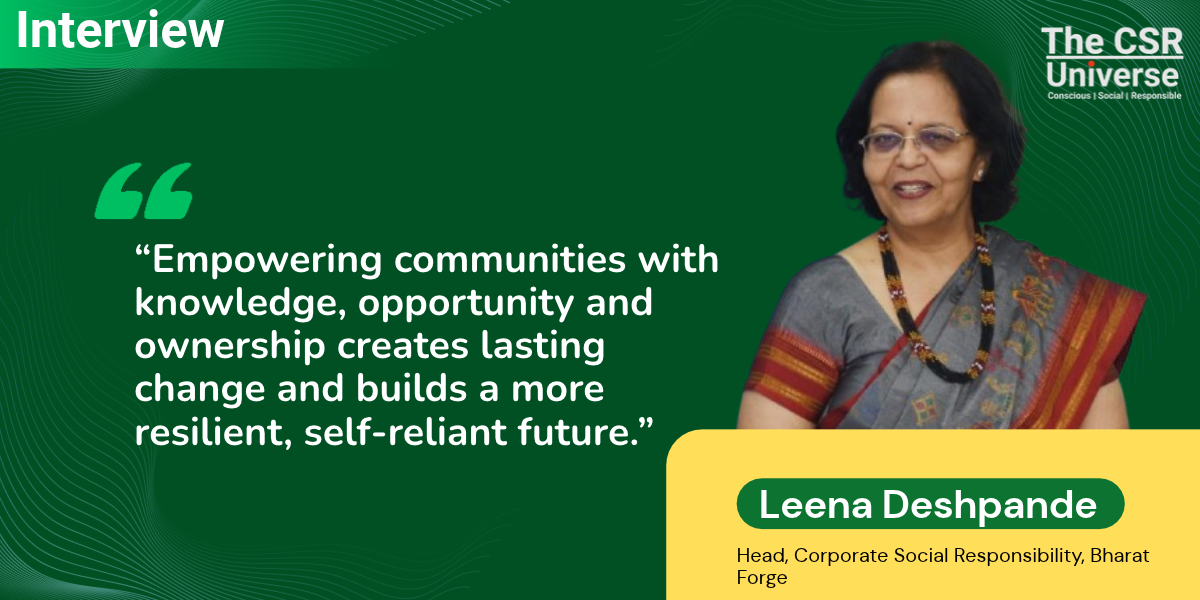
Sustainable community development calls for more than addressing immediate needs. It requires strengthening the interconnected foundations of rural life, from water security and healthcare to education, infrastructure and economic opportunity. As development priorities become increasingly complex, the role of corporate social responsibility lies in creating pathways for communities to participate in, shape and sustain their own progress.
Through its Human Engineering philosophy, Bharat Forge has adopted an integrated approach to rural development, placing community ownership and long-term resilience at the centre of its interventions. From strengthening agricultural livelihoods through water conservation to advancing technical education, women’s economic participation and vocational skills, the company’s approach seeks to connect social infrastructure with lasting economic outcomes. In this interaction with TheCSRUniverse, Ms. Leena Deshpande, Head, Corporate Social Responsibility, Bharat Forge, discusses how the company is translating community participation into measurable development outcomes while building self-reliant villages and expanding opportunities for underserved communities.
Scroll down to read the full interview:
Q. How has Bharat Forge’s understanding of community development evolved over the decades, and what does sustainable social impact mean to the company today?
A. Bharat Forge’s CSR journey began in 1978 with community centres and income-generation programmes and has since evolved into a comprehensive and structured approach to social development. We believe that the society in which we operate has contributed immensely to our growth, and it is our responsibility to give back by creating meaningful and lasting value for the communities around us. Over the years, our initiatives have expanded across village development, education, healthcare, livelihoods and skill development, driven by the understanding that lasting progress requires addressing both immediate needs and the root causes that limit opportunity and well-being.
Guided by our Human Engineering philosophy, we focus on building capabilities, improving access to essential resources and empowering communities to become self-reliant. Today, our interventions span water conservation, education, healthcare, livelihood creation, skill development and rural infrastructure, with the aim of delivering sustainable and long-term socio-economic impact. According to us Sustainable Social impact means- along with water, livelihood, building internal roads and gutters, skills development projects; it isparticipation and ownership of the communities and people with whom we work. All the stakeholders should become the partners in development process and not just beneficiaries. Sustainability is integration of environmental stewardship, economic, and social growth.
Q. What does a community-led approach to CSR look like in practice, and how does Bharat Forge ensure that interventions are shaped by local needs rather than predetermined programme models?
A. We believe that effective CSR begins with a deep understanding of community needs. Our approach is guided by continuous engagement with local stakeholders. Regular communication, constant dialogue and informal discussions help us build trust, gain deeper insights into local challenges and understand the evolving needs of the community. This enables us to identify key priorities that can create meaningful and lasting improvements in people’s lives. Through our Cultivating Villages initiative, we address the unique needs of rural communities across areas such as water security, education, healthcare, infrastructure and livelihoods.
We also recognize that sustainable development is most effective when communities are active participants in the process. Rather than simply implementing projects, we focus on building local ownership and creating an enabling environment that empowers communities to sustain and build upon their progress over the long term.
Q. How does Bharat Forge balance immediate community needs with the longer-term objective of enabling households and communities to become more self-reliant?
A. At Bharat Forge, we recognize that sustainable community development requires balancing immediate priorities with future aspirations. Access to critical resources such as water, healthcare, sanitation and infrastructure addresses pressing needs, while education, vocational training and livelihood creation equip individuals and communities to build a more resilient future. By focusing on these five key parameters, we aim to create a meaningful and sustainable impact on communities, with the outcome of enhancing income levels and improving overall quality of life.
Our approach integrates both aspects. Water conservation initiatives help strengthen rural livelihoods and agricultural outcomes, while skill-development programmes expand pathways to employment and economic mobility. Through this holistic model, we aim to foster self-sustaining communities that are better positioned to thrive over the long term.
Q. What have you learned from working across interconnected areas such as livelihoods, education, health, water and infrastructure about the need to address development challenges holistically?
A. Our experience reinforces that development challenges rarely exist in isolation. Water availability can influence agricultural productivity and household incomes; sanitation and healthcare affect community well-being; and access to education and skills can shape future employment opportunities.
This is why our village-development approach focuses on five interconnected areas: water, health, education, infrastructure and livelihoods. Improvements in one area can strengthen outcomes in another, making an integrated approach more meaningful than isolated interventions. For instance, improved water harvesting can enable changes in cropping patterns, increase agricultural yields and enhance household incomes, while better internal roads can improve access to markets, education and essential services. Our Human Engineering philosophy reflects this understanding: we seek to address the needs of the community while tailoring solutions to the specific challenges of each location. Reverse migration, demographic changes like - positive impact on marriage alliances.
Q. How does Bharat Forge assess whether its village-development interventions are creating lasting improvements in community resilience and quality of life?
A. For us, measuring impact goes beyond tracking the number of projects implemented or beneficiaries reached. We look at tangible outcomes that demonstrate whether our interventions are making a meaningful difference to communities. These include increased income levels, closed gutters for better sanitation, telemedicine in healthcare that saves productive days, farmer training that leads to higher yields, and tree plantation that supports CO2 sequestration and water positivity.
Our CSR programmes track indicators such as water storage, land brought under irrigation, students reached, youth receiving vocational training, women empowered and infrastructure created. We also work with the Indian Green Building Council to assess villages against 40 parameters, with two villages achieving Platinum recognition and nine receiving gold recognition, as reported in our CSR report. Alongside these measures, community participation and capacity-building are important to ensuring that the benefits can be sustained over time.
Q. With water security being a key component of the village-development programme, how are you thinking about the link between water availability, livelihoods, health and long-term climate resilience?
A. Water security is fundamental to rural development, particularly for communities that depend on agriculture for their livelihoods. Our initiatives focus on improving water availability through interventions such as water-body desilting, cement nala bandharas and river deepening. These efforts help improve water storage and support agricultural activity by bringing more land under irrigation. Crop variety, internal roads in the villages are promoting cash crops as they can be easily taken to the market every day.
During FY 2025–26, we created 575 TCM of water storage, taking our cumulative water storage creation to 3,701 TCM. Our initiatives have also helped bring 40,193 acres of land under irrigation cumulatively. We see water conservation as a long-term investment in community resilience, agricultural sustainability and rural livelihoods.
Q. How does Bharat Forge approach the transition from education support to employability, particularly through its work with vocational training programmes and ITIs?
A. We believe that education must increasingly be complemented by practical, industry-relevant skills that prepare young people for employment. Our initiatives focus on creating opportunities for students and young people to develop capabilities that align with evolving industry requirements. Through exposure to new-age technologies and industry-relevant courses, we equip learners with skills employers are actively looking for.
ITI Khed has been an important part of this journey, while our work through the Nagaland Tool Room and Training Centre in Dimapur is helping expand access to advanced technical learning. The centre provides exposure to areas such as drone technology, 3D printing and smart manufacturing. A batch of 21 students is also progressing towards employment opportunities in Germany. Such initiatives demonstrate how technical training can help connect learning with employment opportunities in a changing industrial landscape.
Q. What strategies have proved most effective in enabling women from underserved communities to move from skills training towards sustainable entrepreneurship and greater economic agency?
A. Our approach focuses on expanding women’s access to skills, livelihood opportunities and greater economic participation. We believe that skills development is an important starting point, but meaningful empowerment also requires opportunities to apply those skills and improve household economic security.
Our CSR initiatives include vocational training for women and broader community-development efforts aimed at economic upliftment. Our skills training covers practical, market-relevant trades such as sewing uniforms, bag making, candle making and catering. During FY 2025–26, the CSR report records 790 women empowered through vocational skills, taking the cumulative figure for 2015–2026 to 3,790. These efforts reflect our commitment to strengthening women’s capabilities and participation in economic activity. The next important measure of progress is the extent to which these capabilities translate into sustained incomes and greater independence.
Q. Could you share some of the key impact data from Bharat Forge’s CSR programmes, particularly around water conserved or made accessible, educational outcomes, youth trained and livelihoods or enterprises supported?
A. Our CSR initiatives have delivered measurable outcomes across water conservation, education, skill development, healthcare and rural infrastructure.
• Water conservation: 3,701 TCM of water storage created cumulatively, including 575 TCM during FY 2025–26.
• Agriculture: 40,193 acres of land brought under irrigation cumulatively.
• Education: 49,334 students reached through education initiatives cumulatively, including 5,785 during FY 2025–26.
• Vocational skills: 39,809 students reached through vocational skill-development initiatives cumulatively, including 3,250 during FY 2025–26.
• Women’s skill development: 3,790 women reached cumulatively, including 790 during FY 2025–26.
• Rural infrastructure: 109 km of roads constructed cumulatively, including 15 km during FY 2025–26.
• Healthcare: 7,122 women covered under health programmes cumulatively.
• Community outreach: 3,33,959 direct lives and 7,09,123 indirect lives touched during FY 2025–26.
During FY 2025–26 alone, the report records 575 TCM of water storage created, 5,785 students impacted through education initiatives, 3,250 students reached through vocational skills programmes and 790 women empowered through vocational skills. It also records 3,33,959 lives touched directly and 7,09,123 indirectly through CSR initiatives during the year.
These figures reflect the breadth of our programmes. Equally important is the focus on translating these interventions into lasting improvements in access to resources, capabilities and livelihood opportunities.
Q. Looking ahead, how does Bharat Forge envision its “Human Engineering” philosophy evolving as communities face emerging challenges around employment, climate resilience, education, healthcare and economic inclusion?
A. Going forward, we will continue to build on our Human Engineering philosophy, keeping people and community needs at the centre of our approach. We see significant opportunities to deepen our work in water security, education, healthcare, vocational skills, sustainable livelihoods and climate resilience.
Our work in water conservation, green-village initiatives, healthcare, education and advanced technology skills reflects this direction. Initiatives such as the Centre of Excellence in Dimapur and new-age technology skills centres seek to prepare young people for emerging opportunities, while village-development programmes address essential needs and strengthen local livelihoods. Going forward, our focus remains on combining community participation, technical expertise and measurable outcomes to help build more capable, resilient and self-reliant communities.



.png)