
Metastable Materials and the Case for Turning Battery Waste into a Domestic Source of Critical Minerals
The growing volume of end-of-life lithium-ion batteries presents a challenge that extends beyond waste management. It raises important questions about resource security, industrial sustainability and the ability to recover valuable materials before they are lost from the economic cycle. As demand for critical minerals intensifies alongside the expansion of electric mobility and energy storage, building efficient domestic recycling and refining capabilities is becoming an important part of the circular economy.
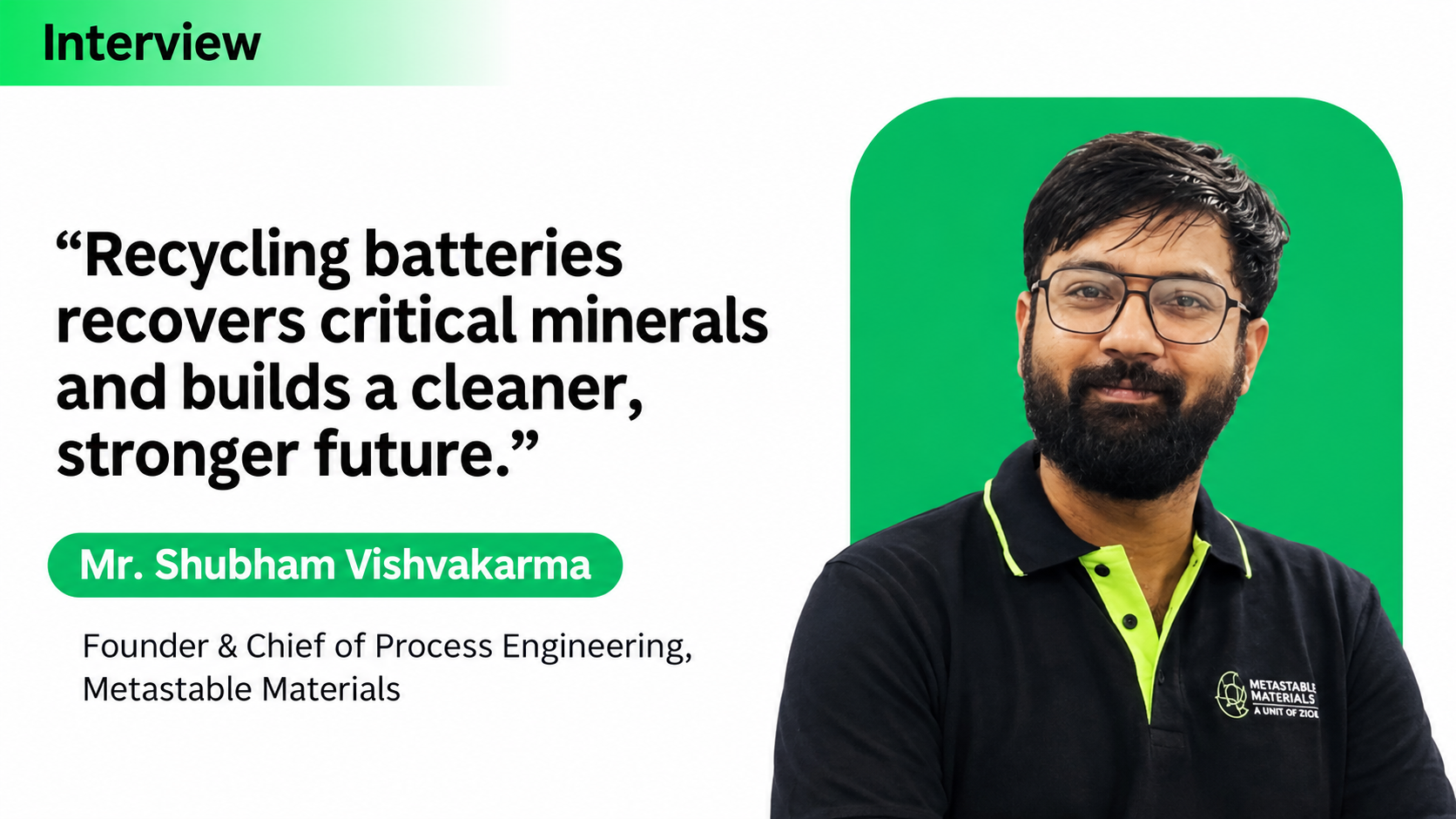
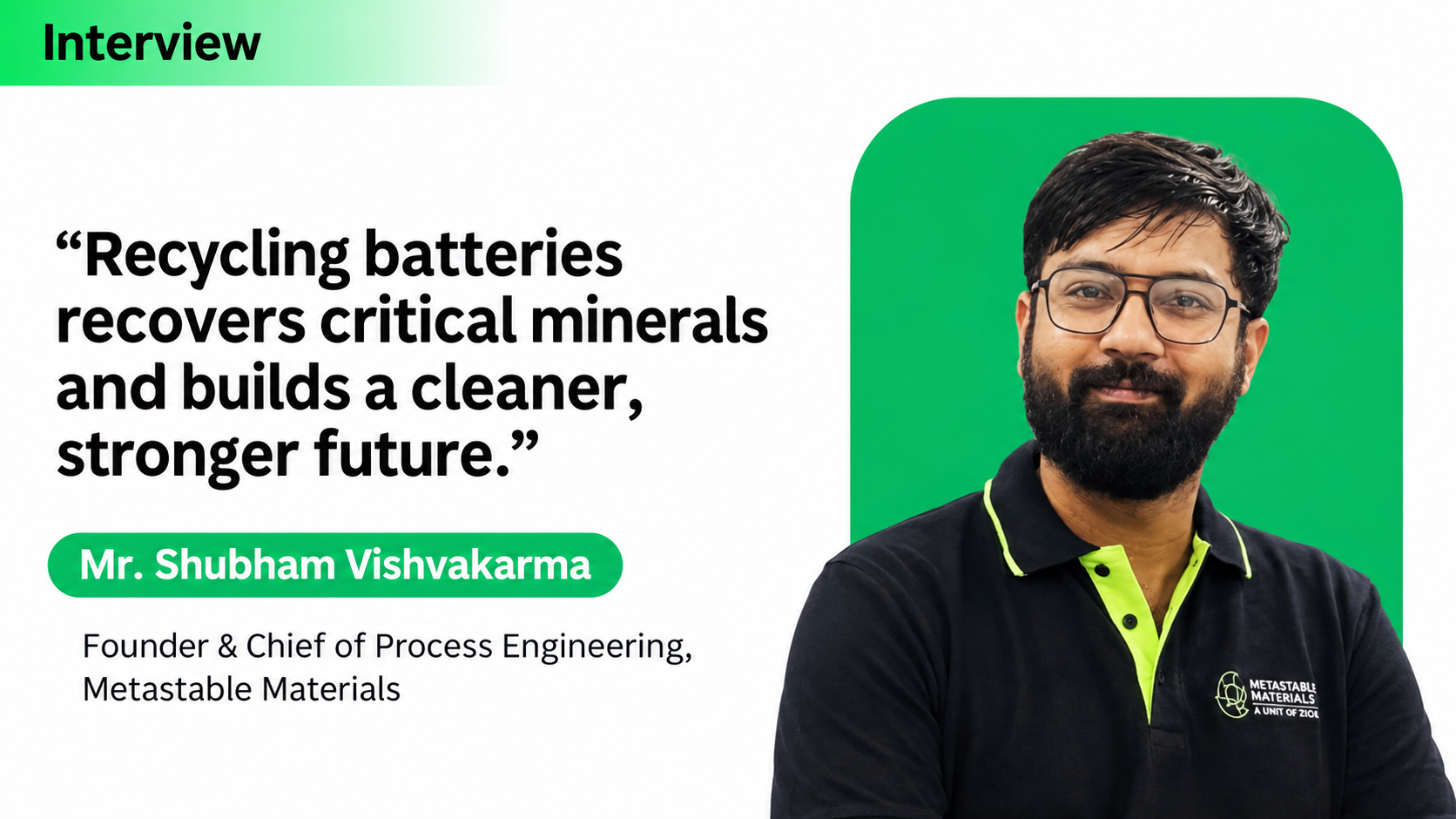
At the centre of this transition is the need to move beyond conventional recycling towards technologies that can recover valuable materials while remaining commercially viable and environmentally responsible. Metastable Materials is approaching this challenge through its ‘waste-to-ores’ philosophy, applying mineral beneficiation principles to battery recycling to create a secondary source of critical minerals. In this interview, Shubham Vishvakarma, Founder and Chief of Process Engineering, Metastable Materials, discusses the technological, operational and economic considerations shaping this approach, including chemistry-flexible recovery, industrial scalability and the role of secondary materials in strengthening domestic supply chains.
Scroll down to read the full interview:
Q. How does Metastable Materials approach the challenge of making critical-mineral recovery a scalable and commercially sustainable part of India’s circular economy?
A. At Metastable Materials, we approach battery recycling as a materials recovery and refining challenge, rather than waste management. End-of-life lithium batteries contain valuable metals such as lithium, nickel, cobalt, copper and aluminium, which can be recovered and returned to industrial supply chains.
Our patented technology has been developed to recover these materials without relying on external reagents that are commonly used in conventional recycling technologies. The goal was resource efficiency, with a cleaner, simpler technology that is also commercially viable.
Scalability mostly depends on three factors, namely access to good quality feedstock reliably, consistent recovery of saleable materials and the ability to process different chemistries of battery waste efficiently. By producing materials that can serve established industrial applications, we aim to build a commercially sustainable model that supports India’s domestic materials ecosystem and reduces dependence on virgin mineral extraction.
Q. What were the key considerations behind developing a technology that can work across different battery chemistries, and how does this influence the scalability of the solution?
A. Lithium batteries are not a uniform waste stream as different form factors exist for different applications and so do different chemistries. Different chemistries mean different elemental compositions, material values and processing requirements. A recycling technology must account for these while maintaining reliable recovery and viable output across these different types of feedstock.
Our approach has been to develop a process that borrows from mineral beneficiation, i.e. the technology that is used to separate and concentrate valuable minerals from ore, for batteries. It facilitates material recovery with minimal use of external inputs. This allows us to process diverse lithium ion battery waste streams through an integrated refining approach.
From a scalability perspective, chemistry flexibility is important because the composition of battery waste changes as electric mobility, energy storage and battery manufacturing evolve. A technology that can adapt to these changes is better positioned to serve a changing feedstock market. However, scalability is not simply about accepting different chemistries; it also requires chemistry-specific process optimisation, consistent output quality and sound operating economics.
Q. How does the company assess the environmental value created through its recovery and refining processes compared with conventional approaches to managing spent batteries?
A. The first measure of environmental value is how much of battery material is recovered, and looking at the material lifecycle, how efficiently resources were used in recovery and how the residual materials and waste streams are managed. Avoiding acids and reagents in our process means that the process has the potential to reduce the environmental burden associated with the use and management of external acids and reagents. We also have a zero liquid discharge system, meaning the water used in the process is not discharged but reused. The environmental performance of an industrial facility depends on its actual operating conditions, including energy and water consumption, emissions and the management of residual waste and we recognise that while designing our plants. The broader benefit is that recovered materials can re-enter industrial supply chains, potentially reducing the need for equivalent quantities of virgin materials.
Q. What role does the ‘waste-to-ores’ approach play in changing the economics of battery recycling and creating a more circular domestic supply chain?
A. “Waste to Ores” is a simple idea that a spent battery is a concentrated source of valuable materials. This “waste” is a great secondary resource for the minerals it contains such as lithium, nickel, cobalt, copper, graphite, aluminium. We also treat the batteries as one would an ore and apply similar mineral beneficiation techniques.
The economics depend on both recovery yield and its consitency, and on producing materials there is an established market for. Feedstock and processing costs, recovery performance and commodity prices all influence commercial viability.
Domestically we can build a secondary source of these strategic materials which are primarily being imported right now. It cannot eliminate the need for mining, but it can complement primary extraction, improve resource utilisation and reduce the amount of valuable material lost from the economy.
Q. How is Metastable Materials working to bridge the gap between laboratory-scale innovation and industrial-scale critical-mineral recovery?
A. To move from lab scale innovation to industrial scale requires translating the chemistry into reliable equipment, repeatable operating procedures and consistent product quality at scale.
At Metastable Materials, we have developed our technology along with the engineering. This includes designing and integrating process equipment, optimising operating parameters, managing variations in feedstock and establishing quality-control procedures. Initial commercial operations also provide an important feedback loop. Real-world feedstock variability, equipment performance, maintenance needs and customer specifications reveal challenges that lab testing alone cannot fully capture.
Q. What measures are being taken to ensure that recovered materials meet the quality and consistency requirements of downstream industries?
A. Recovered material must meet industry requirements for purchase and usage. This is ensured through process control, and testing at relevant stages of the process. Understanding the input material is also essential to controlling the output. We work with customers and third-party laboratories and in-house testing to ensure end products meet the product specifications. This is part and parcel of the refining industry and as the volumes increase the objective is to consistently ensure product quality.
Q. As the company expands its operational footprint, how are you balancing capacity building with maintaining the efficiency and environmental performance of the recovery process?
A. We view capacity expansion and operating discipline as complementary priorities. Adding capacity is meaningful only when the underlying process can operate reliably, recover materials efficiently and meet environmental and quality requirements.
Q. Could you share data on the volumes of batteries or intermediate feedstocks processed so far, along with the quantity or proportion of critical minerals successfully recovered?
A. We are currently ramping up our plant operations. Our Bengaluru facility has an installed processing capacity of approximately 1,500 tonnes per year and our process achieves recovery rates exceeding 90%, under suitable operating conditions though this should not be interpreted as a uniform recovery rate for every element or feedstock. We assess yields at the material and process level because different battery chemistries contain different proportions of recoverable metals.
Q. How can Metastable Materials’ model contribute to reducing the environmental and economic challenges associated with India’s growing battery waste stream?
A. India’s battery waste stream represents two challenges: managing end-of-life batteries responsibly and securing the materials required for the next phase of industrial and energy-transition growth.
An effective recycling ecosystem can address both. Recovering valuable materials reduces the risk of their being lost from the supply chain and creates a secondary source of industrial raw materials. It can also help reduce the pressure on primary mineral supply, although the extent of this benefit depends on recovery performance, material demand and the economics of recycling.
Our model seeks to make this possible through integrated battery recycling and refining. By recovering materials that can serve established industrial applications, we aim to connect waste generators with downstream material users through a commercially viable supply chain.
Q. Looking ahead, what would the next phase of the company’s critical-mineral recovery initiative look like, and which outcomes would you consider most important in measuring its impact?
A. The next phase is about translating technological capability into sustained industrial performance. Our priorities include increasing capacity utilisation and expanding our ability to serve different battery waste streams.
We also want to deepen relationships across the value chain, from battery manufacturers and waste aggregators to industrial customers that can use recovered materials. A strong recycling ecosystem depends on reliable feedstock and dependable markets for the output; progress on both sides is essential.
We would measure impact through a combination of operational, commercial and environmental indicators. These include material recovery rates by element, processing capacity and utilisation, product-quality consistency and commercial performance. Ultimately, success would mean demonstrating that battery recycling can become a dependable domestic source of secondary raw materials, while remaining environmentally responsible and commercially profitable at scale.