80 Years of Independence: Has Development Reached India’s Tribal Communities?
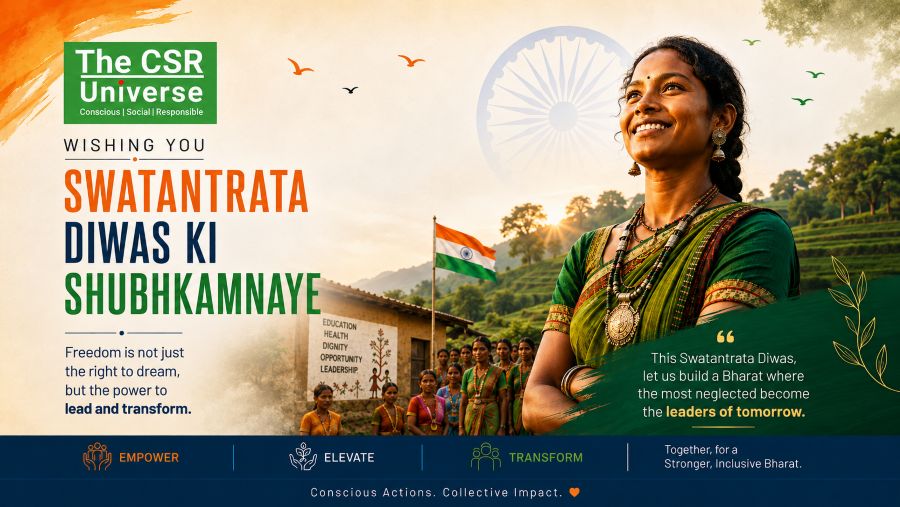
India has expanded its policy focus and investment in tribal development, with programmes addressing housing, education, healthcare, forest rights and livelihoods. But as the country approaches its 80th year of Independence, the more difficult question is whether these interventions are translating into lasting improvements in the lives of tribal communities.
Every year, as India prepares to celebrate Independence Day, the country returns to the ideas of freedom, equality and opportunity. For many Indians, the meaning of independence has gradually expanded beyond political freedom to include access to education, healthcare, livelihoods and the ability to participate in the country’s economic and social progress. For India’s tribal communities, however, some of these aspirations remain closely tied to more fundamental questions of land, forest rights, basic services and economic security.
India is home to more than 10 crore Scheduled Tribe citizens, according to the 2011 Census, accounting for 8.6% of the country’s population. Over the years, governments have created an extensive architecture of tribal development, and in recent years there has been renewed emphasis on Particularly Vulnerable Tribal Groups (PVTGs), tribal-majority villages, education, livelihoods and community rights.
There is undoubtedly progress to acknowledge. At the same time, the gap between policy intent and lived experience remains significant. The challenge today is therefore not simply to create more schemes, but to ensure that existing interventions reach the last mile and translate into outcomes that communities can sustain.
From Schemes to Outcomes
The scale of the current policy response is considerable. The Pradhan Mantri Janjati Adivasi Nyaya Maha Abhiyan (PM-JANMAN), launched in 2023, focuses on 75 Particularly Vulnerable Tribal Groups across 18 states and one Union Territory. Its interventions cover housing, drinking water, roads, healthcare, education, electricity, telecommunications and livelihoods. The Dharti Aaba Janjatiya Gram Utkarsh Abhiyan has similarly brought together interventions across ministries to address infrastructure and development gaps in tribal-majority villages.
PM-JANMAN’s implementation data, however, illustrates why the last mile remains critical. By December 2025, 4,73,939 houses had been sanctioned against a target of 4.90 lakh, but around 2.50 lakh had been completed. Of the 8,000 km of roads targeted, 7,316.62 km had been sanctioned, while 1,196 km had been completed. Under the drinking-water component, 8,199 villages had achieved 100% saturation against a target of 19,375 villages.
These numbers do not necessarily indicate that the programme is failing. Delivering infrastructure in remote and geographically difficult areas takes time, and implementation can be affected by land, logistics, procurement and administrative constraints. But they demonstrate an important distinction in development: a scheme being announced, funded or sanctioned is not the same as a household actually receiving a service, and receiving an asset is not necessarily the same as experiencing a sustained improvement in quality of life.
That distinction needs to inform the next phase of tribal development. The question should increasingly move from how many villages have been covered to what has changed within those villages.
Land and Forest Rights Remain Central to Tribal Development
For many tribal communities, the question of development cannot be separated from their relationship with land and forests. The Forest Rights Act, 2006 was therefore an important shift in policy because it recognised individual and community rights of forest-dwelling tribal communities and other traditional forest dwellers.
Yet implementation continues to require attention. Between March 2021 and March 2026, 11.36 lakh forest rights claims were filed across the country, of which 5.36 lakh were recognised, while 5.88 lakh remained pending at different levels, according to information provided by the Ministry of Tribal Affairs in Parliament.
Recognition of a right, however, is only one part of the process. A forest rights title becomes meaningful when it contributes to greater livelihood security, when community forest rights can be exercised effectively, and when Gram Sabhas have the institutional capacity to participate in decisions about the resources on which their communities depend.
There are encouraging examples of this happening. In Jharkhand’s Bokaro district, six villages recently received community forest rights over around 4,300 acres of forest land. Such developments demonstrate the potential of moving from individual welfare entitlements towards community stewardship and local participation in managing natural resources.
The larger opportunity is to connect rights with livelihoods. Communities may need support with sustainable forest management, value addition, market access, producer institutions and financial linkages if recognition of forest rights is to translate into greater economic security.
Education Has Moved Forward, but Access Is Only the Beginning
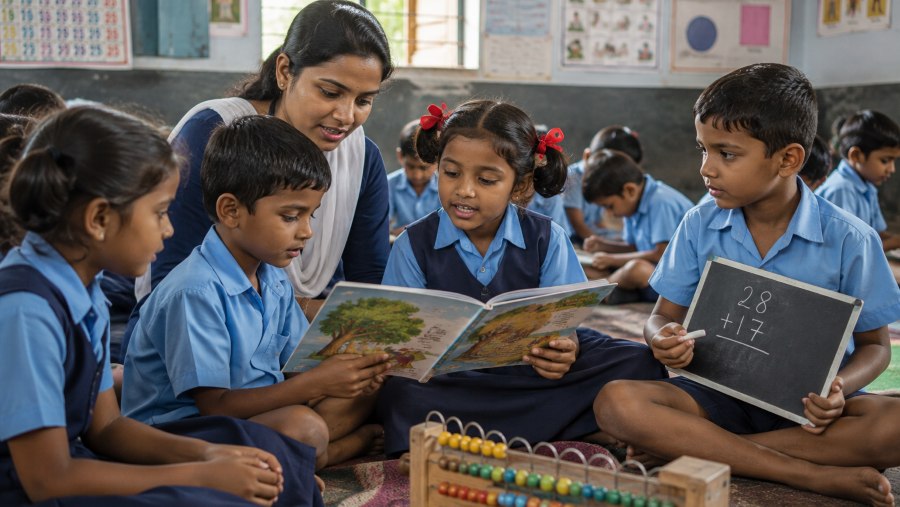
Education remains one of the strongest pathways to changing the long-term prospects of tribal communities, and the expansion of Eklavya Model Residential Schools (EMRS) has been an important part of this effort.
Government data indicates that 728 EMRS have been approved, with more than 500 functional. The schools are intended to provide quality residential education to children from Scheduled Tribe communities, particularly in areas where access to good secondary education is limited.
There are also encouraging outcomes emerging from the system. Government data has highlighted strong performance by EMRS students in board examinations and competitive examinations, including IIT-JEE and NEET. These examples are important because they challenge the tendency to view tribal education entirely through the lens of deprivation. With the right infrastructure and support, tribal students are clearly capable of competing successfully in higher education.
The larger challenge is to ensure that these opportunities become more widespread. Education requires more than a school building or residential facility. Teacher availability and retention, learning outcomes, language, cultural context, support for first-generation learners and pathways into higher education and employment all matter.
The next measure of success should therefore not only be how many children enter or complete school, but what happens to them afterwards.
Livelihoods Need to Create Choices, Not Just Employment
The same principle applies to economic development. Programmes such as Van Dhan seek to strengthen tribal livelihoods by moving beyond the sale of raw forest produce towards aggregation, processing, value addition and market access.
By July 2026, 4,172 Van Dhan Vikas Kendras had been sanctioned, involving more than 12.48 lakh members. The programme has the potential to strengthen local economies and particularly support tribal women, who are often closely involved in the collection and processing of forest produce.
But here too, the success of a livelihood intervention should be judged by what happens beyond the training or project period. Are producers receiving better prices? Are enterprises remaining viable after the initial support? Is more value being retained within the community? Are women gaining greater control over income and economic decisions?
These are more meaningful measures of livelihood security than the number of people trained or groups formed.
The objective of tribal economic development should not simply be to make communities employable. It should be to expand their choices—whether through local enterprises, agriculture, forest-based livelihoods, skilled employment or entrepreneurship.
What Can CSR and the Development Sector Do Differently?
The growing engagement of CSR with tribal development offers an opportunity, provided it is approached as a long-term development partnership rather than another collection of short-duration projects.
Recent partnerships illustrate this potential. Government-linked tribal institutions have been working with companies including ONGC and Coal India on interventions in Eklavya Model Residential Schools, including digital education, infrastructure, career mentorship and capacity building. The Ministry of Tribal Affairs has also been seeking greater corporate participation in tribal development.
Such partnerships can be valuable because CSR can bring additional resources, technical expertise and the ability to experiment with locally relevant models. But its role should not be limited to building infrastructure or funding one-off activities.
There is scope for greater investment in strengthening Gram Sabhas and community institutions, supporting tribal women-led enterprises, improving local-language education, building forest-produce value chains, strengthening access to government entitlements and supporting health and nutrition systems in remote areas.
The development sector can also contribute by improving the way impact is measured. The number of beneficiaries reached, schools supported, people trained or assets created provides useful information, but it does not necessarily tell us whether people’s lives have changed.
A stronger approach would track whether household incomes have become more secure, whether children have progressed into higher education and decent employment, whether women have gained greater economic agency, whether forest rights have translated into livelihoods and whether community institutions have become stronger over time.
From Beneficiaries to Participants
Perhaps the most important change required in tribal development is one of perspective.
Tribal communities are frequently described as vulnerable populations or beneficiaries. These descriptions reflect genuine disadvantage, but they can also reduce communities to the problems that development programmes are designed to solve.
Tribal communities are also rights-holders, producers, entrepreneurs, custodians of traditional knowledge and participants in local governance. Their involvement in defining development priorities is therefore not simply desirable; it can determine whether an intervention remains relevant after an external organisation leaves.
This is particularly important as economic development, infrastructure and climate-related interventions increasingly intersect with tribal lands and natural resources. Development cannot be considered successful if it improves one indicator while creating another source of insecurity for the same community.
For the government, the task is to strengthen implementation, convergence and accountability. For CSR and civil society, the opportunity lies in supporting communities and public systems over the long term rather than creating parallel structures that disappear when a project ends.
As India approaches its 80th year of Independence, there is reason to acknowledge the progress that has been made. Tribal development has greater policy attention, dedicated programmes have expanded, forest rights continue to be recognised, educational opportunities are growing and new livelihood models are emerging.
But the unfinished work is equally clear. The meaning of Independence for India’s tribal communities cannot be measured only through the number of schemes announced or the money allocated. It is ultimately reflected in whether a family has greater security over its land, whether a child can access and complete a good education, whether healthcare is available when needed, whether livelihoods provide a reliable income and whether communities have a meaningful voice in decisions that affect their future.
The next chapter of tribal development therefore needs to move beyond the question of how much has been delivered to the more difficult question of what has changed.
For the development sector, that may be the most important contribution it can make—not simply to bring more programmes to tribal communities, but to help create the conditions in which communities have greater agency to shape their own futures.
That, ultimately, is where the promise of Independence meets the work of development.





.JPG)