
Bharti Airtel Foundation: From Educational Access to Building Systems That Transform Learning at Scale
Educational philanthropy is increasingly being challenged to look beyond access and enrolment towards the institutional foundations that make quality learning sustainable. The real measure of progress lies not merely in how many children enter classrooms, but in whether schools, teachers and public education systems are equipped to nurture their potential over time. This calls for a shift from isolated interventions to sustained investments in institutional capacity, pedagogical innovation and equitable opportunities.
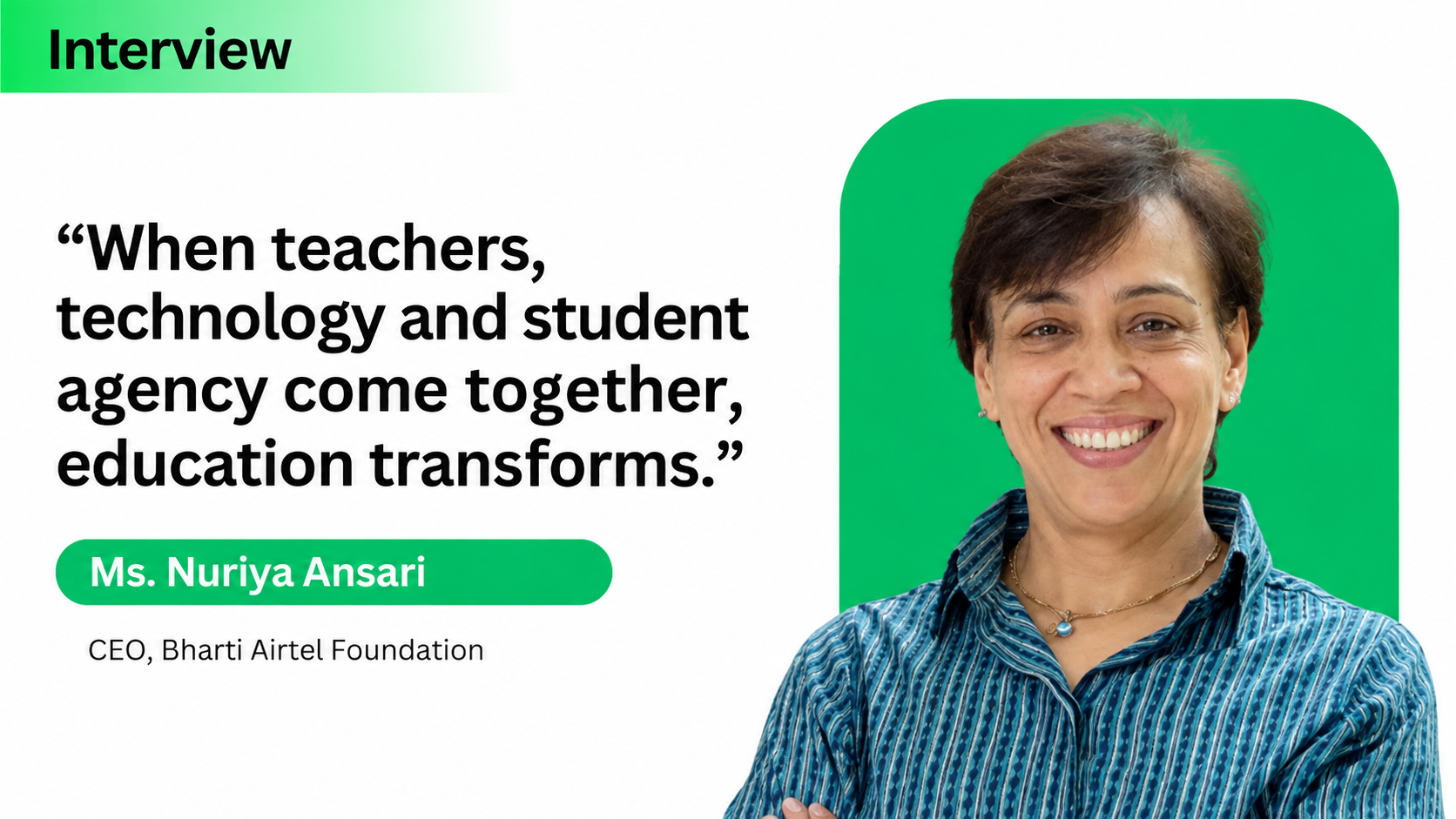
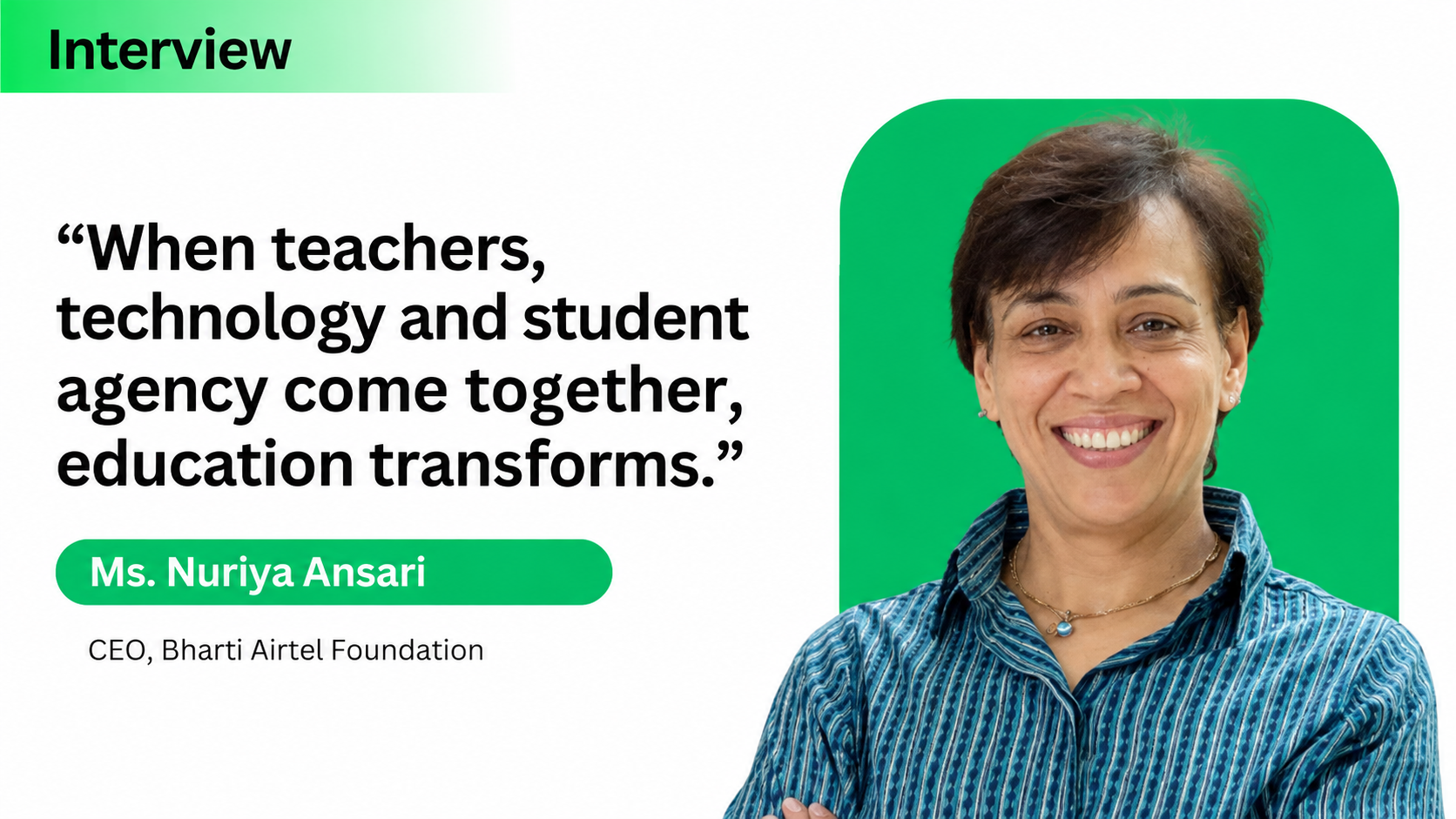
Over 26 years, Bharti Airtel Foundation has steadily evolved its approach to educational development, moving from direct school-based interventions towards strengthening the wider education ecosystem. From improving teaching practices in government schools and expanding continuous professional development through TheTeacherApp to integrating AI-enabled tools and widening access to technology-led higher education, the Foundation's work reflects a broader understanding of what it takes to make educational impact endure. In this conversation, Nuriya Ansari, CEO of Bharti Airtel Foundation, discusses the changing priorities of educational philanthropy, the importance of building self-sustaining institutions, and why the future of learning must place teachers, technology and student agency at the centre of systemic transformation.
Scroll down to read the full interview:
Q. Over 26 years, how has the Foundation’s understanding of meaningful educational philanthropy evolved, particularly from direct service delivery towards strengthening the wider education ecosystem?
A. We began with a strong focus on providing access to quality education through direct interventions, particularly in underserved rural communities. Satya Bharti Schools, our flagship initiative, have been providing free, quality education since 2006, with a special focus on the girl child, demonstrating that children from even the most challenging socio-economic backgrounds can achieve strong learning outcomes when provided with the right opportunities and support.
As we grew, we recognised that lasting educational transformation in a country as large and diverse as India cannot rely solely on isolated institutions. While demonstration models remain important, the larger opportunity lies in strengthening the education ecosystem itself. That realisation led us to increasingly invest in government school partnerships, teacher development, system capacity building, and knowledge-sharing platforms.
Over time, we have come to see that lasting change in education is achieved not by isolated successes, but by strengthening the systems that shape learning opportunities for millions of children. Learnings from Satya Bharti Schools have informed initiatives such as the Quality Support Program and state-level partnerships, enabling successful practices to be adapted within government schools. Our focus today is on helping scale quality through stronger institutions, empowered educators, and collaborative partnerships.
Our approach is anchored in the belief that philanthropy should help build institutions, strengthen systems, generate evidence, and support scale through partnerships. The goal is no longer just to create islands of excellence but to enable system-wide improvement that can benefit millions of children across the country.
Q. What does long-term impact mean when working in education, where outcomes such as learning, confidence, agency and employability may take years to fully emerge? How do you distinguish between scale of reach and depth of impact?
A. Education is inherently a long-term investment. The most meaningful outcomes often emerge years after a child leaves school or completes a programme. For us, long-term impact means enabling individuals to realise their potential, make informed life choices, access opportunities, and contribute meaningfully to society.
While reach is important, we distinguish scale from impact very carefully. Scale tells us how many students, teachers, or schools have been touched by an intervention. Impact tells us whether meaningful change has occurred in learning, classroom practice, school culture, aspirations, confidence, problem-solving abilities, and future opportunities.
We often say that scale without quality is simply expansion. The real test is whether growth is accompanied by meaningful improvements in learning, opportunity, and life outcomes. That is why we continuously focus on strengthening teaching-learning processes, leadership, and institutional capacity rather than measuring success solely through the numbers reached.
Our reach since inception extends to more than 7.8 million beneficiaries, including over 4.3 million students and 3.62 lakh teachers. However, numbers alone do not define success. We place equal emphasis on indicators such as strengthened teaching practices, improved school culture, student engagement, confidence, aspirations, and the institutional capacity that sustains change over time.
Our alumni are entering premier institutions, professional careers, teaching, public service, and entrepreneurship. These trajectories tell us far more about long-term impact than enrolment figures alone.
Q. With education increasingly shaped by technology, changing labour markets and evolving pedagogical practices, what do philanthropic organisations need to rethink about the way they invest in human capital?
A. Philanthropy must move beyond viewing education only through the lens of academic achievement. The future workforce will require adaptability, critical thinking, collaboration, digital fluency, creativity, and lifelong learning capabilities.
This means investing not only in students but also in the systems that support them, particularly teachers, school leaders, and educational institutions. It also means creating opportunities for exposure to technology, experiential learning, career awareness, and real-world problem-solving from an early age.
Equally important is ensuring that technology remains inclusive. The real opportunity is not simply digitisation but democratising access to high-quality learning resources, teaching support, and professional development. Human capital development must be viewed holistically, strengthening both technical competencies and the social-emotional capabilities required to thrive in a rapidly changing world.
The future of human capital development lies in building capable individuals and resilient institutions simultaneously. One without the other rarely creates lasting impact.
Through the Bharti Airtel Scholarship, for example, we complement financial support with structured mentorship. Scholars are connected with professionals and leaders from the Bharti ecosystem who help them navigate higher education, career choices, workplace readiness, and leadership development. These relationships often provide the confidence, networks, and guidance that can make the difference between access and success.
Q. How does the Foundation balance the need to develop models through its own institutions with the larger responsibility of strengthening public education systems?
A. We see these efforts as complementary rather than competing priorities. Our own institutions enable us to innovate, test approaches, refine practices, and generate evidence. They also serve as learning laboratories, helping us understand what works in practice before adapting those insights for wider adoption through public education systems. In that sense, innovation and scale are not separate ambitions; innovation generates the evidence, and system partnerships create the pathway to scale.
The Quality Support Program was designed to ensure that successful practices do not remain confined to individual schools. Through the programme, we work alongside government systems to strengthen school leadership, teacher effectiveness, student engagement, and institutional capacity in government schools. The objective is to help schools become self-sustaining centres of excellence that continue to improve long after external support is reduced.
Philanthropy is most effective when it strengthens public systems rather than substitutes for them. Sustainable change happens when ownership ultimately resides within the system itself. That is why partnership, capacity building, and long-term collaboration remain central to our approach.
Q. TheTeacherApp has grown into a national teacher-development platform. What has the Foundation learned about sustaining teacher engagement beyond one-time training?
A. One of the strongest lessons from our work is that meaningful teacher development cannot be achieved through one-time workshops alone. Teachers benefit most when professional learning is continuous, relevant, flexible, and directly connected to classroom practice.
TheTeacherApp was designed around this understanding. It allows teachers to learn at their own pace, access resources when needed, collaborate with peers, and apply new ideas immediately in the classroom. Sustained engagement comes when learning is practical, contextual, and responsive to teachers’ realities.
Today, the platform supports more than 300,000 educators through thousands of hours of learning content, AI-enabled tools, and collaborative learning opportunities. More importantly, it creates an environment where professional growth becomes continuous rather than episodic.
We believe continuous professional development strengthens teacher confidence, pedagogy, classroom management, assessment practices, and student engagement. Every education reform ultimately succeeds or fails in the classroom, and the classroom is shaped by the teacher. That is why teacher development remains one of the most powerful and scalable investments in education.
Q. How is the Foundation approaching AI-enabled tools while ensuring that technology complements rather than substitutes teachers’ judgement and human engagement?
A. Our philosophy is very clear: technology should augment teachers, not replace them.
The AI-enabled tools within TheTeacherApp are designed to reduce administrative burdens, support lesson planning, generate teaching resources, assist with assessments, and personalise learning support. These capabilities help teachers save time and access high-quality resources more efficiently.
AI can help a teacher generate lesson plans, create differentiated learning resources, design assessments, or develop classroom activities more efficiently. However, the teacher remains responsible for adapting those resources to the specific needs of students and local contexts.
Effective teaching requires empathy, contextual understanding, relationship-building, and professional judgement, all of which remain uniquely human strengths. AI can provide support and guidance, but teachers make the decisions that matter most.
We view AI as an enabler rather than an end in itself. Its greatest value lies in freeing teachers to focus on the uniquely human aspects of education: curiosity, connection, motivation, and learning.
Q. The Quality Support Program now works across more than 1,200 government schools. How do you determine whether an intervention has genuinely strengthened a school’s internal capacity?
A. Capacity building is successful when schools are able to sustain improvement independently. We therefore pay close attention to indicators that reflect ownership rather than dependence.
These include the strength of school leadership, teacher-led initiatives, the use of data for decision-making, effective school improvement planning, parent engagement, and the school’s ability to continue improving after structured support is reduced. We also look for evidence of local ownership, whether principals are driving change, teachers are leading innovations, and students are actively contributing to school life.
The clearest sign of success is when schools no longer need us in the same way they once did. When principals, teachers, students, and communities take ownership of improvement, capacity has truly been built. We are particularly encouraged when effective practices become institutionalised through school processes, leadership structures, and community participation rather than depending on specific individuals or external support.
The ultimate objective is to help schools become self-sustaining centres of excellence. When schools can maintain momentum and continue improving independently, the change is far more likely to endure.
Q. The Satya Bharti Schools combine academic learning with digital education, robotics, experiential learning and career-oriented exposure. How do you assess whether these interventions are translating into greater agency and aspirations?
A. Academic performance remains important, but it is only one dimension of student success. We increasingly look at indicators such as confidence, leadership, initiative-taking, problem-solving, career awareness, aspiration levels, and the ability to make informed decisions about future opportunities.
Through digital classrooms, robotics, experiential learning, sports, career-awareness initiatives, and pre-vocational education, students are encouraged to explore interests, take ownership of their learning, and broaden their understanding of what is possible. Participation in student clubs, innovation platforms, and leadership opportunities provides valuable insight into how students are developing agency and self-belief.
We also see these outcomes reflected in the way students engage with opportunities beyond the classroom. Increasingly, students are participating in innovation challenges, technology-focused programmes, leadership platforms, and experiential learning opportunities that encourage them to apply their learning in real-world contexts. These experiences help build confidence, strengthen problem-solving skills, and broaden aspirations for the future.
Many of our students are first-generation learners. For them, success is not only about examination results. It is about expanding their sense of possibility, giving them the confidence to make informed choices, and enabling them to pursue futures that may once have seemed beyond reach.
Q. The Bharti Airtel Scholarship supports students pursuing technology-based higher education. Beyond affordability, what barriers need to be addressed to make access more equitable?
A. Affordability is a critical barrier, but it is not the only one. Many talented students face challenges related to information asymmetry, access to guidance and mentoring, language barriers, digital access, social constraints, and limited exposure to higher education pathways.
The Bharti Airtel Scholarship is designed to support students pursuing undergraduate and integrated technology programmes, with a particular focus on young women in STEM and students from under-resourced backgrounds. The objective is not only to reduce financial barriers, but also to widen access to opportunity.
Our support therefore extends beyond financial assistance. We combine funding with structured mentorship, career guidance, leadership development, and industry exposure. Scholars are connected with professionals and leaders from the Bharti ecosystem who help them navigate higher education, career planning, and the transition into the workforce.
Educational equity is not achieved when a student gains admission to a premier institution; it is achieved when that student has the confidence, guidance, networks, and opportunities needed to thrive there. Our focus is on helping bridge that gap.
Q. With more than 7.8 million beneficiaries reached since inception, what does the Foundation’s data reveal about the durability of impact over time?
A. Given the breadth of our portfolio, we do not yet maintain a single longitudinal tracking system covering all 7.8 million beneficiaries. As a result, it is not currently possible to report a consolidated proportion being tracked across the entire portfolio. Tracking occurs at programme level, with different methodologies depending on the intervention.
Our monitoring frameworks assess both immediate outcomes and longer-term indicators such as continuation into higher education, progression into employment pathways, teacher adoption of improved classroom practices, and school-level institutional strengthening.
The evidence we have gathered points to sustained and meaningful impact beyond the duration of the intervention. Across our programmes, we have seen first-generation learners progress to higher education and professional careers, young women pursue STEM and technology pathways, teachers emerge as instructional leaders, and government schools strengthen their own systems for continuous improvement.
Our experience suggests that the most durable outcomes of education are often the hardest to measure in the short term. They are reflected in confidence, aspirations, agency, opportunity, and stronger institutions. Over time, these outcomes compound, creating benefits that extend well beyond the period of direct support.