

India’s Philanthropy Crosses ₹11,500 Crore, but 19 Donors Account for 68% of Giving
New entrants nearly quadruple to 45 as individual contributions rise; education remains the biggest recipient, while healthcare and environmental giving record sharp growth
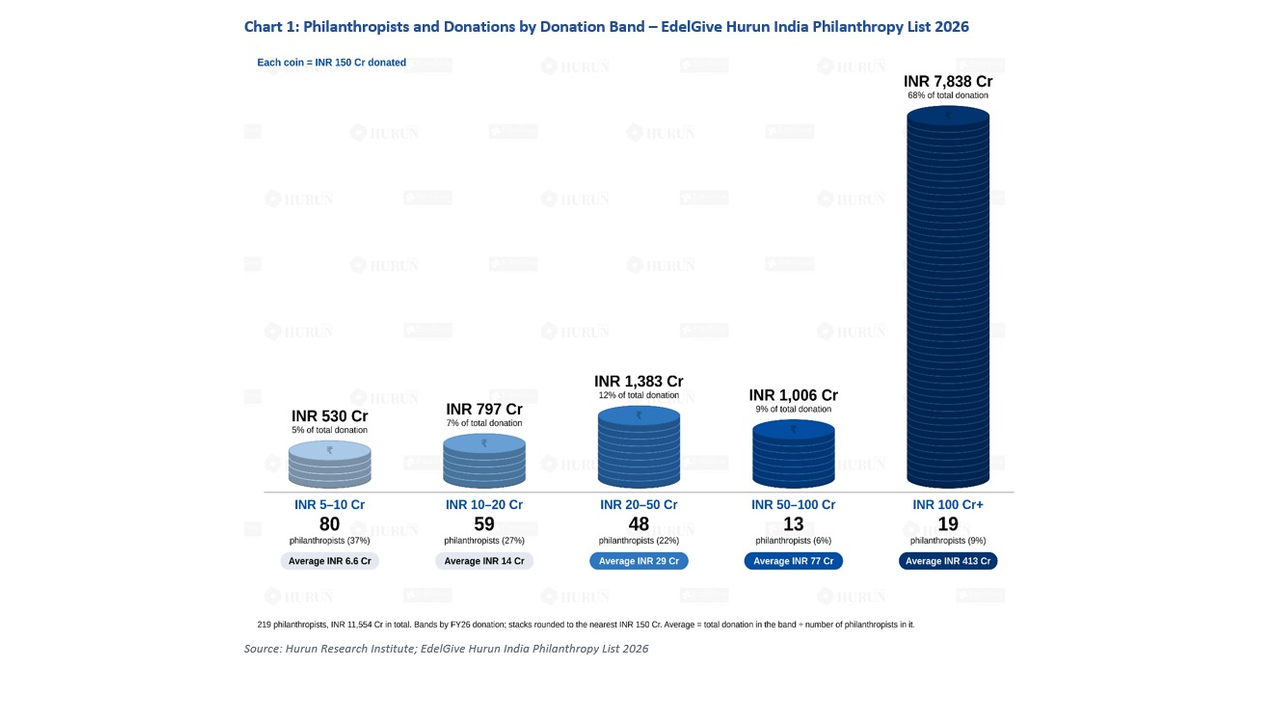
India's philanthropic contributions continued to grow in FY26, with 219 individuals and families donating a combined ₹11,554 crore, an 11% increase over the previous year. However, the latest EdelGive Hurun India Philanthropy List 2026 reveals a striking concentration of this giving: just 19 philanthropists, accounting for 9% of those on the list, contributed ₹7,838 crore, or 68% of the total donations.
The findings point to two parallel developments in India's philanthropy landscape. While the number of individuals making substantial contributions is increasing, a significant share of the country's recorded philanthropic giving continues to come from a relatively small group of donors.
The list, which covers donations made between 1 April 2025 and 31 March 2026, also records a considerable increase in new entrants. Forty-five philanthropists joined this year's list, compared with 12 in 2025, together contributing ₹696 crore. The entry threshold is ₹5 crore in a financial year, making the increase in new entrants a notable indicator of widening participation among high-value individual donors.
The concentration of giving remains significant
The concentration becomes even more evident when donations are examined across different contribution bands. The 19 individuals who donated ₹100 crore or more accounted for 68% of total giving. Including another 13 philanthropists who contributed between ₹50 crore and ₹100 crore, the top 32 donors accounted for 77% of the total.
The top 10 philanthropists alone contributed ₹6,572 crore, representing 57% of the overall amount. Their collective giving increased by 13% compared with the previous year. The threshold for entering the top 10 also rose substantially, from ₹173 crore in 2025 to ₹215 crore in 2026.
Shiv Nadar and family retained the position of India's most generous philanthropists for the fifth consecutive year, with donations of ₹2,593 crore, equivalent to ₹7.1 crore every day. Gautam Adani and family moved to second place after more than doubling their contributions to ₹877 crore, a 127% increase. Their additional contribution of ₹491 crore was the largest absolute increase recorded on the list.
The Bajaj family retained third position with ₹632 crore, followed by Mukesh Ambani and family with ₹620 crore. Nandan Nilekani ranked fifth with ₹380 crore, while Kumar Mangalam Birla and family contributed ₹366 crore.
An important development was the entry of Ranjan Pai and family into the top 10, securing ninth position with ₹219 crore, 98% of which was contributed in a personal capacity. Rohini Nilekani completed the top 10 with ₹215 crore.
A growing cohort of new philanthropists
Beyond the established names, the rise in new entrants offers another perspective on India's changing philanthropic landscape.
Raamdeo Agrawal and Motilal Oswal, co-founders of Motilal Oswal Financial Services, led the new entrants with contributions of ₹120 crore and ₹119 crore, respectively. Chandrika and Ranjan Tandon followed with ₹100 crore through the Krishnamurthy Tandon Foundation. N. R. Narayana Murthy and family also joined the list with ₹25 crore.
The report also highlights the growing contribution of self-made wealth creators. They numbered 125, representing 57% of the philanthropists featured, compared with 101 in the previous year. More significantly, they accounted for 65% of the total donations.
Giving from personal wealth also gained ground. Forty-two philanthropists contributed in their personal capacity, compared with 31 in 2025. Their combined personal contributions amounted to ₹5,413 crore, representing 47% of the total giving recorded.
Among professional managers, Amit Chandra and Archana Chandra led with ₹65 crore, followed by A.M. Naik with ₹49 crore and Prashanth Prakash and Amitha Prashanth with ₹18 crore. Their contributions reflect a segment of philanthropy built on personal wealth accumulated through professional careers rather than corporate giving mandates.
Education continues to dominate, but healthcare and climate gain ground
Education remained the most preferred philanthropic cause, receiving ₹4,188 crore, or 36% of all donations. As many as 200 of the 219 philanthropists supported the sector, making it the most widely funded cause on the list.
Healthcare ranked second, attracting ₹1,768 crore, an 82% increase over the previous year. Arts, Culture and Heritage received ₹1,377 crore, with ₹1,220 crore of this amount coming from Shiv Nadar and family.
Environment and Sustainability recorded one of the sharpest increases, receiving ₹813 crore, up 86% from the previous year. The sector attracted contributions from 104 philanthropists, indicating that environmental concerns are finding a place in the giving priorities of a larger group of donors.
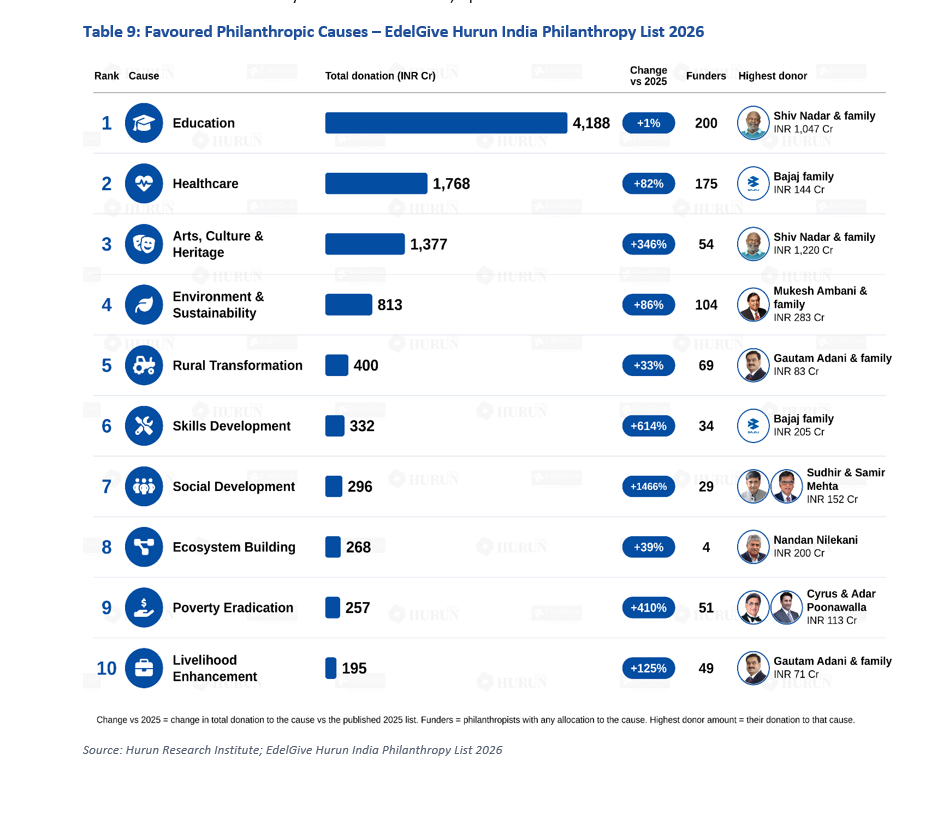 Other areas included Rural Transformation, which received ₹400 crore, Skills Development with ₹332 crore, Social Development with ₹296 crore and Ecosystem Building with ₹268 crore. Poverty Eradication attracted ₹257 crore.
The figures also reveal a distinction between the causes attracting the largest amounts and those receiving the widest participation. While education and healthcare command substantial funding, Sports for Development, Women Empowerment and Animal Welfare each attracted more than 40 funders, though the average contribution to each cause was around ₹2 crore per funder.
The next phase of philanthropy
The report also points to a gradual broadening of the channels through which philanthropic contributions are made. While 111 philanthropists give through their own foundations, 128 work in partnership with NGOs, with several using both approaches.
Geographically, Mumbai accounted for the largest number of philanthropists, with 64, followed by New Delhi with 41 and Bengaluru with 20. However, New Delhi led in terms of the value of donations, recording ₹3,168 crore.
The average donation per philanthropist stood at ₹53 crore, marginally lower than ₹54 crore in 2025, despite the overall increase in contributions. Meanwhile, the number of individuals donating ₹100 crore or more rose to 19, compared with nine in 2019, indicating a growing pool of large-scale donors.
The EdelGive Hurun India Philanthropy List, now in its 13th year, offers a useful picture of how private wealth is being channelled towards social causes in India. Its latest findings show that philanthropy is attracting more participants, with self-made wealth creators and new entrants adding to the donor base.
However, the concentration of contributions among a small number of individuals remains a defining feature. The increase in total donations is significant, but the broader question for India's development landscape is how this growing pool of private wealth can support a wider range of social priorities and strengthen the organisations working on the ground.









.jpg)