
Smarter Water and Sanitation Solutions Through Robotics and Artificial Intelligence
Reliable water supply and safe sanitation depend not only on the availability of resources but also on the infrastructure that delivers and manages them. Across Indian cities, ageing underground pipelines, undetected leakages, contamination risks and hazardous sanitation practices continue to affect public health, municipal efficiency and community well-being. These challenges also have a social dimension, particularly for women who often bear the burden of unreliable household water access and sanitation workers exposed to unsafe cleaning practices.
Technology is creating new possibilities to address these interconnected challenges. Through robotic inspection systems, AI-powered analytics and mechanised sanitation solutions, Solinas Integrity is working to help municipalities identify infrastructure defects, reduce water losses and improve worker safety. Its technologies, including Endobot, SWASTH and HomoSEP, demonstrate how innovation can support more proactive water and sanitation management.
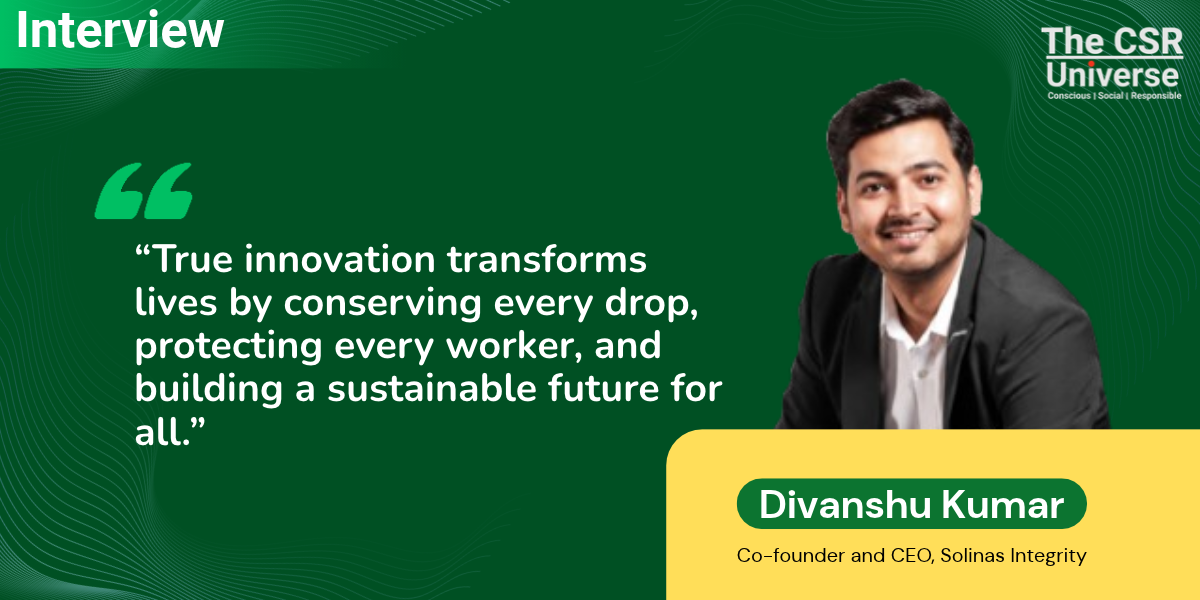
In this exclusive email interview with TheCSRUniverse, Mr. Divanshu Kumar, Co-founder and CEO, Solinas Integrity, discusses the role of robotics and AI in strengthening urban water infrastructure, improving service reliability and reducing the burden on vulnerable communities. He also shares insights into CSR partnerships, measurable project outcomes and the road ahead for technology-led water conservation and sanitation.
Read the full interview below to explore how engineering innovation can contribute to more sustainable and inclusive communities.
Q. India’s water crisis often places a disproportionate burden on women. How can Solinas’ technologies help improve water access and reduce the time women spend managing household water needs?
A. When we talk about water scarcity, we often focus on how much water is available. But an equally important question is how much of that water actually reaches households.
Access to reliable water is a fundamental human need, and water insecurity affects entire communities. However, because women often shoulder a greater share of household responsibilities, they can bear a disproportionate burden when water supply is unreliable.
When supply becomes irregular, everyday activities such as cooking, cleaning and maintaining hygiene become more difficult. Families may have to spend additional time arranging alternative sources or storing water.
At Solinas, we address one of the underlying causes of this problem: inefficiencies within underground water distribution networks.
Our robotic inspection technology, Endobot, helps utilities identify hidden leakages, blockages, contamination entry points and damaged pipelines without extensive excavation. Combined with our AI-powered SWASTH platform, these findings help municipal authorities identify where corrective action is needed.
An experience from Chhatrapati Sambhajinagar illustrates why this matters. Women in the community recalled going without water for ten days during Diwali and receiving dirty water that they could not use. Robotic inspection helped identify the underlying problem, enabling authorities to take corrective action. Following the restoration of supply, the women expressed their relief and appreciation for the technology, particularly its ability to identify problems without extensive digging.
Our project in Kolhapur, Maharashtra, illustrates another meaningful impact. Through a six-month intervention supported by Titan Company Limited, approximately 7,990 households benefited from improvements in water supply reliability following the identification and repair of pipeline defects.
Reliable water supply has implications beyond infrastructure. When water reaches homes more consistently, it can reduce the uncertainty and effort associated with managing daily household needs.
While we have not separately quantified the time saved by women through our interventions, improving water distribution reliability is an important step towards reducing this burden.
Ultimately, water conservation should not only be measured in litres saved, but also in how reliably those litres reach the people who depend on them.
Q. How can AI and robotics help cities detect pipeline leaks, contamination and infrastructure failures before they disrupt water supply?
A. One of the biggest challenges in managing urban water infrastructure is that most of the network remains underground. Municipalities often become aware of problems only after a complaint, visible leakage, pressure loss or disruption in supply.
Traditionally, identifying the exact source could involve repeated excavation and considerable time and resources. Our approach is to help utilities understand what is happening inside the pipeline before deciding how to intervene.
Endobot travels through pipelines and captures internal visual data, helping identify cracks, leakages, blockages, illegal connections and potential contamination entry points.
SWASTH AI helps analyse inspection footage, identify and classify defects, organise inspection records and map findings geographically. This allows engineers to move from lengthy inspection videos to structured information that supports maintenance decisions.
For example, in Coimbatore, our inspections identified more than 300 contamination points and 200 blockages across over 60 locations. In the project's documented operating conditions, diagnosis that traditionally took three to five days could often be completed within approximately 12 hours.
The important distinction is that AI does not automatically prevent every failure. It helps utilities recognise existing defects and potential risks earlier, before they develop into more serious disruptions.
The real value comes when robotic inspection, AI analysis, and municipal action work together. Beyond identifying defects, these insights support pipeline condition assessment and help estimate the remaining useful life of underground infrastructure, enabling engineers to prioritise interventions, plan timely repairs, and protect water supply reliability.
Q. Solinas has deployed its technologies across 30+ cities. What measurable improvements have you seen in leak detection, water loss reduction, maintenance costs and service reliability?
A. Across more than 100 projects in over 30 cities, our experience has reinforced an important lesson: accurate diagnosis can significantly improve how municipalities manage their water networks.
One of our strongest examples is the Kolhapur project, where Endobot and SWASTH were deployed to identify hidden defects in the municipal water distribution system.
During the six-month pilot, approximately 8.67 kilometres of pipelines were inspected, identifying 186 major defects, including 72 leakages, 97 contamination sources and 17 blockages.
An independent impact assessment by Swachh Sangam Foundation estimated that faster identification and repair of leakages prevented between 16.8 and 28 million litres of water loss during the accelerated repair period.
The assessment also estimated financial savings of ₹81.37 lakh and an approximately 82% reduction in cost per defect. Around 7,990 households benefited from improved supply, while water-related complaints in one intervention area, Rajaram Puri, declined by approximately 90%.
These figures demonstrate what becomes possible when municipal teams can locate problems more precisely instead of relying on repeated trial-and-error excavation.
We have also seen operational improvements in other cities. In Coimbatore, faster identification of contamination points and blockages helped reduce the time required to diagnose water distribution issues. In Nagpur, robotic inspections have supported the identification of unauthorised connections and pipeline defects.
An important learning from these deployments is that impact differs across networks. We therefore assess outcomes at the project level rather than applying one city's savings estimates to every deployment.
Our objective is not simply to inspect more kilometres. It is to help cities reduce avoidable water losses, use maintenance budgets more efficiently and deliver more reliable services to their residents.
Q. How can reliable water infrastructure improve women’s health, livelihoods and participation in education and economic activities?
A. Reliable water infrastructure influences several aspects of daily life that are often overlooked when evaluating urban development.
Unreliable water supply affects entire households and communities. However, women often experience a disproportionate burden because of existing social expectations around household responsibilities. Disruptions can mean additional time spent arranging water, adjusting daily routines and maintaining hygiene under difficult conditions.
When water distribution becomes more reliable, these pressures can be reduced. Consistent access to safely managed water can support better household hygiene and sanitation, while reducing the need to depend on uncertain alternative sources.
There are also wider implications for education and livelihoods. Time spent managing water shortages is time that could otherwise be available for paid employment, education, caregiving or other productive activities.
However, it is important to recognise that these outcomes depend on several factors, including household access, water quality, affordability and local conditions. Repairing pipelines is one part of a larger solution.
Our contribution at Solinas is to help strengthen the infrastructure that makes dependable water services possible.
In Kolhapur, the improvement in water supply reliability across approximately 7,990 households offers a meaningful example of how infrastructure interventions can affect everyday living conditions.
For us, this is an important way of looking at infrastructure development. A pipeline repair may seem like a technical activity, but its value ultimately lies in the quality of service experienced by the community.
Q. What are the key barriers to adopting AI-driven water management in smaller cities, and how can municipalities overcome them cost-effectively?
A. The biggest barrier is not always the availability of technology. It is the ability of municipalities to adopt, operate and sustain that technology within their existing systems.
Smaller cities often face limited maintenance budgets, ageing infrastructure, incomplete pipeline records and shortages of trained technical personnel. When day-to-day operations already consume significant resources, investing in new technology can appear difficult.
We believe the most practical approach is to start with a clearly defined problem rather than attempting to digitise an entire network immediately.
For example, a municipality experiencing repeated water supply complaints in a particular ward can begin with targeted robotic inspections of the affected pipeline sections. The inspection findings can then be used to plan repairs and evaluate whether the intervention has reduced recurring problems.
This allows cities to demonstrate measurable value before scaling deployment.
Another important factor is capacity building. Technology should not create permanent dependence on external specialists for every routine activity. Municipal teams need practical training, accessible reports and workflows that integrate with their existing maintenance processes.
CSR-supported pilot projects can also help smaller municipalities evaluate advanced technologies without bearing the full initial cost of adoption.
Our experience has shown that technology adoption becomes easier when city officials can see practical outcomes such as faster defect identification, reduced excavation and more efficient maintenance spending.
The long-term goal should be to make proactive infrastructure management a routine municipal capability, rather than an occasional technology demonstration.
Q. How does Homosep improve worker safety, and what challenges remain in eliminating hazardous manual cleaning of manholes and septic tanks?
A. The way we approach sanitation infrastructure must begin with a fundamental principle: no person should have to enter a hazardous sewer or septic tank simply to remove accumulated waste.
Despite legislation prohibiting hazardous cleaning, sanitation workers continue to face risks from toxic gases, contaminated wastewater and confined spaces.
HomoSEP was developed to address this challenge through mechanisation.
The robotic system uses a specialised homogenisation mechanism to break down settled sludge and accumulated waste, along with a gripper mechanism for removing solid materials. Cameras, gas monitoring and surface-based controls help operators manage the cleaning process while reducing the need for direct entry into hazardous environments.
By shifting cleaning operations towards mechanised, surface-controlled processes, HomoSEP helps reduce workers' exposure to dangerous conditions.
In Noida, our team has demonstrated the practical application of this approach through the mechanised cleaning of more than 1,000 manholes.
However, eliminating hazardous cleaning requires more than developing a machine.
Municipalities need access to suitable equipment, trained operators, dependable maintenance support and consistent enforcement of safety procedures. There must also be greater recognition of sanitation workers as skilled professionals operating modern infrastructure equipment.
Mechanisation should create opportunities for workers to move into safer, more technically skilled roles, supported by appropriate training and working conditions.
For Solinas, the larger mission is to contribute towards a sanitation ecosystem where worker safety, dignity and operational efficiency are treated as equally important priorities.
Q. How does Solinas measure the long-term impact of its technologies beyond the number of inspections or deployments, particularly in water conservation and public health?
A. We believe the number of kilometres inspected or defects identified is only the starting point of impact measurement.
What ultimately matters is whether those findings translate into corrective action, reduced water loss, lower maintenance expenditure and improved service reliability.
Our approach is to connect inspection findings with operational outcomes wherever project data allows.
For water distribution projects, this includes tracking identified leaks and contamination risks, the repairs undertaken by utility teams, changes in resolution time and the estimated volume of water loss prevented.
For example, the independent impact assessment of our Kolhapur intervention evaluated not just inspection activity, but also financial savings, changes in repair efficiency, water conservation and the number of households benefiting from improved supply.
The assessment estimated that faster repairs prevented between 16.8 and 28 million litres of water loss during the repair period, alongside approximately ₹81.37 lakh in financial savings.
SWASTH AI also supports the long-term process by organising inspection records, defect classifications and geographic information. This helps utilities maintain a more structured understanding of pipeline condition and identify sections that may require further attention.
From a public-health perspective, identifying potential contamination entry points is an important contribution. However, confirming improvements in water quality or health outcomes requires additional evidence, including water-quality testing and, where appropriate, health-related assessments.
We distinguish between the problems our technology identifies, the corrective actions subsequently completed and the wider outcomes those actions may produce.
This distinction is essential for credible impact reporting. Our ambition is to help utilities move from counting inspections to measuring the effectiveness of infrastructure improvements over time.
Q. What role can CSR partnerships play in scaling AI-based water solutions in underserved communities, and what are Solinas’ priorities for the next five years?
A. CSR partnerships can play a transformative role by helping bridge the gap between available technology and the communities that need it most.
Many municipalities recognise the importance of reducing water losses and improving sanitation, but face financial and operational constraints when introducing new technologies.
CSR-funded initiatives can help establish pilot projects, demonstrate measurable outcomes and build confidence among municipal stakeholders. When supported by appropriate training and institutional ownership, these projects can create a pathway towards longer-term adoption.
At Solinas, we have seen the value of this collaborative approach through partnerships involving organisations such as Titan Company Limited, The Coca-Cola Foundation, Water.org, Villgro and Imagine H2O, alongside municipal authorities and other implementation partners.
Our work in Kolhapur, supported by Titan Company Limited and implemented in collaboration with the local municipal ecosystem, demonstrates how CSR investment can help convert an infrastructure challenge into measurable water-conservation and operational outcomes.
Similarly, our engagements involving CSR and ecosystem partners in cities such as Lucknow and Hyderabad demonstrate the importance of bringing together technology providers, local authorities and organisations focused on sustainable development.
Looking ahead, we see three important areas for Solinas.
First, making underground infrastructure management more proactive and data-driven. We aim to expand the adoption of robotic inspection and AI-powered condition assessment, enabling utilities to identify problems earlier, prioritise maintenance and manage their water and sewer networks more efficiently.
Second, advancing safer and more sustainable sanitation. Through technologies such as HomoSEP, we want to accelerate the transition towards mechanised cleaning, reduce hazardous human intervention and create opportunities for sanitation workers to develop technical skills.
Third, taking Indian innovation to the global stage. Water loss, ageing pipelines, limited infrastructure visibility and sanitation challenges are not unique to India. Building on our experience across Indian cities and our initial international deployments, we aim to expand into countries facing similar challenges, working with utilities, governments and development organisations to make these solutions more accessible.
Our broader vision is to make underground infrastructure management more proactive, data-driven and accessible.
For us, successful CSR partnerships are not defined by the number of pilots completed. Their real value lies in whether the intervention creates lasting improvements that local institutions can sustain after the initial project period.
The opportunity ahead is to build solutions that conserve water, strengthen public infrastructure and improve the lives of the people who depend on it.



.png)