
Rethinking Foundational Learning Through Peer Collaboration and Classroom Innovation
Foundational literacy and numeracy are essential to a child’s educational journey, yet millions of children continue to struggle with basic reading, writing and arithmetic. As India advances its goal of ensuring foundational learning for every child through NIPUN Bharat, the focus is increasingly shifting towards classroom practices that can accelerate learning while remaining practical, inclusive and sustainable within government school systems.
Developed by DEVI Sansthan, Accelerating Learning for All (ALfA) offers an alternative approach built around peer learning, random pairing and activity-based pedagogy. Instead of relying primarily on teacher-led instruction, children learn in pairs by asking questions, explaining concepts and practising together. Since entering government schools in 2022, the programme has expanded to more than 27,000 schools across multiple states and is available in over 30 languages. Evidence from comparative pilots, government assessments and an independent evaluation in Nandurbar points to encouraging improvements in foundational learning.
 This case study examines ALfA’s pedagogy, implementation model and reported impact, including its partnerships with government institutions and CSR organisations. It also explores teacher experiences, evidence of learning retention and the programme’s approach to long-term sustainability.
Read on to discover how peer-led learning is reshaping classroom experiences and creating new possibilities for foundational education in India.
The Vision Behind ALfA
DEVI Sansthan (Dignity Education Vision International) is a Lucknow-based non-profit founded in 1992 by educationist Dr. Sunita Gandhi, a Cambridge-trained physicist and former World Bank economist. It helps children and adults master reading, writing and basic arithmetic through research, teacher empowerment and partnerships with governments, schools, NGOs and companies. Its flagship programme, ALfA, is designed to work within existing school systems and to last through local capacity. DEVI is the first non-profit from Uttar Pradesh registered on the BSE Social Stock Exchange. Its work supports Sustainable Development Goal 4 on quality education.
A New Rhythm of Learning, One Pair at a Time
ALfA has a simple ambition: to help every child read, write and reason with numbers early enough for the rest of school to make sense. Its roots lie in literacy classes that began in the slums of Lucknow in 2014. It entered government schools in 2022, at the invitation of Anita Karwal, then Secretary in the Ministry of Education, in the low-performing district of Uttar Pradesh: Shamli in Uttar Pradesh.
Today ALfA is used in more than 27,000 government schools. Its materials exist in more than 30 languages and partners have carried it to countries including the Maldives, Ghana, Peru and Kenya.
The programme has three practical objectives:
- Close gaps in foundational reading, writing and numeracy in the early grades.
- Give teachers routines and low-cost materials they can use in existing classrooms.
- Build communication, collaboration and confidence alongside academic skills.
The core cycle runs for 45 working days, with one hour each of literacy and numeracy daily. An intensive option covers 30 working days with a full-day focus. These are delivery models. Individual outcomes depend on the context in which they are used.
For companies, ALfA falls within the promotion of education under Schedule VII of the Companies Act, 2013. It also supports NIPUN Bharat, the National Education Policy 2020 and SDG 4.
In Ranchi, SBI Foundation is supporting ALfA across more than 745 schools, 52,000 students and 2,200 teachers in a partnership running from December 2025. In Chitrakoot block, Reliance Foundation is backing the programme in 200 government primary schools, reaching 10,800 children and 552 teachers.
Need and rationale
The World Bank estimates that 70% of 10-year-olds in low and middle income countries cannot read and understand a simple text. India has answered with NIPUN Bharat, which aims for every child to have foundational skills by Grade 3 by 2026-27. That window is now closing.
The gap is just as visible at the local level. According to ASER 2024, only 29.6% of Grade 3 children in Jharkhand's government schools can read Grade 2 level text. In DEVI's Ranchi pilot, children in the ALfA group began with baseline results of 17% in Grade 2 and 27% in Grade 3.
ALfA began with a plain question: could children learn these skills far faster if they helped teach one another? Conventional teaching often starts with the alphabet, which a child must memorise before reading can begin. ALfA starts with what the child already knows, a familiar picture. In mathematics it starts with the body and everyday objects.
As DEVI puts it, policy builds the highway and pedagogy is the vehicle. India has the policy. ALfA was designed for what happens in the classroom every day.
Implementation strategy and pedagogy
Learning in random pairs
Every ALfA lesson rests on one decision: children learn in pairs and the pairs are chosen at random. In pairs, even the shyest child becomes an active participant. No child is labelled weak or strong. Pairs change often enough for children to work across abilities and backgrounds.
|
Traditional classroom |
ALfA classroom |
|
|
Seating |
Rows facing the teacher |
Pairs facing each other |
|
Grouping |
Fixed groups, often by skill level |
Random pairs, changed frequently |
|
Pace |
Whole class on the same page |
Each pair on its own module |
A lesson follows four steps:
- The teacher and a child model the activity together.
- Two children chosen at random demonstrate it to the class.
- The whole class works in pairs, taking turns to ask and answer.
- Pairs make up new questions for each other.
At the end of a unit, teachers check how many children have gained the skill. They then re-pair the class so that those who have it can help those who do not yet.
In literacy, a child points to a picture and asks, "What is this?" Her partner answers, "Car." The next question is, "What is the first sound?" Car, apple and tie give the sounds c, a and t. The pair has just read the word "cat". They then swap roles.
This Picture-Sound-Word routine moves children from the known to the unknown. They read words from the very first lesson, without spending months on the alphabet first.
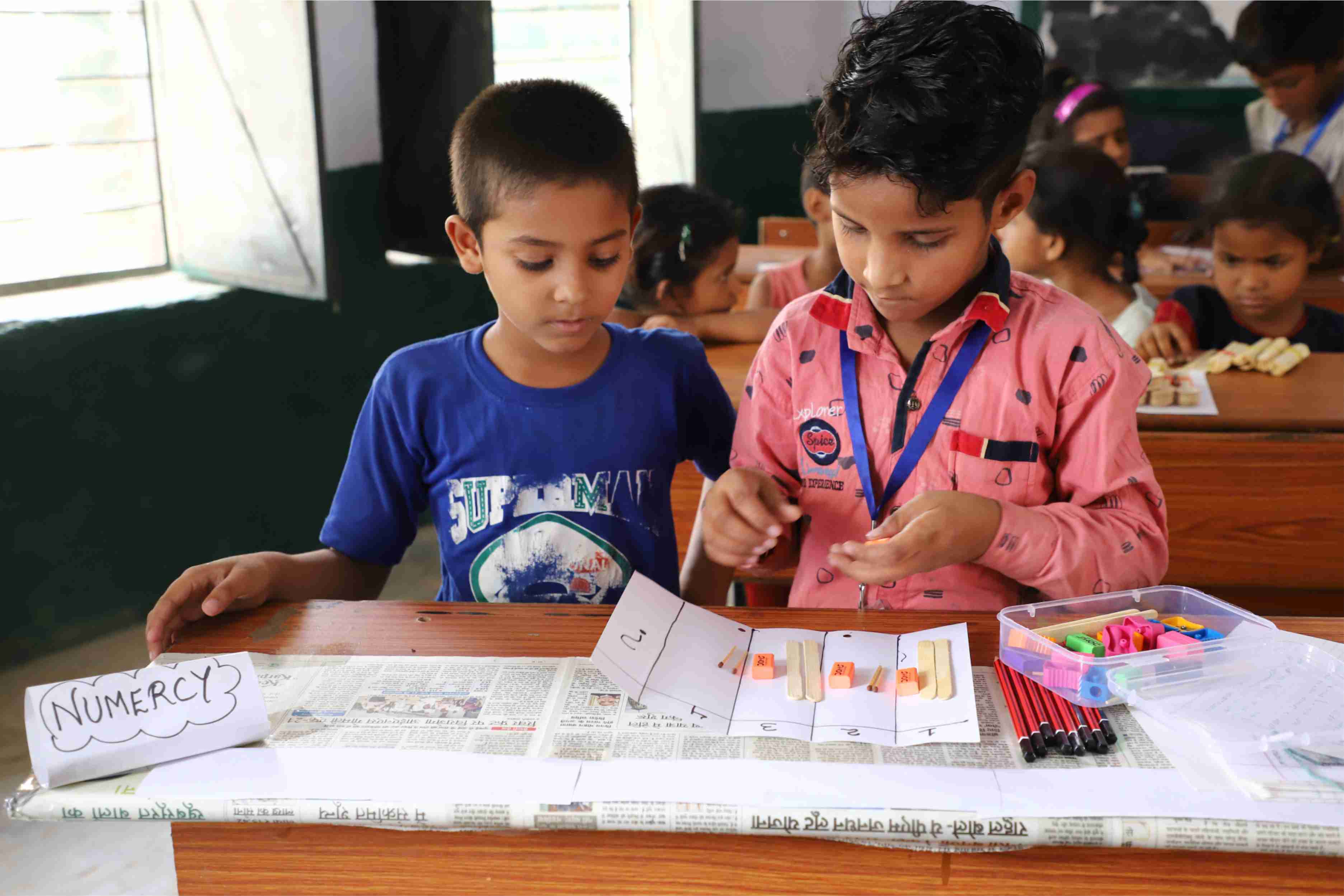
Numeracy moves from the body to objects to symbols. Three claps and four snaps make 34. The same number is then built with sticks or counters and finally written in digits. Children explain their answers using whatever lies to hand, from beans and buttons to leaves and ice cream sticks.
The materials are deliberately slim, at about 40 pages for literacy and 28 for numeracy. DEVI estimates the cost at about US$4 per child.
DEVI organises teacher support around five levers: preparing teachers and mentors, providing materials and prompts, random pairing, practice through Model-Activate-Transfer and rapid feedback. Model School charts and QR-linked videos keep the routines close at hand.
Training is built around two three-hour sessions, one each for literacy and numeracy. Teachers watch classroom videos and try the activities themselves, so they experience what their pupils will do. Support continues through a refresher after two to three weeks, WhatsApp groups, weekly Grow Circles.
ALfA asks to be tested before it is scaled. DEVI suggests starting with four intervention and four comparison schools, randomly allocated, with baseline and endline assessments in both. Comparing the two helps separate programme-associated progress from change that is happening anyway.
DEVI provides online training, materials and assessments. The implementation partner arranges monitoring and third-party assessment. Government coordination supports school selection and communicates what is expected of schools.
Outcomes and impact
ALfA's results now rest on three kinds of evidence: comparative pilots, government tests at scale and an independent study of retention. Together they show learning moving quickly and suggest that the gains can last. In the tables below, pp means percentage points.
Comparative pilots
The Ranchi pilot set ALfA schools against comparison schools in Grades 2 and 3. It covered 902 students in the ALfA group and 651 in the comparison group across the whole sample.
|
Ranchi pilot |
ALfA, baseline to endline |
Comparison, baseline to endline |
Additional gain |
|
Grade 2 |
17% to 65% (gain 48 pp) |
20% to 36% (gain 16 pp) |
32 pp |
|
Grade 3 |
27% to 70% (gain 43 pp) |
30% to 50% (gain 20 pp) |
23 pp |
Additional gain is the ALfA group's improvement minus the comparison group's. A comparative evaluation in Shamli shows the same direction of travel, most sharply in mathematics.
|
Shamli, Grade 3 |
ALfA, baseline to endline |
Comparison, baseline to endline |
Additional gain |
|
Literacy score |
29% to 61% (gain 32 pp) |
20% to 43% (gain 23 pp) |
9 pp |
|
Mathematics score |
15% to 63% (gain 48 pp) |
13% to 35% (gain 22 pp) |
26 pp |
ALfA's first phase in Shamli, in 2022, also features in Rebuilding Resilient Education Systems After the COVID-19 Pandemic (2023), a volume edited by Fernando Reimers of Harvard Graduate School of Education and colleagues. Chapter 8 covers 10 ALfA and 10 comparison schools, with 420 and 547 students respectively. It reports effect sizes of 0.23 for Grade 3 and 0.89 for Grade 5, which measure the size of the learning effect and are not percentage increases.
The chapter recommends that Uttar Pradesh use ALfA for the first six weeks "to quickly establish a strong FLN foundation" before moving to the NIPUN curriculum.
Government tests at scale
The most striking test came in the Hilauli block of Unnao. After strong results elsewhere, the Block Education Officer asked for ALfA in all 155 of his schools, reaching 14,503 students. In a government test in November 2023, partway through implementation, Hilauli ranked first among Unnao's 17 blocks.
The measure was demanding. A NIPUN school is one where at least 80% of sampled students pass the basic literacy assessment in each of Grades 1, 2 and 3.
|
NIPUN Assessment Test, 2023 |
Schools tested |
Rated NIPUN |
Share |
|
Uttar Pradesh, all schools |
68,352 |
16,169 |
24% |
|
Lucknow, Shamli, Unnao and Barabanki, all schools |
3,682 |
638 |
17% |
|
ALfA schools in those four districts |
344 |
120 |
35% |
|
Unnao district, all schools |
1,322 |
193 |
15% |
|
Hilauli block, ALfA schools |
85 |
40 |
47% |
The pattern carries through to the next national survey. Between NAS 2021 and PARAKH Rashtriya Sarvekshan 2024, Uttar Pradesh gained 10 pp in both language and mathematics. The four ALfA districts gained 13 pp in language and 14 pp in mathematics.
Credit for the statewide gain belongs to government policy. The additional progress in ALfA districts suggests what classroom practice can add on top of it.
In Himachal Pradesh, where implementation is under way in 1,200 schools, the share of children scoring below 25% fell from 13% at baseline to 3% at endline.
Do the gains last?
The hardest question for any fast programme is whether its gains survive. In March 2026, a team led by Dr. Gunratna Sontakke of Savitribai Phule Pune University went to the tribal belt of Nandurbar, Maharashtra, to find out.
They assessed 128 children in Grades 3 and 4 one-to-one, about six months after a 72-working-day ALfA cycle had ended. Half came from ALfA schools and half from matched control schools. The assessors were not told which was which.
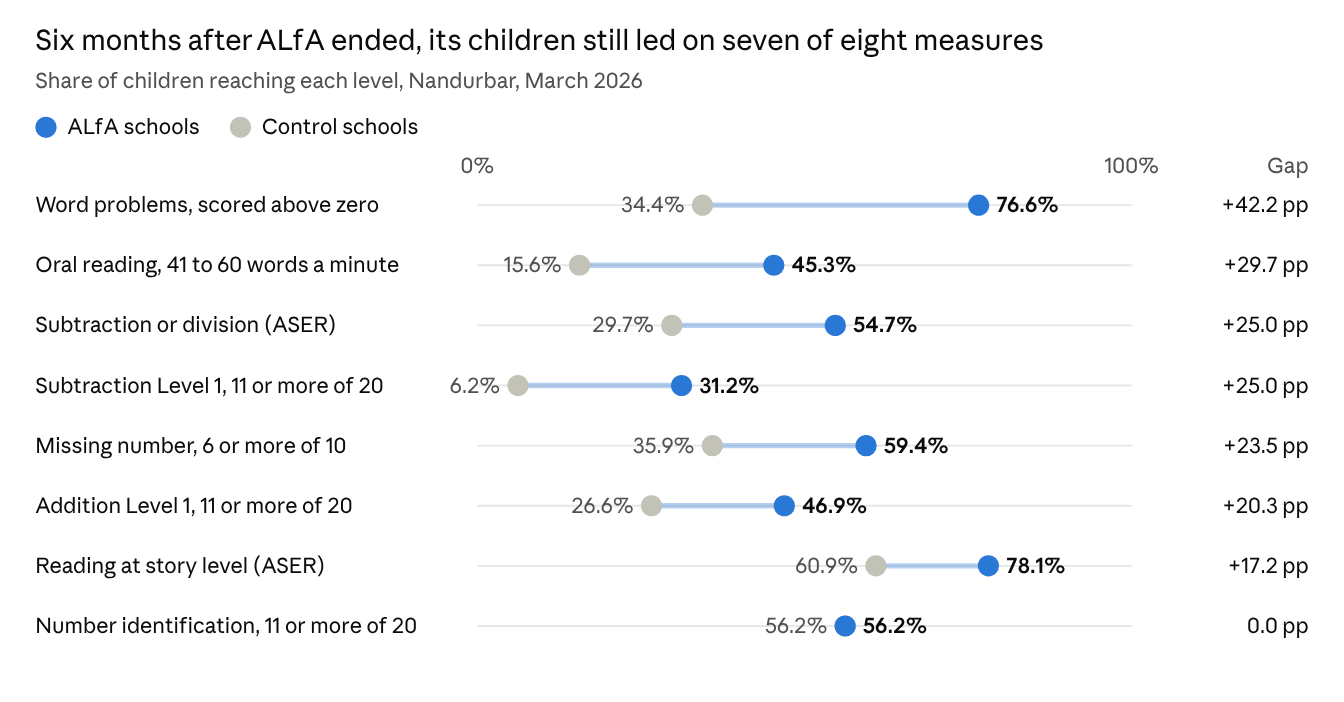
Independent evaluation, Savitribai Phule Pune University, 2026 · 64 ALfA and 64 control children, Grades 3 and 4
Seven of the eight headline measures showed a statistically significant advantage for ALfA children. The one exception was the most elementary skill, number identification, where the two groups stood level. The widest gap was in word problems.
This is ALfA's pedagogy made visible. The advantage sits in the higher-order skills the programme targets, the ones children build by questioning, explaining and solving with a partner. ALfA's Grade 3 children even read better than Grade 4 children in control schools.
What teachers report
In a November 2025 survey, 1,592 teachers, mainly from Himachal Pradesh and Uttar Pradesh, shared their experience. Among the 1,274 who had covered more than 40% of both the Hindi and Maths books, 86% reported better attendance. Some 79% agreed that ALfA should be integrated into the government curriculum.
Beyond India
In the Maldives, in a pilot with UNICEF support, ALfA schools gained 7 pp in English against 1 pp in control schools. In two schools in Peru, the share of children proficient in reading, writing and arithmetic rose from 32% to 80% after 45 days. In Ghana, ALfA schools recorded learning gains three to five times greater than control schools.
 Voices from the ground and success stories
The people closest to these classrooms describe the change in plainer terms.
"The ALfA pedagogy has helped Hilauli become NIPUN; for this I praise and recommend your work." Sangeeta Singh, Basic Shiksha Adhikari, Unnao
"The results are highly positive and exciting. Children's attendance has also improved." Rahul Mishra, Basic Shiksha Adhikari, Shamli
"When children use concrete objects, the learning sticks in their brain. Children who were being bored by the traditional method are enjoying learning with ALfA." Veena Gupta, Principal, PS Ramshehar 1, Solan, Himachal Pradesh
"The results they have demonstrated are very promising." Naman Goyal, Chief Executive Officer, Zilla Parishad, Nandurbar
"Different pairs were formed every day, and the whole class became friends with each other." Teacher, Nandurbar, recorded in the independent evaluation
A teacher, then a colleague
When schools reopened in 2022, Ugrasen Verma of Composite School, Srinagar, turned to ALfA to rebuild his students' learning and confidence. Printing costs soon became a barrier, so DEVI supplied the books. His colleague Varun Sharma saw what was happening and adopted the approach too. Renewed support in 2025 has helped the school keep the practice alive.
Future plans and sustainability
ALfA grows through a deliberate sequence: Study, Scale and Sustain. A small research implementation builds the proof. Partnerships then carry it across hundreds of schools. The final stage embeds the materials, pedagogy and teacher training within the education system itself.
Uttar Pradesh has signed an MoU covering 9 districts. MoUs in Himachal Pradesh and Jammu & Kashmir cover the entire district.
After the booster cycle, children carry the same paired routines into their prescribed textbooks, so ALfA becomes part of ordinary teaching. Teachers and mentors are trained within partner systems, which means training and classroom resources can continue beyond the first pilot.
Better pedagogy can raise learning for the children in the room, but it cannot by itself resolve the migration and poverty that keep others away. The Pune University team has also recommended following the same children for another year, to see whether the gap holds.
For CSR partners, the first step is deliberately modest. DEVI offers a free research pilot in four schools, with four more as a control, covering training, materials and assessments. A company or district can see the results before committing to scale.
DEVI will share its evidence at the Global Learning Lab, in Lucknow from 8 to 10 February 2027.
A New Way Forward for Learning
ALfA rests on a simple conviction: given the right materials and a partner beside them, children can carry much of their own learning. Comparative findings from Ranchi and Shamli show stronger gains within their study samples. Government tests in Uttar Pradesh point the same way. In Nandurbar, independent researchers found the advantage still standing six months after the programme ended.
With the NIPUN Bharat deadline at hand, DEVI Sansthan remains committed to building the local teaching capacity that allows this progress to last.



.JPG)