
Building Rural Prosperity Through Entrepreneurship, Skills and Community Development
Building Rural Prosperity Through Entrepreneurship, Skills and Community Development
Rural development becomes sustainable when communities have access not only to education and resources but also to opportunities that enable them to earn, innovate and build livelihoods close to home. Across rural India, local entrepreneurs play an important role in generating employment, strengthening agricultural value chains and creating economic opportunities, particularly for women. Supporting these enterprises requires more than financial assistance. Mentorship, market access, relevant skills and strong local institutions are equally important.
Amara Raja Group’s rural development approach brings together these interconnected priorities through the Better Way Awards, education, skill development and community initiatives led by the Rajanna Foundation. While the awards recognise rural entrepreneurs creating local impact, the Group’s schools and training centres aim to connect young people with education and employment opportunities. Its work also addresses essential community needs such as healthcare, water, sanitation and livelihoods.
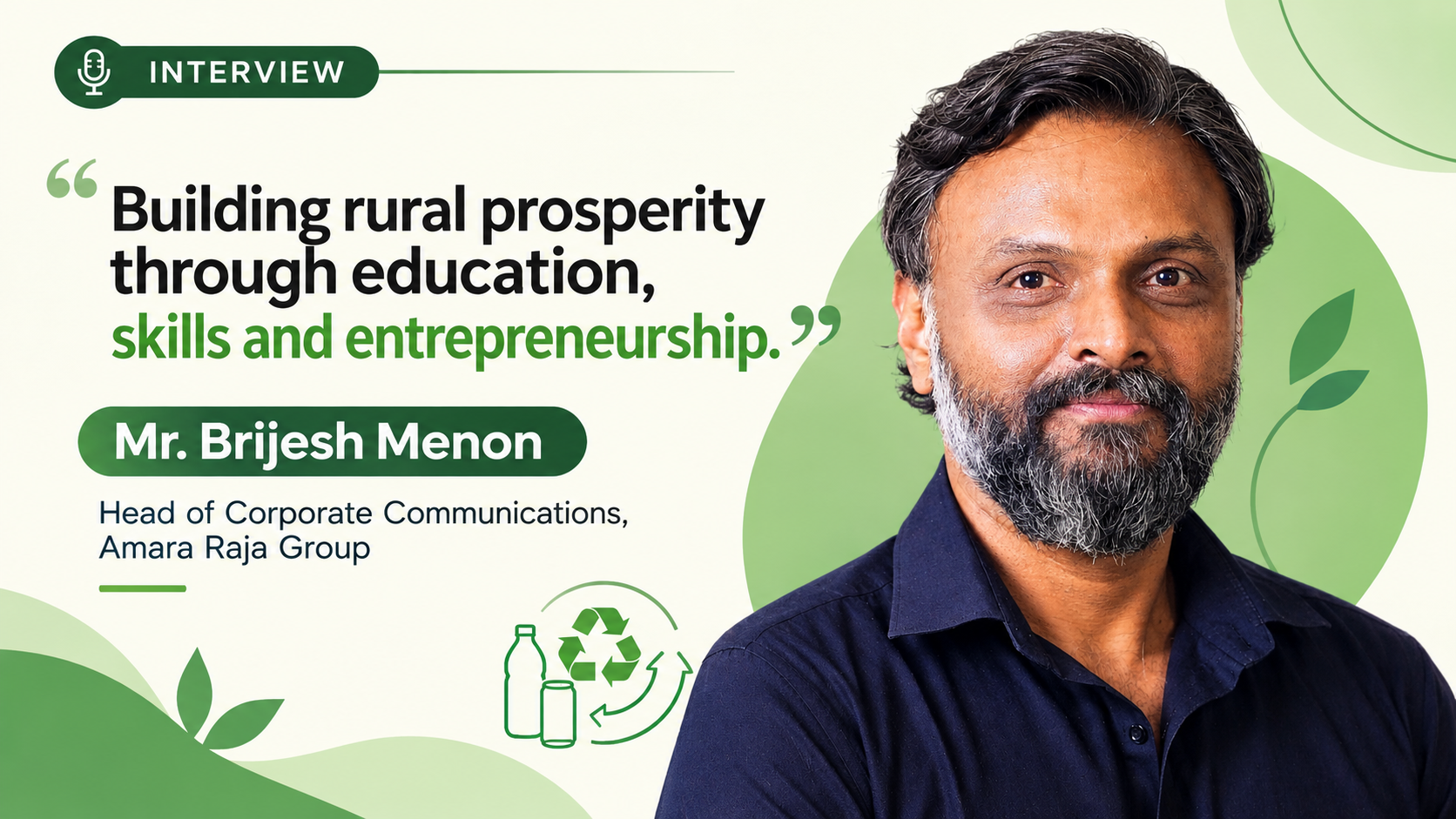
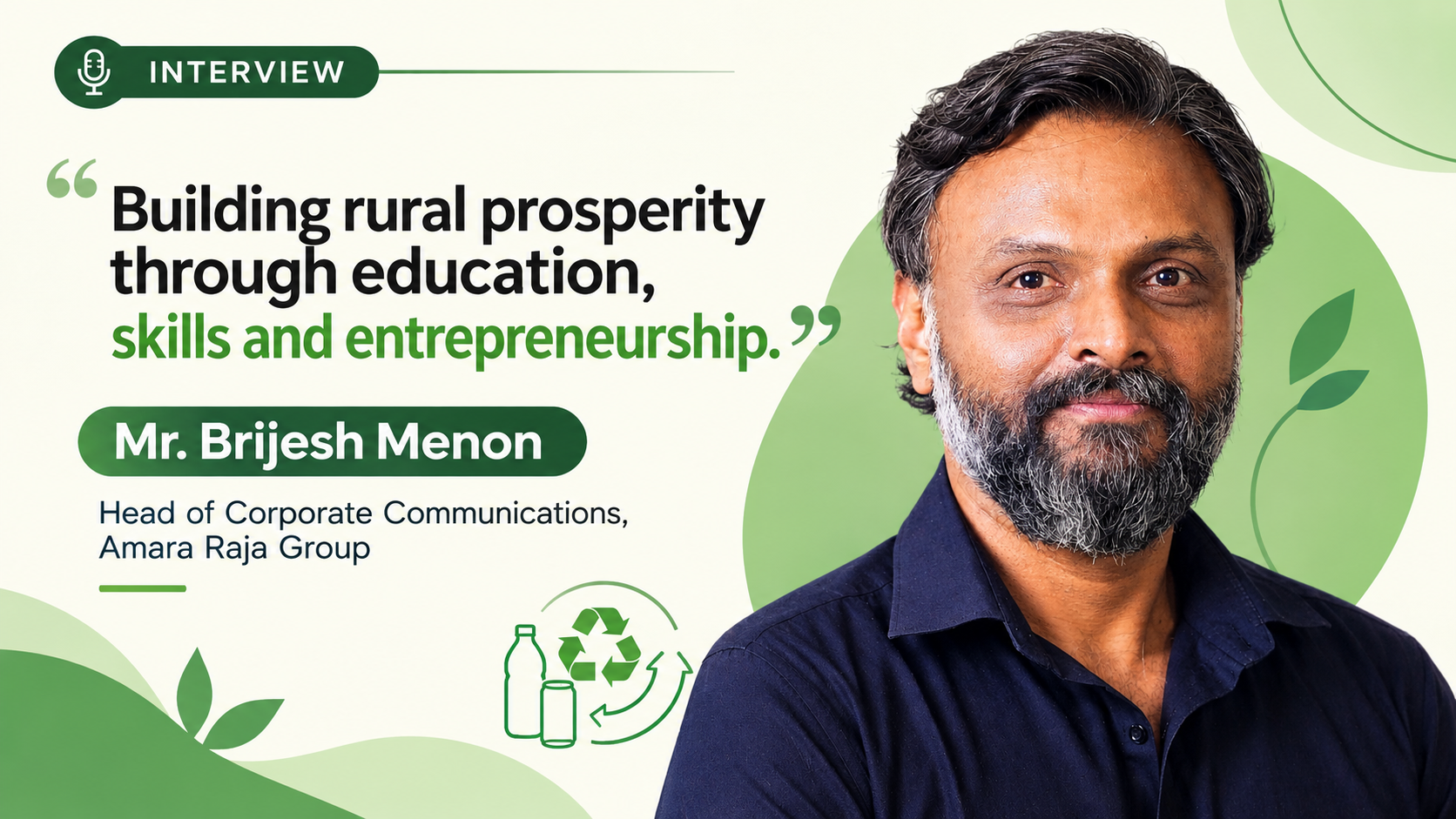
In this exclusive email interview with TheCSRUniverse, Mr. Brijesh Menon, Head of Corporate Communications, Amara Raja Group, discusses how these initiatives contribute to rural prosperity. The conversation explores support for rural enterprises, women's economic participation, industry-linked skilling, employment outcomes and the importance of community-led development. Read the full interview below to understand how these efforts are helping create pathways from learning and employment to entrepreneurship.
Q. What led Amara Raja to launch the Better Way Awards, and how does the initiative fit into the Group's broader rural development vision?
A. Amara Raja's own story begins in a village. When our founder, Dr Ramachandra N Galla, returned from the United States to set up a business, he chose his village near Tirupati at a time when manufacturing in India almost always meant a city address. That choice carried a conviction that has stayed with us for four decades: opportunity should travel to people, rather than asking people to leave home in search of it.
The Better Way Awards, instituted in 2023, grew from watching that conviction at work in others. Across rural India there are people quietly doing what large institutions often struggle to do. They are creating jobs in their own villages, bringing women into paid work and finding smarter ways to grow, process and sell what the land produces. More than 85 percent of rural entrepreneurs are first-generation founders. They build without inherited capital, without networks and, too often, without anyone noticing. A Group whose first chapter was written in rural India has both the standing and the responsibility to notice them.
The awards carry our purpose of providing better access to better opportunities to more people. Our Group’s CSR arm, Rajanna Foundation runs schools and skill centres to prepare young people to find work. The Better Way Awards honour those who create it. Seen together, they describe a single idea of rural prosperity in which a person learns, earns, and eventually builds something that lets others earn too.
Q. How do you assess whether the ₹3 lakh award and one year of mentorship are helping rural entrepreneurs build sustainable businesses and generate local employment?
A. We are careful not to overstate what ₹3 lakh can do. For an early enterprise it can buy a machine, fund a season's working capital or carry a first hire through a lean quarter. For a larger one it is closer to a vote of confidence. The deeper value lies in the year of mentoring that follows, across finance, HR, marketing, IT and supply chain, because that is where an entrepreneur's instinct meets the disciplines of running a company at scale.
Our assessment begins at selection. Every winner is evaluated on social and community impact and on their contribution to local employment, which gives us a clear baseline: how many people they employ, how many of them are women, how many farmers, artisans or producers depend on them.
The questions we keep returning to are practical ones. Has the business become more resilient? Is it hiring more people from its own district? Does it have systems that will outlast the mentoring year? Our winners give us a high bar. Resham Sutra, recognised in our first edition, had already helped create livelihoods for around 22,000 women through solar-powered silk reeling machines. Our job with enterprises like these is to help them go further and steadier, and to learn from them as much as we offer.
Q. What challenges do rural entrepreneurs face beyond funding, and how does Amara Raja help them access markets, business networks and other growth opportunities?
A. Money is the problem everyone sees, so it is the one most often addressed. The harder problems are less visible. A rural founder may make an excellent product and still have no reliable way to reach a buyer two states away. She may have no one to ask how to price a distributor's margin, how to keep accounts that a bank will trust, or how to hire and keep a supervisor. Many work in languages that most formal programmes, application forms included, simply do not speak. And there is isolation. An urban startup is surrounded by peers, investors and advisers. A rural one is often the only enterprise of its kind for a hundred kilometres.
Our response is designed around those gaps. The mentoring year pairs winners with experienced professionals in the functions that usually hold a small business back, from costing and compliance to digital systems and supply chains. The award itself also travels. A recognition from a $2 billion Group lends credibility with lenders, institutional buyers and partners, and the films and media coverage around each edition put winners in front of audiences they could not have reached alone.
This year we have also changed how we find entrepreneurs. Alongside the online application, we are working with grassroots networks to run nomination drives on the ground and in regional languages, so that the next great enterprise is not excluded simply because its founder does not fill in forms in English.
Q. How do you identify entrepreneurs with the potential to create meaningful change in their communities, particularly in agriculture, women's employment and rural livelihoods?
A. The categories themselves set the direction. We recognise enterprises in Women Employment, Rural Income Generation and Best Agri-Based Business, and this year we have added Changemaker of Tomorrow for graduate and postgraduate students working on scalable ideas for rural development. Nominations are open to entrepreneurs across India, and a jury of experts evaluates every entry on its social and community impact and on its contribution to local employment.
Within those criteria, we look for a few telling signs. The first is rootedness: is the enterprise based in the community it serves, and does it hire from there? The second is the multiplier, meaning how many households move forward when this business grows. The third, for women's employment in particular, is whether women hold real economic roles, as owners, producers or decision-makers, rather than appearing as a statistic in a report. Shreeja Mahila Milk Producer Company, one of our first winners, is owned by more than 1.2 lakh women dairy farmers. That is the kind of depth we mean.
We also value originality that solves a local problem. Past winners include India's first certified Agri-drone services marketplace, a farm-to-bar chocolate maker from a Dakshina Kannada village, and a foundation turning banana fibre into reusable sanitary pads. None of these ideas came from a boardroom. Each came from someone who understood their community's problem better than anyone else could.
Q. The Rajanna Foundation has been working since 1999. How has its approach to rural development evolved, and what key lessons have shaped its current programmes?
A. The Foundation, which began as the Rajanna Trust, started where the needs were most immediate. Chittoor district has long lived with water stress, so some of the earliest work was about water itself: building around 23 check dams and reviving tanks and ponds to recharge groundwater and greening a barren 250-hectare hillock at Pemmagutta. Alongside came schools in the villages around our plants, because families told us plainly that their children had nowhere good to study.
Over time, the work moved from building assets to building pathways. The Amara Raja Skill Development Centre opened at Petamitta in 2014 to connect rural youth directly to industrial careers. The 30-bed Rajanna Primary Health Centre, run in partnership with the Andhra Pradesh government, now serves 81 villages. In Petamitta, the Foundation installed underground drainage and solid waste management for 174 households.
Three lessons have shaped this evolution. Proximity matters more than we first assumed: over a third of the students in our schools travel more than five kilometres, and without Foundation-run transport many simply would not attend. Partnership with government multiplies reach in a way no single company can. And the people who benefit most are often women, who carry the heaviest share of household water, sanitation and caregiving burdens. That is why we commissioned an independent social impact assessment in FY26, covering 480 respondents across education, health, livelihoods and community development. It tells us honestly what is working and where we must do better.
Q. How do the Foundation's schools and skill development centres translate education and training into better employment opportunities and long-term economic independence for rural youth?
A. Think of it as a road with no missing bridges. The three CBSE schools run under the Amara Raja Educational Society, at Karakambadi, Diguvamagham and Petamitta, serve close to 4,700 students, around 80 percent of them from vulnerable communities and many of them the first in their families to complete school. Quality education close to home keeps these children in the classroom long enough for ambition to take shape.
The Amara Raja Skill Development Centres then turn that ambition into a trade. Training is residential and intensely practical, with the larger share of time spent in workshops and labs rather than lecture halls, and it leads into on-the-job training inside the Group's own businesses. Since inception, 5,947 young people have enrolled. Of the more than 2,800 who have completed the programme, 1,886 now work within the Amara Raja Group.
That last number matters because it describes a promise kept. A certificate on its own guarantees nothing. A regular salary, earned a short distance from home, changes the arithmetic of an entire household. Many of these young people are the first salaried earners in their families, and with that income come savings, the education of younger siblings, and a confidence that does not leave when the shift ends. That, to us, is what economic independence looks like on the ground.
Q. How do you ensure that the skills taught at your centres remain relevant to changing industry requirements, and what employment outcomes have you seen among trained youth?
A. Our advantage is that the industry is not an abstraction to us. It is next door. The people who design our curriculum work alongside the plants that will employ our trainees, so when production lines change, the training changes with them. On-the-job training inside Group companies acts as a constant feedback loop: supervisors see within weeks where a trainee is strong and where the classroom falls short.
The clearest example of this is what is happening in Telangana. As Amara Raja builds its Giga Corridor for advanced battery cells and packs, we have opened a new Skill Development Centre at Mahbubnagar, established by Amara Raja Advanced Cell Technologies with the Rajanna Foundation's support and in partnership with the Electronics Sector Skills Council of India. Its courses cover EV battery pack assembly, electric vehicle service and repair, electrical work and HVAC. These are the skills India's energy transition will need, taught to rural youth from the very districts where that transition is being built. The first batch recorded a placement rate of 98.85 percent.
Across our centres, the outcome we are proudest of is consistency. Roughly two in every three young people who complete our training go on to build their careers within the Amara Raja Group, in roles that did not exist in their villages a generation ago.
Q. How do the Better Way Awards, education and skill development initiatives work together to create a pathway from learning to employment and entrepreneurship?
A. We see them as three stages of one rural life. A child in one of our schools gains the foundation. As a young adult, the same person can gain a trade at a skill centre and a steady job. The Better Way Awards speak to the stage that follows, when someone with knowledge, experience and nerve decides to build an enterprise that employs others. Most of the children from our schools of course go on to complete professional courses like BE, MBBS, MBA etc.
Each stage needs the one before it. An entrepreneur hiring in a village depends on young people who can read a manual, operate a machine and keep a record. A skilled worker with savings and confidence is far more likely to take the risk of starting something. And every enterprise we celebrate becomes proof, to the students in our classrooms, that ambition need not mean migration.
The new Changemaker of Tomorrow category adds a bridge we had been missing. It invites graduate and postgraduate students to bring their ideas for rural development to the same platform as established founders, so the pathway can begin earlier and draw in a generation that is still deciding where to spend its talent. Our hope is that, over time, some of the young people who walked through our own schools and centres will one day stand on the Better Way Awards stage.
Q. How does Amara Raja ensure that its rural development initiatives respond to community needs rather than follow a one-size-fits-all CSR approach?
A. The simplest safeguard is that we are not visitors. Our plants sit among the villages the Foundation serves, and thousands of our colleagues go home to them every evening. Needs reach us through conversations at the factory gate, at school meetings and at the health centre long before they appear in any survey. Our Founder Dr. Ramachandra Galla personally leads and monitors all the initiatives; he is really the heart and soul of the foundation.
That closeness has shaped the work in ways a template never would have. Water scarcity in Chittoor led to check dams before it led to anything else. Distance from schools led us to run transport, once we saw how far children were travelling. Women's difficulty in reaching care without a male family member accompanying them made a nearby primary health centre a priority. In Petamitta, drainage and waste management came from residents describing the everyday cost of their absence.
The Better Way Awards follow the same principle in a different form. We do not decide in advance what a good rural enterprise looks like. The entrepreneurs define the problem they are solving, and the mentoring is shaped around each winner's specific gaps rather than a fixed curriculum. Finally, we test ourselves against independent eyes. Our FY26 social impact assessment was commissioned precisely so that the community's experience, rather than our own assumptions, would decide what we change next.
Q. What are the key priorities for the next phase of Amara Raja's rural development work, and how will you measure progress in areas such as income growth, enterprise sustainability and women's economic participation?
A. The next phase follows the Group's own growth. As Amara Raja expands into new energy technologies in Telangana, our priority is to ensure that rural youth in those districts are trained for the jobs being created there, as we have begun to do at Mahbubnagar. The energy transition should open doors in the villages around our plants, not pass them by.
Our second priority is reach. The Better Way Awards have recognised nine enterprises across three editions, and we want the next cohorts to come from places no awards programme has visited before. Multilingual, on-the-ground nominations and the new student category are the first steps. The third is to deepen our work with women, who our assessment shows are the clearest beneficiaries of improved health and sanitation and who remain under-represented in rural enterprise.
On measurement, we intend to track what changes lives rather than what fills reports. For enterprises, that means revenue growth, the number of local jobs sustained, the share of those jobs held by women, and whether a business is still growing two and three years after its award. For our skilling and education work, it means placement, retention and earnings over time. And we will keep returning to independent assessment, because credible measurement is the only way to know that a better way is working.