
Why India’s Rural Women Must Be at the Centre of the Clean-Energy Transition
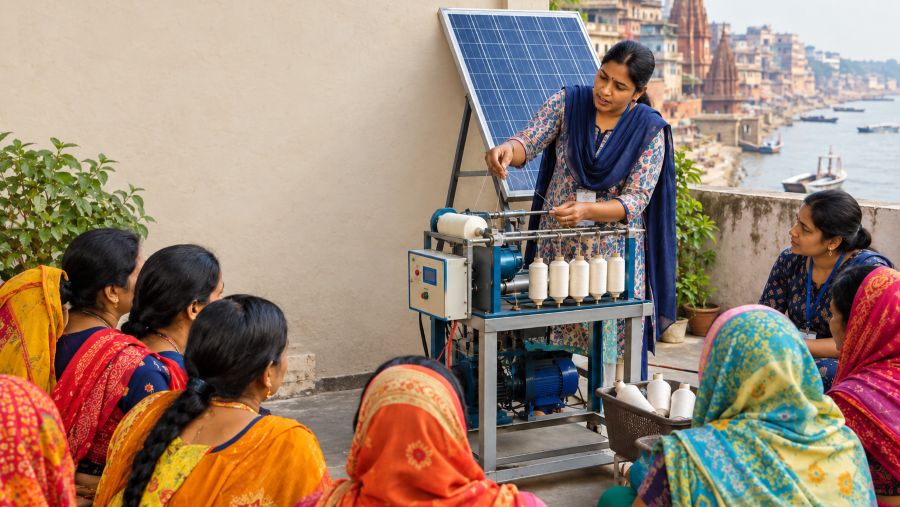
India’s clean-energy transition holds the potential to do more than reduce emissions—it can reshape rural livelihoods, strengthen women-led enterprises and expand economic opportunities. Yet, the real measure of progress lies not merely in installing renewable-energy systems, but in how they improve productivity, reduce operating costs and enable women to participate in the growing green economy. In this OP-ED, Dr Kanika Chowdhary, Ms Rashmi Murali and Dr Mini Govindan of TERI examine how initiatives in dairy, pottery and solar-powered livelihoods can connect clean energy with women’s economic empowerment, while highlighting the need for finance, skills, technical support and market access to ensure lasting impact.
Read the full article below.
For a rural enterprise, the value of clean energy is not the solar panel itself. It lies in what happens after it is installed: diesel expenditure can fall, production can become more reliable, equipment can run for longer, and a small business may have greater scope to grow. When women own or manage such assets, the transition can also influence who earns, who decides and who captures the value created.

This is the economic opportunity India’s clean-energy transition presents to rural women. At Pochina Dairy in Jaisalmer, Rajasthan, a milk-chilling system is being solarised and managed by a women-led self-help group. In the Pokhran pottery cluster, hybrid solar systems are being introduced to support more energy-efficient production. These initiatives raise a larger question: can clean energy strengthen the livelihoods and businesses through which rural women already earn?
The question is particularly relevant on the International Day of Rural Women, observed on 15 October. Rural women are farmers, producers, artisans, processors, entrepreneurs and workers. Yet many operate on thin margins, with limited capital and unreliable access to energy, technology and markets.
The pathway can be straightforward. A dairy using solar-powered chilling can potentially reduce recurring diesel costs and limit losses when electricity is unreliable. A pottery unit with dependable power can operate machinery more consistently and lose less production time to outages. A farm using a solar pump can reduce dependence on purchased diesel for irrigation. For a small processing enterprise, reliable electricity can make operating hours more predictable and improve the utilisation of equipment. Clean energy therefore has value not only as infrastructure, but through its effect on operating costs, productivity, production capacity and potentially income.
For women, however, ownership matters. If a women’s collective manages an energy system linked to an existing livelihood, the benefit can extend beyond a lower energy bill. It can bring new technical responsibilities, strengthen business capabilities and give women greater involvement in decisions about production and earnings. But technology alone cannot guarantee these outcomes. The enterprise must have viable demand, maintenance and technical support, while any savings must be sufficient to improve its financial position.

TERI’s Lighting a Billion Lives (LaBL) 2.0 offers an emerging illustration. At Pochina Dairy, solarisation is being connected directly to an existing dairy activity managed by women. In Pokhran, hybrid solar systems are being introduced within an established pottery cluster. These interventions remain under implementation and evaluation, so their longer-term effects on costs, productivity, employment and income should not yet be presented as established outcomes. Their significance lies in testing whether renewable energy can strengthen livelihoods that already have local skills, production systems and markets.
Gujarat illustrates the importance of skills alongside assets. Training women salt-pan workers as solar-panel and solar-pump technicians can create a pathway from an existing livelihood into emerging technical occupations. But certification has limited economic value unless it leads to paid work, contracts, enterprise opportunities and sustained income. Rural skilling must therefore be connected to actual labour demand and markets.
This calls for a broader understanding of SDG 7. Progress should not be measured only through electricity connections or renewable-energy capacity, but also by what affordable, reliable energy enables people to produce and earn. For rural women, the ambition should be participation across the emerging green economy as enterprise owners, skilled workers, technicians and service providers.
Policy can help make this possible. Women’s self-help groups, cooperatives, farmer collectives and rural businesses need access not only to clean-energy technology, but also to appropriately structured finance, technical support, working capital, procurement opportunities and markets. Renewable-energy programmes should ask not only how many systems are installed, but what economic activity they support, what costs they reduce, what skills they create and who benefits from the resulting value.
India’s clean-energy future will require large solar parks, transmission networks and major investment. But its economic success will also be shaped much closer to the ground in a dairy in Jaisalmer, a pottery cluster in Pokhran, a salt field in Gujarat and thousands of rural businesses where energy costs influence what people can produce and earn.
On the International Day of Rural Women, the test of a just energy transition should therefore be more than access. It should be whether clean energy helps women reduce costs, raise productivity, create employment, grow enterprises and gain greater control over the income they generate. That is when renewable energy becomes not merely an infrastructure intervention, but a pathway to rural economic transformation with women helping to shape and drive it.