The Missing Middle: Who will Lead India’s Growing Nonprofits?
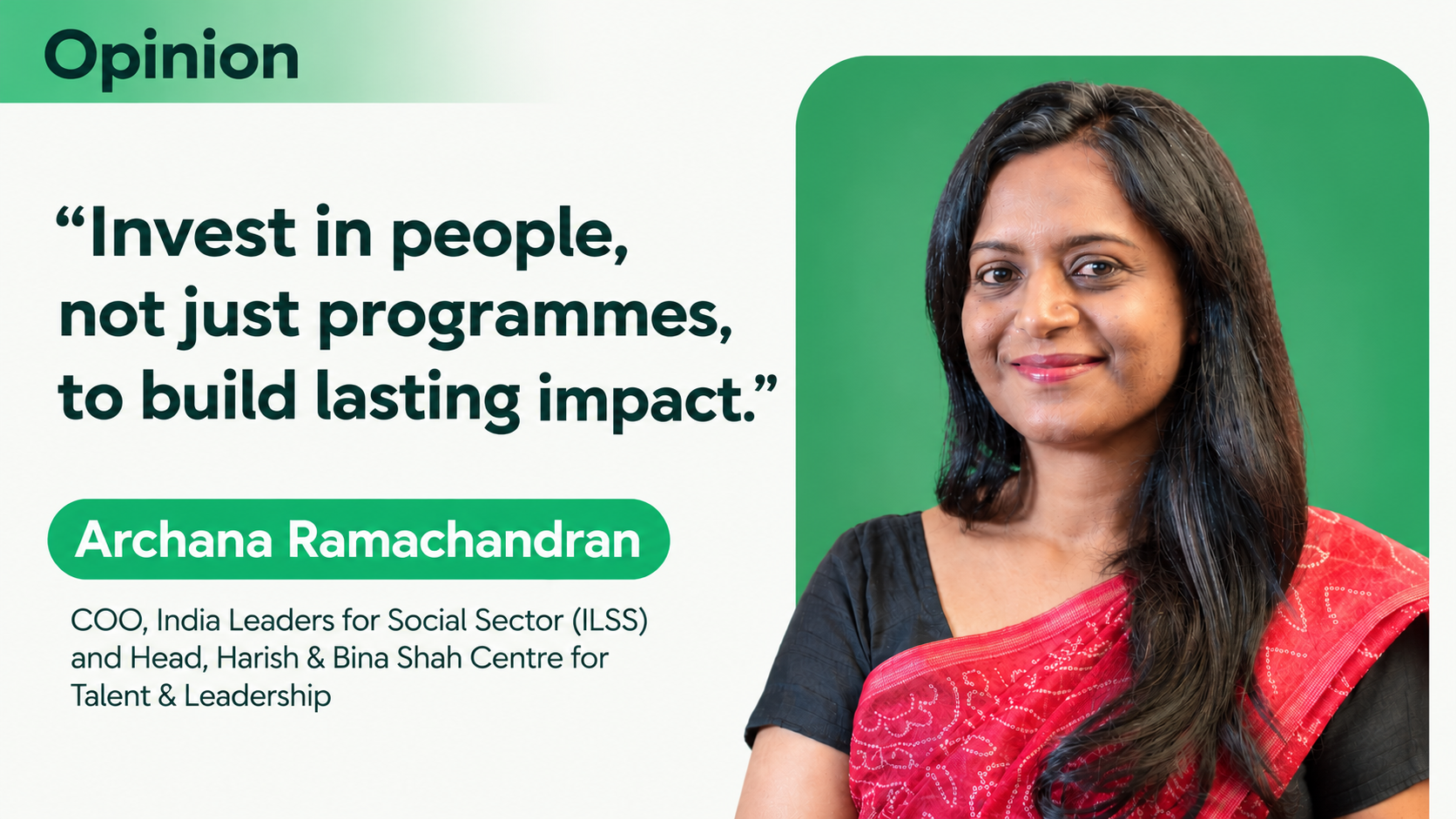
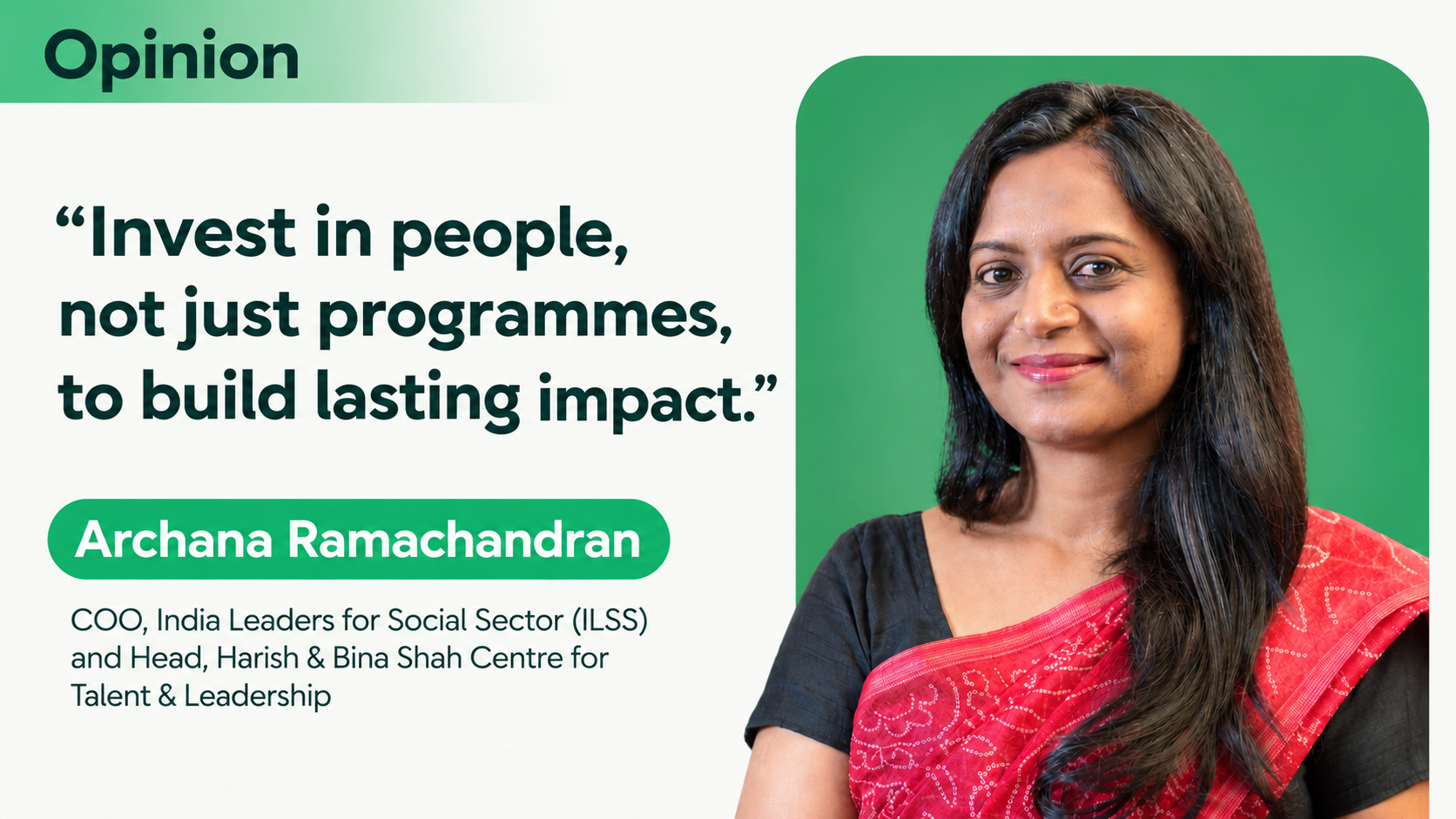
As India’s nonprofit sector grows in scale and complexity, a critical question remains: who will steer these organisations as their founders step back? While much attention is devoted to programme expansion, fundraising and measurable impact, preparing the next generation to lead often takes a back seat. Many experienced programme heads and functional managers have the sector knowledge and organisational experience to take on greater responsibilities, but may lack opportunities to develop the strategic perspective and judgement needed to guide an entire institution. In this op-ed, Archana Ramachandran, COO of India Leaders for Social Sector (ILSS) and Head of the Harish & Bina Shah Centre for Talent & Leadership, examines this often-overlooked gap and argues that addressing it requires more than succession planning. It calls for investing in people, distributing decision-making and building organisations that can sustain their mission beyond any one individual.
Read the full article below to explore why strengthening the second line is essential to the long-term resilience of India’s nonprofit sector:
Many of India’s social sector organisations began with a strong founder. This is a familiar story. An organisation begins with a founder who sees a problem differently. There is conviction, a small team and usually not enough money. The founder becomes fundraiser, recruiter, strategist, spokesperson and, often, the person who makes the final call. In the early years, it is the only way an organisation can survive.
Then the organisation grows. The team gets larger. The geography expands. Funding becomes more diverse. Government partnerships expand in scope. Boards become more involved. Compliance becomes more complicated. Over time, this leads to more programs, more relationships and more decisions. And the founder can no longer be everywhere.
This is when another leadership problem begins to surface: as the organisation grows, how does the founder move from being central to making the organisation stronger around the mission?
India’s nonprofit sector has a missing middle: program heads, functional leaders, regional leaders and senior managers who have learnt to run a part of the organisation, but are not yet ready to think about the whole of it. Many are experienced. Many are deeply committed. Many know their organisations better than anyone hired from outside. Yet they are not always prepared for the shift from managing a function to leading an institution. This may become one of the more important questions for the social sector as it grows.
When the founder becomes the system
Founder-led organisations have an obvious strength. The founder knows the history, understands the relationships and carries a deep sense of why the organisation exists. Beyond this, what is important to acknowledge is the depth of personal commitment that founders often bring to the organisations they have built. For many, the organisation is not simply a job or even a leadership role; it is deeply connected to their own sense of purpose and life’s work. They have carried the organisation through uncertainty, taken risks when there was little certainty of success, built relationships over years and often held the organisation together through its most difficult moments. That level of commitment deserves deep respect.
The same personal involvement that was essential in the early years can, over time, make it harder to let go of decisions, relationships and ways of working that have become closely associated with the founder. The question therefore is not whether the founder should step aside. It is how the founder’s role can evolve as the organisation grows, so that the founder’s commitment and connection to the mission remain a source of strength, while leadership, ownership, and decision-making become more distributed across the institution.
This mirrors what ILSS found in its study for the ANLM Report, drawn from interviews with nonprofit CEOs and founders, senior leaders, sector experts, philanthropists, and government officials. The report concludes that leadership in the social sector is “no longer about charismatic founders alone,” but about institutions capable of navigating uncertainty and building agile, values-driven teams while staying rooted in mission. It notes that nonprofit leaders are routinely expected to be strategist, fundraiser, compliance officer, people manager, communicator and digital navigator all at once — “often without adequate training or support” — operating in emotionally taxing contexts while constantly balancing the pressures of scale with the preservation of organisational culture and integrity.
The people who know the organisation best
The second line is usually not short on experience. A program director may have spent years understanding the field. A fundraising head may know the organisation’s donors intimately. But organisational leadership asks a different set of questions: Should the organisation expand or consolidate? Which opportunity should it turn down? How much complexity can the team absorb? Where should scarce resources go? What happens to culture when the organisation doubles in size? How should a difficult message be taken to the board? These are questions of judgement. And judgement does not automatically come with seniority. This is where many organisations make an odd assumption. They give people increasingly large responsibilities and expect the leadership capability to emerge along the way. Sometimes it does. Often it doesn’t.
We should rethink the way we talk about talent in the social sector. We often worry about finding the right people. Perhaps we should spend more time asking whether we are developing the people already there.
Someone who has spent seven years inside an organisation carries a kind of knowledge that cannot simply be recruited from a job description. They know the history, the culture, the communities and the relationships. They know which decisions have worked and which have not. That does not automatically make them the right person for the next role. But it gives them something worth developing.
The cost of not doing so is not visible at first. Then it appears as founder fatigue. It appears when good people leave because they cannot see where their careers are going. It appears when teams keep escalating decisions upwards. It appears when processes are repeatedly reinvented because institutional knowledge sits with individuals. And it becomes particularly visible when a founder moves on, a senior leader resigns, or a key donor relationship changes hands. Suddenly, an organisation discovers how much of its memory and judgement was being carried by a few people.
That is why this is not simply an HR challenge. It is an organisational priority. For a sector increasingly interested in scale, there is a question worth asking more often: Can an organisation’s leadership scale as quickly as its programs?
From functional capability to institutional leadership
For years, capacity building in the social sector has largely meant helping people perform specific functions better, like fundraising, finance, communications, monitoring and evaluation, technology or program management. All of these remain important. But senior leaders cannot afford to see them as separate boxes. A fundraising decision can change strategy. A people decision can change culture. A technology decision can alter how teams work. A regulatory problem can become a governance problem. A change in donor priorities can slowly alter an organisation’s direction. A social sector leader has to see the connections.
Leaders here need fewer opportunities to simply hear about leadership and more opportunities to practise it. A difficult organisational decision teaches something else. It forces a leader to weigh competing interests, live with incomplete information and accept that there may be no perfect answer. That is where leadership actually develops.
But the second line cannot be built by the second line alone. There is a temptation to put all the responsibility on N-1 leaders. They need to be more strategic. They need to take ownership. They need to develop their judgement. All true. But the organisation has to create the conditions in which that leadership can emerge.
Founders have to allow other people to make consequential decisions. Boards have to work with founders to think about succession before the situation arises. Organisations need to create credible pathways for people who show leadership potential. Funders have a role to play too. Leadership development, team development and organisational systems are still too easily treated as costs around the ‘real’ work of impact. But an organisation cannot take on larger challenges without investing in the people who have to lead that growth.
This is not an argument for building larger organisations for their own sake. It is about building organisations that can carry greater responsibility without concentrating all of that responsibility in a handful of people.
The real test of an institution
Perhaps there is a simple way to think about how far an organisation has travelled as it grows. It is not about whether the founder is in the room or not. It is about what the organisation is able to hold beyond any person, and how the founder’s role evolves as that happens.
Can decisions be made with clarity even when the founder is not directly involved? Is institutional memory held across the organisation? Can people disagree, adapt and move forward while remaining anchored in the mission? And has the founder been able to shift from carrying so much of the organisation personally to playing the role that is most valuable for the organisation and the mission at its next stage?
The answer tells us something that a budget size or beneficiary count cannot. They tell us whether leadership, ownership and judgement are becoming more distributed, while the founder’s commitment and connection to the mission continue to be a source of strength.
This is why the conversation about second-line leaders deserves to move beyond succession planning. The objective is not simply to identify who might replace the founder one day. It is to create an organisation in which leadership is already being exercised by many people, and where the founder can continue to contribute in ways that are most valuable to the organisation's next chapter. That is a much bigger ambition.
India’s social sector has built remarkable organisations around remarkable individuals. The next phase will require those organisations to become remarkable institutions as well. That will take more than charismatic founders and more than strong programs. It will require people below the founder to be trusted with real decisions, prepared for larger responsibilities and given the room to develop their own judgement.
The founder may have started the organisation, but building the leadership around the mission will determine how far that organisation can go. And that may be the real leadership challenge for India’s social sector now.