Beyond Screen Time: Rethinking Investment in Early Childhood
India’s debate around children and screen time often begins and ends with parental responsibility. But the deeper development question is what children are being offered in place of the screen, and whether our homes, communities, cities and institutions are investing enough in those alternatives. For children in the foundational years, play is not a luxury. It supports learning, social development and wellbeing, yet the time, spaces and adult engagement that make play possible rarely receive the same attention as academic outcomes or digital interventions. Deepika Mogilishetty, Chief of Policy & Partnerships at EkStep Foundation, brings this perspective to the early-years ecosystem through Bachpan Manao, seeded with 100+ organisations. Her work connects policy, partnerships and public narratives to a larger question for CSR, philanthropy and development practitioners: what would it take to make play an investment priority?
Read the full article below for deeper insights:
Every few months, a new report on digital screen addiction among the country's youngest citizens catches media attention. Parents are alarmed, debates take centre stage, guidelines get updated, and then nothing changes on the ground.
We have been fighting the wrong battle. We keep addressing the symptom instead of the cause. Screen time isn't the problem. The deeper question is: what has the screen replaced, and why?
Two things created the vacuum. On one side, a generation of us grew up hearing "Padhoge likhoge banoge nawab, kheloge kudoge hoge kharab." Study, and you'll succeed; play, and you'll be ruined. That saying didn't just shape individual families. It shaped what an entire generation of caregivers came to believe responsible parenting looked like. On the other side, public play spaces, especially in cities, have quietly slipped out of urban planning budgets and policy frameworks. Parents saying "Go, play outside", is not as commonplace as it used to be. The unstructured hours, where nothing is planned, and a child has to figure out what to do next, have been swapped for a timetable of classes and activities built to pad a five-year-old's CV. There is no room to get bored. No scope to sit still, or to play.
Bachpan Manao's Voices of Play initiative, anchored by REACH India Collective and Shiksharth, put this to children directly. Across 10 states, through events held by 22 organisations, over 4,000 children were asked what play means to them and what gets in its way. The manifesto built from their answers, India's first national play manifesto written from what children said rather than what adults assumed, confirms something we suspected. Children don't ask for more screen time when you ask them what's missing. They ask for a place, a person, or permission.
Faced with that vacuum, we hand children the only unlimited playground left on the planet: a screen. We did it unintentionally, without at first understanding what it would cost.
The Real Gap Is Not Awareness, But Opportunity
Here's what our work in early childhood keeps showing us. Indian parents are not confused about the value of play. Studies on parental perceptions find strong, intuitive belief in it. The problem isn't knowledge. It's what has come to matter more. Parents override free, unstructured play without a second thought the moment academic pressure arrives, as if the two cannot coexist. And that pressure now starts as early as age three.
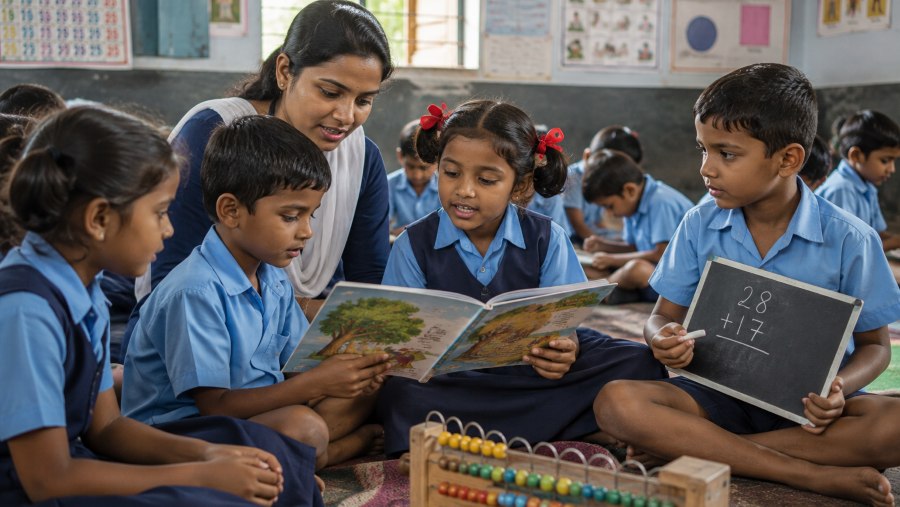
Somewhere, we stopped asking what play even looks like for a child between zero and eight — not decoration on top of a childhood, but the thing childhood is mostly made of. Somebody, somewhere, has already started trying to answer that. Prajayatna has built free-play corners inside the 100-plus Anganwadis it works with in Karnataka. The Aga Khan Foundation's Khel Kona model turns a spare corner and a few recycled objects, a bottle, and a sock, into a play space inside the home. The Opentree Foundation has created an open source database of play ideas shared by teachers, facilitators, volunteers, artists, and play-practitioners working with children and adults in many different contexts, called Playpedia. Aavishkaar has started putting out math games that caregivers can play with their child through their Instagram page @MomsForMath. None of them needed a construction budget. Just someone who decided to make space for play.
That last line is the whole point for anyone deciding where social investment should go. The binding constraint in early childhood play is rarely money. It is will, attention, and the decision to treat play as infrastructure worth backing — and perhaps the better question to start with is what children themselves would say they need, if anyone thought to ask.
Investing in Play Does Not Always Mean Building More
The evidence backs the low-cost route. Play-based research finds that when children get open-ended materials, loose parts like mud, sticks, cardboard and rope, their engagement in play rises, and it can begin to displace screen time simply by offering something more compelling. A J-PAL trial in Tamil Nadu found the same pattern with people rather than props: give an Anganwadi just one additional adult's worth of attention on play-based instruction, and children show measurable gains in language, math and executive function, because the day finally has room for a child to explore instead of being managed.
That doesn't change by postcode. An Anganwadi is short on staff. An urban home is short on unscheduled hours. Different shortages, same fix: someone has to fund the time back in, not tell the adult already stretched thin to find more of it.
And once that time exists, the screen doesn't have to be fought. It just stops being the only thing in the room. Not because anyone said "put down the tablet," but because something better became available. Children aren't choosing screens over play. They are choosing screens over nothing. That distinction changes everything, because it means the problem was never the screen. It was nothing.
For a child under eight, play isn't about toys or scheduled time. Small acts of involvement are enough. A parent making a face back at a babbling infant is play. A tired parent humming at bedtime, and the child humming back. Research calls these "serve and return." Children call it being with someone. An Indian longitudinal cohort study found that this kind of daily interactive stimulation predicts a child's resilience at age nine, independent of income or living conditions.
None of this needs a separate room or special equipment. What it needs is an undiluted presence — and most early childhood spending is still built around managing something, the space, the curriculum, the child's outcomes on a chart, rather than simply freeing up a person's time to give it.
The policy architecture already exists. The National Curriculum Framework for the Foundational Stage (2022) puts play at the centre of early learning, alongside two companion frameworks from the Ministry of Women and Child Development — Aadharshila for ages three to six, and Navchetna for birth to three. The commitment exists on paper. Last year, Bachpan Manao's Less Screen, More Play pledge with NDTV drew more than 70,000 signatures. This year, Poshan Pakhwada named screen-time reduction and play-based learning in the same breath as nutrition, across 14 lakh Anganwadi centres — the first time a government campaign at that scale has said it out loud.
What's still missing isn't the availability of money. It's someone deciding to fund the time, the presence, and the space, the corner — not only the technology. Fund the ideas that bring mothers and fathers into the space for play, let them experience the joy of play and childhood with their children. Back the NGOs already doing this at the last mile unlocking play and protecting childhood. Put weight behind the next pledge, the next Poshan Pakhwada, because normalising an idea is infrastructure too, and cheaper than almost anything else in the sector.
The screen didn't take childhood on its own. Somewhere along the way, presence stopped feeling productive enough, and the screen filled the gap. The work now is to make it feel productive again — and to put institutional weight behind the people and places that make play possible.