
From Learning to Earning: Making Higher Education More Accessible Through Earn-and-Learn Models
India’s higher education system continues to face the challenge of making quality education accessible to students from diverse economic backgrounds while ensuring that graduates are equipped for the demands of the workforce. For many young people, the financial burden of pursuing a degree often means choosing between continuing their education and earning a livelihood. At the same time, the gap between academic learning and practical workplace requirements highlights the need for more flexible and industry-integrated approaches to higher education.
Earn-and-Learn models offer a potential pathway to address these challenges by combining recognised academic qualifications, structured workplace experience and financial support within the learning journey. By bringing education and employment closer together, such models can help reduce financial barriers, strengthen employability and create more inclusive opportunities for young people.
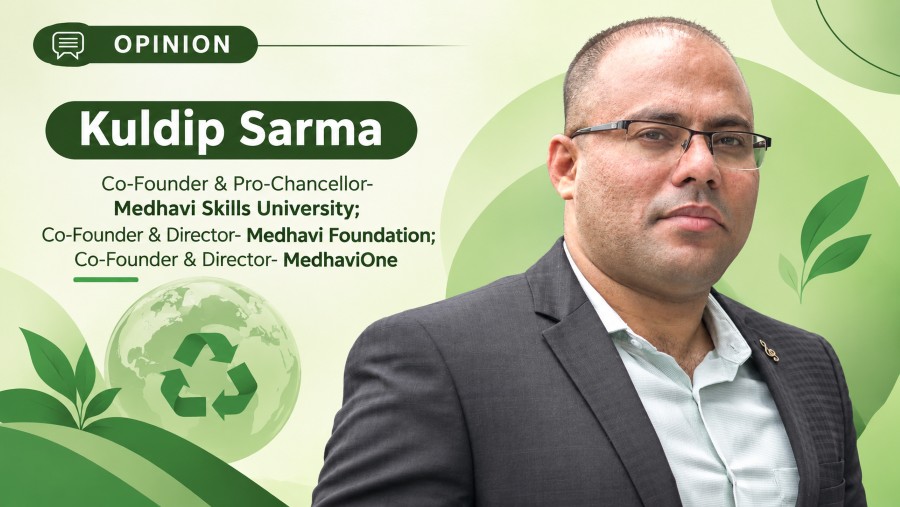
In this article, Mr. Kuldip Sarma Co-Founder & Pro-Chancellor- Medhavi Skills University Co-Founder & Director- Medhavi Foundation Co-Founder & Director- MedhaviOne, examines how Earn-and-Learn models can reshape India's higher education landscape, the role of industry-academia partnerships in developing a skilled workforce, and why integrating practical learning into mainstream higher education is essential to building a Skills-First India.
Explore the full article below:
India’s higher education system must move beyond the traditional separation between classrooms and workplaces. Earn-and-Learn models can make education more accessible by enabling students to gain recognised qualifications, practical experience and financial support while preparing for meaningful careers.
For millions of young Indians, pursuing higher education is not simply a question of academic aspiration. It is equally a question of affordability, opportunity and the financial realities of their families. A student may have the ability and ambition to pursue a degree, but the cost of education, accommodation and the opportunity cost of spending three or four years outside the workforce can make that aspiration difficult to sustain. For many households, particularly those from economically constrained backgrounds, higher education often comes with a difficult choice: continue studying or start earning.
This is a choice our education system must increasingly work to eliminate. If India is serious about democratising higher education and harnessing its demographic dividend, access cannot be measured by enrolment numbers alone. It must also be measured by how many learners can afford to continue their education, acquire relevant skills and transition into productive employment. This calls for a fundamental rethink of how we structure higher education, and Earn-and-Learn models offer a practical way forward.
Making education accessible beyond the classroom
Traditionally, higher education has followed a fairly linear path: students complete their schooling, enrol in a college or university, spend the next few years studying and eventually enter the workforce. While this model has served an important purpose, it does not adequately account for the realities of a large section of India's young population. For students who need to support their families or cannot afford to remain financially dependent for the duration of a degree, this pathway can be difficult to pursue.
The Earn-and-Learn approach challenges this conventional structure by bringing education and work together. Instead of treating employment as something that begins after graduation, it integrates structured workplace learning into the academic journey itself. Students pursue recognised academic qualifications while gaining hands-on experience in professional environments and, where applicable, receiving stipends for their contribution.
The significance of this model goes beyond the immediate financial assistance. A stipend can help students meet some of their personal and educational expenses, ease the financial pressure on their families and give them a greater sense of independence. More importantly, it allows them to continue their education without having to choose between acquiring a degree and earning an income.
However, we must recognise that Earn-and-Learn is not simply about placing students in part-time jobs. Its real value lies in creating a structured relationship between academic learning, workplace responsibilities and financial support.
From theoretical knowledge to practical capability
One of the persistent challenges in Indian higher education is the disconnect between what students learn and what workplaces expect them to know. Degrees remain important, but a qualification by itself does not necessarily translate into workplace readiness. Employers need individuals who can apply their knowledge, understand professional environments, solve problems and contribute from an early stage.
This is where work-integrated education becomes particularly relevant. On-the-Job Learning (OJL), when embedded into the curriculum, allows students to experience the practical application of concepts while they are still pursuing their degrees. Unlike conventional internships, which are often short-term and undertaken towards the end of a programme, structured workplace learning can be mapped to academic outcomes and integrated throughout the learning journey.
At Medhavi Skills University, this philosophy informs our approach to Skill-Based Higher Education through Work-Integrated Skill-Based Higher Education (WISE) and Earn-and-Learn programmes. Eligible programmes integrate academic instruction with supervised workplace experience, with OJL forming a mandatory, credit-bearing component in applicable curricula. Students can spend six to nine months in industry environments, applying their learning in actual professional roles.
Our industry partnerships across sectors, including hospitality, retail, healthcare and engineering, create opportunities for students to understand workplace expectations while developing practical and professional capabilities. The objective is to ensure that students graduate with more than theoretical knowledge. They should have the confidence and experience to apply what they have learnt.
Industry must become a co-creator of education
For Earn-and-Learn models to succeed at scale, industry participation is essential. Employers cannot remain passive recipients of graduates and expect universities to independently anticipate every change in workplace requirements. They must become active partners in shaping curriculum, providing structured learning environments and identifying the capabilities their sectors require.
Such partnerships create value for both sides. Students gain exposure to real workplace practices, while employers get an opportunity to engage with emerging talent, contribute to capability development and build stronger talent pipelines. The relationship also helps universities keep their programmes relevant to evolving industry needs.
Initiatives such as the nationwide Learn While You Earn collaboration between Chai Point and Medhavi Skills University demonstrate how industry partnerships can create structured pathways that combine workplace exposure with education. Such models can be adapted across sectors, provided the learning component remains central and student development is not reduced to meeting immediate workforce requirements.
Industry-academia collaboration is also central to building a Skills-First India, where industry-aligned skills are embedded within mainstream higher education rather than treated as an additional qualification or a separate vocational pathway. When employers become co-creators of education, skills become an integral part of how India prepares its future workforce
Building a more inclusive higher education ecosystem
The National Education Policy (NEP) 2020 provides an important framework for this transition by emphasising vocational integration, experiential learning, flexibility and multidisciplinary education. The National Credit Framework further creates opportunities to recognise learning across academic, vocational and experiential settings. The task ahead is to translate these policy directions into accessible pathways that learners can meaningfully participate in.
This also requires us to rethink how we perceive vocational and work-integrated education. It should not be seen as an alternative reserved for students who cannot access conventional degrees. Rather, it must be recognised as a credible, aspirational pathway that combines academic rigour with practical competence.
There are, of course, important considerations. Stipends must be fair and transparent, workplace learning must be supervised and aligned with educational outcomes, and students must be protected from being treated merely as low-cost labour. Equally important is ensuring that recognised qualifications, academic progression and the quality of learning are never compromised.
Turning the right to learn into the opportunity to earn
India's ambition of becoming a Viksit Bharat by 2047 will depend significantly on how effectively it converts its young population into a skilled, productive and economically empowered workforce. That requires us to look at education not only as a means of acquiring qualifications but also as an instrument of social mobility.
Earn-and-Learn models bring these objectives closer together. They help reduce the financial barriers to higher education, give students an opportunity to develop professional confidence and create a stronger connection between learning and livelihoods. For a young person who might otherwise have to discontinue education to support their family, the ability to study, gain experience and earn simultaneously can change the trajectory of an entire household.
The larger question before India's higher education ecosystem is whether we are willing to redesign education around the realities of learners rather than expecting learners to adapt to the limitations of the system. Access must mean more than opening the doors of universities. It must mean enabling students to stay, succeed and build sustainable careers. The future of higher education cannot be defined by the number of degrees awarded alone. It must be defined by the opportunities those degrees create, the capabilities learners develop and the economic independence they enable.
This calls for a fundamental rethink of how we structure higher education. Earn-and-Learn models offer a practical way forward, bringing us closer to the vision of a Skills-First India, where education is not just about earning qualifications but about building capabilities, enabling livelihoods and preparing young people for the world of work.