
Beyond Eighteen: Building the Bridge from Care to Citizenship
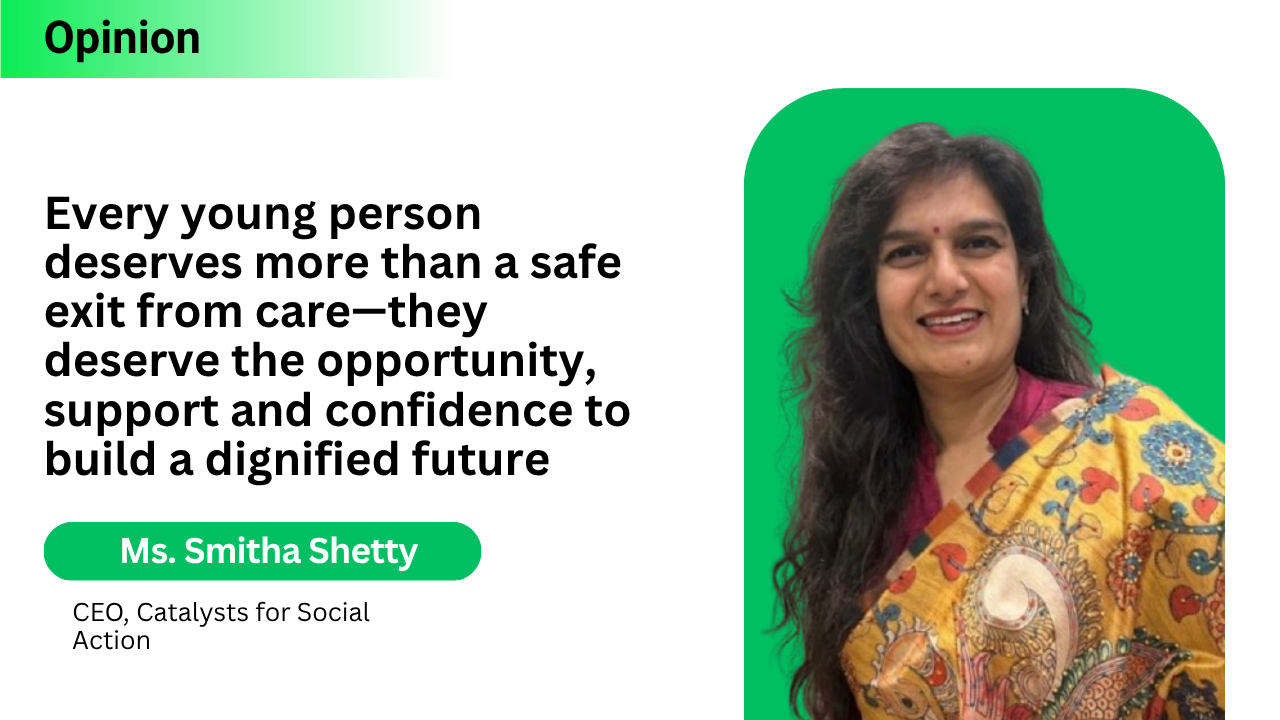
For many young people, turning eighteen marks a gradual move towards independence, supported by family, familiar surroundings and the reassurance of having somewhere to return. For those leaving institutional care, the transition can be far more uncertain. India’s child protection system must therefore address a question that extends beyond legal discharge: how can young people be prepared for independent lives, and supported as they navigate the challenges of adulthood?
With experience spanning over two decades, Catalysts for Social Action (CSA) works across institutional care and aftercare, supporting children in 124 Child Care Institutions and young adults transitioning out of care across six states, according to the organisation. Its work includes education, health, emotional wellbeing, vocational readiness and employment support, reflecting the need for continuity beyond the age of eighteen.
In this article, Smitha Shetty, CEO, Catalysts for Social Action, examines what meaningful aftercare requires, from sustained relationships and workforce readiness to stronger collaboration among institutions, governments and employers. Drawing on CSA’s experience, she explores how India can move from preparing young people to leave care towards helping them build secure and dignified futures.
Read the full article below for her insights:
A nineteen year old who drops out of college can return home. There is a room that still holds their belongings, a meal placed quietly on the table, a parent who may worry or disagree but does not withdraw. In such homes, adulthood is elastic. It expands to absorb confusion, hesitation, even failure.
For a young person leaving institutional care, often referred to as a care leaver, adulthood does not expand in the same way. At eighteen, sometimes a little after, the structure that has held them begins to recede. The nature of the State’s support begins to change. There may be a transition plan, financial assistance for a defined period, counselling support. Yet the shift is unmistakable. Independence is no longer a gradual unfolding. It is an expectation.
This moment invites a deeper question. When the State has acted in the place of a parent, what does its responsibility look like once the child becomes a legal adult? How might that responsibility evolve once the child becomes a legal adult? How can continued support best balance rights, vulnerability, need and growing independence? Or does it continue as a right grounded in vulnerability and need?
What Does the State Owe Young Adults Leaving Care?
Across countries, aftercare is shaped by different answers to this question. France presumes continued support up to twenty one for young adults who lack resources, with withdrawal requiring justification. South Africa offers transition programmes beyond eighteen, but as a matter of institutional capacity rather than enforceable right. The United States channels federal Chafee funds toward education, housing and life skills through grants and eligibility criteria. Each model reflects a different view of what a society believes it owes young people it has raised.
India's own framework sits meaningfully within this responsibility-oriented tradition. The Juvenile Justice Act defines aftercare for young people between eighteen and twenty one leaving institutional care, and the Model Rules mandate individual aftercare plans, counselling, and support for education, skilling, housing and finances. Mission Vatsalya provides a monthly stipend intended to ease this transition. In statutory terms, this is a considered and evolving framework, one that recognises reintegration requires planning and structured support, and several states have already begun extending timelines and services further, suggesting the system is well placed to keep deepening.
From Policy to the Reality of Aftercare
What this national commitment creates space for, and where mission-driven organisations can meaningfully complement government efforts, is the texture of implementation: how a stipend translates into stable housing, how a plan translates into a relationship a young person can actually lean on. This is precisely the space Catalysts for Social Action (CSA), a Mumbai-based nonprofit, has spent nearly a decade working in, alongside government systems, to build out what sustained, personalised aftercare can look like in practice.
The aftercare field has traditionally offered two models, each with an inherent trade-off. High-touch programmes, often residential, provide intensive and highly effective support, but reach only a small fraction of care leavers each year given their resource intensity. Low-touch programmes, including skilling platforms and stipend-based support, reach far more young people but offer little continuity once a young person is placed, leaving housing, education and emotional needs largely unmet.
A Scalable Approach to Sustained Support
CSA's Aftercare Program was built as a deliberate third category: a “scalable-touch” model that delivers personalised, multi-year, holistic support to a large and geographically dispersed population, at low unit cost, tapering that support against a clear graduation benchmark rather than continuing indefinitely. At its centre is a paid, full-time Program Officer who works with each care leaver as a consistent, quasi-parental presence, an anchoring adult, for three to five years, alongside education support, skilling, housing assistance, and emotional wellness support built into the journey from the outset.
The model is open to care leavers from any Child Care Institution, not only CSA's own, and is anchored in a shared, measurable definition of success: two years of sustained employment. A data-driven system tracks each young person's journey, turning individual progress into an improvable, evidence-led programme rather than a one-time intervention. Today, this approach has supported over 4,000 care leavers across several states, with the majority moving into stable employment and the vast majority sustaining it two years on, at a fraction of the cost of residential alternatives. A growing Alumni Network, now over 1,200 members strong across more than a dozen clusters, extends this support into a lasting community, ensuring that the relationship a young person built through their transition does not simply end when formal support does.
This is what a responsibility-oriented approach to aftercare can look like when statutory intent is matched with sustained, on-ground partnership. Extending timelines, deepening financial support, and strengthening implementation are all technical questions with real answers, and India's own evolving practice, alongside the work of organisations like CSA, shows that these answers are within reach.
Ultimately, aftercare is less about funds and more about faith: faith that young people deserve continuity, that stability cannot be rushed, and that citizenship is cultivated through supported transition rather than granted abruptly at eighteen. When families support their children through uncertain years, we call it care. When a State and its partners do the same for young people raised in public care, that too deserves to be understood as care, not merely as welfare.
The way a nation, and the organisations working alongside it, answer this question reveals not only how care leavers are treated, but how responsibility itself is understood, as something that evolves with a young person's journey towards stability and independence.