Beyond Traffic Why Urban Mobility Should Become Corporate India’s Next CSR Mission
As India’s cities expand, the challenge of urban mobility is moving far beyond congestion and commute times. Road safety, emergency response, air quality, public transport, infrastructure efficiency and citizen wellbeing are increasingly interconnected, making mobility a critical development and public policy priority.
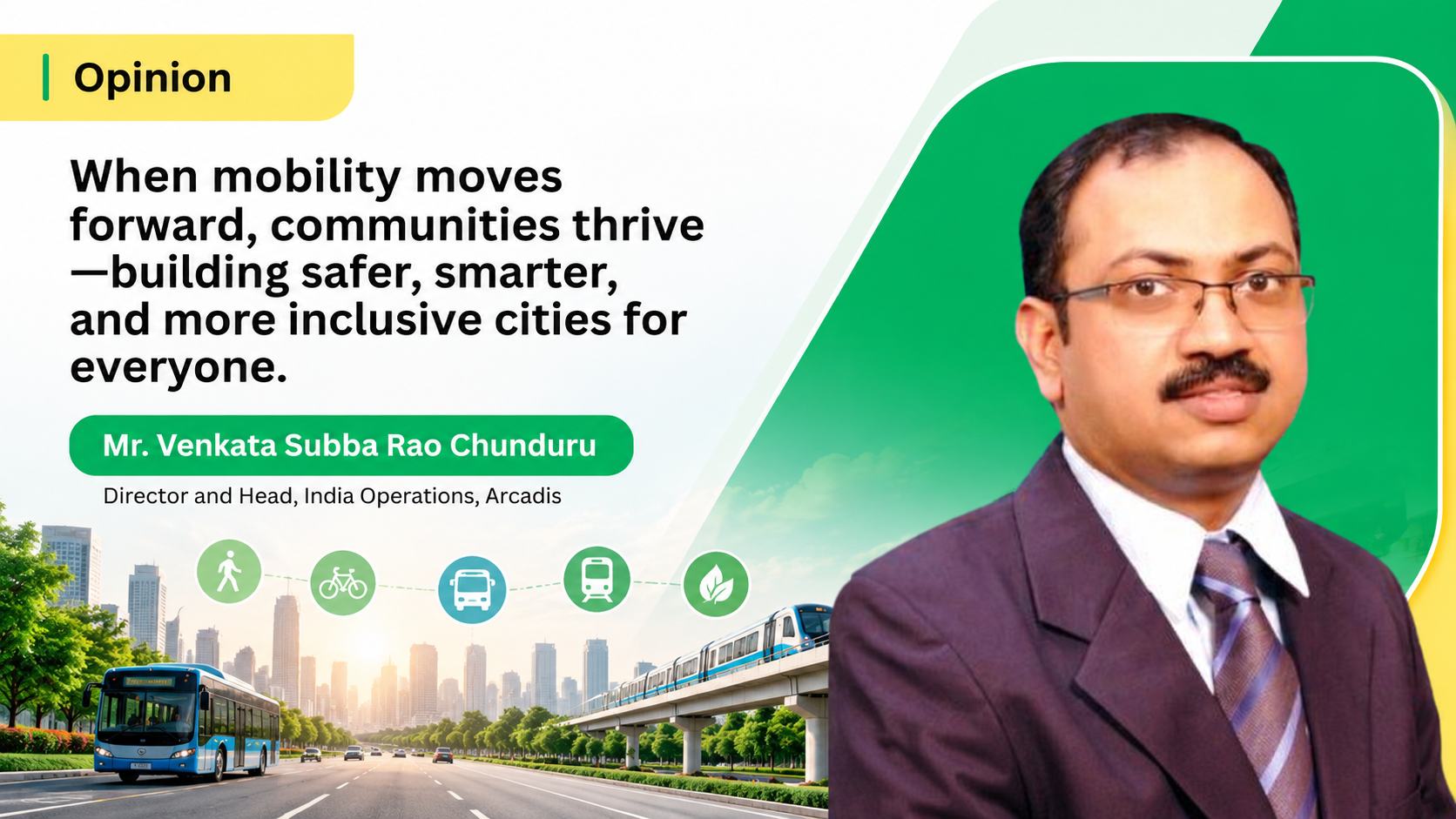
With more than 22 years of experience spanning transportation systems, infrastructure appraisal, travel demand modelling and Intelligent Transportation Systems, Venkata Subba Rao Chunduru, Director and Head, India Operations, Arcadis, brings a practitioner’s perspective to this evolving landscape. A graduate of IIT Mumbai with a Master’s in Transportation Systems Engineering, he has worked across highways, airports, ports, public transit, rail and urban transport projects, including those implemented through PPP/P3 models and multilateral funding. His work with the Indian Roads Congress and CII further connects his experience to the broader evolution of India’s transport systems. In this article, he explores why intelligent urban mobility deserves greater attention within Corporate India’s CSR agenda and how technology can translate mobility investments into measurable social outcomes.
Read the full article below for the detailed perspective.
Every morning, millions of Indians begin a journey with a simple expectation: to reach school, work, a hospital or home safely. A child boards a school bus, a nurse starts an early shift, an ambulance races to save a life, a delivery rider navigates busy streets and a bus driver carries hundreds of passengers.
Yet, for far too many, these ordinary journeys have become increasingly stressful, unhealthy and, at times, life-threatening.
We continue to call it traffic congestion, but what India is experiencing today is far more profound. It is an emerging humanitarian challenge affecting public health, road safety, economic productivity, environmental sustainability and the quality of life of millions of citizens. By 2047, more than 820 million Indians will live in urban areas. The future of our cities will depend not only on the infrastructure we build, but also on how intelligently we manage the movement of people and goods.
Traffic is no longer merely a transport issue. It is a public health issue, a workforce wellbeing issue, a climate issue and, above all, a humanitarian issue.
The consequences are visible every day. India loses over 1.7 lakh lives annually in road crashes. (Source: Ministry of Road Transport and Highways (MoRTH), Government of India, Road Accidents in India 2023).
Millions more are exposed to dangerous levels of air pollution during their daily commutes. Ambulances lose precious minutes trapped in congestion. Bus drivers, delivery personnel and commercial vehicle operators work under relentless physical and mental stress. Families lose valuable hours together because of unpredictable travel, while businesses lose productivity through delays and inefficiencies.
These are not isolated transport problems. They are interconnected societal challenges that affect how safely we live, how efficiently we work and how sustainably our cities grow.
From Infrastructure to Intelligence
Over the past two decades, India has invested significantly in roads, metro systems, Intelligent Traffic Management Systems, CCTV networks and Integrated Command and Control Centres. These investments have created an important foundation. Yet congestion persists, accidents continue and emergency response remains challenging.
The issue is no longer the availability of infrastructure. It is the ability to orchestrate it intelligently.
Modern cities generate enormous volumes of mobility data from traffic signals, cameras, public transport, emergency services, weather systems and citizen applications. However, data alone does not improve mobility. Only intelligence that transforms information into coordinated action can deliver better public outcomes.
This is where Artificial Intelligence and Mobility Digital Twins are redefining urban management.
A Mobility Digital Twin creates a real-time, continuously learning representation of a city's transport ecosystem. It enables authorities to anticipate incidents, optimise traffic operations, coordinate multiple agencies and make proactive decisions rather than reacting after problems have escalated.
Emerging mobility intelligence platforms, including initiatives such as ASTraM (Actionable Intelligence for Sustainable Traffic Management), demonstrate how existing city infrastructure can be transformed into integrated operational intelligence ecosystems. Rather than managing isolated traffic events, cities can increasingly manage mobility as a connected, adaptive and continuously learning system.
The real value of such intelligence is measured not in dashboards or technology deployments, but in human outcomes.
When Mobility Intelligence Saves Lives
In Bengaluru, intelligent mobility management has enabled ambulance travel times to reduce by more than 40 percent, helping critically ill patients receive lifesaving treatment sooner. Predictive traffic management during major public events has contributed to safer roads and improved emergency preparedness. Similar initiatives have demonstrated that intelligent mobility is equally relevant for emerging Tier-2 cities, proving that this transformation is both scalable and achievable.
These outcomes illustrate an important truth: mobility intelligence saves lives.
The next challenge is scaling these proven outcomes across India. This is where Corporate Social Responsibility can play a transformational role.
A New Frontier for Corporate India
For decades, Corporate India has strengthened education, healthcare, sanitation, water conservation and rural development. The next frontier is urban mobility—not because traffic needs technology, but because citizens deserve safer, healthier and more equitable cities.
Imagine corporations adopting Safe School Corridors, Ambulance Priority Networks, Women's Safety Corridors, Clean Air Mobility Zones or AI-enabled Road Safety Programmes. Every initiative could deliver measurable reductions in accidents, emergency response times, emissions and commuter stress, while improving public health and quality of life.
Building Cities Around People, Not Just Vehicles
Unlike many CSR interventions, intelligent mobility offers transparent and measurable impact. Every investment can be linked to lives saved, emissions reduced, travel time improved and citizen wellbeing enhanced.
Governments will continue to provide policy, governance and long-term stewardship. Technology providers will continue to innovate. Academic institutions will contribute research and evaluation. Corporate India can become the catalyst that accelerates innovation, demonstrates measurable outcomes and enables successful models to scale nationwide.
The cities of tomorrow will not be remembered for the number of roads they built, but for the lives they protected.
Urban mobility is no longer about moving vehicles more efficiently. It is about enabling children to reach school safely, ambulances to reach hospitals on time, workers to return home to their families and citizens to breathe cleaner air.
The next great CSR movement in India has the potential to transform every journey into an opportunity to save a life. Because when mobility works, cities thrive. And when cities thrive, the nation prospers.