
Beyond The Pilot: Why Education System Transformation Needs Collaboration
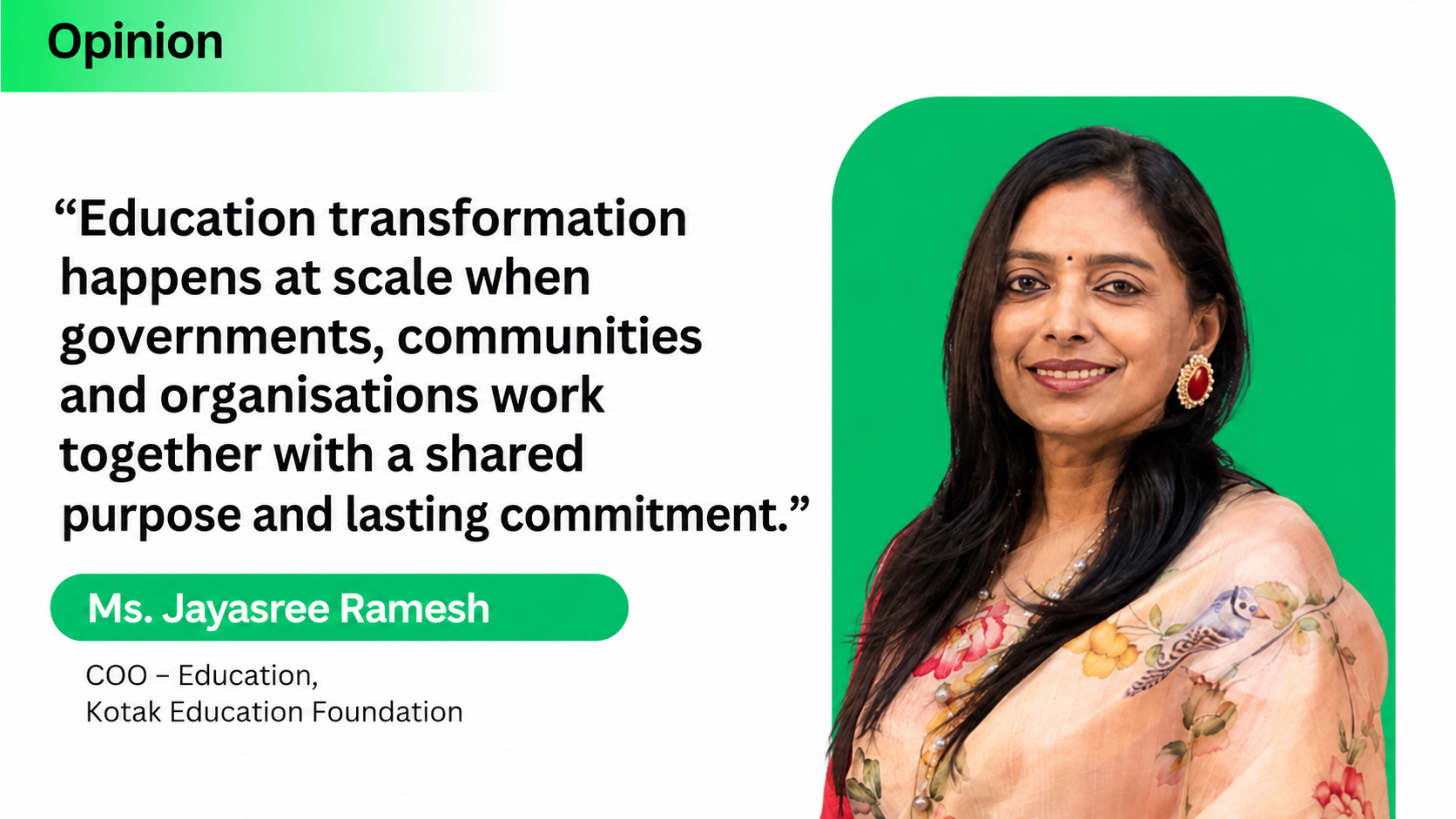
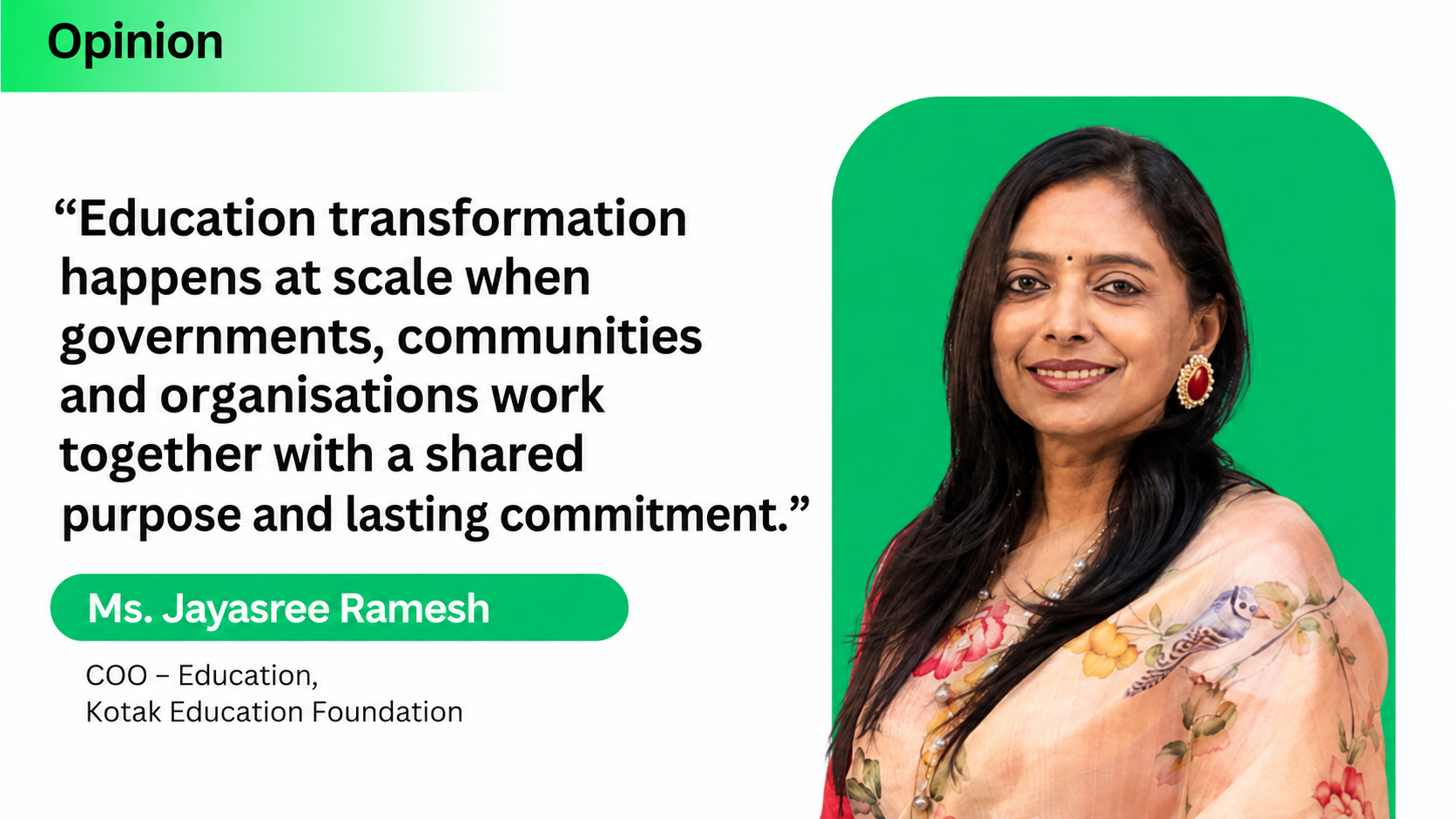
The challenge of improving learning outcomes across India’s diverse education landscape extends well beyond access to schools or the availability of resources. It calls for sustained institutional commitment, shared accountability and the ability to bring together expertise across sectors. While government programmes, civil society initiatives and private sector investments have contributed to strengthening foundational learning, fragmented efforts can limit their reach and continuity. The need, therefore, is to move towards partnerships that are built around common goals and long-term ownership. In this article, Ms. Jayasree Ramesh, COO – Education, Kotak Education Foundation, examines why collaboration is essential to taking education transformation from local interventions to systemic change.
Read the full article below:
Shared Goals. Shared Effort. Endurance for the Marathon.
In one Indian state, a government education department and an NGO chose to work as one team, not as funder and vendor, to move the needle on foundational learning at scale. Within three months of that shared ownership, the share of Class 3-9 students who could read their own textbook rose from 48% to 63%, and those who could solve a division problem rose from 54% to 71% - not in one pilot school, but across every government school in the state, because the partnership was built jointly from day one, not handed over midway.
Globally, a similar model operates at even greater scale. The Global Partnership for Education (GPE) brings together nearly 90 governments, civil society organisations, teachers, foundations and the private sector into one pooled partnership, rather than a set of parallel projects. Since 2021, this shared model has reached over 250 million children, trained close to 2 million teachers and mobilised over $9.5 billion in financing - proof that when partners fund and build together instead of in silos, impact compounds at a national, and even global scale.
That is the scale of ambition India's foundational learning crisis demands. According to NEP 2020, over 50 million elementary school students across the country cannot read and comprehend basic text or perform basic addition and subtraction. NIPUN Bharat aims to address this learning crisis through teacher capacity building, strengthening institutional and school leader accountability, designing novel FLN-specific teaching-learning materials. FLN Nishtha bridges the language barrier. Stage-specific learning goals target quantifiable progress tracking of students with multiple learning levels in one classroom, a reality that teachers wrestle with every day. Unified inputs from government changemakers and policymakers, academicians and educationists, have defined the way forward. States are mapping their pathways and aligning curricula; individual institutions and their much-needed pilots and programs are making a meaningful difference. However, isolated pilots and programs in silos, may not scale.
The sheer magnitude of effort and intrinsic know-how required to disseminate fundamental skills across the width and depth of our geography, necessitates urgent collaborative action.
Can we pool multidisciplinary expertise - EdTech specialists, champions of PAL (Personalised Adaptive Learning) pedagogies, targeted remediation and differentiated instruction for classrooms with varying learner levels, and neural, digital, physical and infrastructural assets - into one unified model of collaboration: built once, and adapted for every state, rather than reinvented pilot by pilot?
Can we shape Knowledge Collectives that are incubators of nation-building?
Redefining Frontiers through A Melange of Education Entrepreneurs
Let’s look at a melange of education entrepreneurs and experts who can lead the charge, scale transformation and redefine the frontiers of change in the education ecosystem.
Teachers and school leaders, curriculum designers and academic course creators, special educators and special education therapists, educational psychologists, neuroscientists, diversity experts catering to neurodivergent learners.
EdTech software developers, technologists who build digital learning platforms and tools, AI specialists , business leaders and industry professionals who help align real-world workplace, marketplace and industry-relevant career needs with educational content.
Data analysts who track student learning outcomes and the metrics that matter in a journey of millions towards basic literacy.
Grassroots organisations driving remote, hilly, tribal, rural education, mobilising local communities and youth to run remedial learning camps, operating technology-driven volunteer-led models simultaneously connecting hundreds of teachers, combining outreach with last-mile implementation rigour.
Each organisation has depth in something: Foundational Literacy and Numeracy, Communicative English, girls' education, secondary retention, technology, inclusion. Aligning specialised competencies and addressing specific needs simultaneously in harmony with state priorities, can avoid duplication of time and effort, and fragmentation of the teaching-learning process for teachers and officials.
Strengthening the education ecosystem through teacher training, school leadership development, and enabling access to quality education for underprivileged and underserved communities becomes less challenging when fulfilled through collaborative partnerships. The lens shifts. Goals jointly set, convergence of energy, capital and entrepreneurial mindset, innovative problem-solving and reciprocal data sharing propel the partnership towards successful outcomes.
Migrating from a limited-tenure project approach to enduring partnerships can upskill and empower teachers and head teachers en masse, invigorate sustained community engagement for shared responsibility and tackling local challenges, and nurture students’ academic and holistic development.
Future-Ready, Joining Forces, and Moving Mountains
Partnership is core to the long-term success of education transformation and nationwide socioeconomic growth. The way forward lies in meticulously conceptualising five-year blueprints and vigorously building a collaboration strategy with peer NGOs, corporate philanthropy and CSR divisions, and education entrepreneurs, rooted in trust and shared purpose, with clarity on actionable and accountability, measurable success metrics for learning outcomes, and transparency of data capture.
We avidly envision a brighter horizon for our dynamic, ever-increasing band of 50 million talented young minds - potentially a squad of foundationally sound, future- ready, global citizens - ascending the ladder of education.
Knowledge Collectives and Knowledge Networks are key to our collaborative endeavours in education, as we go from a high-intensity, high-energy sprint to a steady, sustainable marathon.
Let’s join hands, join forces and prevail for good.
As Einstein said, “Persistence is the most powerful force on earth, it can move mountains.”