Moving Beyond Sustainability Compliance Towards Sustainability-Led Business Value Creation and Responsible Growth
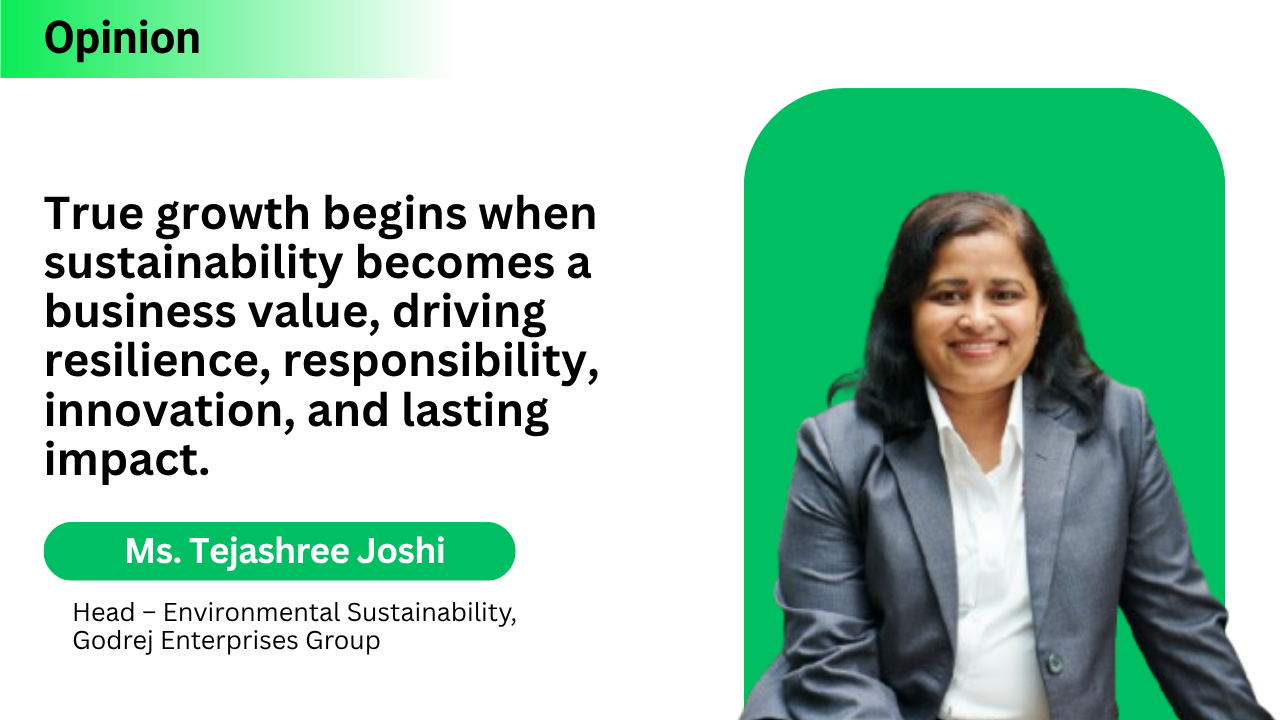
India’s growth story is increasingly shaped by questions that go beyond economic output. How businesses use water and natural resources, strengthen supply chains, engage smaller enterprises, and affect communities and ecosystems will influence the quality and durability of that growth. This calls for a shift from viewing environmental and social responsibilities primarily through the lens of disclosure to making them part of everyday business decisions.
In this insightful article, Tejashree Joshi, Head – Environmental Sustainability, Godrej Enterprises Group, examines what this transition means for Indian industry. She explores how resource efficiency, resilient supply chains, water security and nature can influence the way businesses plan, invest and grow, while creating value that extends beyond the organisation to communities, livelihoods and the wider economy.
Scroll down to explore more:
India's sustainability journey is entering a decisive new phase. Over the last decade, organizations have focused on establishing commitments, setting targets, and enhancing transparency through increasingly rigorous disclosures. While these efforts have laid a strong foundation, the next stage of progress must move beyond reporting and accountability. Sustainability must evolve into a driver of business intelligence, strategic decision-making, competitive advantage, and responsible growth.
For Indian industry, this transition is no longer optional. Climate variability, water stress, resource volatility, and supply chain disruptions are steadily reshaping operating environments and investment choices. Extreme weather events can impact productivity, disrupt logistics networks, and increase the cost of doing business. As these challenges intensify, sustainability can no longer remain a parallel function. It must become an integral component of business strategy, influencing how organizations assess risk, allocate capital, design products, manage operations, and pursue growth.
From Reporting to Strategic Decision-Making
India has made significant progress through frameworks such as Business Responsibility and Sustainability Reporting (BRSR), which have strengthened the measurement and disclosure of environmental and social performance. However, the real test of sustainability leadership lies not in what organizations report, but in how effectively sustainability insights inform decision-making.
Metrics should increasingly serve as strategic inputs rather than reporting outputs. Water intensity should influence facility design and location decisions. Energy productivity should guide technology investments and capital allocation. Environmental data from suppliers should help identify hidden vulnerabilities that may not be visible through conventional procurement assessments. The key question for businesses is no longer, "What should we report?" but rather, "What are these metrics telling us about the future resilience and competitiveness of our business?"
Achieving this shift requires stronger collaboration across sustainability, finance, operations, procurement, and strategy functions. Environmental performance indicators must increasingly be evaluated alongside traditional business metrics such as productivity, profitability, operational efficiency, and risk management. Independent assessments also play an important role in validating progress. At Godrej Enterprises Group, our recent EcoVadis Gold Medal recognition with a score of 82, placing us among the 5% top-performing organizations globally, highlights a broader industry reality: credibility today is determined not merely by commitments, but by robust systems, transparent governance, and demonstrable outcomes.
Resource Efficiency as a Driver of Competitiveness
Resource efficiency is often viewed through an environmental lens, but it is equally a business imperative. Every unit of energy, water, or material saved contributes to improved productivity, lower operating costs, and reduced exposure to resource constraints and market volatility. For a rapidly expanding manufacturing economy such as India, resource efficiency will increasingly define competitiveness across sectors ranging from engineering and automotive to electronics and consumer products.
This perspective requires a broader approach to investment decisions. The long-term resource economics of an asset must be considered alongside its initial capital cost. Energy intensity, water dependency, climate exposure, material efficiency, and future regulatory requirements can significantly influence the lifetime value and resilience of infrastructure investments. The most impactful sustainability initiatives will be those that generate measurable environmental benefits while simultaneously enhancing business performance and shareholder value.
Building Resilient and Future-Ready Value Chains
Sustainability does not end at the factory gate. It extends across the entire value chain. India's manufacturing ecosystem relies heavily on an extensive supplier network, including a large MSME base that often faces challenges related to financing, technology adoption, and technical capacity. Green procurement must therefore evolve beyond compliance-based supplier screening to become a vehicle for capability building and long-term partnership.
Supporting suppliers in improving energy efficiency, reducing waste, strengthening water stewardship, and enhancing material productivity can create shared value across the ecosystem. Resource-efficient suppliers are often more resilient to market volatility, while stronger environmental practices reduce operational, regulatory, and reputational risks. Enabling this transition will require meaningful collaboration among industry, financial institutions, technology providers, and policymakers to ensure that sustainability becomes a growth opportunity for businesses of all sizes.
Elevating Water Security and Nature as Strategic Business Priorities
Water may emerge as one of the most significant business constraints of the coming decade. Unlike many other resources, water availability is location-specific and deeply interconnected with communities, ecosystems, and economic development. Consequently, businesses must move beyond facility-level conservation efforts and adopt a watershed-based approach focused on long-term water resilience. This requires understanding not only consumption and reuse patterns, but also replenishment potential, local availability, and future water-related risks while planning expansion and investment decisions.
Similarly, the role of nature in supporting economic activity is becoming increasingly evident. Wetlands, forests, mangroves, and other ecosystems provide critical services that underpin water security, climate resilience, biodiversity protection, and supply chain stability. At Godrej Enterprises Group's Vikhroli campus, where over 1,500 species thrive, biodiversity conservation is integrated into our broader sustainability vision. Such examples illustrate why ecosystem health should no longer be viewed solely through an environmental perspective, but as an essential component of business continuity and long-term value creation.
From Commitments to Outcomes
The defining characteristic of sustainability leadership in the coming decade will not be the number of commitments organizations announce, but the extent to which those commitments influence everyday business decisions. Sustainability must shape how capital is allocated, products are designed, suppliers are selected, operations are managed, and future growth is planned.
Business leaders must increasingly ask fundamental questions: What resources does future growth depend upon? What risks could disrupt that growth? How can resources be used more efficiently? How can value be retained, regenerated, and circulated rather than simply consumed? These questions are no longer environmental considerations alone; they are strategic business considerations.
India's growth ambitions and sustainability ambitions are not competing priorities. In fact, they are mutually reinforcing. The greatest opportunity before us is to build an economy where growth becomes progressively more resource-efficient, resilient, inclusive, and responsible.
Ultimately, sustainability-led business value creation is about improving the quality of decisions rather than adding another layer of compliance. Organizations that lead this transition will be those that transform environmental insights into business advantage, resource security into resilience, innovation into circularity, and responsible practices into enduring growth.