
What India Forgot About Water
Water is increasingly emerging as one of India's defining development challenges, with growing pressure on agriculture, livelihoods, urban infrastructure and climate resilience. While policy discussions often focus on augmenting supply or improving efficiency, a less explored question is whether the country has gradually lost the ecological wisdom that once enabled communities to live in harmony with their water landscapes. Drawing on years of grassroots experience, Shashank Singh, Founder-Director of GRAM Association and an SBI Youth for India Fellow, explores how India transitioned from community-led water stewardship to fragmented water governance, and why reconnecting with traditional knowledge systems could be critical to building long-term water security.
India's relationship with water is among the oldest and most deliberate in human history. Water in the Indian worldview was never merely a natural resource. It was the foundation of social stability, agricultural prosperity, and civilizational continuity. Excavations of the Indus Valley Civilization reveal cities carefully planned with wells, reservoirs, and drainage networks thousands of years ago. Kautilya's Artha shastra specified rules for irrigation management and penalties for damaging water infrastructure. The Chola dynasty built large tank irrigation systems across the Cauvery basin, some of which continue to function today. For centuries, India functioned as a decentralized hydrological civilization, from the kuhls of the Himalayas to the eri tanks of Tamil Nadu, from the johads of Rajasthan to the ahar-pyne systems of Bihar, every ecological region had developed its own way of catching, storing, and sharing water. These were not merely engineering structures. They were social institutions, built through collective participation and maintained across generations. At the beginning of the twentieth century, India still had approximately eleven to twelve lakh ponds filling with water every monsoon season. A country that could build and sustain that number across such diverse terrain, from the Himalayan highlands to the Thar desert, was not short of water knowledge. Water conservation was not a technical intervention. It was a civilisational ethic, translated into landscape.
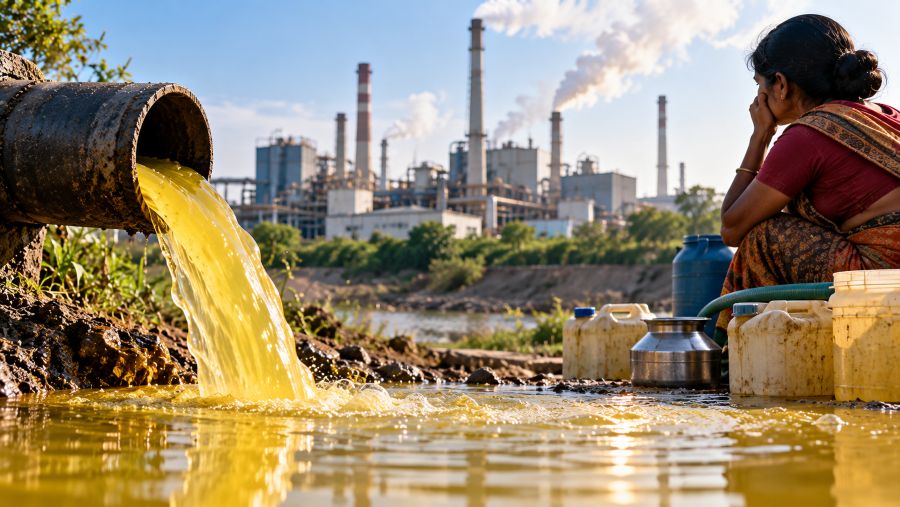
Today, India's diverse water landscapes tells a quieter, more unsettling story. In some villages, the memory of that relationship still holds. Elders speak about where runoff travels, which soil absorbs water, which slopes lose it. But the practice is thinning. Old tanks silt up without anyone clearing them. Borewells are sunk where open wells once sufficed.
The same pattern appears across regions. In Rajasthan, women carry water in clay pots. Across the country in coastal Tamil Nadu, the walk is the same, the distance is the same, the waiting is the same but the pots are plastic. The vessels have changed. The water story has not. Two regions, separated by language, landscape, and rainfall, are living the same story.
Across villages and towns alike, roads cut across natural drainage paths. Lakes survive without their catchments. Seasonal streams have been converted into construction sites. Borewells go deeper each year. Tankers have become routine not just in cities but in districts that once held water through careful local storage. None of it looks dramatic. That is the most unsettling part. It all looks normal.
A decade of such observations no longer requires interpretation. NITI Aayog's Water Budgeting in Aspirational Blocks report, released in November 2025, describes in plain administrative language what many parts of India have been quietly experiencing for years: a present-tense water deficit. In Abu Roadblock of Sirohi district in Rajasthan, groundwater is now being extracted faster than it can be recharged. In Sikkim's Namchi block, the water deficit stands at ninety-four percent. These are not cities. They are ordinary rural blocks that have crossed a hydrological threshold.
What makes the picture sobering is how geographically scattered such stressed regions are: coastal, Himalayan, Gangetic, plateau, arid. The thread running through them is not climate or terrain. It is a quieter pattern of ecological disconnection. In Chennai, a city once shaped by 474 wetland complexes, more than eighty-five percent have been degraded or vanished within three decades. In rural districts across the country, the same process shows up differently: dry wells, failed recharge, crops lost to rain that the land can no longer hold even when it arrives. The symptoms vary; the underlying condition does not. Floods and water scarcity now coexist in the same regions. Intense rainfall arrives, runs off, and leaves without becoming groundwater. The natural function of a landscape, to slow, absorb, and store rain, has been quietly lost.
Several factors are usually offered to explain this: climate change, population growth, agricultural demand, urbanization. All are real. But each rest on a deeper, less discussed condition: the fragmentation of how India thinks about water. This is not an entirely new condition. During the colonial period, British irrigation policies prioritized large canal systems and revenue-generating infrastructure while systematically neglecting local water bodies. The scale of what was lost can be seen in what was documented. In 1700, Mysore state alone had 39,000 ponds, maintained jointly by community and state. In 1763, when the British transferred those ponds from community hands to a newly created PWD department, the system that had functioned for centuries began to unravel. Land revenue reforms weakened the village institutions that had historically maintained these structures. Water management shifted from community stewardship to centralized government control. Post-independence India inherited and, in many ways, deepened that centralization. Today, forests, wetlands, floodplains, commons, groundwater, drainage, and land use are managed by separate departments with conflicting mandates. Ecology, however, does not function department-wise. A wetland erased for a road today shows up as a flood next monsoon and a dry borewell three summers later.
India's water policy has, for decades, leaned almost entirely toward supply: dams, pipelines, river-linking, deeper extraction. The Model Groundwater Bill, successive National Water Policy revisions, and the recent Water Data Policy of 2026 each gesture toward integrated, recharge-based thinking. Yet implementation remains scattered across agencies that rarely sit at the same table. Watershed logic, the understanding that water can only be managed at the scale of the landscape that holds it, still operates as an exception rather than a rule. Local communities, who carry the most precise memory of how their landscape holds water, remain at the periphery of decisions made about it. No engineering can substitute for a landscape that has lost its capacity to absorb rainfall.
Public discussions often reduce water conservation to individual behavior: shorter showers, closed taps, household awareness. These matter, but they can also distract from the harder structural truth. No community, urban or rural, can conserve its way out of ecological collapse if wetlands disappear, drainage is erased, and groundwater is extracted without recharge. Conservation, as publicly understood, has become a story about behavior. The harder story is about land.
India's water future may depend less on discovering new sources of water and more on recovering the ecological intelligence that development displaced. A country that once built an entire civilisation around reading its landscape for water can learn to do so again. The evidence that it works is not theoretical. Anupam Mishra documented that Jaisalmer district, the driest region in India receiving sometimes just ten effective days of rain per year, had 99.78 percent of its villages with clean drinking water, built entirely through community-maintained ponds, wells, and traditional structures, with almost no modern infrastructure. The most water-scarce geography in the country solved its water problem through local knowledge and collective responsibility. That is not nostalgia. That is a fact worth sitting with. The knowledge has not entirely disappeared. It lives in the memory of communities still reading their landscape, in the tanks that still function where someone chose to maintain them, in the watersheds that still recharge where the land has been left to do its work that knowledge has not entirely disappeared. It lives in the memory of communities still reading their landscape, in the tanks that still hold water where someone chose to maintain them. The question is not whether it can be recovered. It is whether the recovery begins before the memory runs too thin. Water rarely disappears suddenly. First, a landscape forgets how to hold it.