
CSR in Healthcare: Moving Beyond Funding Towards Sustainable and Measurable Impact
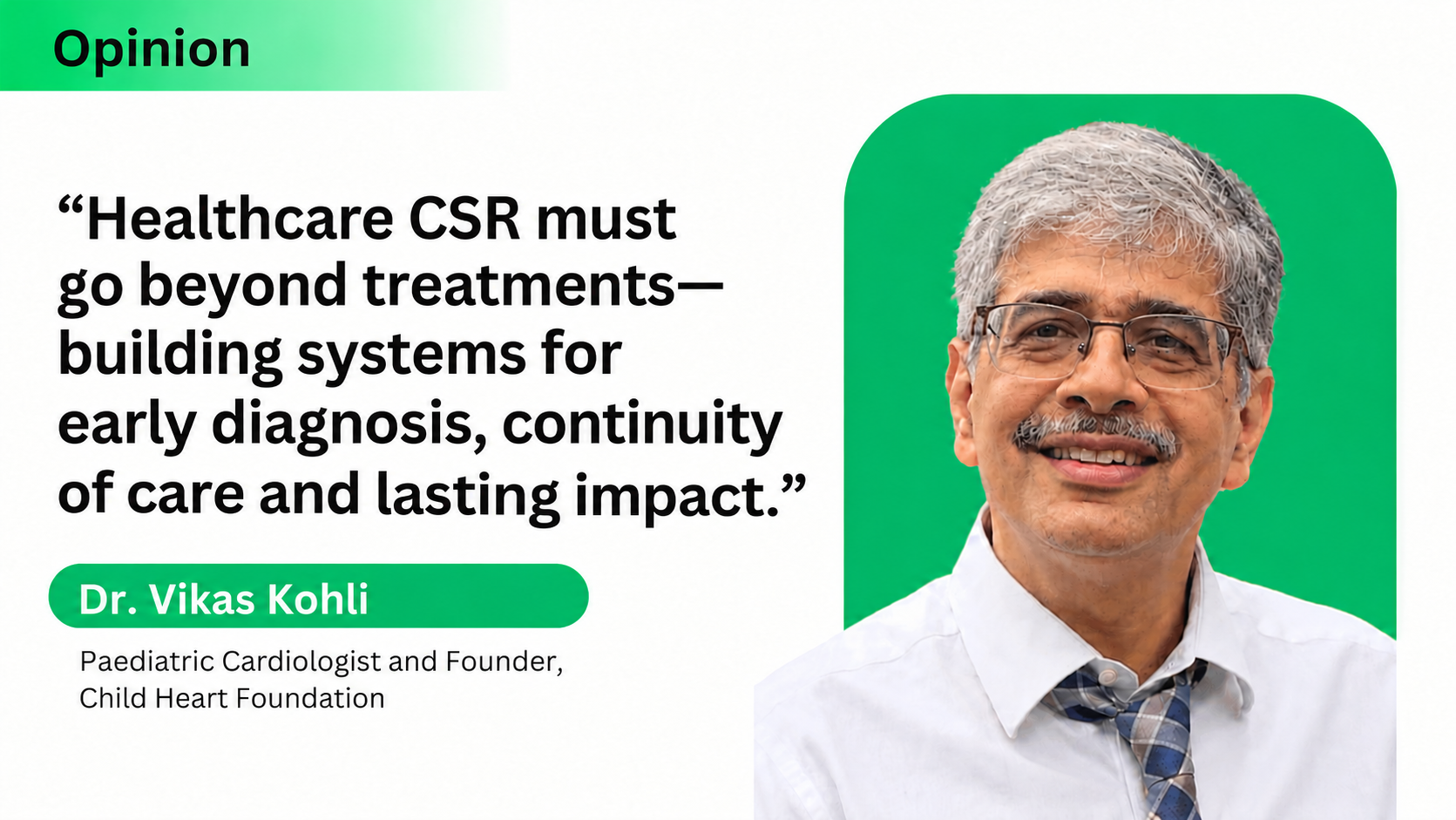
A surgery can save a child’s life, but sustainable healthcare impact demands more than a successful procedure. It requires early diagnosis, timely referrals, continued medical care and systems that support children as they grow. As India’s healthcare CSR investment expands, the focus must shift from counting interventions to assessing their long-term impact. In this article, Dr. Vikas Kohli, Paediatric Cardiologist and Founder, Child Heart Foundation, explores how stronger partnerships and outcome-based measurement can help make healthcare CSR more effective and sustainable.
Read on to know more:
Corporate India’s investment in CSR continues to grow, with healthcare and sanitation emerging as significant areas of corporate engagement. According to the Crisil CSR Yearbook 2026, CSR spending in India reached Rs 22,563 crore in FY25, with Rs 5,386 crore directed towards healthcare and sanitation.
These numbers reflect an encouraging commitment to social development. However, in healthcare, the true measure of CSR impact goes beyond the amount invested. It lies in whether that investment enables timely diagnosis, treatment, continuity of care and, ultimately, better health outcomes for the communities being served. This distinction becomes particularly important in paediatric healthcare, where delays in diagnosis and treatment can have lifelong consequences.
From Funding to Outcomes
An estimated two lakh children are born with congenital heart defects in India every year. A significant proportion require medical or surgical intervention early in life. Yet, many children continue to face barriers to timely care, particularly those from economically disadvantaged and geographically underserved communities.
The challenge is therefore not simply one of funding. It is also about creating pathways that enable funding to translate into accessible and sustained healthcare. Government hospitals provide an essential foundation for delivering affordable healthcare, but many operate under considerable capacity constraints. At the same time, private healthcare institutions may have the clinical capacity to provide specialised treatment but require sustainable mechanisms to support patients who cannot afford it.
For families, the journey can involve multiple barriers from limited access to diagnostic services and delayed referrals to lack of awareness and difficulty in navigating the healthcare system. This is where CSR can play a transformative role: not merely by funding individual procedures, but by helping build the systems and partnerships that enable a child to move successfully from identification to diagnosis, treatment and follow-up.
Redefining What Impact Means
Healthcare impact should not be measured only by the number of surgeries or treatments supported. For a child with congenital heart disease, treatment is an important milestone, but it is not necessarily the end of the healthcare journey. Children may require follow-up consultations, medication adjustments, monitoring of growth and development, and access to specialist care as they grow.
At the Child Heart Foundation, our experience has reinforced the importance of looking at the child’s journey as a continuum of care. Our engagement extends beyond the immediate treatment episode, with patients being followed up over the long term because a heart condition treated in infancy may still require medical attention during childhood and adolescence for CSR programmes, this calls for a broader definition of impact.
Impact can mean a child being identified through a screening programme in a district, receiving an accurate diagnosis closer to home, being successfully referred to an appropriate treatment centre, receiving timely intervention and continuing to receive follow-up care after treatment. It can also mean that a government hospital is left with stronger diagnostic capacity, healthcare professionals receive additional skills, and referral mechanisms continue to function after a CSR programme concludes.
Building Healthcare Systems, Not Just Projects
The most sustainable healthcare interventions are those that strengthen existing public health systems rather than operate in isolation from them. CSR can contribute by supporting diagnostic infrastructure within government hospitals, strengthening paediatric cardiac services, enabling referrals between districts and specialised centres, training healthcare professionals and building long-term partnerships with state health departments and other healthcare stakeholders.
Such interventions create value beyond the immediate project period. For example, an investment in a diagnostic facility can potentially benefit hundreds or thousands of patients over several years. Training a paediatrician can strengthen local diagnostic capacity. Establishing a functioning referral pathway can help ensure that children identified in one location are able to access specialised treatment elsewhere. This is where the distinction between expenditure and impact becomes important.
The question is not only: How much was spent and how many beneficiaries were reported?
It is also:
- How many children were identified early?
- How many reached appropriate treatments on time?
- How many completed their treatment journey?
- How many continued to receive follow-up care?
- What healthcare capacity was created or strengthened?
- What remains in place after the CSR funding cycle ends?
Measuring What Matters
As CSR in healthcare becomes more strategic, measurement must evolve alongside it. Traditional indicators such as the number of surgeries, camps or beneficiaries remain relevant, but they provide only part of the picture. Outcome-oriented monitoring can provide a deeper understanding of whether an intervention is creating sustained value. For healthcare CSR programmes, this could include tracking diagnosis-to-treatment timelines, treatment completion, follow-up adherence, geographical reach, healthcare capacity created, professionals trained and the continued utilisation of infrastructure supported through CSR.
Better measurement also enables corporates and implementing organisations to learn from their programmes, identify gaps and improve interventions over time.
For organisations such as Child Heart Foundation, this approach is particularly important because the objective is not simply to facilitate treatment for individual children, but to contribute to a healthcare ecosystem in which children can be identified earlier, referred appropriately and supported throughout their care journey.
The Next Phase of Healthcare CSR
India’s healthcare needs are complex, and no single stakeholder can address them alone. The government provides the public health infrastructure and policy framework; healthcare institutions provide clinical expertise; NGOs and civil society organisations often bridge access and implementation gaps; and corporates bring resources, innovation and the ability to support programmes at scale. The opportunity for CSR lies in bringing these strengths together through long-term partnerships.
For corporates evaluating healthcare programmes, the conversation can therefore move from “How many procedures did we fund?” to “What changed because of our intervention?”
Did more children receive timely diagnosis?
Did treatment become more accessible?
Was local healthcare capacity strengthened?
Did a referral pathway become more effective?
Did the intervention continue to create value after the grant period ended?
These are the questions that can help move healthcare CSR from funding individual interventions towards creating sustainable and measurable impact.
At Child Heart Foundation, we believe that the future of healthcare CSR lies in this shift from supporting isolated episodes of care to strengthening the continuum of care, from measuring expenditure to measuring outcomes, and from short-term projects to partnerships that build lasting healthcare capacity.
Ultimately, the success of healthcare CSR should be reflected not only in what was funded, but in the lives that were changed and the systems that became stronger because of it.