
Designing AI for 1.4 Billion Voices: Rethinking Inclusion in India's EdTech Future
As India accelerates towards an AI-powered economy, the question of inclusion is becoming increasingly difficult to separate from the question of opportunity. For millions of young Indians entering a rapidly changing world of work, access to technology alone may not determine whether they can participate in this future; language, relevance, digital trust and the ability to learn in familiar contexts could matter just as much. The conversation, therefore, needs to move beyond connectivity and infrastructure to how AI-enabled education and skilling are actually designed and delivered.
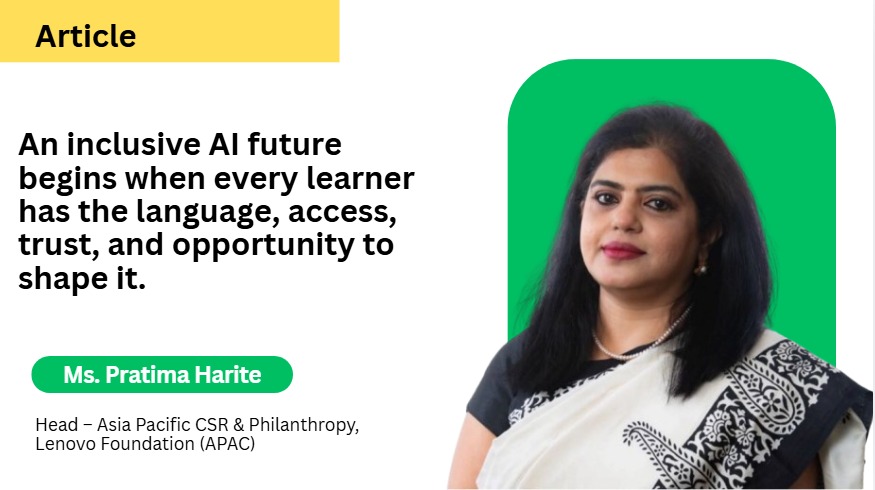
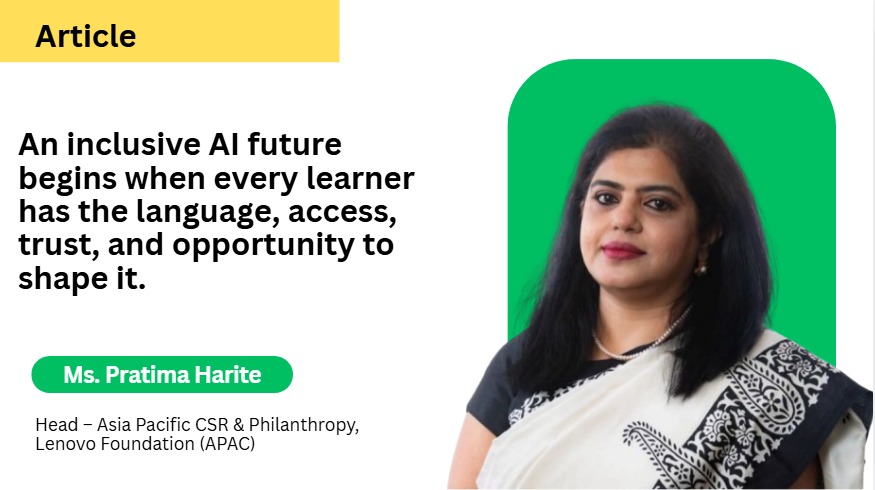
In this article, Pratima Harite, Head – Asia Pacific CSR & Philanthropy, Lenovo Foundation (APAC), examines what it would take to make India’s AI and EdTech ecosystem genuinely inclusive. She highlights the importance of language-first design, vernacular content, mobile-led delivery and responsible data practices, while arguing that India’s AI ambition must extend beyond building infrastructure to ensuring that learners across diverse linguistic and social contexts can understand, trust and create with the technology shaping their future.
India is home to the world's largest youth population, and it is also racing to become one of the world's most consequential AI economies. But speed and inclusion are not the same thing, and right now, India's AI story is being written almost entirely in one language, for one segment of its population. This World Youth Skills Day, the question worth asking isn't how fast we are building an AI-powered India. It's who we are building it for.
Consider this: only about 13% of India's 1.4 billion people speak English. Yet nearly every AI-led learning tool, curriculum, and skilling platform we build is designed in that language first. The remaining 87% includes a student in a Tier-2 town, a girl in a government school in Uttar Pradesh, a first-generation learner in a rural district. They aren't missing a smartphone. They're missing a language. And in an AI-first economy, language is fast becoming the new gate to opportunity.
For a while now, the conversation on AI in education has centred on infrastructure: internet access, device penetration, compute capacity. All of it matters, and India has made real strides here. The country's compute base under the IndiaAI Mission has grown past 38,000 GPUs, with another 20,000 announced this year. But infrastructure by itself is a road with no destination. What moves along it, the content, the language, the design choices decides who actually arrives. Infrastructure and democratization of AI is where we need language-first tools.
This is also the year India hosted the world at the AI Impact Summit in New Delhi, where the government's own framing for AI, laid out as the MANAV vision, placed being “accessible and inclusive” at its centre. The idea that AI must be a multiplier, not a monopoly shined through. The Summit's outcome documents point in the same direction: access without inclusion is an incomplete answer. For India's edtech and skilling ecosystem, that's a mandate as much as an aspiration.
Democratizing AI Means Starting With Language, Not Ending With It
India's linguistic diversity of more than 20 constitutionally recognized languages and hundreds of dialects is one of the country's great cultural assets. In an AI-led learning economy, it is also the most under-served design requirement. When AI tutors, assessment tools, and career-guidance platforms speak only in English, they exclude the majority from the very literacy that will define economic participation over the next decade.
The instinct has often been to solve connectivity first and content later. That arrangement is backwards. Mobile penetration in India has already outpaced fixed-line internet, and the platforms that have scaled fastest here, from payments to social media, did so by meeting people on the phones and in the languages they already use. AI learning tools can follow the same path: a WhatsApp-based chatbot delivering career guidance in a learner's own language, on a basic smartphone, will always reach further than an app most learners will never download. MentorMe Foundation's AI chatbot is a good example of this in practice: it already delivers career guidance in Hindi, Marathi, Kannada, and Punjabi in addition to English, with translation into other local languages currently underway.
This is where the infrastructure conversation needs to go a step further: it isn't infrastructure or democratization. It's both, and the sequencing matters. India's own BHASHINI platform, now supporting dozens of Indian languages across text and voice, shows that the building blocks for language-first AI already exist. What's missing is the discipline to design education products around them from day one, rather than retrofitting translation later. The National Education Policy 2020 and the IndiaAI Mission have both signaled this imperative clearly; the policy architecture is largely in place. The product and delivery architecture is still catching up.
Physical access paired with content that speaks the learner's language needs to come together. When that happens, native-language education stops being a compliance checkbox and starts expanding who gets to build AI, not just use it. A STEM curriculum available only in English draws India's next generation of AI talent from a narrow slice of the population. A vernacular-first one widens that pipeline considerably which matters for a country betting so heavily on becoming an AI creator, not just an AI consumer.
Inclusion Without Safeguards Is an Incomplete Promise
There is a second risk in the push to reach the next billion learners: treating inclusion and safety as separate workstreams. They are not. As AI tools move deeper into Tier-2 and Tier-3 India, often reaching first-time internet users and children on shared family devices, data privacy, consent, and security have to be built into the product from day one, not bolted on after scale.
For a rural learner accessing an AI tutor for the first time, questions about what data is collected and who can see it are not abstract policy debates. They are the difference between a tool that earns trust and one that quietly erodes it. Responsible AI for the 87% demands the same rigor on privacy and security that any enterprise deployment would require — arguably more so, given significantly lower digital literacy as a buffer. Vernacular-first design means nothing if the consent flow is in English, or if the data architecture wasn't built with that learner in mind.
Design for the 87%, Not the 13%
The real measure of India's AI ambition won't be the number of GPUs provisioned or the courses launched this year. It will be whether a first-generation learner in a village in Jharkhand can access, understand, and build with AI in their own language, on a device they already own, and trust that their data is safe while doing so.
Designing for 1.4 billion voices means accepting that English-first, infrastructure-only AI is a choice, one that quietly excludes the majority. Vernacular-first content, mobile-optimized delivery, responsible data practices, and AI-ready STEM education aren't nice-to-haves. They are the minimum standard for genuine inclusion.
India's youth are ready for an AI future. This World Youth Skills Day, the real question worth asking is whether that future is being designed for them in a language, on a device, and with safeguards, they can actually call their own.