The Bengaluru Impact Story: How Biocon Foundation Is Building Opportunity at the Last Mile
Bengaluru is known as India’s technology and innovation capital, a city that has powered economic growth and attracted talent from across the country. Yet beyond its technology corridors, the experience of the city is far less uniform. For many communities on its expanding peripheries and in low-income neighbourhoods, access to healthcare, education, mobility and basic urban infrastructure remains shaped by income, location, information and the ability to navigate public systems.
This makes Bengaluru an important setting for a larger development question: how can interventions move beyond delivering services to addressing the barriers that prevent people from accessing and benefiting from them?
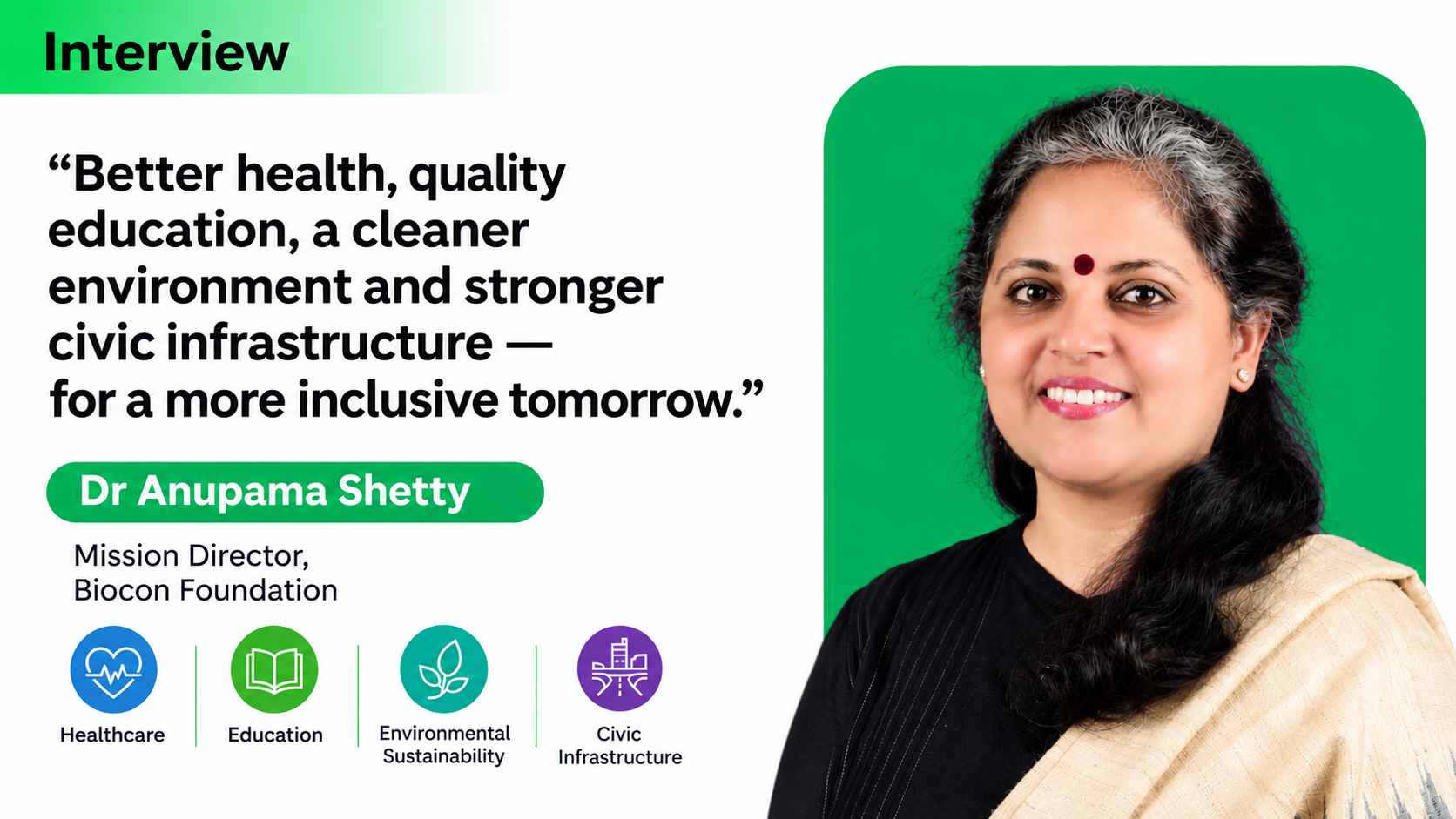
Biocon Foundation has taken a place-based approach to this challenge, working across healthcare, education, environmental sustainability and civic infrastructure. In this conversation, Dr Anupama Shetty, Mission Director, Biocon Foundation, discusses what last-mile access really means in an unequal city, how technology and community engagement can strengthen healthcare delivery, why impact must be measured beyond outputs, and what the organisation has learnt by adapting its programmes on the ground. She also reflects on whether a Bengaluru model can be relevant to other geographies without losing local ownership.
Scroll down to read the full interview:
Q. What does “last-mile access” mean within a city marked by sharp social and spatial inequalities?
A. Access means different things for different people, particularly in a city shaped by sharp social and spatial inequalities.
For an elderly retired couple in their 60s or 70s from a low-income household, access to
healthcare may depend on their children’s work schedules, household income, power relations, ability and willingness to spend, and several other socio-economic factors.
For a middle-aged woman working in one of the many small factories dotting Bengaluru’s industrial areas in the peripheries, access to a breast health evaluation would mean prioritising her health despite a rigid work schedule, taking time from household obligations, and, if a test is positive, navigating fear, uncertainty, referral pathways, and finally, debating the cost of an ultrasound or mammography.
We speak of foregone care in such contexts. Forgone care is not simply low utilisation of healthcare; it is the result of accumulated barriers to access.
Access can be understood as a multi-layered concept, operating across different points.
In a person’s journey to care. Early scholars such as Donabedian, and later Penchansky and Thomas, framed access in terms of the relationship between populations, health services and resources. Much of this literature examined supply-side dimensions such as availability, affordability, accommodation and acceptability. Levesque, Harris and Russell extended this understanding by placing the patient’s perspective at the centre, describing access as the ability to recognise a health need, seek care, reach services, obtain care and ultimately benefit from it. This framing is particularly useful in understanding last-mile access, because it reminds us that barriers are not only infrastructural; they are also informational, financial, social and navigational.
For our teams at Biocon Foundation, it has meant designing interventions around the lived realities of communities rather than expecting communities to navigate complex systems on their own. Our outreach teams have built an adaptive program with multiple components to reach low-income groups, across different age cohorts. The focus has been on population-based screening, as opposed to opportunistic screening, wherein our teams take healthcare to populations in different settings.
This is enabled through partnerships across institutions, self-help groups, small-size factories, CSOs, NGOs as well as directly reaching households in collaboration with local health workers. Using standard templates and point-of-care devices, the overall objective has been to ensure access, affordability, quality, dignity, continuity of care and connected care with superior clinical outcomes.
Q. How do health navigators, electronic medical records and AI-enabled diagnostic tools translate into better health-seeking behaviour and lower out-of-pocket expenditure?
A. Biocon Foundation’s community health outreach is anchored by a cadre of trained health navigators who combine social engagement skills with technical competencies in chronic disease management, screening protocols and digital health tools. Their role is not merely to identify individuals at risk, but to help them navigate what is often a fragmented and intimidating healthcare journey.
In many low-income communities, individuals may delay seeking care because of lost wages, household responsibilities, fear of diagnosis, lack of awareness, uncertainty about where to go, or concerns about cost. Health navigators address these barriers through repeated community engagement, risk communication, referral support and follow-up. Working alongside ASHA workers rather than creating parallel structures, they help bridge the gap between communities and formal healthcare services.
Electronic medical records have been equally important. Unlike episodic care, longitudinal records enable continuity across screening, diagnosis, treatment and follow-up. They allow our healthcare providers to track disease progression, medication adherence and patient outcomes over time.
AI-enabled tools have added a further layer of capability. In oral cancer screening, AI-assisted image analysis is helping frontline healthcare workers identify suspicious lesions earlier and prioritise referrals. Similar approaches in breast cancer and cardiovascular disease risk assessment have aided objective risk stratification. The objective is to augment frontline capacity, improve risk stratification and reduce delays in diagnosis and treatment.
Most importantly, the services provided through Biocon Foundation’s community health programs, including consultations, screening, diagnostics and medicines, are offered free of cost. As a result, the reduction in out-of-pocket expenditure is not only a consequence of earlier diagnosis and better referral pathways, but also of removing financial barriers that would otherwise prevent individuals from seeking care. Combined with active navigation support, this has enabled more timely healthcare utilisation, improved adherence to treatment pathways and better continuity of care.
An independent impact assessment undertaken by the Indian Institute of Management Bangalore found evidence of sustained engagement with care pathways, reflected in high rates of regular follow-up and continuity of care. More importantly, the assessment demonstrated improvements in disease control among patients with chronic conditions such as hypertension and diabetes, suggesting that patients were not merely accessing services but successfully managing their conditions over time. This distinction is important. The true test of our model is not whether a patient enters a system, but whether they remain in the system long enough for their condition to come under control.
Q. Why must healthcare, education, mobility and environmental sustainability be viewed as interconnected determinants of opportunity?
A. Development challenges rarely exist in isolation. A child’s educational attainment may be influenced by household income, parent’s education levels, the child’s own health, their gender and a host of associated issues. Access to employment may depend on safe and affordable mobility.
Community wellbeing may be shaped by environmental conditions such as waste management, air quality or water availability. We therefore view healthcare, education, mobility and environmental sustainability as interconnected determinants of opportunity. Progress in one domain often supports progress in another.
The WHO Commission on Social Determinants of Health (2008) famously concluded that “social injustice is killing on a grand scale”, highlighting how health and wellbeing are shaped by the conditions in which people are born, live, learn and work. This insight remains highly relevant to rapidly urbanising cities such as Bengaluru, where social, economic and environmental vulnerabilities often overlap.
This understanding has shaped Biocon Foundation’s place-based approach. Rather than pursuing disconnected interventions across multiple geographies, we have often chosen to work across multiple domains within the same communities over extended periods of time. The rationale is simple: people’s lives are lived as integrated realities rather than as separate sectors.
In the communities where we work, healthcare access may coexist with challenges related to education, environmental conditions or water security. By implementing programmes such as primary healthcare services, science education through mobile science laboratories, solid waste management initiatives, lake rejuvenation, rainwater harvesting as well as mobility initiatives within the same geography, we gain a more nuanced understanding of how these issues interact and influence one another. More importantly, it allows us to respond to multiple constraints that shape people’s opportunities and quality of life.
Q. How are government agencies, local communities and implementation partners involved in designing and sustaining programmes?
A. Like most CSR organisations, Biocon Foundation’s interventions are informed by needs assessments and consultations with a range of stakeholders, including local communities, implementation partners and government agencies. However, we view programme design not as a one-time exercise, but as an iterative process that continues throughout implementation.
Communities play an important role in shaping this process. In Biocon Foundation’s healthcare programme, for example, we organise a quarterly forum called Namma Arogya, Namma Maathu (Our Health, Our Voice), where members of our regular patient cohort come together for an informal breakfast interaction with the programme team.
These conversations provide valuable insights into their experiences, concerns and priorities, helping us identify issues that may not be evident through routine monitoring data alone.
Our implementation partners are equally central to programme design and delivery. Many have deep contextual knowledge and longstanding relationships within the communities where we work. Over the years, our partnerships have been built on trust, mutual learning and shared responsibility, with each partner contributing distinct expertise while working towards common objectives.
Engagement with government stakeholders is equally important. Whether in healthcare, education or environmental initiatives, we have found that programmes are more likely to be relevant, sustainable and scalable when they are aligned with local priorities and implemented with the support of public institutions. Seeking their guidance, incorporating their feedback and working within existing systems has therefore been an important part of our approach.
Ultimately, sustaining programmes requires more than financial resources. It requires ongoing dialogue, trust and a willingness to adapt. We have found that the most effective interventions are often those that are shaped continuously by the people and institutions that they are intended to serve.
Q. What metrics does the Biocon Foundation use to distinguish activity from measurable social impact?
A. Distinguishing activity from impact is an ongoing challenge in the social sector. While activities such as screenings conducted, clinic visits or referrals generated are important, they do not necessarily tell us whether people are receiving better care or experiencing better outcomes.
Over time, Biocon Foundation’s measurement frameworks have evolved from tracking activities to assessing quality of care, patient experience and clinical outcomes.
In Biocon Foundation’s primary healthcare programme, eLAJ, for example, we introduced process-of-care indicators to assess whether patients with chronic conditions such as hypertension and diabetes were receiving recommended standards of care, including regular consultations, monitoring and complication screening. We subsequently incorporated Patient Reported Outcome Measures (PROMs) to better understand patients’ experiences of care and, more recently, added clinical outcome indicators to assess whether patients were actually achieving disease control over time.
Independent assessments found evidence of regular follow-up, continuity of care and improved disease control, suggesting that healthcare utilisation was translating into meaningful health outcomes.
Biocon Foundation’s approach to referrals has evolved similarly. We initially measured referrals generated and tracked. Today, we place greater emphasis on referral-loop closure, namely whether an individual successfully completes the pathway from screening to consultation, diagnosis and follow-up. This provides a far more meaningful understanding of whether access is translating into care.
Beyond healthcare, we have sought to understand impact in ways that extend beyond immediate program outputs. Our longitudinal assessment of Bengaluru’s Yellow Line, undertaken with IISc Bangalore, examined not only mobility and environmental parameters but also changes in physical activity, mental wellbeing, social connectedness and overall quality of life. The study found that travel wellbeing and general wellbeing were among the strongest determinants of quality of life, illustrating how investments in public transport can influence wellbeing in ways that are often overlooked by conventional infrastructure metrics.
Ultimately, we have found that meaningful impact measurement is an evolving and iterative process, rather than a framework fixed in time. This continuous process has helped us elicit rich perspectives, strengthen program design and improve on our services.
Q. Which interventions required course correction, and what did those experiences teach the organisation?
A. Many of our programmes have evolved significantly over time, often in response to realities that only become apparent during implementation. These experiences have reinforced our belief that programme design is not a one-time exercise but an ongoing process of learning and adaptation.
Biocon Foundation’s primary healthcare programme, eLAJ, is a good example. While it began as a clinic-centric model, we gradually recognised the need for a stronger community outreach component, particularly as we expanded into remote tribal geographies.
In several locations, tribal hamlets were dispersed, difficult to access and, in some cases, not adequately served by existing frontline health workers. This led us to develop the Health Navigator model, wherein local tribal youth were identified, trained and equipped with mobility support and screening tools to serve as a bridge between their communities and the healthcare system. Their familiarity with local contexts, languages and social dynamics proved invaluable in extending access to care.
We have seen similar lessons emerge elsewhere. In one aspirational district, for example, we found that strengthening healthcare services alone was insufficient. Increasing utilisation of nearby public health facilities required sustained community engagement, awareness generation and follow-up. This reinforced an important lesson: service availability does not automatically translate into service utilisation. Trust, awareness and community participation are equally important.
The need for adaptation has not been limited to healthcare. Several of our education initiatives have also evolved in response to feedback from students, teachers and implementation partners. These experiences have highlighted the importance of remaining receptive to perspectives from the field and recognising that those closest to communities often have the clearest understanding of what is working and what is not.
More broadly, these experiences have strengthened our belief in distributed leadership. Our implementation partners are not simply delivery agencies; they bring deep contextual knowledge and play an important role in shaping programme strategy and implementation. Many of our most meaningful improvements have emerged from their observations and recommendations.
Q. Can Bengaluru’s place-based CSR model be replicated elsewhere without losing local relevance or community ownership?
A. I believe a place-based approach is highly replicable, although the specific interventions will differ across geographies. The strength of the model lies in its ability to create the conditions for deeper engagement, long-term partnerships and collective action around shared challenges. By working within a geography over an extended period, organisations can better understand local realities, build trust and develop a network of collaborators capable of sustaining momentum for change.
At the same time, community ownership cannot be assumed, particularly in peri-urban settings where populations are often heterogeneous, have poor social cohesion and are rapidly changing. In such contexts, the objective is not to prescribe solutions but to remain responsive to local priorities and aspirations as they emerge. What is replicable is therefore not a specific program portfolio, but an approach rooted in long-term commitment, collaboration, adaptation and local relevance.

.png)