
Sony India: Advancing CSR Through Technology, Skills and Sustainable Community Empowerment
The measure of corporate social impact is increasingly shifting from the scale of support delivered to the agency it creates among communities. Skills that translate into employment, assistive technologies that enable greater independence, and digital interventions that build confidence point towards a model of CSR centred on capability, dignity and long term participation.
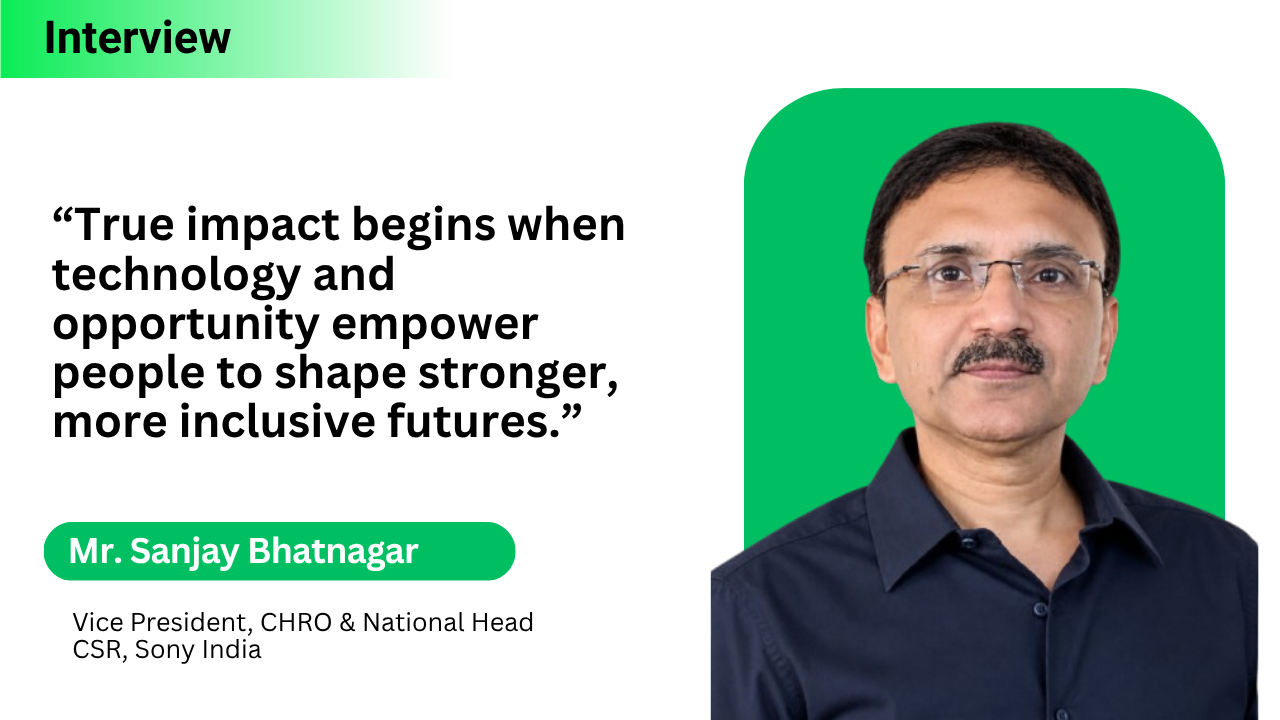
For Sony India, this approach is closely linked to its technological strengths while keeping community needs at the centre of its interventions. From employability and technology enabled education to disability inclusion, biodiversity conservation and heritage preservation, the company is seeking to connect innovation with grassroots development. In this conversation, Mr. Sanjay Bhatnagar, Vice President, CHRO & National Head CSR, Sony India, discusses the principles shaping the company’s social impact strategy, the importance of moving beneficiaries from recipients to active participants, and the role of partnerships, measurable outcomes and technology in building more sustainable pathways to empowerment.
Scroll down to read the full interview:
Q. CSR is increasingly moving from philanthropy and welfare towards creating systems that enable people to become more independent and resilient. How does Sony India define meaningful social impact today, and what principles guide the company when deciding where its CSR resources can create the greatest long-term value?
A. For us, meaningful social impact is about creating something that lasts. We therefore look at initiatives that can create long-term benefits for communities, rather than one-time support.
A key focus is empowerment and skill building. The objective is to help people become more independent and create opportunities for themselves. Our work with women through Skill Centres and workshops, for instance, is aimed at developing skills and encouraging rural entrepreneurship.
The other important consideration is how we can bring Sony’s own strengths into our CSR work. In line with our global theme, “For the Next Generation” we look at how technology, our products and the involvement of our employees can add greater value to the communities we work with.
So, when we look at where our CSR resources should go, the focus is on sustainability, empowerment and building capabilities that can continue to create value over the long term.
Q. Sony is fundamentally a technology driven organisation, yet its CSR portfolio spans livelihoods, education, disability inclusion, healthcare, community development, environmental conservation and heritage. How do you bring the company’s technological identity into social impact without allowing technology to overshadow the human and grassroots dimensions of development?
A. Technology, in our view, should be an enabler. It should help people, but it cannot replace the understanding of what people and communities actually need. That is also consistent with Sony’s Purpose which is “to fill the world with emotion, through the power of creativity and technology” and our global CSR theme, “For the Next Generation.”
As a technology company, we have strengths that can be applied across different areas of social impact. Whether it is livelihoods, disability inclusion or heritage, technology can help create opportunities and support change at the grassroots level.
But the starting point has to remain the people. Technology should support their needs, protect their dignity and respect the local context. That balance is important to us.
Q. Several of Sony India’s programmes appear to focus on enabling rather than merely providing, whether through employability training, assistive technology or technology enabled education. How important is the shift from beneficiaries being recipients of support to becoming more independent participants in the social and economic ecosystem?
A. I think that shift is very important. The traditional approach was often about providing support, whereas the larger opportunity today is to help people become more independent.
That is the thinking behind many of our CSR initiatives. Through employability training, assistive technology and technology-enabled education, we are trying to move from a charity-led approach towards sustainable empowerment.
Whether it is giving someone skills that can help them find employment, providing technology that enables greater participation, or helping children learn through technology, the objective is to give people the ability to participate more actively and independently in the social and economic ecosystem.
Q. Partnerships with organisations such as IGF India, NIIT Foundation, Jaipur Foot, Blind Vision Foundation and SHEOWS form an important part of Sony India’s CSR approach. What does Sony look for in an implementation partner, and how do you ensure that these partnerships contribute to sustained impact rather than becoming limited to project based delivery?
A. The first thing we look for is the partner’s expertise and whether it is relevant to the area we want to work in. Different organisations bring different strengths, for example, education through the NIIT Foundation, healthcare through Jaipur Foot, COVID care support through Impact Guru Foundation and elderly care through SHEOWS.
Equally important is their understanding of the communities they work with. We prefer partners who are closely connected with the local population because they are better placed to understand the actual needs on the ground and also have the necessary regional acceptance.
We also look closely at how the work is tracked. Our CSR partners follow defined tracking methodologies and transparent governance processes, which help us monitor the work and ensure compliance with CSR regulations.
So, for us, it is not just about delivering a project. It is about having the right expertise, community connect, tracking and governance in place.
Q. The Sony Gyan Setu programme at Poornima University trained 222 students in its inaugural year and reported a 96% placement rate, with 30% of seats reserved for women and differently abled candidates. What have you learned from the programme about aligning CSR funded skilling with actual industry demand, and how do you see this model evolving or scaling in the coming years?
A. This flagship SID CSR initiative at Poornima Institute of Engineering & Technology (PIET) goes beyond skilling, it creates a pathway from aspiration to meaningful employment. Its inaugural success offers an inspiring blueprint for how corporate social impact can be both purposeful and measurable. Instead of taking a one-size-fits-all approach to technical training, the program is designed around real gaps in the service economy, particularly the persistent need for entry-level talent in sectors such as Healthcare and Retail. Sony India is also opening 2 more skill centres in Uttar Pradesh in FY26 for young children for grass root skill enhancement which is need of hour.
This flagship SID CSR initiative at Poornima Institute of Engineering & Technology (PIET) bridges skilling with meaningful employment by addressing talent gaps in sectors such as Healthcare and Retail. With nearly one-third of opportunities reserved for marginalized and diverse groups, it offers a purposeful model for inclusive growth and measurable social impact.
Q. Sony India’s work with persons with disabilities combines physical mobility support through Jaipur Foot with technology enabled solutions such as AI, machine learning and machine vision based smart glasses. How do you assess whether such interventions are translating into greater independence, dignity and participation in everyday life, rather than simply providing access to an assistive device?
A. The real measure of impact lies far beyond the number of devices placed in people’s hands. A device may open the door to access, but truly human-centric progress begins when technology becomes a natural part of how people express themselves, connect with others, and participate in their communities, empowering not just access, but belonging, possibility, and meaningful change.
Q. The Hole in the Wall programme reached 7,221 learners in underserved communities, while Sony India’s wider education and skilling initiatives address both digital access and employability. From your experience, what are the deeper barriers that continue to prevent technology from translating into genuine educational and livelihood opportunities for underserved communities?
A. Initiatives like the Hole in the Wall programme and Sony India's digital safety and skilling projects create opportunity, but access alone is not enough. Lasting impact comes when learners gain the skills and confidence to move from consuming technology to creating, innovating, and generating value. Under these projects, needy children learn how to navigate interfaces, watch videos, or use basic applications for their skill enhancement.
Q. Sony India’s CSR portfolio extends beyond conventional education, healthcare and livelihoods to biodiversity conservation at Elephanta Island and heritage protection in Haridwar. What is the thinking behind investing in environmental and cultural assets alongside human development, and how do you evaluate the social value of these less immediately measurable interventions?
A. Sony India supports long-term community sustainability by investing in people, nature, and heritage. Initiatives such as biodiversity conservation at Elephanta Island protect vital ecosystems, while cultural preservation in Haridwar strengthens local identity, tourism, and livelihoods. In addition, Sony India is also ISO-14001 certified organization taking care of Environment aspects since more than two decades & we also align our CSR outcome with Sony HQ’s "Road to Zero" environmental and social framework as well.
Q. Looking across Sony India’s FY25 interventions, including 1,419 artificial limbs and mobility aids, support for 83 COVID affected families, 222 students trained through Sony Gyan Setu and 7,221 learners reached through Hole in the Wall, what do the company’s internal assessments tell you about the scale, reach and outcomes of its CSR portfolio? Which impact indicators are becoming increasingly important to Sony beyond beneficiary numbers?
A. Our FY25 review tells us that the focus of our CSR programmes is not simply on how many people we have reached, but on what difference the intervention has made to them.
For example, through the Jaipur Foot initiative, the objective is to help beneficiaries become more independent and, wherever possible, return to work. Under the Sony India Sanjeevani Programme, healthcare support and educational scholarships were provided to families affected by COVID, with careful checks carried out before beneficiaries were selected. Sony Gyan Setu is another good example. The programme trained students in vocational skills, and more than 96% of the students were successfully placed in jobs in and around Jaipur. Similarly, the Hole in the Wall programme reached needy children in underserved communities and helped address the digital divide by giving them an opportunity to use technology and learn independently.
So, beyond beneficiary numbers, we increasingly look at outcomes such as independence, livelihood opportunities, employment and the ability to learn independently. Those are important indicators of whether the support is actually making a difference.
Q. As Sony India looks ahead, where do you see the next frontier of its CSR strategy? In particular, are there areas where the company intends to deepen existing interventions, replicate successful models such as Sony Gyan Setu, or use technology and cross sector partnerships to address social challenges at a significantly larger scale?
A. As Sony India plans the next phase of its Corporate Social Responsibility (CSR) journey, the focus is on creating meaningful and lasting impact. The aim is to move beyond local initiatives and build programs that can grow through technology and strong partnerships. Inspired by the global promise, "For the Next Generation," Sony India continues to focus on sustainable initiatives that empower communities, create opportunities and support long-term economic well-being.