Regaal Resources: Building Pathways to Education, Women’s Empowerment and Sustainable Livelihoods
Social investment is most effective when it addresses the interconnected barriers that limit communities’ ability to achieve lasting social and economic progress. In regions where access to education, healthcare, livelihoods and basic infrastructure shapes long term opportunity, CSR has a critical role to play in strengthening local capabilities and enabling greater self reliance.
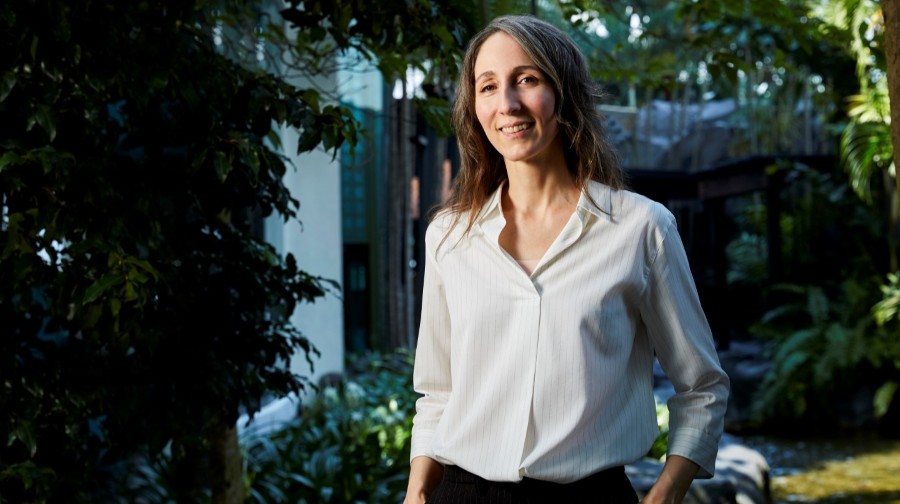
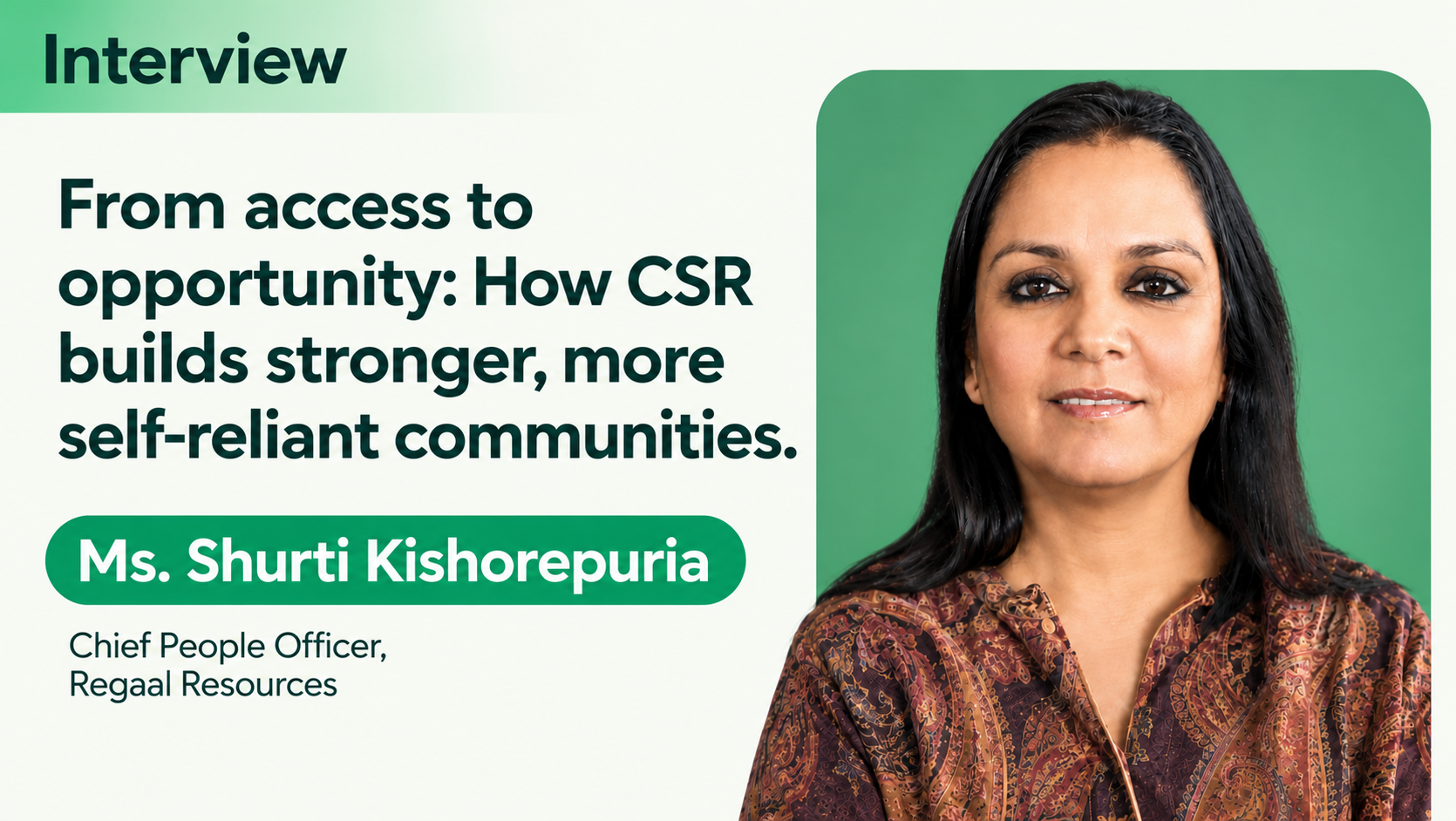
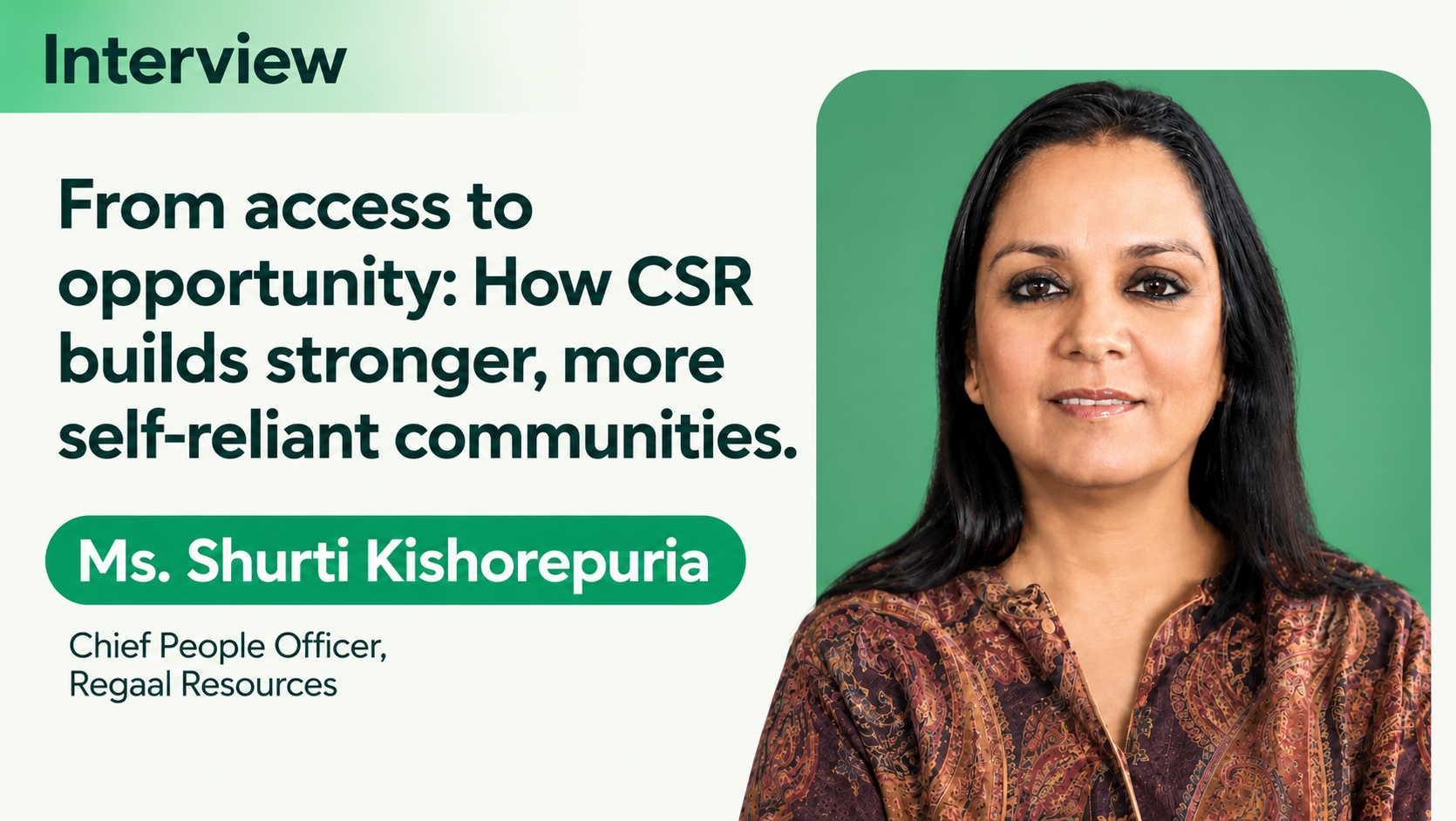
At Regaal Resources, this approach is reflected in initiatives spanning girls’ education, women’s skilling, rural livelihoods, healthcare and essential community services, with a focus on communities in Bihar and West Bengal. In this interview, Ms. Shurti Kishorepuria, Chief People Officer, Regaal Resources, discusses how integrated social interventions can expand economic opportunities, why sustained community engagement matters more than the scale of individual projects, and how CSR impact must ultimately be assessed through lasting improvements in educational progression, household resilience and women’s economic agency.
Scroll down to read the full interview:
Q. CSR is increasingly being viewed as a means of strengthening community capabilities rather than simply addressing immediate welfare needs. From your experience, what does meaningful social investment look like in a development context such as Bihar, where education, livelihoods, migration and access to basic services are closely interconnected?
A. In a development scenario like Bihar, social investment needs to consider education, gender equality & women empowerment, healthcare & sanitation including hunger, poverty & malnutrition and rural development & environmental sustainability as one interconnected ecosystem rather than isolated problems. We have tried to build an approach that reflects this.
Our projects span education including building women’s wing at the Marwari College, supporting construction of the residential school for girls called Adhigam Bhoomi.Women’s empowerment, healthcare, rural developmentand environmental sustainability, all concentrated in Bihar and West Bengal, the area of our operation. Meaningful investment here means enabling conditions such as setting up an environment through investments in school infrastructure, technology-based learning solutions, provision of clean drinking water, health care, and livelihood solutions. So that a girl who stays in school can later access skills, jobs or entrepreneurship instead of migrating far away from home out of necessity. By anchoring interventions near Kishanganj facility and in nearby districts, We ensure that CSR is not a distant charity but part of the local economic fabric, strengthening community capabilities to absorb shocks and participate in growth.
Q. For businesses operating in emerging regions, there is often a question of whether CSR should respond primarily to immediate community needs or invest in the foundations for long-term economic mobility. How does Regaal Resources strike this balance while deciding its CSR priorities?
A. Corporate Social Responsibility should cater to both the immediate needs of communities and the foundations of sustainable economic mobility in the regions where a business operates. We are trying to address both aspects by focusing on interventions that respond to immediate needs, including access to clean drinking water through the Chowrangee Rotary Trust, sanitation and hygiene support through UHS School in Kishanganj, support for SahomormiOld Age Home and animal welfare through Chayya, while also working towards education through UHS School and Help Us Help Them, women’s empowerment through Apni Kutir and Marwari College for Girls, and alternative livelihoods through Apni Kutir’s livelihood and skill-development initiatives. Our long-term objective is to improve the quality of life of the communities we serve through long-term value creation for all stakeholders.
Q. Regaal Resources’ CSR portfolio spans education, women and girl child empowerment, healthcare, rural development and basic infrastructure. What has your experience taught you about the importance of addressing these issues together rather than treating them as separate CSR verticals?
A. Our focus areas are intertwined and complement each other. Education, women and girl-child empowerment, healthcare, rural development, skill development/entrepreneurship and basic infrastructure, these reflect a core insight, that these issues reinforce each other and cannot be solved in silos. A girl’s continued schooling depends on family income, health, safe transport and social norms around gender; rural livelihoods depend on education, market access and environmental sustainability. By supporting a residential school for 1,200+ girls, a women’s wing at Marwari College, rural education and upliftment in Sunderbans, clean-water projects across cities, rehabilitation centres, animal welfare and care for old & disabled people , we are addressing multiple constraints simultaneously. This integrated approach increases the likelihood that beneficiaries can convert one gain into another: a girl who completes school can access upskilling (such as Apni Kutir, Adigham Bhoomi and Help Us Help Them), which in turn improves household income and decision-making power, enabling the next generation to stay in education. Treating these as separate verticals would dilute impact; together, they create a virtuous cycle of social and economic mobility.
Q. Education is often presented as the foundation of social mobility, but access to education alone may not translate into economic opportunity. How can corporate interventions in education be designed to create a longer pathway towards skills, employability, confidence and eventually greater economic participation for young people in Bihar?
A. Education can be a strong foundation for social and economic mobility when supported by digital access, practical skills and opportunities. We have renovated a public school in Kishanganj with smart classrooms and computer labs to improve access to technology-enabled learning for students in the region. This focus is complemented by initiatives such as Apni Kutir, which supports women through skilling and livelihood opportunities. Together, these efforts reflect our approach to strengthening education while creating pathways towards greater confidence, skills, technological advancements and economic participation, helping communities build capabilities that can support better opportunities and sustainable livelihoods over the long term.
Q. Women’s empowerment sits prominently within Regaal Resources’ CSR approach, including Apni Kutir, through which around 800 women are upskilled every year. What have you learned about the conditions required for women’s skilling to translate into sustained livelihoods and greater decision-making power within households and communities?
A. Women’s skilling can translate into sustained livelihoods and greater decision-making power when it is supported by market-relevant skills, access to finance and market linkages, social support within households, and safe and flexible working environments.
Through Apni Kutir, we support around 800+ women annually with skills that can translate into local or home-based livelihoods. We believe skilling must be accompanied by access, confidence and opportunities to help women turn these capabilities into sustainable income. Our wider CSR efforts across girls’ education, healthcare and rural infrastructure also address barriers that can affect women’s participation in the workforce. By enabling greater economic independence, we aim to create benefits that extend beyond individual women to their families and communities.
The focus, therefore, is not simply on providing skills but on creating the conditions in which those skills can generate sustained livelihoods. Connecting Apni Kutir graduates with local demand, raw materials, market platforms and continued mentorship can help women move from training to income generation and, ultimately, greater agency within their families and communities.
Q. Regaal Resources has supported initiatives ranging from a women’s wing at Marwari College to a residential school for girls, rural education and the renovation of a public school with smart-classroom and computer-lab facilities. How do you evaluate whether investments in educational infrastructure are actually improving learning outcomes and expanding future opportunities for beneficiaries?
A. For us, the success of an education initiative is measured by the difference it makes to students, not simply by the infrastructure created. Our initiatives range from supporting the women’s wing at Marwari College and a residential school for girls to rural education programmes and the renovation of a public school in Kishanganj with smart classrooms and computer facilities. Given the varied needs of each community, we assess impact through indicators such as enrolment, attendance, retention, digital engagement and progression to higher education or vocational courses. Feedback from students, teachers and implementation partners also helps us understand what is working and where support needs to evolve. This approach ensures that CSR investments remain focused on meaningful learning and opportunity.
Q. Regaal Resources has also supported rural livelihood interventions, including plantation of more than 1,000 fruit trees aimed at increasing farmer income. What is your perspective on CSR’s role in strengthening rural economic resilience, and how can companies ensure that livelihood interventions create durable income rather than remain project-dependent?
A. Rural livelihood programmes create a lasting impact when they strengthen the productive capacity of a community and give families an asset that can continue to generate value over time. This is an important consideration for us when evaluating livelihood-focused CSR interventions.
The plantation of more than 1,000 fruit trees in a village near Bolpur District, West Bengal reflects this approach. Beyond the immediate act of plantation, such an initiative creates a long-term community asset that can contribute to household incomes while also encouraging greater diversification of rural livelihoods. Fruit-bearing trees can provide returns over multiple years and, when managed collectively, can become an additional source of economic activity for the village.
The larger objective is to support communities in building greater self-reliance rather than creating dependence on continued intervention. This requires attention to what happens after the initial project, including how the assets are maintained, how communities participate in their management and how the economic benefits are sustained.
Q. Your CSR work also extends to healthcare, sanitation, access to clean drinking water and support for vulnerable groups, including children with disabilities. How do you determine which gaps require direct corporate intervention and which are better addressed through partnerships with local organisations and community institutions?
A. The starting point is to understand the nature of the need and what is required to address it effectively over the long term. Where the need is closely connected to the communities around our operations, we can take a direct role through initiatives such as improving access to drinking water, sanitation and community infrastructure. Our proximity also allows us to stay closely connected to the outcomes of these interventions.
In areas such as healthcare, disability support, education and care for vulnerable groups, specialised organisations can bring valuable expertise and established community relationships. We therefore work with partners such as Vaani Deaf Children’s Foundation, Katakhali Swapnopuron Welfare Society, Project Potential and Future Hope Foundation where their experience can strengthen the impact of our efforts. Our approach is to choose the model that best suits the need, whether through direct intervention or the right partnership.
Q. Regaal Resources has described its CSR corpus as relatively small and says its projects are undertaken under the guidance of its CSR Committee and CSR Policy. How does working with a focused CSR corpus influence your approach to prioritisation, partnerships and depth of impact? Could a smaller but sustained intervention sometimes deliver greater value than spreading resources across a larger number of beneficiaries?
A. A focused CSR corpus brings an important discipline to decision-making: every intervention has to have a clear reason for being there. The objective cannot be to maximise the number of projects or beneficiaries simply to demonstrate reach. It is more important to identify areas where sustained support can address a meaningful need and where we can remain engaged long enough to see the intervention mature.
The CSR Committee and CSR Policy provide the framework for making these choices, while the needs of communities around the company’s areas of operation help determine the priorities. This naturally means selecting fewer initiatives where there is a stronger case for sustained engagement, rather than distributing resources too thinly across multiple causes.
The same principle applies to partnerships. A long-term relationship with an organisation that understands the local context can often create more value than repeatedly supporting new projects without continuity. It also gives us the opportunity to learn from what is happening on the ground and refine its approach over time.
A smaller corpus should not be seen simply as a limitation. It can be a reason to be more intentional about where the company chooses to show up. In CSR, the measure of commitment is not how many initiatives carry a company’s name, but whether its presence continues to matter after the initial contribution is made.
Q. Ultimately, should the success of CSR in Bihar be measured by the number of beneficiaries reached, the infrastructure created and the programmes delivered, or by what communities are able to achieve several years after the intervention? Based on Regaal Resources’ experience, what 2-3 measurable outcomes or indicators would you use to demonstrate that CSR is genuinely contributing to long-term social and economic mobility?
A. The number of beneficiaries reached or projects completed is useful for understanding the scale of a CSR programme, but it does not by itself establish whether lives have changed. The more meaningful question is what remains possible for a community several years after the intervention.
For us, three indicators would be particularly relevant. The first is economic resilience: whether beneficiary households are able to generate more stable incomes and build productive assets rather than remain dependent on one-time support. The second is educational progression: whether children, particularly girls, are staying in education for longer, progressing to higher education or vocational pathways, and gaining capabilities that improve their future choices. The third is greater economic agency for women: whether women who receive skilling support are able to sustain income-generating activities and exercise greater participation in household financial decisions.
These indicators also need to be viewed over time rather than at the point of project completion. A CSR intervention is genuinely successful when its benefits begin to sustain themselves within the community. The strongest evidence of impact is when a family no longer needs the intervention that helped it take its first step.



.png)