
Oxford International India: Making Local Partnerships and Employee Participation Central to CSR
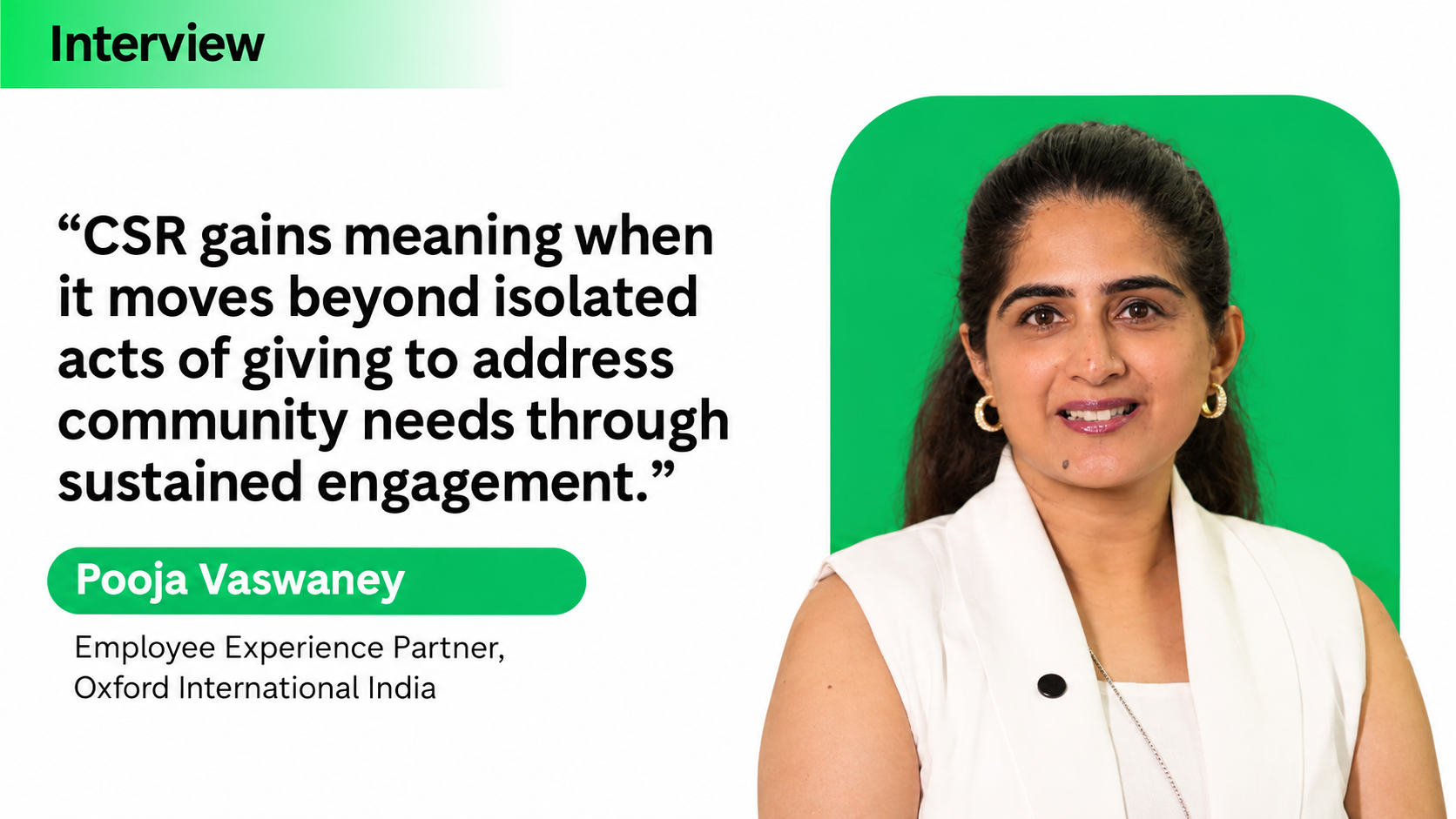
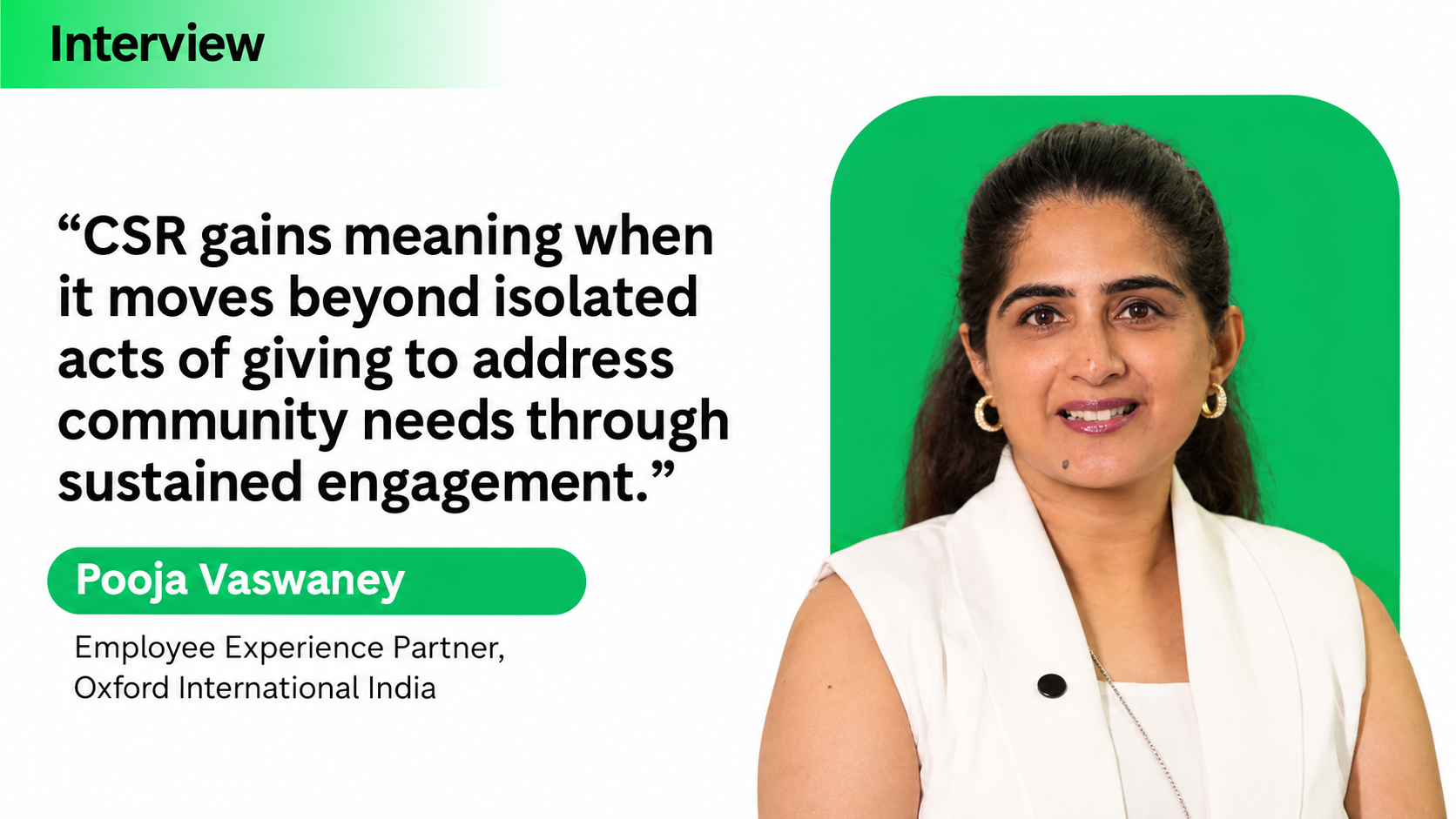
Corporate social responsibility gains meaning when it moves beyond isolated acts of giving to address community needs through sustained engagement. Whether supporting children navigating critical illness, improving school environments, mobilising essential supplies or responding to local environmental concerns, effective interventions depend on understanding the people they seek to serve and enabling employees to contribute beyond the workplace.
Through its Momentum initiative, Oxford International India is exploring how local partnerships and hands-on participation can shape a more responsive approach to community engagement. Pooja Vaswaney, Employee Experience Partner at Oxford International India, discusses the role of beneficiary-led support, employee volunteering and evidence-based interventions in strengthening the organisation’s CSR approach, alongside the challenge of turning individual activities into sustained community impact.
Scroll down to read the full interview:
Q. For the Make-A-Wish India initiative, how did Oxford International determine what forms of support would be most meaningful to children and families navigating critical illness, particularly when their needs extend beyond medical care?
A. Our starting point was to recognise that when a child is undergoing treatment for a critical illness, their world can become centred around hospitals, appointments and medical care. A meaningful intervention therefore needs to look beyond the illness and recognise the child as an individual—with their own interests, relationships, ambitions and dreams.
That is why our partnership with Make-A-Wish India was particularly important. Rather than deciding what children should receive, we worked through Make-A-Wish India's established wish-granting process, which places the child's own wish at the centre of the experience. This allowed the support to be personal and relevant to each child.
Between January and July 2026, Oxford International supported 100 wishes for children across 10 states, working through 17 hospitals and care partners. Forty-two of those wishes were delivered through Tata Memorial Hospital in Mumbai. (Oxford International Education Group)
What was particularly striking was how many wishes connected back to everyday life. 98 of the 100 wishes were for a phone, laptop or tablet. These were not simply technology donations; for many children, they represented a way to stay connected with parents, siblings, friends and school while treatment disrupted normal routines. Other wishes reflected deeply personal aspirations—for example, becoming a doctor for a day or meeting a chess hero. (Oxford International Education Group)
We also went one step further to encourage the team to look for children looking to learn a new skill, build knowledge and grow despite their present circumstances, aligning this with the OIEG belief in Learning Without Limits. For us, it reinforced an important principle: meaningful CSR does not always mean providing something extraordinary. Sometimes it means helping restore a sense of normality, connection, choice and possibility at a time when a child's world has become very restricted. This was highly apparent as our team members visited the Make-A-Wish office on multiple occasions, engaging with both the parents and children showcased to us that doing something as simple as dancing, listening to music or a little art and craft brought small joys in the chaos of their everyday and presently challenging everyday lives.
Q. What did the Make-A-Wish India initiative reveal about the potential of CSR to support continuity in education, family connection and personal aspirations during a child’s treatment journey?
A. The initiative showed us that CSR can play a role in protecting the parts of childhood that illness can interrupt – bringing the bounce back into their step, a smile on their face and a little hope in their hearts.
Education was an especially meaningful dimension for Oxford International. As an education organisation, we understand the importance of children being able to continue learning and pursuing their ambitions, even when circumstances make that difficult. A laptop or tablet can therefore become much more than a piece of technology—it can be a connection to school, teachers, friends and the child's sense of progress. This helps build the child’s confidence, sense of connection with their peers and has a knock-on effect to their betterment, health and wellbeing.
At the same time, the wishes highlighted the importance of family connection. A phone could allow a child to remain connected to loved ones, while the experience of fulfilling a wish created something positive for the entire family to share.
The team at OI India also had opportunities to participate directly in wish-granting experiences. These interactions made the impact tangible. We saw that a wish can create a moment where the child is not defined by treatment, but by what they enjoy, what they aspire to and what makes them happy. Oxford International's work with Make-A-Wish India ultimately reinforced our belief in Learning Without Limits - that circumstances should not unnecessarily limit a person's opportunity to learn, connect or dream. (Oxford International Education Group)
Q. For the Snehasadan Christmas Giving Drive, what did Oxford International learn about mobilising employees around essential community needs, and what could make this model more sustainable beyond the festive season?
A. The Snehasadan Christmas Giving Drive demonstrated how our core values can naturally translate into action beyond the workplace.
At Oxford International, our values are not limited to formal CSR initiatives. We actively encourage and live these values in the way we support one another, work as teams and contribute to the wider organisation. Care, in particular, is something our employees are already sensitised to and practise in their everyday interactions. So when an opportunity came up to extend that care to people in the wider community, the response came quite naturally.
During the festive season, 216 colleagues came together and collectively contributed 537 kg of non-perishable food supplies, including cereals, pulses, grains and sanitary requirements. The donations were then distributed to local NGOs supporting underprivileged communities. (Oxford International Education Group)
What stood out was that this was an employee-driven initiative. It was curated, promoted and coordinated by our people themselves. The scale of participation showed that when employees are presented with a genuine community need and a simple way to contribute, they are willing to come together and make a difference.
For us, this is where our values become particularly meaningful. Care is not only about how we treat each other; it is also about recognising when communities around us need support and responding to it. The initiative also reflected the Passion and Pride our colleagues bring to making a positive contribution, while the spirit of Smile helped make the experience positive and collective.
To make this model more sustainable, the opportunity is to create more regular avenues for employees to respond to clearly identified community needs throughout the year — whether through essentials drives, skills-based volunteering, fundraising or longer-term partnerships.
We have already been approached by organisations working across areas such as animal welfare, feeding underprivileged communities and other local causes. These provide opportunities for our people to extend the same values they demonstrate within the organisation to the communities around us.
The lesson is therefore not simply to create more CSR activities. It is to create more opportunities for our people to act on values they already believe in — allowing Care, Passion, Pride and Smile to extend beyond our workplace and into the wider community.
Q. How did Oxford International ensure that the Snehasadan Christmas Giving Drive translated employee contributions into support that was aligned with the actual needs of the communities served?
A. The partnership approach was central to this. Rather than asking employees to donate items based purely on assumptions about what a community might need, the initiative was carried out in partnership with Snehasadan, an organisation with knowledge of the communities it supports. That helped give the collection a practical focus around essential, non-perishable food supplies. Since the centre has young children, we were specifically advised to collate healthy and nutritious items that are central to the Indian staple foods such as rice, pulses, sanitary items to help maintain better hygiene.
The final scale of the contribution—537 kg collected by 216 colleagues—also demonstrated the value of providing employees with clear, specific categories of items to contribute. (Oxford International Education Group)
For us, this is an important principle for CSR more broadly: companies do not necessarily have the expertise to identify community needs on their own. Local partners bring context, relationships and knowledge, while employees can bring resources, energy and participation.
That combination makes a CSR initiative much more meaningful than a donation made in isolation.
Q. In the ConnectFor Artshala initiative, how did employees approach the transformation of the school environment, and what did the experience reveal about the value of involving corporate teams directly in education-related interventions?
A. The Artshala experience was deliberately hands-on; our team members volunteered to spend a morning at the school in person.
In October 2025, four Oxford International colleagues participated in an initiative organised with ConnectFor, helping transform a school environment through painting and artwork, including a kindergarten classroom. The objective was to create a brighter and more welcoming physical environment for children. (Oxford International Education Group)
What made the experience particularly valuable was that colleagues were not simply contributing financially—they were physically present and involved in the transformation.
There is something powerful about seeing a space change through your own effort. A classroom that may initially feel ordinary becomes brighter, more engaging and more welcoming because a group of people has invested its time and creativity into it.
For an education organisation, that direct connection is especially meaningful. It reminded us that learning environments are about more than curriculum and teaching. The physical environment can also influence how children experience school, and corporate volunteering can contribute in a very tangible way.
Q. How does Oxford International envisage building on the ConnectFor Artshala initiative to support learning environments beyond one-time physical transformations?
A. The Artshala experience made us think about the difference between creating a positive environment once and contributing to an environment that continues to support learning over time. A physical transformation can be an important starting point, but its greatest value comes when it complements the wider needs of the school and its learners. In a country like India, we have immense opportunity to teach or mentor underprivileged children in meaningful ways – the physical transformation could be clubbed into a learning opportunity with art and craft for children.
We also want to retain the element that made Artshala so engaging: giving colleagues the opportunity to contribute directly. Momentum is designed around local action, so the intention is not to impose a single CSR model everywhere, but to work with community partners to identify where our people, skills and resources can add genuine value in the local region.
Q. What did the ConnectFor Beach Cleaning Drive reveal about the effectiveness of hands-on environmental volunteering in building employees’ understanding of local ecological challenges?
A. The beach clean-up was a good example of how participation can create awareness in a way that a communication campaign alone cannot.
In June 2026, nearly 15 Oxford International colleagues participated in the Juhu Beach clean-up with ConnectFor as part of the launch of Momentum and in recognition of World Environment Day. Together, the team collected six bags of waste and was recognised by ConnectFor with its Best Team Performance award. (Oxford International Education Group)
When people physically walk through a public space and begin collecting waste themselves, environmental issues become much more immediate. It is no longer an abstract discussion about sustainability; colleagues can see the volume and variety of waste present in a familiar local environment and understand that environmental responsibility is connected to everyday behaviour.
The experience also reinforced the importance of collective action. No individual volunteer could have meaningfully transformed the beach alone, but a group working together could make a visible contribution.
That is very much aligned with the philosophy behind Momentum: local action can be the starting point for broader impact.
Q. Beyond the immediate outcome of the ConnectFor Beach Cleaning Drive, how does Oxford International assess whether participation has translated into lasting changes in employees’ environmental awareness or behaviour?
A. We see this as an area where measurement needs to evolve, because the impact of an initiative like this is not always something that can be captured immediately through numbers.
The immediate outputs — number of volunteers, bags of waste collected, volunteering hours and partner recognition — are relatively straightforward to measure. But there is another, less tangible impact that we believe is equally important: what happens when people actually experience the issue first-hand.
When someone physically encounters the extent of waste and environmental neglect during a beach clean-up, it can change their perspective in a way that statistics or awareness messages sometimes cannot. They become more conscious of the issue, and that awareness can naturally extend into their personal choices and conversations with their families, friends and wider networks. In that sense, even if we cannot immediately quantify a permanent behavioural change, we believe the experience helps people become more environmentally conscious individuals.
Interestingly, our collaboration with ConnectFor itself came through a member of our team who regularly participates in such initiatives. That is a good example of how awareness and personal passion can already exist within our organisation and then create opportunities for others to participate.
For us, these initiatives therefore serve two purposes. There are colleagues who participate because they already genuinely care about the environment and sustainability. And then there are colleagues who may participate simply because they have the opportunity to get involved — and through that first-hand experience, their perspective can change.
That second group is particularly important. We may not expect one beach clean-up to permanently change someone's behaviour, but giving people the opportunity to see and experience the problem can be the starting point for greater awareness and further action.
As Momentum develops, we want to continue creating these experiences while also strengthening how we capture longer-term indicators — not just how many people participated or how much waste was collected, but whether these experiences encourage conversations, greater awareness and continued engagement with environmental initiatives.
Q. Looking across the Make-A-Wish India, Snehasadan Christmas Giving Drive, Artshala and Beach Cleaning initiatives, what data does Oxford International collect on beneficiary outcomes, employee participation and resources mobilised, and how does this evidence shape subsequent CSR interventions?
A. We look at CSR impact across three interconnected dimensions: community impact, employee engagement and collective resources mobilised.
At the community level, we capture tangible outputs and outcomes wherever the partner can provide them. For example, the Make-A-Wish partnership enabled us to track the number of children supported, locations, hospitals and types of wishes. The initiative reached 100 children across 10 states and 17 hospitals and care partners. (Oxford International Education Group)
For employee engagement, we look at participation and involvement. The Snehasadan initiative, for example, involved 216 colleagues and resulted in 537 kg of essential food supplies being collected. The beach clean-up brought together nearly 15 volunteers, while Artshala involved four colleagues directly in transforming a school environment. (Oxford International Education Group)
But data is only useful if it informs what we do next. We look at which initiatives employees engage with most strongly, where community partners identify continuing needs, and where there is a genuine alignment between those needs and the skills, time and resources our people can offer.
This helps us move from a model of one-off CSR activities towards a more intentional portfolio of community engagement.
Q. Based specifically on the learnings from these initiatives, which elements of Oxford International’s Momentum model does the organisation intend to replicate, modify or deepen in its next phase of community engagement in India?
A. The biggest learning is that there is no single form of meaningful CSR.
Make-A-Wish showed us the value of highly personal, beneficiary-led support. Snehasadan demonstrated the power of collective employee giving around an immediate community need. Artshala showed the value of using our employees' time and creativity directly in education settings. The beach clean-up demonstrated how accessible, hands-on volunteering can bring environmental issues closer to people.
What we want to replicate is the underlying model: strong local partnerships, meaningful employee participation and a clear connection to community needs.
What we want to deepen is the continuity. We want to move beyond asking, “What activity can we organise?” towards asking, “What need are we trying to address, what can Oxford International uniquely contribute, and how can we know whether it made a difference?”
That means developing longer-term partnerships where appropriate, strengthening impact measurement, creating more opportunities for skills-based and hands-on volunteering, and giving employees greater opportunities to participate in causes that matter to them.
Ultimately, Momentum is about making CSR part of how we engage with the communities around us—not treating it as a series of standalone events.
The phrase “Local Action, Global Impact” captures that philosophy well. Momentum began in India with a beach clean-up and has since brought together environmental action, community giving, education-focused volunteering and support for children living with critical illness. (Oxford International Education Group)
The ambition for the next phase is to build on that momentum thoughtfully, listen locally, partner meaningfully, involve our people and measure what matters.
CSR is most meaningful when it starts with a real community need, is shaped by local partners, gives employees an opportunity to participate personally, and uses evidence to determine what happens next. We will continue to build this Momentum we have started and the teams across the OI family will also create ripple effects in their local regions.