
Rethinking Corporate Social Responsibility: Toyota Kirloskar Motor’s Focus on Lasting Community Impact
The measure of corporate social responsibility lies not merely in the scale of resources deployed, but in what communities are able to sustain long after an intervention ends. From water security and environmental resilience to vocational training and livelihoods, the challenge for corporate philanthropy is to move beyond the delivery of programmes towards building institutions, strengthening local capacities and enabling communities to shape their own development.
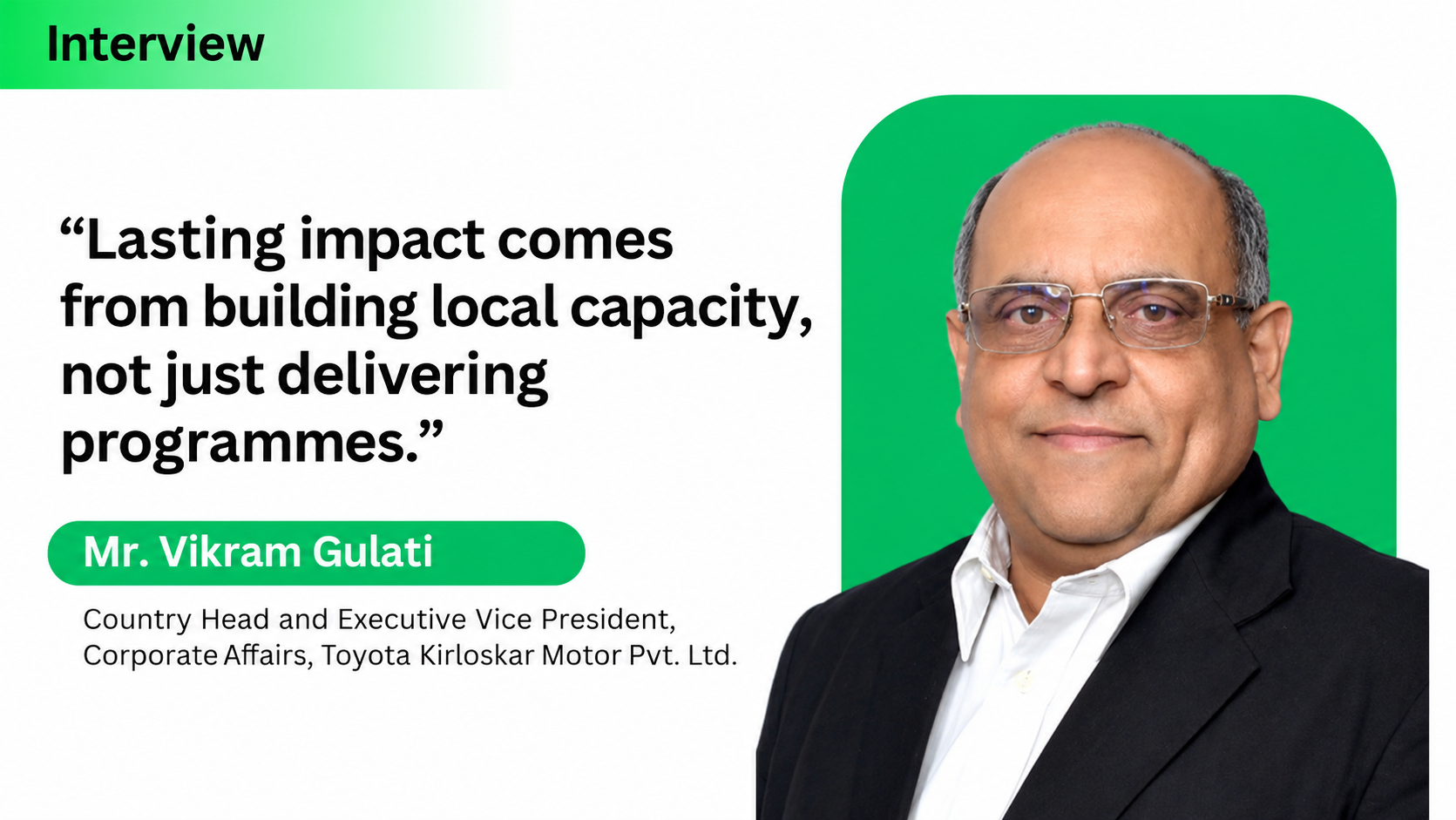
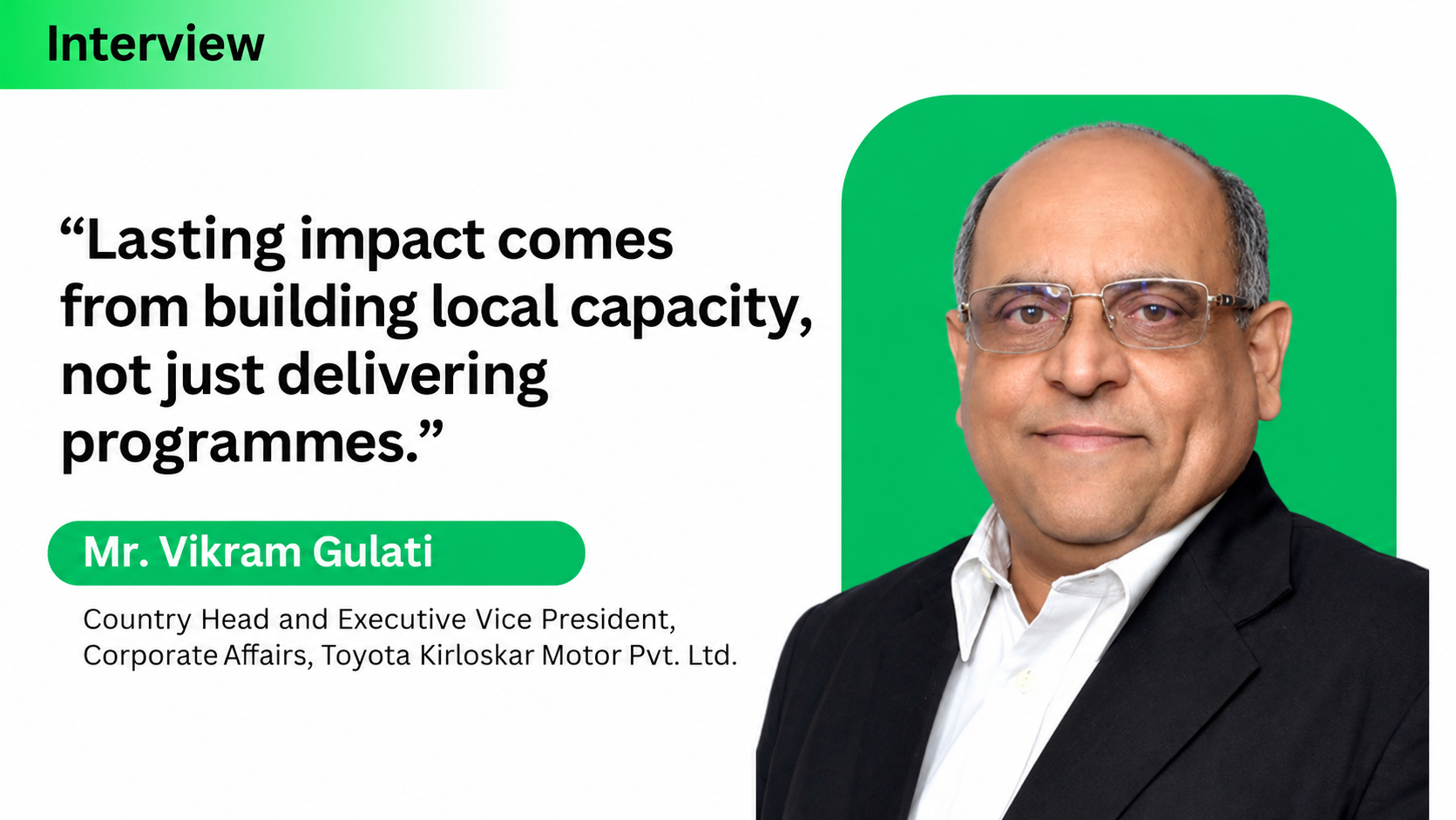
At Toyota Kirloskar Motor (TKM), this thinking informs its “Child to Community” approach, which places long-term social outcomes at the centre of its CSR strategy. In this interview, Mr. Vikram Gulati, Country Head and Executive Vice President, Corporate Affairs, Toyota Kirloskar Motor Pvt. Ltd., reflects on the evolving role of corporate philanthropy, the need for more rigorous impact measurement, and the potential of public-private partnerships to make development interventions more sustainable, scalable and responsive to community needs.
Scroll down to read the full interview:
Q. How do you believe the role of corporate philanthropy is changing as businesses increasingly move from short-term welfare interventions towards long-term community development?
A. At Toyota, we believe corporate responsibility goes beyond immediate interventions to create systemic, sustainable change. The shift from short-term welfare to long-term community development represents a fundamental evolution in how corporations view their role in society. Rather than distributing resources to address immediate challenges, organizations recognize that lasting value emerges only through deliberate, multi-year interventions designed with communities.
This philosophy is embedded in our "Child to Community" approach, where we design programs with a community basedneed assessment that address structural barriers across key pillars such as Education, Skill Development, Environment, Health & Hygiene, Road Safety. Our programs are rooted in understanding that community transformation requires patience, consistent investment, robust governance, and willingness to adapt based on community feedback. Success is measured not just by reach, but by lasting transformation and strengthened systems that communities own and sustain independently, long after corporate involvement concludes
Q. What, in your view, makes a CSR programme capable of creating lasting change rather than becoming dependent on continued corporate intervention?
A. Lasting change embedded in our philosophy of “Child to Community” requires three foundational elements working in concert. First is Community Ownership, where communities identify problems, co-design solutions, and drive implementation rather than receiving top-down interventions. Communities become architects of their own solutions, not beneficiaries of corporate charity. Second is Structural Sustainability, where we focus on building local capacity and expertise, so programs continue independently through trained faculty, community institutions, and local systems. Our Train-the-Trainer model in ITI partnerships exemplifies this, local faculty develop expertise internally, enabling continuous improvement without external reliance. Third is Ecosystem Integration, where government, private sector, and community institutions share accountability. When multiple stakeholders’ own outcomes, no single factor can withdraw without visible impact, creating collective commitment.
Our Jeevan Dhara watershed program demonstrates all three elements: 147 village institutions now autonomously manage water resources through Self-Help Groups and village committees; farmers independently practice water-efficient agriculture; local government has integrated watershed management into development plans. Similarly, our 45-ITI roadmap across Maharashtra succeeds because government owns scale and sustainability through budget integration, not corporate dependency. The program persists not because Toyota funds it, but because government systems have been strengthened to own and sustain the work.
Q. How has TKM's experience shaped your understanding of the relationship between business priorities and the social priorities of the communities around which a company operates?
A. Initially, business and community priorities appear misaligned, businesses optimize for efficiency; communities seek equity. Yet our experience reveals this tension becomes synergistic when navigated thoughtfully. The Alignment is profound: Toyota's business success depends on skilled workforces, engaged communities, water resources, and safe roads. Community priorities like education for livelihood opportunities, health & hygiene, watershed management for agricultural viability, road safety for family security, directly address these needs. When we invest in watershed management in Marathwada, we simultaneously strengthen water resources for agricultural livelihoods and ensure community resilience around our operations. When we upgrade ITIs, we meet industry's need for skilled technicians while creating youth employment pathways.
Managing genuine tensions requires transparency about constraints, inclusive decision-making on trade-offs, and willingness to invest beyond immediate business returns when communities demonstrate need. This approach recognizes interdependence, our business cannot without engaged communities, and communities cannot prosper without economic opportunity. CSR becomes not charity, but enlightened self-interest rooted in shared prosperity.
Q. TKM has reported reaching more than 7 million lives through its CSR initiatives. What metrics does the organisation use to distinguish reach from meaningful and sustained impact?
A. This is a critical distinction we've learned through experience. Reach represents exposure and participation like the number of people attending a screening camp, children in schools we support, farmers trained in new techniques. Impact represents sustained behavioral change, economic mobility, and institutional capacity that persists post-program. Many initiatives achieve high reach but low sustained impact. A health screening camp might reach 5,000 people but result in only 15% following through on treatment; tree-planting events plant 10,000 saplings but achieve only 20% survival without ongoing stewardship.
Our CSR strategy has evolved to prioritize depth over breadth. Rather than pursuing program diversity spread thinly across 50 initiatives, we concentrate resources on six core pillars with rigorous multi-year tracking. Each program defines clear milestones: 6-month knowledge transfer, 12-month behavioral adoption, 24-month self-reliance, and 3+ year systemic change. We measure success by % of trained farmers practicing improved agriculture, % of trained youth in sustained employment, income mobility metrics, and community institution capacity to manage programs independently. For example, our watershed programs don't celebrate trees planted; we track soil moisture improvement, crop yield increases, and reduced distress migration 3 years post-intervention. This measurement discipline has transformed how we design and allocate CSR resources.
Q. What has the experience of Jeevan Dhara taught TKM about designing environmental philanthropy around long-term sustainability?
A. Jeevan Dhara represents our most sophisticated environmental philanthropy model precisely because it acknowledges that water scarcity's consequences extend 10+ years beyond initial intervention. Bidar district's chronic water scarcity isn't a 3-year crisis; it's a 30-year structural reality driven by erratic rainfall, groundwater depletion, and degraded soil water-holding capacity. A 3-year intervention addressing symptoms fails if communities revert to old practices or if drought returns before coping capacity solidifies.
Long-cycle design is essential:
Phase 1 (Year 1) combines infrastructure deployment, check dams, contour trenches, farm ponds etc with behavioral change through farmer collective training in water management.
Phase 2 (Year 2-3) focuses on consolidation and adaptation, transitioning farmers to multi-season cropping and shifting infrastructure maintenance to village committees.
Phase 3 (Year 4+) centers on resilience building, where community institutions assume full management, livelihood sustainability is tracked, and climate-smart agriculture is embedded.
Post-Year 4, communities don't "graduate" from support; they graduate from dependency to self-management.
The transformational outcome extends beyond water access. Jeevan Dhara impacted 11,026 people across 9 villages, but the profound outcome was reducing distress migration. When reliable irrigation enabled multi-season cropping, farmers no longer migrated seasonally, stabilizing families, increasing school enrollment, and reducing urban pressures. We've introduced similar watershed models in Marathwada, adapting to local agroclimatic conditions, demonstrating that environmental resilience is contextual and time-bound, not generic.
Q. How do you assess the social value of iCARE, particularly when employee participation becomes part of corporate culture?
A. iCARE's value extends far beyond numbers (38+ editions, 4,500+ employee volunteers, 68,500+ lives impacted) to cultural embedding and authentic skill-based contribution. When structured as core business practice rather than occasional feel-good activity, employee volunteerism becomes a powerful culture-building mechanism generating tangible community impact. The evolution is significant: traditional volunteering sees sporadic participation where employees view it as time-off benefit and communities see corporate employees as temporary actors. iCARE transforms this by ensuring thematic alignment with our six CSR pillars, enabling skill-based contribution where employees apply domain expertise, and creating outcome orientation where volunteers see direct causality.
For example, during the 3th iCARE in August 2026, 570Toyota volunteers enabled 15 women artisans of ‘ Krishikala’ SHG to establish independent livelihoods. Rather than manual labor, employees contributed domain expertise: engineersadvised on production efficiency, market linkages and logistics on supply chains. This partnership model enabled 15 women artisans to create 260 eco-friendly products. Tosustain the activity further, engraving machines and crafting tools were also provided for independent operations. The SHG didn't become dependent; it became empowered. Culturally, iCARE participation becomes a career milestone. Senior leaders speak about contributions; performance reviews reference volunteering quality; young employees see iCARE as pathway to leadership visibility. This cultural integration creates lasting impact: communities receive direct livelihood support and institutional strengthening through genuine partnership, employees develop purpose-aligned skills in meaningful contexts, and the organization builds embedded culture of shared responsibility.
Q. What does TKM's experience with Government ITI partnerships reveal about public-private collaboration?
A. Public-private collaboration works when both sectors accept their comparative advantages—government brings community trust and scalability; private sector brings innovation and employment linkages. India's 11,000+ ITIs produce technically competent graduates with poor employment outcomes (40-50% placement). Outdated curriculum, underdeveloped faculty, missing soft skills, weak employer engagement were identified as the root causes and neither private sector solutions alone (reaching only 15-20% of needs) nor government resources alone could address this gap.
Our collaboration model demonstrates how this works: Phase 1 involves diagnosis and partnership design through on-ground assessment and consultative meetings with faculty, students, employers, and district officials to co-design multi-year roadmaps. Phase 2 focuses on institutional capacity building—faculty Train-the-Trainer programs, curriculum upgrades to industry standards, skill laboratory establishment, and student exposure to dealerships. Phase 3 transitions to self-reliance where government ITI faculty independently lead updates, government budgets orient toward maintenance, and dealerships directly engage ITIs for placement.
Measurable results validate this approach: Government ITI Deogiri in Maharashtra improved from baseline placement of 45% toward target of 70%; we've upgraded 16 Government ITIs across Marathwada and Nagpur with scalability to 45 ITIs across 36 Maharashtra districts by 2030, reaching 20,000+ annual students. We believe this works as government owns sustainability through budget integration; incentives (industry needs skilled technicians, government needs employment outcomes, ITI students need livelihoods)are aligned ; and scalability can be achieved through proven ITI models propagated by Toyota. Additionally, context adaptation allows standardized excellence with regional customization. This partnership model proves corporations can meaningfully contribute to development at national scale without creating dependency.
Q. Looking ahead, what aspects of TKM's CSR philosophy have the greatest potential for replication and what should companies fundamentally rethink?
A. Looking across our portfolio of CSR activities like the TTEP skilling across all states, Jeevan Dhara watershed models in multiple regions, iCARE expanding, Government ITI partnerships scaling to 45 institutes are certain elements that demonstrate clear replicability while others reveal what the sector must fundamentally rethink.
Scalability : Institutional capacity building models through Train-the-Trainer pedagogy transfer across regions because they embed sustainability into public systems rather than creating corporate dependencies. Community institution-led approaches like Jeevan Dhara succeed because villages own resources post-project. Green supply chain accountability extends benefits to broader sectors. These models scale because they make communities and government systems agents of change, not corporate beneficiaries. Scalability potential: 45-ITI roadmap achievable; TTEP's pan-India presence demonstrates regional adaptability; watershed models applicable across water-stressed regions (20+ districts, 500,000+ people within 5 years).
Shift in approach : First, CSR must shift from "program diversity spread thinly" to "concentrated depth" with 3+ year cycles, allocating resources to 5-10 initiatives rather than 50. Second, measurement should track 3+ year livelihood trajectories and behavioral persistence, not activity counts. Third, corporations should position themselves as ecosystem participants, not leaders—accepting longer timelines, shared credit, and authentic government partnerships rather than corporate visibility. When CSR aligns with national priorities like Skill India and Viksit Bharat 2047, it unlocks scalability.
Our priority focus for next 3-5 years: expand skilling models to pan-India states (50,000+ annual students by 2030), extend watershed programs (500,000+ people across 20+ districts), embed health and road safety into community development, invest in rigorous 3-5 year impact evaluation, and establish formal collaboration frameworks with government and NGO partners. India's challenges are too large for corporate CSR alone, but when corporations contribute strategically through institutional partnerships, long-term commitment, and authentic ecosystem participation, CSR becomes genuine development catalyst.


.png)