Monica Sarin Foundation on Skilling Youth for Sustainable Livelihoods
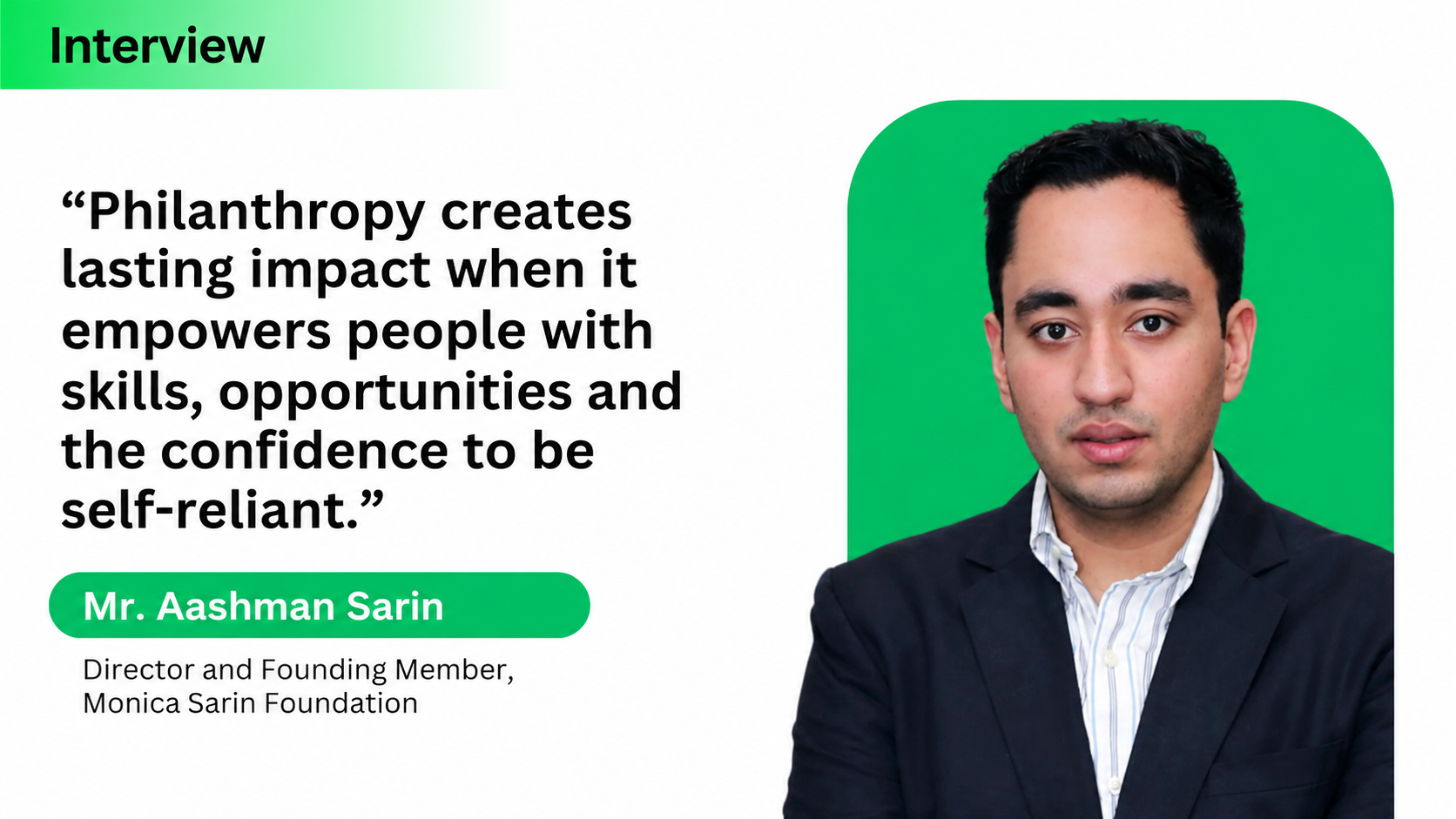
Creating sustainable livelihoods requires more than access to education or the promise of a first job. It calls for an ecosystem that connects relevant skills with industry needs, supports long-term career growth and enables individuals to achieve financial independence. As philanthropy increasingly engages with India’s human capital and development priorities, the focus is shifting towards interventions that address structural barriers to opportunity and build pathways to self-reliance.
At the Monica Sarin Foundation, this approach informs its work through MS-CASIE, which seeks to bridge the gap between academic learning and industry requirements. In this interview, Mr. Aashman Sarin, Director and Founding Member of the Monica Sarin Foundation, reflects on the role of private philanthropy in strengthening employability, the importance of measuring livelihood outcomes beyond placements, and the collaborations needed to prepare young people for an evolving world of work. He also discusses the Foundation’s ambition to skill and empower 50,000 young people by 2030 and the broader contribution of philanthropy to the vision of Viksit Bharat@2047.
Scroll down to read the full interview:
Q. How do you think private philanthropy can move beyond addressing immediate needs to creating conditions for sustained economic and social mobility?
A. I believe philanthropy creates its greatest impact when it moves beyond charity and focuses on empowerment. Addressing immediate needs such as skilling, education, healthcare, and community development, women’s empowerment, and sustainable livelihoods, especially for vulnerable communities. However, lasting change happens when people are also equipped with opportunities, and confidence needed to become self-reliant.
At Monica Sarin Foundation, we echo the same philosophy. This also has been our thinking behind MS-CASIE, a flagship institution where we focus on bridging industry-academia gaps by equipping students with technical and soft skills. Our primary aim is to make them job-ready for leading industry players in both national and international job markets. This ideology stems from the fact that when philanthropy helps bridge structural gaps in education, skills, and access to quality opportunities, it creates a multiplier effect that benefits not just individuals but entire communities.
Q. From your experience at the Monica Sarin Foundation, what determines whether a social impact intervention remains relevant and effective as community needs evolve?
A. For me, a social impact intervention remains relevant and effective only when it stays closely connected to the people it is meant to serve. Communities are constantly evolving, and their needs and aspirations change with shifts in the economy, technology, education, and employment. This means we must keep listening, learning, and adapting with humility.
That belief is central to the Monica Sarin Foundation (MSF), established by mother in 2019 on the values of dignity, opportunity, and self-reliance. As I spearhead the Foundation today, I remain committed to advancing her vision while ensuring that our work responds to the evolving needs of the communities we serve. Over the years, MSF has evolved from supporting underserved communities into a purpose-led organisation working across skilling, education, healthcare, community development, women’s empowerment, and sustainable livelihoods.
We regularly assess whether our programmes are addressing the real challenges beneficiaries face. We listen to communities and engage with educators, employers, and implementation partners to understand changing needs. While data and measurable outcomes guide us, the voices and aspirations of the people we serve remain at the heart of every decision.
I believe meaningful social impact cannot come from one-time solutions. It comes from walking alongside communities and creating opportunities that enable people to become self-reliant. That is what makes an intervention truly relevant, sustainable, and meaningful.
Q. What have you learned from building MS-CASIE about the kind of collaboration required between philanthropy and the private sector to create more meaningful livelihood outcomes?
A. One of my biggest learnings from building MS-CASIE is that meaningful livelihood outcomes cannot be created by any one stakeholder working in isolation. Philanthropy can bring patient capital, purpose, and a deep understanding of communities, while the private sector brings insights into evolving skill requirements, workplace expectations, and emerging employment opportunities. The real impact comes when these strengths work together from the outset.
At MS-CASIE, our partnerships with accredited skill councils and industry bodies help us ensure that training is aligned with both learner aspirations and market demand. I have seen that collaboration is most effective when employers are not involved only at the placement stage, but participate in shaping curricula, providing industry exposure, and preparing young people for the realities of the workplace.
For me, the shared objective must go beyond helping someone secure their first job. It should be about equipping young people with relevant skills, confidence, and the ability to build sustainable careers. When philanthropy and industry come together with that long-term commitment, they can create a much stronger bridge between education and employment, and more meaningful pathways to self-reliance.
Q. How should organisations measure the quality of a livelihood intervention beyond the immediate outcome of a beneficiary securing employment?
A. Securing a job is the beginning of the journey, not the final measure of success. The quality of a livelihood intervention should be assessed by whether it enables an individual to retain employment, progress professionally, increase their earning potential, and move towards greater financial independence.
This requires organisations to look beyond placement numbers and consider indicators such as job retention, career progression, earnings growth, workplace readiness, confidence, and resilience. At MS-CASIE, I have seen young people enter our programmes with limited confidence and little industry exposure. Through practical learning, mentorship, and industry engagement, they develop the technical skills, professionalism, and self-belief required to sustain and grow in their careers.
Ultimately, a successful intervention must create both economic opportunity and personal transformation. Its true impact lies not only in helping someone secure their first job, but in enabling them to build a stable, fulfilling, and self-reliant future.
Q. MSF has set a target of reaching 50,000 youth by 2030. How many beneficiaries have been reached so far, and what key impact indicators will determine whether the Foundation is progressing towards this goal?
A. Our vision through MS-CASIE is to skill and empower 50,000 young people by 2030. However, I believe progress towards this goal must be assessed through both scale and depth of impact.
Alongside enrolment, we track programme completion, placement, job retention, earnings progression, and career advancement. We also consider changes in confidence, workplace readiness, and resilience, as these often determine whether a young person can sustain and grow in employment.
Our aim is not simply to reach a numerical target, but to help young people access meaningful opportunities and build more secure, self-reliant futures. That combination of reach and lasting impact is how I would measure our progress.
Q. Through initiatives such as the Retail Management, Allied Healthcare and Hospitality Management programmes, what differences have you observed in the aspirations, challenges and career trajectories of young people entering different sectors?
A. I have observed that young people entering each sector bring different aspirations and face distinct challenges.
In Retail Management, many seek a quick pathway to employment but may initially struggle with customer interaction and store operations. Practical exposure helps them adapt quickly and build confidence. In Allied Healthcare, students are often motivated by the opportunity to build stable careers while contributing to the well-being of others. Their challenge lies in mastering technical concepts, patient-care practices, and the discipline of a professional healthcare environment. Hospitality Management attracts young people interested in dynamic, service-oriented careers, where communication, professional etiquette, attention to detail, and operational discipline are essential.
Despite these differences, what stands out to me is their shared aspiration to build better futures for themselves and their families. With the right training, mentorship, and industry exposure, I have seen them grow into confident professionals equipped to sustain and progress in their careers.
Q. As technology continues to alter the nature of work, how should philanthropic organisations rethink their approach to preparing young people for an increasingly uncertain employment landscape?
A. As technology reshapes the world of work faster than ever before, I believe philanthropic organisations must shift from training young people for specific jobs to preparing them for lifelong learning and change. Digital literacy is essential, but so are adaptability, critical thinking, communication, and problem-solving. Through our AI and Robotics workshops, we expose learners to emerging technologies while encouraging curiosity and innovation. We cannot predict every future role, but we can help young people develop the confidence, skills, and mindset to adapt. For me, that is the true meaning of future readiness.
Q. What has MSF's experience with organisations such as Rainbow Homes, ISKCON Food for Life, The Akshaya Patra Foundation, Annamrita Foundation, and the Breast Cancer Patient Benefit Foundation taught you about the value and limitations of partnership-led philanthropy?
A. Our partnerships have taught me that philanthropy is most effective when organisations combine their strengths. Partners such as Rainbow Homes, ISKCON Food for Life, The Akshaya Patra Foundation, Annamrita Foundation, and the Breast Cancer Patient Benefit Foundation bring specialised expertise, trusted community networks, and the ability to extend impact at scale.
However, partnerships are not without challenges. They require clear roles, shared goals, transparency, and consistent ways of measuring outcomes. Without this alignment, it can be difficult to maintain quality and ensure accountability.
For me, partnership-led philanthropy is most valuable when it goes beyond expanding reach and brings together complementary capabilities to create lasting change. Trust, open communication, and shared responsibility are what make that possible.
Q. Looking towards Viksit Bharat@2047, where do you believe philanthropy can make the greatest contribution to building human capital, and what kind of ecosystem will be required for these efforts to achieve scale and lasting impact?
A. As India moves towards Viksit Bharat@2047, I believe philanthropy can make its greatest contribution by investing in people, particularly those at risk of being left behind. Education, skilling, healthcare, and entrepreneurship must be viewed as interconnected foundations of human development. Philanthropy can help address gaps in access, support innovation, and invest patiently in solutions with the potential to scale. But lasting impact will require government, industry, educational institutions, civil society, and philanthropic organisations to work together towards shared outcomes.
Our experience at MSF with MS-CASIE has shown me that meaningful change occurs when community needs, relevant skills, and industry opportunities come together. With strong partnerships, shared accountability, and people at the centre, philanthropy can help build a more skilled, self-reliant, and inclusive India aligned to the vision of Viksit Bharat@2047.



.png)