Beyond Access: Rethinking Foundational Learning Through Better Pedagogy and Stronger Teacher Support
Achieving foundational literacy and numeracy (FLN) for every child requires more than ensuring access to education; it demands a deeper focus on how children learn, how teachers teach, and how learning gaps are addressed in the classroom. As India advances towards its foundational learning goals under the NIPUN Bharat Mission, the need for child-centric pedagogy, continuous teacher development, and outcome-oriented education funding has become increasingly important.
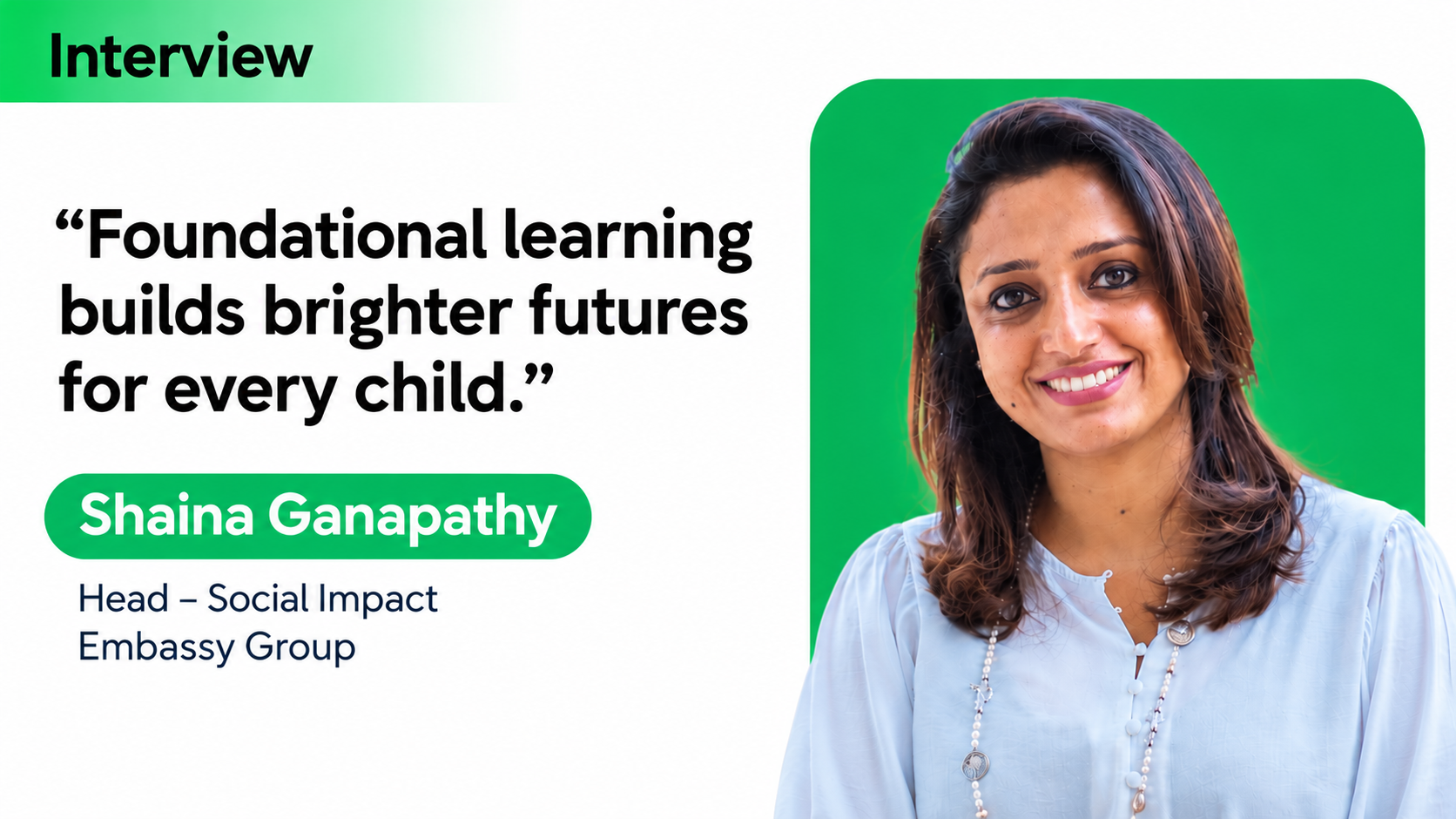
In this email interview with TheCSRUniverse, Ms. Shaina Ganapathy, Head of Community Outreach Initiatives, Embassy Group, shares insights from the organisation’s sustained engagement with government schools and its efforts to strengthen foundational learning. Drawing on initiatives spanning remedial education, teacher support, digital learning, and academic interventions, she highlights why children at different learning levels need flexible teaching approaches and targeted classroom support.
The conversation explores the systemic challenges affecting FLN outcomes, including teacher availability, classroom sizes, parental engagement, and the need for continuous assessment. Ms. Ganapathy also discusses how structured pedagogy and level-based learning can help bridge learning gaps, the role of corporate social responsibility (CSR) in strengthening classroom practices, and the potential of technology and artificial intelligence (AI) to support teachers without replacing their role.
She further explains Embassy Group’s Cradle to Career approach and how collaboration among corporates, government institutions, and implementation partners can contribute to more sustainable education outcomes. The interview underscores a central message: improving foundational learning requires investments that go beyond infrastructure and technology to focus on what matters most—children’s learning progress.
Read the full interview below:
Q. To what extent do you see classroom pedagogy as a key challenge in achieving India’s FLN goals, based on your experience of supporting education initiatives? What other systemic factors need attention?
A. Classroom pedagogy is certainly a critical factor in achieving India’s FLN goals. However, while access to schooling has progressed, we need to continuously reassess and re-examine how students are being taught as each child learns at their own pace. Some children, for instance, may respond better to visual learning, some to reading and writing, while others understand concepts better through activities, games, or enactment.
This is where alternative approaches become important. Through Embassy Group’s sustained outreach efforts in education across 19 government schools and 6,000+ students, students within the same classroom can excel at different competency levels. Our implementing partners have been able to deliver a pedagogical remedial program that identifies individual learning levels and caters to different paces and methods. Remedial lessons are developed and taught using tools and activities that aim to support and bridge learning gaps.
At the same time, pedagogy cannot be viewed in isolation - teacher capacity and availability, classroom size, regular assessment, contextual learning resources, parental engagement, and continuity between policy and implementation all influence positive outcomes. These require sustained support through partnerships at every level, with the results building on each other. FLN requires a holistic approach - one that brings together pedagogy, teachers, families, and technology, with the wider school environment.
Q. From your experience, what are the biggest challenges teachers face in addressing children with different learning levels within the same classroom?
A. In our experience, classrooms with children at different learning levels benefit from a combination of appropriate classroom support, flexible teaching approaches, and ongoing teacher development. As part of our programme, we currently support 81 guest teachers, bringing the total teaching workforce across 17 government schools to 139 teachers, and helping improve the teacher-student ratio from 1:55 to 1:22
This also enables a greater focus on differentiated and integrated learning. Rather than approaching every child in the same way, teachers can use multiple methods and connect learning across subjects and activities. Our implementing partners, Colours of Life and Pratham Mysore, follow an integrated model that incorporates level-based classroom interventions, teaching and learning materials, games, outdoor activities, and digital interventions.
Equally important is giving teachers ongoing opportunities to strengthen and apply these approaches in the classroom. Continuous mentoring, classroom observation, and practical capacity building help educators build confidence and adapt their teaching to different learning needs. Training across areas such as classroom management, use of teaching materials, student engagement, parent engagement, and community participation further equips teachers to create learning environments that are more engaging and effective for every child.
Q. Which approaches or interventions have you seen deliver measurable improvements in foundational literacy and numeracy, and what will it take to scale such models across the public education system?
A. The World Bank’s Global Education Evidence Advisory Panel identifies structured pedagogy as a cost-effective approach to improving foundational learning, particularly when lesson plans, learning materials and continuous teacher support work together. It provides teachers with sequenced learning approaches, appropriate materials, professional development and classroom-level coaching.
Embassy Group, through our implementing partners, uses a level-based approach aligned with principles seen in Teaching at the Right Level (TaRL). This enables children to be assessed according to their learning levels and receive targeted instruction in foundational skills alongside the broader curriculum. At scale, the opportunity is to integrate such approaches with the public education system and complement existing structures through teacher development, appropriate learning materials, regular assessment, academic mentoring and the use of learning data to adapt instruction.
This is also where the private sector can contribute - by helping develop and strengthen models that complement the public system and can be sustained over the long term. Embassy Group’s Cradle to Career model brings together Foundational Literacy and Numeracy, teacher development, academic interventions, career guidance, mentoring and scholarships across different stages of a child’s journey. Through our long-term engagement with government schools and our Corporate Connect platform, we also bring corporates, NGOs and implementation partners together around shared education priorities.
Q. How can funding in this domain move beyond supporting infrastructure, digital tools and learning materials to strengthen teacher capacity, classroom practice and actual learning outcomes?
A. Education funding should connect what is provided to schools with what changes for children. Infrastructure, technology, and learning materials remain important, but their impact is stronger when combined with teacher capacity and effective pedagogy.
Teacher development, in particular, can be most effective when it is a continuous process. This can include practical pedagogical approaches, appropriate resources, classroom-based mentoring and coaching, regular assessment and adapting instruction to children’s learning needs. India’s NIPUN Bharat framework similarly recognises these elements as interconnected to achieving foundational learning goals.
This also creates an opportunity to complement these inputs with measures of learning progress – instead of classrooms built, teachers trained, or devices distributed, we can instead focus on whether children are progressing in reading, comprehension and numeracy.
For corporate India, the opportunity is to make CSR funding more catalytic by bringing together teacher development, contextualised learning resources, mentoring, assessment and implementation support, in partnership with governments and experienced education organisations. Embassy Group’s long-term engagement with government schools and our Cradle to Career approach reflect this integrated model.
Q. What role can technology and AI play in supporting teachers and improving foundational learning, and where do you see the limits of technology-led solutions?
A. Technology is an important part of how children learn and engage with the world today. Technology and AI can help teachers identify learning gaps, provide differentiated resources, make concepts more visual and interactive, strengthen assessments and track individual student progress. At the same time, teachers remain central to the learning process, with technology complementing classroom engagement.
Our experience with Project Sputnik, Colours of Life’s in-house digital learning programme, reflects this blended approach. Sputnik supplements classroom teaching with Math and English modules aligned with NCERT and DSERT resources, using visual and audio-led formats to offer children different ways to engage with concepts.
For corporate and philanthropic funding, the question should therefore be less about bringing AI into schools and more about where it can address a specific learning or teaching need effectively. This could include lesson preparation, identifying learning gaps, differentiated instruction, assessment or professional development.
With AI specifically, its effectiveness will depend largely on the quality of the underlying content and data, teachers’ ability to use its recommendations and appropriate safeguards around accuracy, privacy, and bias.






.png)