
Apurva.ai: Turning Collective Knowledge into a Catalyst for Systems Change in Philanthropy
Social impact depends not only on the resources committed to development, but also on how effectively knowledge informs decisions. Across the development sector, years of community experience, programme evidence and institutional learning often remain confined to individual organisations, limiting their potential to shape broader strategies. The challenge is to build systems where these insights can inform one another without compromising local context, community agency or data ownership.
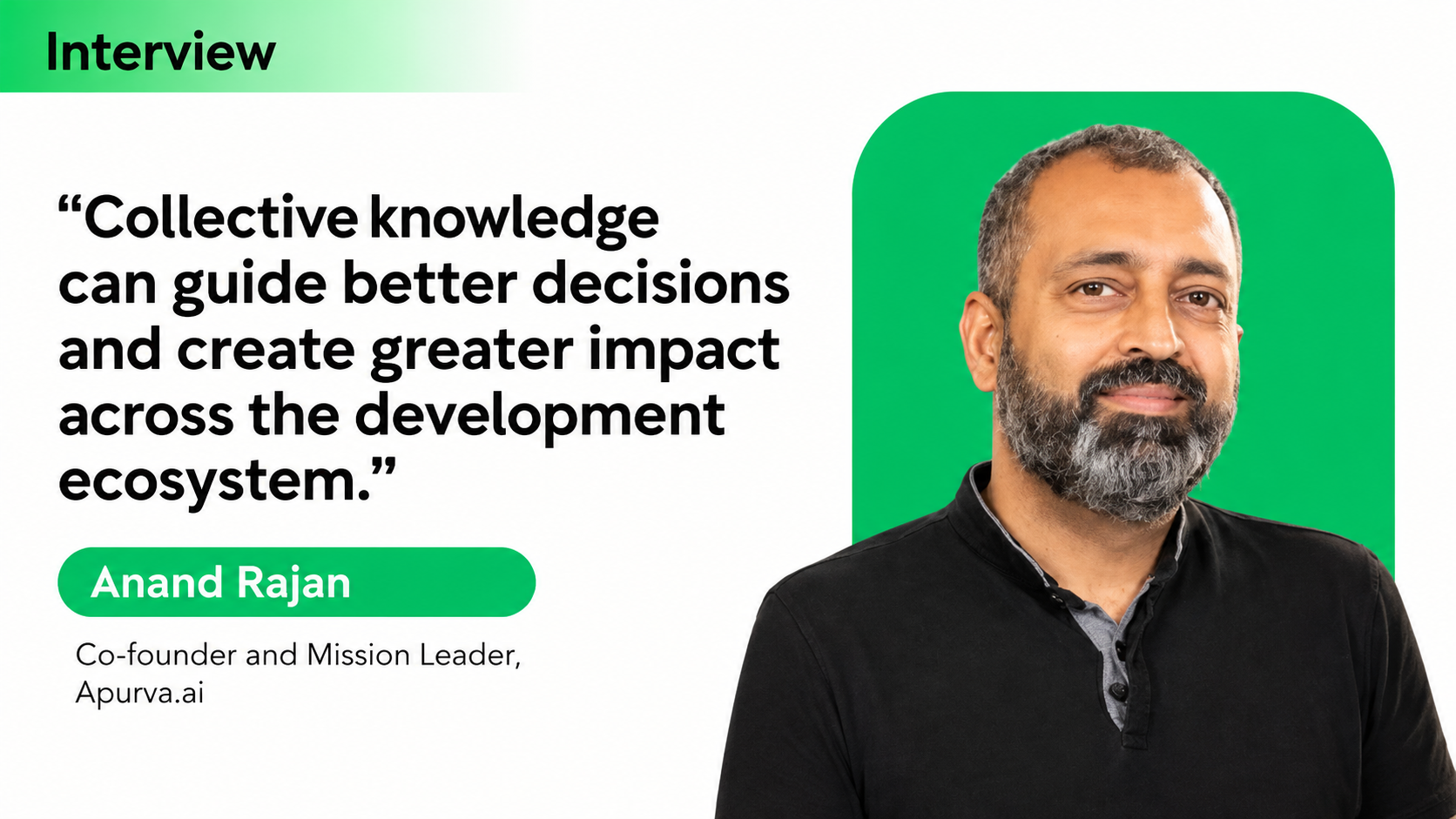
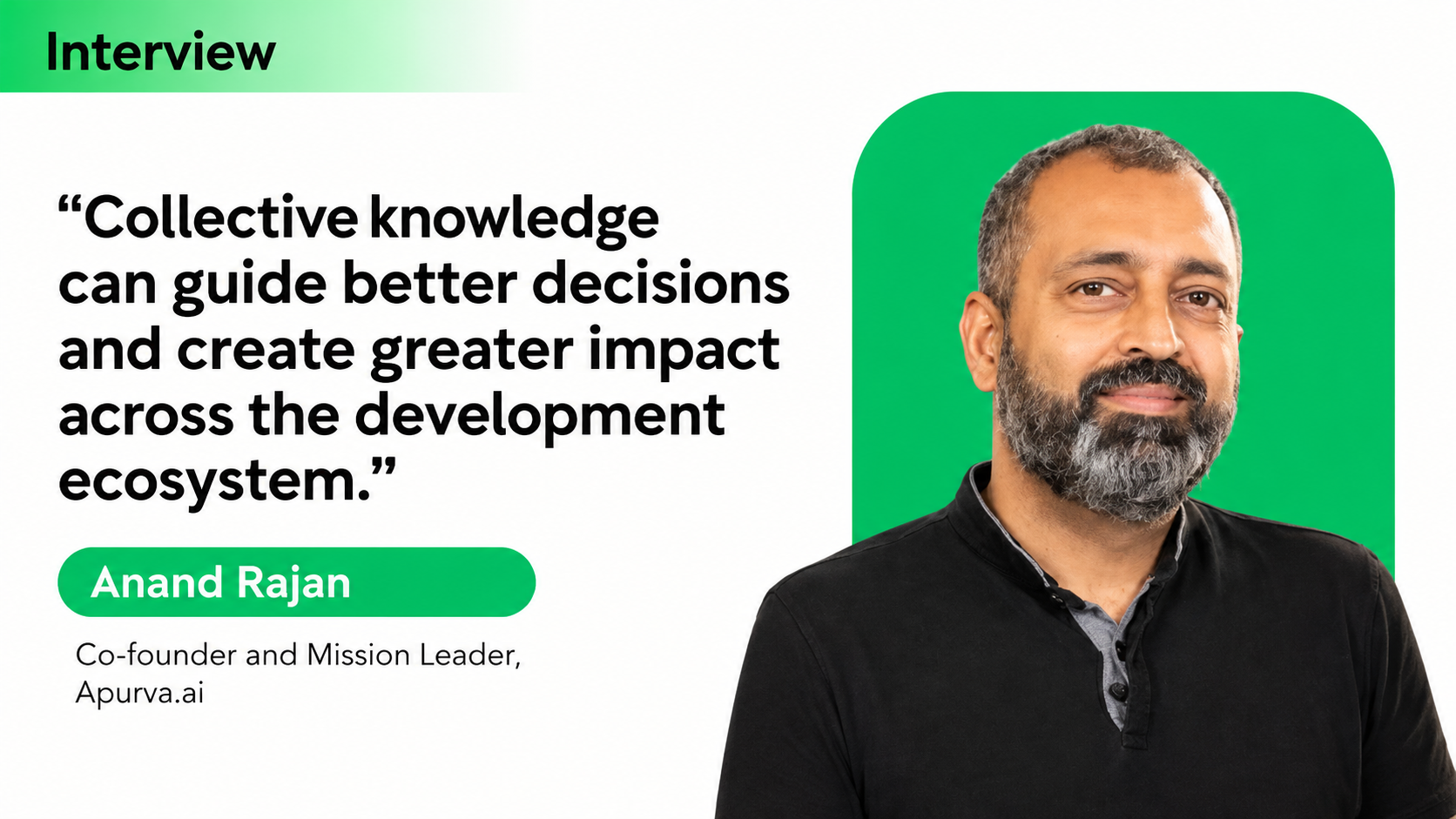
For Apurva.ai, this calls for a shift from fragmented interventions towards collective intelligence that can influence philanthropic priorities and strengthen collaboration across the development ecosystem. Anand Rajan, Co-founder and Mission Leader at Apurva.ai, discusses how Apurva LENS uses AI to connect community voices and practitioner knowledge, the safeguards required for responsible knowledge-sharing, and the role collective learning can play in shaping funding decisions and advancing systems-level change.
Scroll down to read the full interview:
Q. As social challenges become increasingly interconnected, how do you think philanthropy and the development sector need to rethink the way knowledge is generated, shared and translated into action?
A. There is already an enormous amount of knowledge in the development sector. Grantees accumulate years of experience from working closely with communities - what works, what does not, how problems are changing and where interventions need to adapt. The challenge is that much of this knowledge remains within individual organisations or programmes.
For funders, the opportunity is to bring these different sources of knowledge together and use them to inform not just individual grants, but their overall funding strategy. If you are supporting ten organisations working on different parts of the same problem, what can they collectively tell you that none of them can tell you individually? And how can you create opportunities for those organisations to learn and co-create with one another? That shift - from funding individual interventions to learning across a portfolio - can fundamentally change how philanthropy responds to complex problems.
Q. What does meaningful collaboration between funders, NGOs, governments, practitioners and communities look like when the objective is to move beyond individual interventions towards systems-level change?
A. The starting point is being able to see the system collectively. Today, different actors often see different parts of the same problem. A community experiences it one way, an NGO encounters another dimension, a funder sees patterns across a portfolio, and government operates at a completely different scale.
What we are trying to enable at Apurva.ai is a way for these different actors to see the system together. Once that happens, each can respond with its own capabilities, resources and solutions. They do not all need to do the same thing. What matters is that they are responding to a shared understanding of the problem.
That is very different from a series of siloed interventions. Systems change requires us to surround a problem rather than continue answering it in pieces.
Q. In your view, what are the biggest barriers preventing valuable knowledge generated through development programmes from travelling across organisations and geographies, and where can technology meaningfully address these gaps?
A. We often assume this is a technology problem. It is not, at least not entirely. A large part of the challenge is how the development system itself is structured.
Take reporting. Organisations generate enormous amounts of knowledge for funders, but much of it is created for a reporting requirement rather than for others to learn from. Similarly, collaboration is spoken about frequently, but organisations do not always have the incentives or spaces to genuinely learn and build together.
Technology can make knowledge easier to connect, discover and use. AI can help us find patterns across volumes of information that would be difficult for any individual to process. But technology cannot create collaboration where the system does not encourage it. If we want knowledge to travel, we have to address both: the infrastructure through which knowledge moves and the structures and incentives that determine whether organisations share and learn from it.
Q. Apurva.ai places community voices and lived experience at the centre of its approach. How can philanthropic institutions ensure that technology strengthens community agency rather than turning lived experience into another dataset to be interpreted by institutions?
A. One opportunity for philanthropy is to think about community voices and lived experience as infrastructure in their own right. Instead of every organisation separately collecting community inputs for its own programme or reporting requirements, can we create shared infrastructure through which that knowledge can contribute to learning across networks and grantees?
That changes the role of community knowledge. It is no longer simply data that travels upwards to an institution; it becomes part of a knowledge ecosystem that others can learn from.
But this has to be designed carefully. Privacy, safety, security and agency cannot be afterthoughts. Communities and organisations need clarity and control over how their data and knowledge are used and shared. The objective should be to make community knowledge more consequential in decision-making, not simply more available.
Q. With Apurva LENS evolving into a platform, what changes in the way organisations should think about ownership, privacy and responsible knowledge-sharing when insights generated within one organisation can potentially inform the wider development ecosystem?
A. Ownership and control are fundamental to how we have designed Apurva LENS. Every participating organisation retains ownership of its data, and that data remains private by default.
An organisation decides what, if anything, it wants to make available for others to learn from. This distinction is important because an ecosystem does not become more collaborative by requiring everyone to make everything public. Organisations need to be able to participate in collective learning while retaining control over knowledge that is sensitive, contextual or simply not theirs to share.
The opportunity is to create an environment where knowledge can travel responsibly - where organisations can contribute to and benefit from a larger pool of learning without giving up ownership of their own data.
Q. The Platform for Collective Wisdom brings together community voices, practitioner knowledge and institutional learning. What would it take for such collective intelligence to influence how funders frame priorities and allocate philanthropic capital, rather than merely improving programme-level decision-making?
A. For funders, one of the most valuable applications is being able to identify leverage points across an entire portfolio.
If you can see what different grantees are learning, where their work overlaps and where important gaps remain, that can inform the next funding decision. Perhaps the answer is not another organisation working on a solution that is already well represented in the portfolio. Perhaps it is funding a missing capability or actor that allows the portfolio collectively to address the problem more effectively.
It can also create opportunities for co-creation between grantees. Instead of ten programmes independently solving adjacent parts of a problem, their knowledge can begin to inform one another. That is when collective wisdom starts influencing not only programme decisions, but how philanthropic capital itself is deployed.
Q. The experiences of SELCO Foundation, RANA, Museu da Pessoa and Fish Forever span very different geographies and social challenges. What have these engagements revealed about which forms of knowledge can be meaningfully connected across contexts, and which must remain deeply rooted in local realities?
A. There are things that can travel across contexts: patterns, structural connections, approaches and methodologies. An organisation working in one geography may recognise a pattern that is also appearing somewhere very different, and there is enormous value in being able to make those connections.
But context cannot be flattened. The meaning of a particular community experience is shaped by local political, social and cultural realities. The same pattern can mean very different things in two different places.
This is an important distinction for us. AI can help surface connections across large bodies of knowledge, but those connections still have to be understood in context. The goal is not to create one universal answer. It is to make it easier for people to learn across contexts without losing what makes each context distinct.
Q. RANA’s experience highlights the importance of combining AI-assisted analysis with human judgement and an understanding of local political economy. How should development organisations define the boundaries between what AI can identify, what practitioners must interpret and what communities themselves should determine?
A. We have designed Apurva around a simple principle: judgment, context and action remain fundamentally human.
AI can surface connections and patterns at a scale that would be difficult for people to do manually. It can show you that something is recurring across hundreds or thousands of voices, or connect community experience with a wider body of knowledge.
But a pattern is not a decision. Practitioners have to interpret what it means in a particular context and decide whether and how to respond. The where, when, for whom and how remain human decisions. And communities need agency over how their voices and data are used, as well as visibility into what is ultimately acted upon.
AI can help us see more. It should not decide for us what matters.
Q. Apurva LENS has reportedly surfaced more than half a million voices and perspectives across the Global South. What measurable outcomes have emerged from this body of knowledge so far, such as changes in programme design, organisational decisions, collaborations or resources, and how do you assess whether those insights are translating into social impact?
A. The clearest outcomes we can document today are around access to evidence, programme adaptation, organisational practice and collaboration. We should also be careful not to overstate where we are: consistent population-level social impact takes longer to establish.
We are seeing community evidence being translated into theories of change, advocacy pathways, country reports and action plans. In one multi-country network, community dialogues were taken through to validated action plans. In another instance, an organisation analysed around 400 entries from one country, surfaced regional insights that had previously been difficult to see, and used those insights to change how it approached outreach.
We are also seeing operational changes. Teams are spending less time on documentation and synthesis, institutional knowledge is becoming less dependent on individual senior colleagues, and organisations can identify patterns across programmes and portfolios more quickly.
Language has been another important learning. In one instance, a team found that querying knowledge in an African local language produced more accurate insight than doing so in English. First-mile users have also been able to provide feedback directly in their own language.
These are important indicators for us. The longer-term test, however, is whether better knowledge leads to better decisions and, ultimately, better outcomes for communities. That is something we need to continue measuring with our partners over time.
Q. Looking ahead, what would success for Apurva LENS as an open platform look like over the next three to five years, particularly in terms of the number and diversity of organisations participating, knowledge shared, cross-organisational collaborations enabled and development outcomes influenced?
A. We would not define success simply by the number of organisations on the platform or the volume of knowledge it contains. Those numbers matter, but they are not the end goal.
Success would mean organisations are having better and more trusted knowledge interactions - with communities, within their own institutions and with others working on the same problems. We would want to see knowledge moving more easily across organisational boundaries, less duplication of effort, stronger collaboration and better decisions being made with a fuller understanding of the system.
Ultimately, the test is whether that leads to better solutions being developed and acted upon with greater speed, scale and sustainability. If LENS can help the development ecosystem become less fragmented and better able to learn and solve together, that would be meaningful success.