
Transforming Sugarcane Farming: Advancing Farmer Prosperity, Productivity, and Sustainable Rural Growth
Agriculture remains central to the strength of rural economies, and for sugarcane-growing communities, improving farm productivity is closely linked to strengthening farmer incomes, resource efficiency, and the resilience of the wider agricultural ecosystem. As farming practices evolve, the transition towards scientific cultivation, better crop management, and stronger knowledge-sharing networks can create new pathways for farmers to achieve better returns while supporting sustainable industrial growth.
Against this backdrop, the Sugarcane Development Programme of The Adie Broswon Group is working with farmers in Punjab to promote modern and practical agricultural practices, including Trench & Space Planting, seasonal cultivation, disease-free seed selection, soil and water management, and improved ratoon care. The programme currently covers 21,000 acres across 94 villages, with an ambition to expand its reach to 35,000 acres. Its farmer-first approach combines field demonstrations, agronomist support, progressive farmer-led learning, digital tools, and collaboration with agricultural scientists, government representatives, and local cane societies.
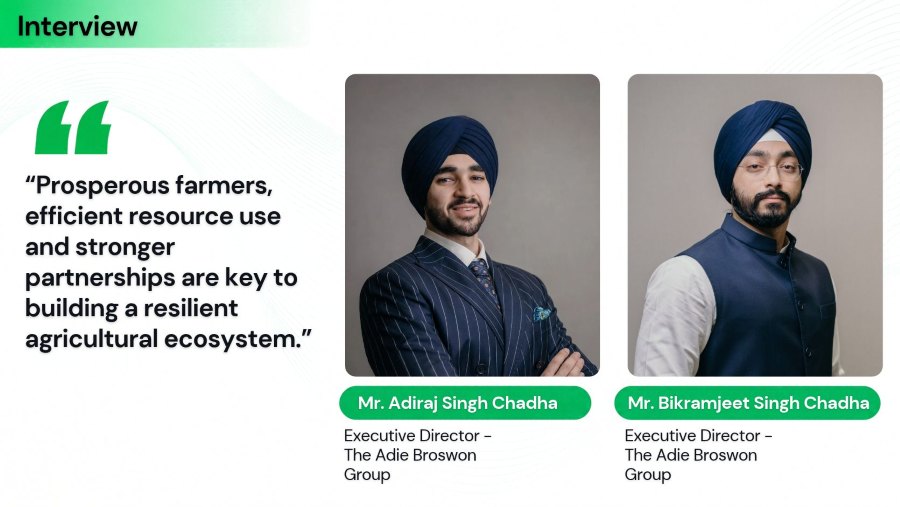
In this exclusive email interview with TheCSRUniverse, Mr. Adiraj Singh Chadha, Executive Director – The Adie Broswon Group, and Mr. Bikramjeet Singh Chadha, Executive Director – The Adie Broswon Group, discuss how the programme is connecting farmer prosperity with the long-term sustainability of the sugar, ethanol, and bio-energy value chain. The conversation explores farmer adoption of scientific practices, productivity and yield enhancement, digital advisory support, sustainability-linked opportunities, key impact indicators, and the role of multi-stakeholder partnerships in scaling agricultural transformation.
Scroll down to read the full interview and explore how stronger farmer partnerships can contribute to a more productive, resilient, and sustainable agricultural ecosystem in Punjab.
Q. How does this Sugarcane Development Programme reflect The Adie Broswon Group's broader commitment to rural development and sustainable industrial growth?
A. A strong sugar business depends on prosperous farmers. Our programme helps farmers improve productivity, manage crop risks and use resources more efficiently. By supporting better farm returns and a reliable cane supply, we connect rural development with the Group's long-term industrial growth.
Q. The programme emphasizes practical, modern interventions such as Trench & Space Planting, Monsoon/Autumn cultivation, and disease-free seed selection. How are your team and agronomists helping farmers transition away from conventional practices toward these modern scientific methods on the ground?
A. Our agronomists and field teams use demonstration plots and regular farm visits to explain trench planting, suitable spacing, seasonal planting and disease-free seed selection. Farmers can observe local results and receive practical guidance as they adopt these methods. We combine scientific advice with farmers' experience to make improved practices workable on the ground.
Q. You currently cover 21,000 acres with an ambitious target to reach 35,000 acres and achieve yields of over 600 quintals per acre. What key strategies and field operations are being deployed to hit these scale and productivity benchmarks across Punjab?
A. We are expanding village by village through farmer engagement and cane societies, while improving seed quality, variety selection, soil and water management, timely crop advisory and ratoon care. Over 600 quintals per acre is a yield target that depends on consistent execution throughout the crop cycle and local growing conditions.
Q. Farmer adoption is often the biggest hurdle in agricultural reforms. How are platforms like the recent Kisan Goshti in Harchowal and the strategy of recognizing progressive farmers as "local champions" helping overcome resistance and accelerate peer-to-peer knowledge transfer?
A. Forums such as the Harchowal Kisan Goshti give farmers direct access to scientists and agronomists to discuss practical challenges. Progressive farmers build confidence by demonstrating results under local conditions and sharing their experience. This combination of technical guidance and peer learning encourages wider adoption.
Q. With your 170-acre integrated complex at Kiri Afgana housing a sugar mill, three distilleries, and a brewery, how does improving sugarcane quality and yield directly benefit the operational efficiency and supply chain security of Adie Broswon’s sugar, ethanol, and bio-energy operations?
A. Consistent cane supply supports steadier mill operations and better capacity utilisation, while better cane quality can improve sugar recovery. Cane processing also supplies molasses for ethanol and bagasse for steam and power. These links strengthen raw-material security and operating efficiency across our cane-based operations.
Q. Beyond seasonal drives, the programme offers continuous support, including soil testing, digital tools, mechanisation guidance, and capacity building for internal cane development teams. Could you elaborate on how this institutional support system works throughout the crop cycle?
A. Our support runs from seed selection and soil testing through planting, irrigation, nutrition, crop protection and harvesting, including mechanisation guidance. Field visits are complemented by the Chadha Kisan Connect app, which provides crop and weather information, survey and supply details, payment status and access to the Cane Officer. Regular team training helps maintain consistent advisory support.
Q. How is the Group preparing smallholder farmers in Punjab to participate in and benefit from sustainability-linked financial incentives and regenerative agriculture?
A. Our priority is to make sustainable practices financially practical for smallholders through better soil health, water efficiency and input management. These improvements can strengthen farm returns and prepare farmers for future sustainability-linked financing or incentives, subject to programme availability and eligibility.
Q. As the initiative completes its first season of implementation, what specific key performance indicators (KPIs)—such as input cost reduction, crop quality enhancement, or household income growth—are you tracking to measure success?
A. Our key indicators are yield per acre, cane quality, variety performance, crop health, adoption of improved practices and farmer participation. Over time, we aim to assess input costs and net returns per acre. The ultimate measure is whether farmers earn more consistently from the same land.
Q. The programme engages agricultural scientists, government representatives, and 13 local cane societies. How critical has this multi-stakeholder ecosystem been in building trust and scaling field operations rapidly across 94 villages?
A.Scientists provide technical guidance, government representatives connect the programme with the wider agricultural system, and cane societies bring local relationships and trust. Our field teams coordinate this support on the ground. Together, these partners make outreach and field implementation more effective across participating villages.
Q. How do you see this farmer-first movement reshaping Punjab’s agricultural landscape, and does The Adie Broswon Group plan to replicate this model across other grain or raw material supply chains in your bio-energy and beverage portfolios?
A. Punjab's next phase of agricultural growth needs better returns per acre and more efficient resource use. Our model supports this through practical advice, stronger market linkages and continuous farmer engagement. We see potential to apply these principles to other agricultural supply chains within the Group where closer farmer partnerships can strengthen sourcing.