

EY Foundation: Building Community Resilience Through Education, Entrepreneurship and Environmental Sustainability
Philanthropy is increasingly being measured not only by the scale of support delivered, but by whether it enables communities to build lasting capabilities, economic security and greater agency. Across the development landscape, this is bringing greater attention to approaches that connect education with employability, entrepreneurship with financial independence, and environmental sustainability with livelihoods.
For the EY Foundation, this thinking has shaped an approach centred on education, entrepreneurship and environmental sustainability, with community participation and long term partnerships at its core. From supporting first generation learners through EY Disha to enabling rural women to build enterprises and strengthening water security across vulnerable communities, the Foundation’s work reflects an emphasis on creating conditions for people to sustain progress beyond the intervention itself.
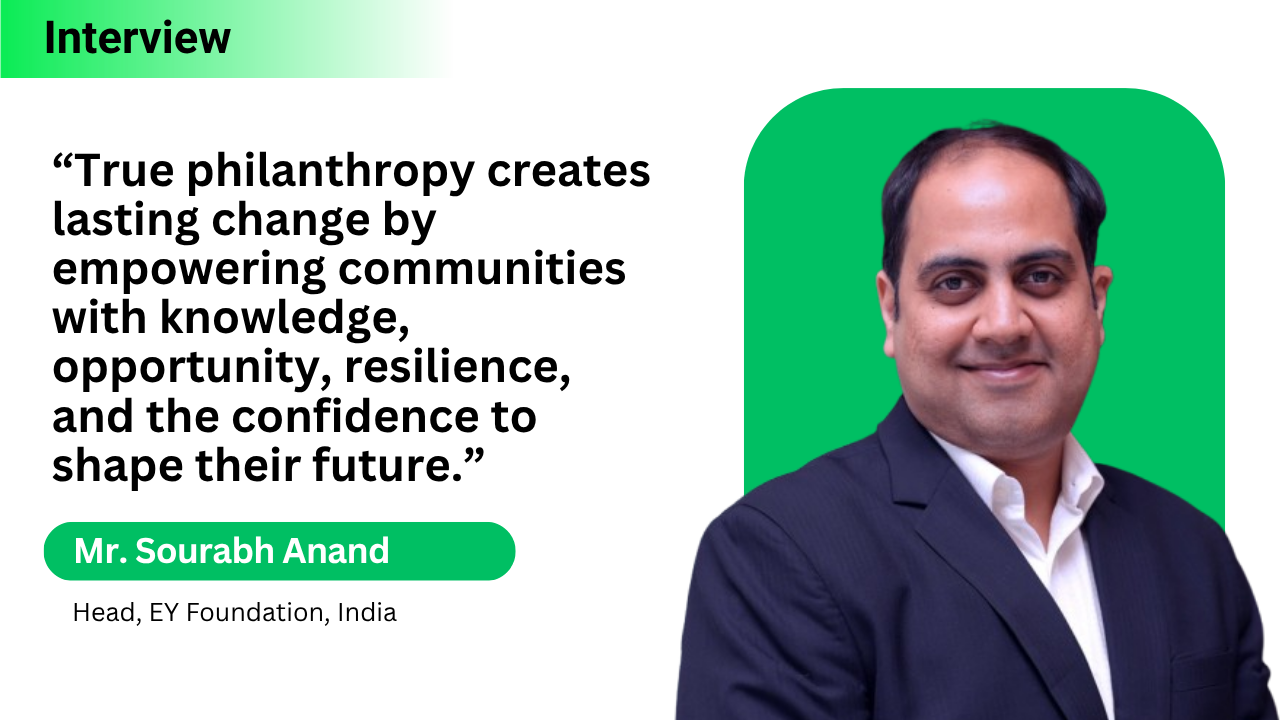
In this interview, Mr. Sourabh Anand, Head, EY Foundation, India, discusses how the Foundation’s understanding of meaningful philanthropy has evolved, why communities must be treated as co-creators of change, and what the experiences of its education and rural entrepreneurship programmes reveal about confidence, livelihoods and economic mobility. He also speaks about linking water conservation with livelihood resilience and the role of philanthropy in addressing the twin priorities of water security and future ready skills in the years ahead.
Scroll down to read the full interview:
Q. How has the evolution of CSR from welfare to inclusion, livelihoods and systemic change shaped EY Foundation’s approach to meaningful philanthropy, and how do Education, Entrepreneurship and Environment work together to address the root causes of vulnerability?
A. Over the last two decades, our work at EY Foundation in Indiahas strengthened our belief that philanthropy must do more than address immediate needs. It should create opportunities for people and communities to build better futures for themselves.
We began with a focus on education because of its power to transform lives across generations. Access to education, however, is the first step – it must also lead to employability, livelihoods, entrepreneurship and financial independence. This understanding shaped our approach and led us to focus on three interconnected areas: education, entrepreneurship and environmental sustainability.
Throughout this journey, one principle has remained constant: lasting social change cannot be achieved through one-time interventions. It requires long-term partnerships, built on trust and respect, and solutions that reflect the realities and aspirations of the communities they serve. Our experience has also shown that large-scale impact requires strengthening the systems around people. This means supporting institutions, building local capabilities, encouraging collaboration and enabling communities to lead and sustain change themselves.
For us, meaningful philanthropy is about helping people develop the skills, opportunities and resilience needed to shape their own futures. Its success is measured not only by what is achieved today, but by the confidence, agency and opportunities it creates for tomorrow.
This philosophy continues to guide our work across education, entrepreneurship and environment, where we have worked alongside underserved communities for more than twenty years to create impact that is inclusive, sustainable and enduring.
Q. How does EY Foundation’s approach of treating communities as co-creators shape the identification, design and adaptation of programmes to ensure they remain locally relevant and create lasting change?
A. For us, this begins with a simple belief: the people closest to a challenge are often best placed to help shape its solutions. That is why we see communities not as beneficiaries, but as partners in creating change. Our work begins with listening. Every community has its own needs, aspirations and circumstances, so there is no one-size-fits-all solution. In many ways, communities show us the path and we become enablers – keeping a close ear with the help of local NGOs, community groups and institutions is important to understand local realities and design programmes that are relevant, effective and sustainable.
Our approach is guided by a clear long-term vision for impact, but we also recognise that change is rarely linear. Regular feedback from communities and partners helps us understand what is working, address challenges and adapt our approach when needed.
This philosophy is reflected across our focus areas. In our entrepreneurship programmes, local partners and community institutions play a key role in identifying opportunities, mobilising participants and helping women build skills, confidence and stronger livelihoods. In our environmental initiatives, communities are actively involved in planning and managing water conservation efforts, helping ensure that the benefits continue long after the project has ended. Meaningful change takes time, which is why we invest in long-term partnerships. Many of our NGO partners have worked with us for years, allowing us to move beyond programme delivery and focus on building local capacity, strengthening institutions and supporting community-led development.
Ultimately, we measure success not by the number of activities completed, but by whether communities have the confidence, capabilities and ownership to continue driving progress on their own. When that happens, change becomes truly lasting.
Q. EY Disha goes beyond financial assistance into a more holistic model involving mentorship, communication skills, and career guidance. What have you learnt about the factors that determine whether educational support actually translates into long-term social and economic mobility?
A. From the beginning, EY Disha Scholarship was designed around the belief that supporting a student's education means more than helping them stay in school or college. It is equally important to equip them with the confidence, skills and opportunities they need to build successful careers and shape their own futures.
Most Disha scholars are first-generation learners and often the first in their families to pursue higher education. While scholarships help remove financial barriers, mentorship, career guidance and exposure to professional networks help students navigate opportunities that may otherwise seem out of reach.
This belief has shaped the evolution of EY Disha from a scholarship programme into a holistic development initiative. Since its launch in 2007, the programme has supported over 10,000 scholars, with more than 3,500 students currently enrolled and around 1,100 new scholars joining every year.
A key strength of the programme is the active involvement of EY professionals, who volunteer as mentors and role models. Through mentoring, resume-building workshops, mock interviews and career guidance sessions, scholars gain valuable exposure to the workplace and develop the confidence to pursue their ambitions.
As the world of work changes, our focus is expanding from career readiness to future readiness. We want scholars to be equipped not only for today's jobs but also for emerging opportunities, with the adaptability and continuous learning mindset needed to succeed in a rapidly evolving economy.
The impact of the programme is best reflected in the journeys of its scholars. Sujan Chowdhury, from a small town in West Bengal, credits EY Disha with helping him develop the confidence, leadership and communication skills that shaped his career. Today, he works with ATP STEM Education & Training Services in the UAE. Similarly, Dr. Nupur Goswami overcame financial challenges to complete a Ph.D. at IIT Bombay and is now a Post-Doctoral Research Associate at the University of Cambridge.
Over the years, Disha scholars have gone on to build successful careers in leading companies, consulting firms, research institutions, public sector organisations and the armed forces. Many have joined EY, while others have pursued higher education and become role models within their families and communities. Increasingly, alumni are also returning as mentors, creating a cycle of support and inspiration for future scholars.
EY Disha has reinforced our belief that education creates the greatest impact when it goes beyond financial assistance and focuses on building aspirations, confidence and capabilities. Going forward, we aim to strengthen this support through deeper mentorship, enhanced career-readiness programmes and greater exposure to future-focused skills such as digital literacy, AI and problem-solving.
Ultimately, our goal is not just to help students complete their education, but to empower them to thrive, lead and create opportunities for others.
Q. The Foundation’s rural entrepreneurship programmes have reached more than 480,000 women across nine states, with the stated objective of helping women move towards sustainable incomes. What evidence are you seeing around sustained income growth, enterprise continuity and greater decision-making power among the women who have participated?
A. One of the most encouraging outcomes of our rural entrepreneurship work is that the impact goes far beyond increasing incomes. We are seeing women become more confident, financially secure and empowered to make decisions about their own lives and futures.
Our focus has always been on helping women build sustainable livelihoods. Working closely with grassroots partners, Self-Help Groups and community institutions created under government rural livelihood programmes, we support women through skills training, market access, financial services and mentoring. As a result, many women are increasing their incomes, building savings and moving towards becoming "Lakhpati Didis" with annual earnings of over ₹1 lakh.
Many enterprises that started as small livelihood activities have grown into stable businesses over time. Women are diversifying their income sources, strengthening their enterprises and, in some cases, creating employment opportunities for others in their communities.
Some of the most significant changes can be seen within families. As women begin to earn and contribute regularly to household income, they often gain greater confidence and a stronger voice in family decisions. Many use their earnings to support their children's education, improve healthcare, provide better nutrition and create greater financial security for their families. We are also seeing more women take on leadership roles within Self-Help Groups and community institutions, helping drive change beyond their own households.
One such example is Priyanka Meena from Rajasthan, who transformed herself from a homemaker into a successful dairy entrepreneur. As part of the livelihood programme implemented by the Centre for Microfinance (CmF) in partnership with the Rajasthan Rural Livelihoods Mission (Rajeevika), Priyanka identified a key challenge faced by local dairy farmers who were dependent on informal milk vendors and often received low, inconsistent prices for their produce. With support from Self-Help Groups and community institutions she set up a milk collection centre that not only improved her family's livelihood but also helped nearly 70 dairy-farming households secure better prices and more reliable market access for their milk.
Ultimately, our goal is not just higher incomes, but greater empowerment. When women gain the confidence, skills and resources to make decisions, invest in their families and contribute to their communities, the benefits extend far beyond individual enterprises. They create lasting change for families, communities and future generations.
Q. How does EY Foundation measure the longer-term social, economic and environmental impact of its water conservation initiatives, particularly in terms of groundwater recharge, agricultural productivity, livelihood security and community resilience?
A. At EY Foundation, we believe that environmental sustainability and livelihood security are closely connected. For farming families, water is not just a natural resource. It affects incomes, food security, education, health and overall quality of life. That is why our environmental initiatives focus on "Water for Livelihoods", where improving water security helps strengthen both communities and the environment.
Across Rajasthan, Gujarat and Madhya Pradesh, we have worked to improve access to water through structures such as check dams, tanks, farm ponds and earthen dams. Together, these interventions have the potential to harvest nearly 1.5 billion litres of water annually, support irrigation across more than 6,000 acres of farmland and benefit over 8,500 farming households.
However, building water infrastructure is only part of the solution. Long-term impact depends on communities having the knowledge, tools and ownership needed to manage water resources effectively. This is why community participation is at the heart of our approach.
Our non-profit partners have worked closely with communities to form more than 110 Water User Groups that manage and maintain local water assets, promote equitable access and encourage community ownership. They have also introduced practices such as groundwater monitoring, water budgeting and local weather stations to help communities better understand and manage their water resources. Alongside this, technologies such as solar-powered lift irrigation and drip irrigation are improving water efficiency and supporting better farm productivity.
These efforts are also delivering important environmental benefits. Improved groundwater recharge, more efficient water use and community-led management are helping communities become more resilient to irregular rainfall, water scarcity and drought.
What is most encouraging is the wider impact that follows. Better access to water leads to stronger livelihoods, greater financial security for families and increased community ownership of local resources. When environmental sustainability and community wellbeing reinforce each other, the results are both meaningful and lasting.
Q. As EY Foundation enters its next phase, with greater emphasis on environmental stewardship, water conservation, and scalable community-led solutions, what do you see as the most important gaps that philanthropy and CSR in India must address over the next decade, and where does EY Foundation believe it can make the greatest difference?
A. As we look to the future, we see two areas that will be critical to India's development: water security and skilling for employment. While they may seem like different challenges, both are essential for building resilient communities and creating sustainable opportunities for people.
Water security is an area where we see significant potential for impact. As water stress increases across many parts of India, ensuring the sustainable management of water resources is becoming increasingly important. Building on our experience in environmental sustainability, we aim to continue supporting community-led solutions for groundwater recharge, water conservation and responsible water management, with a strong focus on local ownership and long-term resilience.
At the same time, India's young population represents one of the country's greatest strengths. With one of the world's largest youth populations, India has a unique opportunity to become a global talent hub. However, millions of young people still lack access to quality education, skills training and employment opportunities.
We see this as a natural extension of EY Foundation's work. Going forward, we want to play a larger role in helping young people prepare for the future by equipping them with the skills, knowledge and confidence needed to succeed in a changing economy. This includes not only technical and digital skills, but also communication, problem-solving, adaptability and a mindset of continuous learning.
Our goal is to help both urban and rural youth access meaningful livelihood opportunities while preparing them for emerging careers in an increasingly connected and technology-driven world. Ultimately, whether it is strengthening water security or improving employability, our purpose remains the same: to help individuals and communities build the capabilities, confidence and opportunities they need to thrive. Long-term development depends not only on protecting vital resources such as water, but also on empowering people, especially young people, to realise their potential and create a more resilient future for themselves and their communities.


.png)