Can NGO Partnerships Become the Missing Link in Management Education?
Management education is increasingly being called upon to prepare leaders for a world where business decisions intersect with social, environmental and ethical realities. As organisations navigate climate risks, inequality, changing workforce expectations and the implications of AI, the ability to understand people and communities is becoming as important as technical and analytical skills.
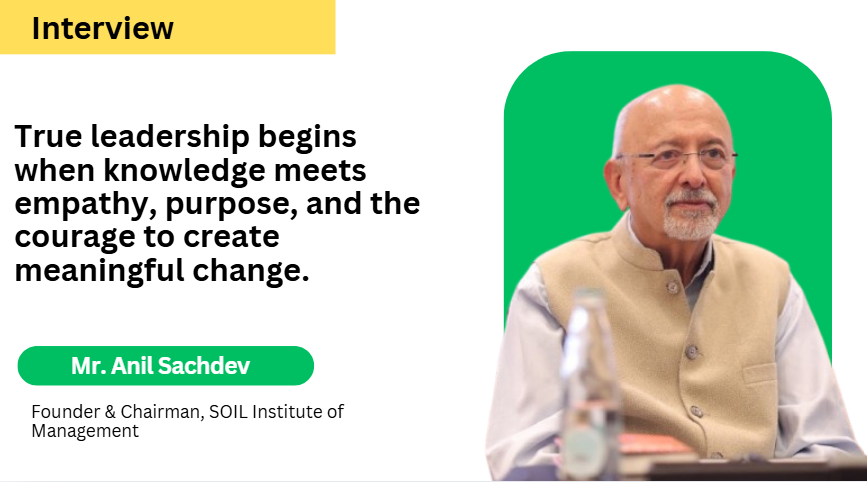
In this context, experiential engagement with the social sector can offer management students a different kind of classroom, one grounded in real world complexity, limited resources and diverse stakeholder needs. Drawing on his experience of over four decades in leadership development, Anil Sachdev, Founder & Chairman, SOIL Institute of Management, argues that partnerships with NGOs can help bridge this gap. He explores how working on community challenges can build empathy, systems thinking, adaptability and ethical decision making, while challenging students to look beyond conventional measures of organisational success. He also makes the case for giving social sector experiences greater academic and institutional weight as business schools rethink what it means to prepare responsible, future ready leaders.
Read the full article below.
Business schools have traditionally prepared students to solve organizational problems. They teach strategy, finance, marketing, operations, and increasingly, artificial intelligence and digital transformation. These capabilities remain essential. Yet the world our graduates are stepping into today demands something more.
Today's managers are expected to navigate climate challenges, widening inequalities, changing workforce expectations, ethical dilemmas, and increasingly complex stakeholder relationships. These are not problems that can be solved through spreadsheets alone. They require empathy, systems thinking, and the ability to understand realities very different from one's own.
This is where I believe management education has an opportunity to evolve.
Experiential learning has been recognized as one of the most effective ways of developing leaders. We encourage internships, live consulting assignments, industry projects, and international immersions because they expose students to real business challenges. But there is another learning environment that deserves equal attention: the social sector.
NGOs are often viewed as organizations working at the margins of society. In reality, many of them are laboratories of innovation. They work with limited resources, navigate complex stakeholder ecosystems, build trust within communities, and create measurable impact under conditions of uncertainty. These are precisely the kinds of leadership challenges that modern managers will increasingly encounter throughout their careers.
Working with an NGO is therefore not simply an act of social service. It is an opportunity to develop managerial capabilities that are difficult to cultivate inside a traditional classroom. One of the most valuable lessons students learn through such partnerships is perspective.
Business education often focuses on markets, consumers, and organizations. NGO engagement introduces students to citizens, communities, and ecosystems. It challenges assumptions about development, inclusion, and access. More importantly, it reminds future managers that every business decision eventually affects real people.
This shift in perspective changes the kinds of questions leaders begin to ask. Instead of asking, "How do we maximize efficiency?" they also ask, "Who benefits from this decision?" Instead of focusing only on profitability, they begin thinking about sustainability, accessibility, and long-term societal value. These are not competing priorities. Increasingly, they are becoming interconnected.
The corporate world itself reflects this change. ESG commitments, responsible business practices, stakeholder capitalism, and purpose-led leadership have moved from being peripheral conversations to strategic priorities. Organizations now expect leaders to understand social impact alongside business performance. That understanding cannot be developed through theory alone. It requires immersion.
When students spend time working with grassroots organizations, they encounter challenges that rarely fit neatly into management frameworks. They learn to operate with ambiguity, communicate across diverse communities, build trust without authority, and create solutions despite resource constraints.
Ironically, some of the most profound leadership lessons emerge in environments where resources are the scarcest. NGO partnerships also cultivate one quality that is becoming increasingly valuable in an AI-driven world: empathy. Artificial intelligence can analyze behaviour, but it cannot experience it. It can generate recommendations, but it cannot understand the lived realities behind them. As technology automates more analytical work, the distinct human ability to listen, relate, and exercise compassionate judgment becomes even more important.
Management education must therefore protect and strengthen these capabilities rather than assuming they develop automatically. At SOIL, this belief has shaped our educational philosophy for many years. Students engage with social enterprises, NGOs, and community initiatives not simply to fulfil academic requirements but to broaden their understanding of leadership itself. These experiences encourage reflection, challenge preconceived notions, and help students appreciate the interconnected nature of business and society.
However, this is not a model that should belong to one institution alone. The larger question is whether management education should build stronger and more sustained partnerships with the social sector.
Imagine if every management student spent meaningful time working alongside NGOs tackling education, healthcare, climate resilience, livelihoods, financial inclusion, or rural development. Imagine if social impact projects carried the same academic weight as corporate internships. The result would not simply be more socially aware graduates. It would be better managers.
Because the competencies developed through these experiences - adaptability, ethical reasoning, stakeholder management, collaborative problem-solving, and systems thinking are exactly the competencies organizations increasingly seek.
The future of management education will not be defined solely by how effectively it integrates artificial intelligence or emerging technologies into the curriculum. Those capabilities are undoubtedly important.
But equally important is ensuring that students do not lose sight of the human realities that business exists to serve. Perhaps the missing link in management education is not another course or another framework. It is creating more opportunities for future leaders to step outside the classroom, engage with communities, and understand that leadership is ultimately about creating value not only for organizations, but also for society.
If business schools can successfully build that bridge between enterprise and empathy, they will prepare graduates who are not only capable managers but also responsible leaders. And in a world facing increasingly interconnected challenges, that may be the most valuable education we can offer.