United Way Mumbai: Reimagining CSR Through Regenerative Agriculture
Farming communities cannot build lasting resilience when soil health, water security and household economics are treated as separate concerns. Regenerative agriculture offers a different proposition: restoring the health of the land while reducing cultivation costs, strengthening livelihoods and enabling communities to withstand increasing climate variability.
United Way Mumbai’s India Climate Action Project in Maharashtra’s Dharashiv district puts this approach to the test through field research, farmer-led adoption and measurable environmental and economic outcomes. The experience points to a broader shift in CSR thinking, from short-term agricultural inputs and infrastructure towards interventions designed to change practices, build local institutions and sustain impact beyond the project cycle.
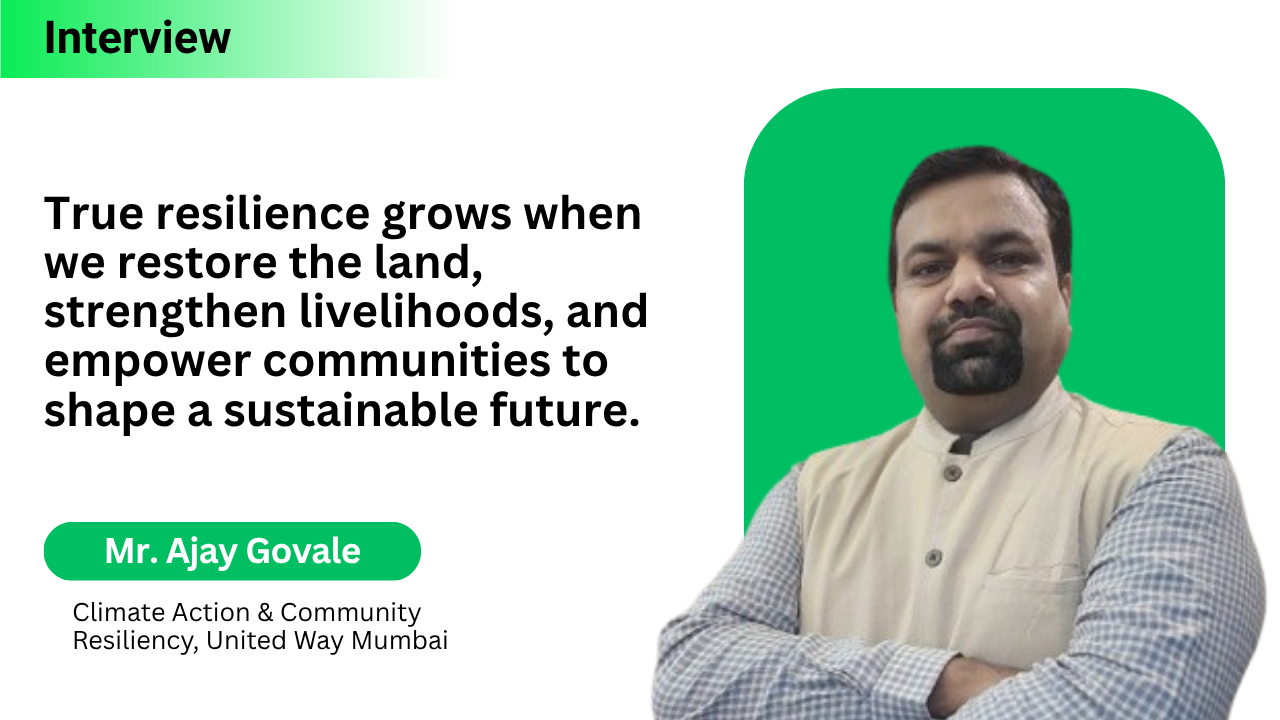
In this interview, Mr. Ajay Govale, Sr. Vice President, Climate Action & Community Resiliency, United Way Mumbai, discusses what the organisation’s work has revealed about regenerative farming, from significant reductions in cultivation costs and improved soil moisture retention to the role of farmer institutions and peer-led adoption. He also examines what it will take for corporates, civil society and government to move regenerative agriculture from promising pilots to a scalable rural resilience strategy.
Scroll down to read the full interview:
Q: Climate resilience has increasingly become a priority within corporate social responsibility. How do you see regenerative agriculture evolving from a sustainability intervention into a long-term rural development and livelihood strategy that businesses can meaningfully support?
A. Over the past few years, as the visible signs of climate change have become harder to ignore — erratic monsoons, prolonged dry spells, degrading soil health — we've seen a genuine uptick in CSR interest in climate resiliency interventions. That shift is welcome and reflects how seriously corporate India is beginning to engage with climate risk.
Regenerative agriculture, however, is still a relatively newer area within this space. Unlike more established interventions like renewable energy or afforestation, which offer a fairly direct, visual before-after narrative, regenerative agriculture involves a slower, layered process — soil biology, cropping systems, water cycles — that takes longer to show results. This is less a gap in corporate understanding and more an opportunity for implementing organisations like ours to invest in better storytelling and evidence-building.
There's also considerable work still needed to build awareness and appetite among farmers themselves. Regenerative practices — reduced tillage, crop rotation, organic inputs, cover cropping — ask farmers to depart from decades of conventional practice and absorb some short-term risk while soil health and yields stabilise. Our integrated watershed management work in Vidarbha and Marathwada has taught us that these practices only take root when introduced alongside water security measures and market linkages that give farmers tangible, near-term reasons to persist.
For regenerative agriculture to evolve into a genuine rural development and livelihood strategy, three shifts need to happen together — and we're seeing real corporate willingness on all three: committing to longer engagement horizons of three to five years, since that's the realistic timeframe for soil regeneration and income stability to show up; investing in farmer awareness and capacity building as an ongoing extension service rather than a one-time exercise; and building India-specific evidence on yield resilience and cost savings that makes the business case as compelling as it already is for solar or water conservation.
We're seeing more corporate partners lean into this with genuine curiosity, and that gives me real confidence that regenerative agriculture in India is on the cusp of moving from a niche interest to a mainstream rural development strategy.
Q: United Way Mumbai works across diverse social sectors, from health and education to community resilience. How does regenerative agriculture complement your broader CSR and philanthropy vision, and what role does it play in strengthening rural communities beyond improving farm productivity?
A. United Way Mumbai's work spans five pillars — Education & Youth Opportunity, Healthy Community, Financial Security, Climate Action & Community Resiliency. While regenerative agriculture sits within our Climate Action portfolio, its impact rarely stays confined to farm output — which is what makes it such a powerful entry point into rural communities.
Our own field research in Maharashtra’s Dharashiv district, conducted with ICAR-Indian Institute of Millets Research, illustrates this well. Across the regenerative farming models we piloted with farmers, we recorded measurable improvements in soil organic carbon, water-holding capacity, and nutrient availability — the underlying indicators of long-term land health. But the number that really speaks to farmers is cost: cultivation costs fell by as much as 89% in the rabi season within just two years, as reliance on synthetic fertilisers and pesticides dropped. That's not just an environmental outcome; it's a direct, near-term financial security outcome for smallholder households.
There's a health dividend too. With the reduction or complete elimination of chemical fertilisers and pesticides and the shift to organic farming, farmers and their families also gain access to safer, more nutritious food grown on their own land — a benefit that often gets overlooked when we talk about agricultural interventions purely in productivity terms.
That's really the pattern we see: financial security improves as input costs fall, easing the debt cycles many rural families face. Water security improves as regenerative practices work alongside water conservation structures to recharge groundwater. And health improves as communities move toward more diverse, chemical-free food systems.
There's also a quieter but equally important dividend: institution-building. At United Way Mumbai, we never treated regenerative agriculture as a top-down technical fix to be delivered and left behind. Instead, we deliberately anchored every intervention in village-level institutions — Village Development Committees, Water User Groups, Farmer Producer Organisations, and Women's Self-Help Groups — so that the knowledge, decision-making, and ownership stayed with the community. These institutions don't just plan and sustain the agricultural practices; they go on to anchor other interventions too, from disaster preparedness to women's economic empowerment, becoming a lasting piece of local infrastructure long after our direct engagement ends.
This is really where regenerative agriculture reflects our tagline, “Social Impact. Done Right” — it isn't a standalone climate project, but a strategic anchor, backed by field evidence, that lets us layer in financial security, health, and resilience outcomes in a way that's integrated, community-owned, and built to last.
Q: Many CSR initiatives in agriculture continue to focus on infrastructure or input support. In your view, what distinguishes regenerative agriculture as a more sustainable and community-led investment, and how can companies measure its long-term social and environmental returns?
A. Infrastructure and input support — borewells, farm equipment, subsidised seeds and fertilisers — often deliver visible, immediate results that make for good CSR reporting. But their impact tends to plateau once the support ends.
The key distinguishing factor of regenerative agriculture is that it isn't a one-time input delivered to a farmer — it requires concerted, sustained engagement over time to sensitise farmers and shift their behaviour and practices. That behaviour change is what makes farmers independent, able to sustain the impact on their own long after any external support ends. And critically, the same farmers who adopt regenerative practices and witness the results — better soil, lower costs, more resilient yields — become ambassadors themselves, encouraging fellow farmers in their village to adopt the same practices. That peer-driven spread is something infrastructure or input-based CSR simply cannot replicate.
United Way Mumbai’s work in the villages of Dharashivreflects this. What we tracked wasn't just seasonal output, but underlying health indicators — soil organic carbon, water-holding capacity, and nutrient availability — that determine whether the land keeps performing years down the line. Because these models reduce dependence on purchased inputs, cultivation costs fell by as much as 89% in the rabi season within just two years — a direct, near-term financial security outcome for farmers.
The community-led dimension reinforces this. Rather than a top-down technical fix, we anchor regenerative agriculture in Village Development Committees, Water User Groups, Farmer Producer Organisations, and Women's Self-Help Groups — institutions that carry the practice forward independently of us.
On measurement, I'd encourage companies to move beyond output indicators — farmers trained, acres covered — toward:
• Environmental returns: soil organic carbon, water-table trends, water-holding capacity, tracked over three to five years
• Economic returns: input cost trends, yield stability across good and bad monsoon years, reduction in agricultural debt
• Social returns: survival of farmer institutions and the emergence of farmer-ambassadors after direct project support ends — the truest test of whether ownership has genuinely transferred to the community
Companies that measure this way will find regenerative agriculture isn't a slower return on investment — it's one that keeps paying out well after the initial capital is spent.
Q: The India Climate Action Project study examined three regenerative farming models under similar agro-climatic conditions in Maharashtra. What were the most significant differences in outcomes across the Alley Farming, Agri-Horti and Integrated Farming models, and what lessons do these offers for designing future CSR-supported agricultural programmes?
A: Yes, the India Climate Action Project examined three regenerative farming models under similar agro-climatic conditions in Maharashtra. Before designing the models, we understood that farmers have different economic conditions, risk-bearing capacities, landholdings, and willingness to adopt new practices. Instead of introducing completely new farming systems, we developed three practical models by combining farming practices that farmers were already familiar with. The objective was to identify the best-fit model for different types of farmers while minimizing adoption risk.
The key question was not whether regenerative agriculture works, but which combination of practices delivers the best outcomes under similar climatic conditions and is most suitable for different farmer profiles.
Model I – Alley Farming:
In this model, horticultural plants were established along the farm boundaries, while the central area was used for mixed cropping and crop rotation. This was the simplest and lowest-risk model, allowing farmers to improve soil health and diversify crops without making major changes to their existing farming practices.
Model II – Agri-Horti:
This model built upon alley farming by integrating horticultural plantations within the cultivated field. Fruit trees were planted at 8-metre row spacing and 5-metre plant spacing, with annual crops grown between the rows. This created multiple income sources while maintaining regular crop production and improving long-term farm productivity.
Model III – Integrated Farming:
This was the most comprehensive model. It combined alley farming, agri-horti, a farm pond for water harvesting, and multilayer farming within the same landholding. The objective was to improve water security, diversify income, increase land-use efficiency, and make the farming system more resilient to climate variability.
The study showed that there is no single model that fits every farmer. The most suitable approach depends on factors such as land size, financial capacity, water availability, and the farmer's willingness to adopt new practices. This is an important lesson for CSR-supported agriculture programmes. Rather than promoting a single solution, projects should offer flexible models that farmers can choose based on their local conditions and capacity. Such an approach improves adoption, reduces implementation risks, and creates more sustainable long-term outcomes for farming communities.
Q: The study found up to a 40 percent increase in soil moisture retention, improvements in crop quality reported by nearly 59 percent of farmers and a positive correlation between regenerative practices and ecological health. Beyond these headline findings, which data points or field observations surprised your team the most, and why?
A: One of the biggest learnings was that the use of organic agricultural inputs created benefits far beyond reducing farming costs or improving soil health.
We found that replacing synthetic NPK fertilizers with Jeevamrut, a locally prepared organic fertilizer, helped farmers save nearly ₹21,000 per acre. Similarly, using Dashaparni, a homemade biopesticide, reduced pesticide costs by around ₹4,500 per acre. At the same time, farmers reported fewer pest and disease incidences, which reduced the frequency of pesticide application and lowered labour costs.
What surprised us even more was how these practices made day-to-day farming operations easier. The addition of organic matter improved soil structure, making de-weeding less labour-intensive and easier to manage. Farmers also observed that healthier soils retained moisture for longer, which reduced the frequency of irrigation and saved both water and labour.
Another encouraging observation was that these operational improvements gave farmers greater confidence in adopting regenerative practices. They were not only seeing better soil health and improved crop quality but were also experiencing tangible benefits in terms of lower input costs, reduced labour requirements, and more efficient farm management.
These findings reinforced that regenerative agriculture is not only good for the environment it also makes farming simpler, more economical, and more resilient for farmers in the long run.
Q: Could you share quantitative insights into the scale of the India Climate Action Project? How many farmers, villages and acres were covered in the study, what was the duration of the intervention, and what measurable livelihood or income-related outcomes have emerged so far?
A: The India Climate Action Project was implemented in the Dharashiv district of Maharashtra, a semi-arid region in the Marathwada belt that is highly vulnerable to climate variability. The action research was conducted over 32 months with 25 farmersacross six villages in the micro-watersheds of the Lohara and Tuljapur blocks—Mardi, Nagral, Undergaon, Karla, Wanegaon, and Hipparga (Rava). The intervention focused on testing different regenerative agriculture models under similar agro-climatic conditions while strengthening local institutions such as Farmer Producer Organisations and Self-Help Groups.
Although the project began with just 25 demonstration farmers, continuous handholding, technical guidance, and farmer-to-farmer learning have resulted in the voluntary adoption of regenerative practices by more than 300 farmerstoday. This organic growth has been one of the strongest indicators of the project's success.
From a livelihood perspective, the results have been very encouraging. Farmers adopting regenerative practices experienced significant reductions in cultivation costs by replacing chemical inputs with locally prepared organic alternatives. The use of Jeevamrut saved farmers approximately ₹21,000 per acre by replacing synthetic NPK fertilizers, while Dashaparni reduced pesticide costs by nearly ₹4,500 per acre. Farmers also reported lower labour requirements due to easier weeding, reduced frequency of pesticide application, fewer pest and disease incidences, and less frequent irrigation because of improved soil moisture retention.
Beyond cost savings, the project demonstrated measurable environmental and productivity gains. Soil moisture retention improved by up to 40%, 59% of participating farmersreported better crop quality, and the study found a positive relationship between regenerative farming practices and improved ecological health. These outcomes indicate that regenerative agriculture can simultaneously improve farm profitability, reduce production risks, and strengthen long-term climate resilience.
Building on these learnings, the next phase, ICAP 2.0, will focus on expanding adoption through stronger farmer collectives, improving access to organic inputs, and strengthening local institutions so that regenerative agriculture becomes a self-sustaining community-led movement rather than a project-driven intervention.
Q: Water scarcity and soil degradation remain persistent challenges across several agricultural regions in India. Based on your findings in Marathwada, which regenerative interventions delivered the greatest impact on improving climate resilience while also enhancing farmers’ economic security?
A. Marathwada's semi-arid character means water scarcity and soil degradation are almost always two sides of the same problem — degraded soil holds less moisture, and moisture-stressed land degrades faster. So the interventions that worked best for us were the ones that addressed both simultaneously, rather than treating them as separate problems.
Our field research in Dharashiv, conducted with ICAR-Indian Institute of Millets Research, tested three regenerative models over two years, and a few clear patterns emerged.
The Agri-Horti model — combining horticultural plantations along field borders with mixed cropping in the core, and no chemical inputs — delivered the most balanced results overall. It showed the strongest gains in potassium availability and water-holding capacity, and cultivation costs in this model, like the others, fell sharply as farmers stopped purchasing synthetic fertilisers and pesticides. This combination of soil health improvement and cost reduction is what makes it particularly compelling for economic security: farmers aren't just producing more sustainably; they're spending significantly less to do so.
The Integrated Farming model, which incorporated a farm pond alongside multilayer cropping and horticulture, showed the highest post-harvest soil moisture retention of all three models — pointing to real potential for long-term drought resilience, since water availability, not just soil health, is often the binding constraint in Marathwada. This suggests that pairing regenerative cropping practices with even small-scale water harvesting structures can meaningfully extend a farm's resilience through dry spells.
On the cost side, the results were striking across all models — rabi season cultivation costs fell by as much as 89% within two years, as farmers moved away from dependence on purchased inputs. This is arguably the most persuasive economic security outcome for smallholders in Marathwada, where debt tied to input costs is a major driver of agrarian distress.
If I had to point to a single takeaway for corporates designing interventions in similarly water-stressed districts, it would be this: don't choose between soil health and water security — the models that combined both, like Agri-Horti with water harvesting elements, delivered the most durable resilience and the clearest economic upside for farmers.
Q: One of the biggest barriers to sustainable farming is often the initial transition period. From your experience on the ground, what behavioural, financial or institutional challenges do farmers encounter while adopting regenerative agriculture, and how can CSR programmeshelp address these barriers more effectively?
A: The Action Research project, with its focus on water conservation, soil health, and strengthened village-level institutions, such as Farmer Producer Organisations and Self-Help Groups, created the foundation for introducing regenerative agriculture. While the practices were initially new to many farmers, continued engagement, technical guidance, and peer learning encouraged gradual adoption, with participation growing from 25 to over 300 farmers today.United Way Mumbai also strategically worked with some of the mid-sized but progressive farmers to demonstrate some of the models. This helped us in creating a proof of concept for the other fellow farmers to get motivated and follow the same. The next phase, ICAP 2.0, will focus on strengthening farmer collectives and local systems to help sustain these practices over the long term.
Q: Scaling regenerative agriculture requires collaboration among corporates, civil society, governments and farming communities. What partnership model has proven most effective for United Way Mumbai, and what additional policy or private-sector support would accelerate adoption across climate-vulnerable regions?
A. The model that has worked best for us is one where each stakeholder contributes what it's genuinely best placed to contribute, rather than a corporate simply funding an NGO to execute in isolation. Our Dharashiv work is a good example: our CSR funder provided the funding and long-term commitment, United Way Mumbai's in-house agriculture experts designed and led the regenerative farming models on the ground, and ICAR-Indian Institute of Millets Research partnered with us on the scientific validation of crop and soil data, lending research rigour to the findings. Each of those roles is distinct, and that's really the point: effective partnerships aren't just about pooling money, they're about combining capabilities that don't exist together in any single organisation.
Layered onto this, government engagement matters enormously, even when government isn't the primary funder. Local agricultural extension networks, Krishi Vigyan Kendras, and gram panchayats often hold the last-mile trust and infrastructure needed for adoption to spread beyond a pilot cohort, and we actively work to align our interventions with existing government schemes rather than run parallel to them. And farming communities themselves — through the Village Development Committees, Water User Groups, and Farmer Producer Organisations we help establish — aren't just beneficiaries in this model; they're co-designers, adapting practices to local conditions and eventually taking over implementation themselves.
On what would accelerate adoption further, I'd point to three things:
From corporates: Longer funding cycles. Regenerative outcomes take three to five years to show up meaningfully in soil health and farmer income, but many CSR grants are structured on one-year cycles. Multi-year commitments, even at modest scale, would do more for adoption than larger one-time grants.
From policy: Stronger linkages between regenerative and organic farming practices and existing government schemes — crop insurance, MSP mechanisms, and soil health cardprogrammes — so that farmers transitioning to regenerative practices don't bear disproportionate risk during the transition years when yields and practices are still stabilising.
From the sector broadly: Shared, standardised measurement frameworks. This isn't a hypothetical ask — the world is already moving in this direction. Globally, bodies like the World Business Council for Sustainable Development, through its Regen10 initiative, are working to align major agri-food companies around common outcome indicators, and industry platforms like SAI Platform have recently launched frameworks to standardise how companies define, measure, and verify regenerative progress. What's still missing is an equivalent that's calibrated for the Indian smallholder context — semi-arid, rain-fed geographies like Marathwada, with farm sizes and constraints very different from the commercial supply chains these global frameworks were largely built around. That's exactly the gap Indian CSR and civil society could fill, and it would strengthen the case for corporates to invest at scale, the way credible carbon accounting standards have done for climate finance more broadly.
Ultimately, scaling this beyond pilot districts like Dharashivwill depend less on any single stakeholder doing more, and more on all four — corporates, government, civil society, and farmers — treating this as a shared, long-term investment rather than a series of separate, short-term interventions.
Q: Looking ahead, how does United Way Mumbai plan to build on the findings of the India Climate Action Project? Are there plans to expand the programme geographically, introduce new impact indicators or strengthen evidence generation to encourage greater corporate investment in regenerative agriculture and rural resilience?
A. The India Climate Action Project has provided valuable evidence on what works in regenerative agriculture, and we are now building on these learnings through ICAP 2.0. Our focus is not only on expanding the programme but also on creating systems that make regenerative agriculture sustainable beyond the project period.
• Geographical Expansion: The next phase has already been initiated in the same blocks wherein, we continue to work with the villages of first phase and we have also expanded the geography to include a few more adjoining villages with the aim to reach out to over 2,900 farmers. Further, in the near future, we also plan to scale the programme to more climate-vulnerable areas in Marathwada and Vidarbha, adapting the regenerative agriculture models based on local farming conditions, water availability, and farmer needs.
• Strengthening Farmer Institutions: One of our key priorities is establishing and strengthening Farmer Producer Organisations. These FPOs will focus on millet processing and value addition, helping farmers access better markets and improve their incomes. They will also work to produce and supply quality organic agricultural inputs such as Jeevamrutand other bio-inputs, which are often difficult for farmers to source in the market. Today, the availability and authenticity of organic inputs remain major challenges, and local production through FPOs can help address both issues.
• Building Stronger Evidence: We will continue to monitor environmental, economic, and social outcomes over multiple seasons. Along with indicators such as soil health, water conservation, crop productivity, and farmer incomes, we aim to generate stronger evidence on the long-term benefits of regenerative agriculture to support better decision-making by corporates and policymakers.
• Encouraging Corporate Investment: By generating credible field evidence and demonstrating measurable impact, we hope to encourage more companies to invest in regenerative agriculture as a long-term climate resilience and rural development strategy rather than as a short-term CSR intervention.
Our long-term vision is to create self-sustaining farming ecosystems where strong farmer institutions, local availability of organic inputs, better market access, and evidence-based decision-making enable regenerative agriculture to scale across climate-vulnerable regions with reduced dependence on external support.










.png)