Technology for Good: How Synergy Connect is Strengthening Governance, Transparency, and Social Impact
The future of social impact will not be defined by how much money is spent—it will be defined by how well that impact is measured, understood, and improved. As CSR, ESG, and sustainable development become increasingly data-driven, technology is emerging as the bridge between good intentions and measurable outcomes. For organizations working across diverse geographies and communities, digital platforms are no longer just operational tools; they are becoming essential for transparency, accountability, and better decision-making.
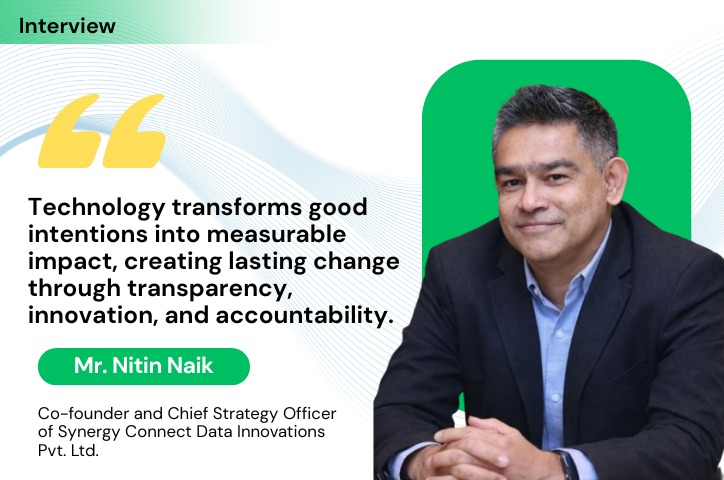
In this exclusive interview, Nitin Naik, Co-founder and Chief Strategy Officer of Synergy Connect Data Innovations Pvt. Ltd., shares how he and Co-founder Nilesh N. Khanolkar,CEO have built the company to help transform the development sector through technology. Naik brings more than 25 years of development-sector experience, while Khanolkar has been the technology and product pillar behind Synergy Connect's platforms and scale. Together, they have shaped an integrated technology ecosystem that simplifies CSR, ESG, grant management, program monitoring, and impact measurement. The conversation explores the role of AI, GIS, mobile applications, real-time analytics, and data intelligence in improving governance and implementation. From supporting grassroots organizations to enabling large-scale government and CSR initiatives, Naik explains how technology can strengthen transparency, enhance collaboration, and help organizations move from reporting activities to creating measurable social impact.
Scroll down to read more:
Q. What is the vision behind Synergy Connect, and what key gaps in the development sector are you trying to address through your technology solutions?
A. The vision behind Synergy Connect is simple yet ambitious: to make impact visible, measurable, and actionable through technology.
Having worked in the development sector for over 25 years across health, livelihoods, agriculture, financial inclusion, and community development, I observed a recurring challenge—organizations were creating tremendous social impact, but they often lacked integrated systems to capture, monitor, and communicate that impact effectively.
The social sector has traditionally struggled with several critical gaps:
- Fragmented data spread across spreadsheets and multiple systems.
- Limited real-time visibility into program performance.
- Manual reporting processes that consume valuable resources.
- Difficulty in measuring outcomes and long-term impact.
- Lack of evidence-based decision-making.
- Limited use of technology, AI, and analytics in program management.
Together with my co-founder, Nilesh N. Khanolkar, we founded Synergy Connect to bridge these gaps. Nilesh's technology and product leadership complemented my development-sector experience, enabling us to build a technology ecosystem specifically for the sector. The platform integrates data capture, project management, monitoring and evaluation, GIS, analytics, compliance, and impact measurement into one unified ecosystem.
Our objective is not simply digitization. It is to enable organizations to answer fundamental questions:
- Are we reaching the right beneficiaries?
- Are our interventions creating measurable change?
- Where should resources be allocated?
- What is the long-term social return on investment?
We believe technology should become an enabler of better governance, greater transparency, and more meaningful social outcomes.
Q. How can technology help simplify and strengthen CSR, ESG, grant management, and development sector operations?
A. Technology helps simplify and strengthen CSR, ESG, grant management, and development sector operations by making processes more efficient, transparent, and data-driven.
Key ways technology adds value:
- Automates workflows – Reduces manual effort in project approvals, grant applications, fund disbursements, and reporting.
- Centralizes data – Brings CSR, ESG, and program information into one platform for better visibility and decision-making.
- Improves compliance – Helps track regulatory requirements, maintain audit trails, and manage documentation.
- Enhances monitoring and impact measurement – Enables real-time tracking of projects, beneficiaries, outcomes, and fund utilization.
- Strengthens stakeholder engagement – Facilitates communication with NGOs, donors, beneficiaries, and other stakeholders.
- Generates actionable insights – Uses dashboards, analytics, and AI to support informed decision-making and strategic planning.
- Increases transparency and accountability – Provides accurate, timely reporting for leadership, funders, regulators, and communities.
In essence, technology enables organizations to spend less time on administration and more time creating measurable social and environmental impact.
Q. Many organizations still rely on multiple disconnected systems for reporting and monitoring. How important is it to move towards integrated impact management platforms?
A. Moving towards integrated impact management platforms is becoming increasingly important for organizations working in CSR, ESG, grant management, and the development sector.
When data is spread across spreadsheets, emails, reporting tools, and separate systems, organizations often face challenges such as data duplication, reporting delays, limited visibility, and difficulty measuring impact accurately.
An integrated platform brings all project, financial, beneficiary, compliance, and impact data into a single ecosystem, enabling:
- Better visibility through real-time dashboards and centralized data.
- Improved decision-making with accurate and consolidated insights.
- Enhanced efficiency by reducing manual data entry and reconciliation.
- Stronger compliance and governance through standardized processes and audit trails.
- More effective impact measurement by connecting activities, outputs, outcomes, and reporting in one place.
Ultimately, integrated platforms help organizations move beyond simply tracking activities to managing and demonstrating meaningful impact, making them an essential tool for scaling programs and improving accountability.
Q. Why is data-driven decision-making becoming increasingly important for CSR programs, NGOs, and donor-funded initiatives?
A. Data-driven decision-making is becoming increasingly important for CSR programs, NGOs, and donor-funded initiatives because stakeholders today expect greater accountability, transparency, and measurable impact.
By leveraging data, organizations can move beyond assumptions and make informed decisions based on real evidence. This helps them identify needs more accurately, allocate resources effectively, monitor program performance, and measure outcomes with greater confidence.
Data-driven approaches enable organizations to:
- Track progress and impact in real time.
- Identify challenges and opportunities early.
- Improve program effectiveness and resource utilization.
- Strengthen reporting to donors, boards, and regulators.
- Demonstrate tangible social and environmental outcomes.
Ultimately, data empowers organizations to make smarter decisions, maximize the value of their investments, and create more meaningful and sustainable impact for the communities they serve.
Q. What are some of the biggest challenges organizations face when managing social impact programs at scale, and how can digital transformation help address them?
A. As social impact programs grow in size and complexity, organizations often face challenges such as fragmented data, manual processes, limited visibility into program performance, compliance requirements, and difficulties in measuring long-term impact.
Digital transformation helps address these challenges by streamlining operations, centralizing data, and enabling real-time monitoring and reporting. It allows organizations to automate routine tasks, improve collaboration among stakeholders, track outcomes more effectively, and generate actionable insights through dashboards and analytics.
By adopting digital tools and integrated platforms, organizations can enhance efficiency, strengthen accountability, improve decision-making, and focus more resources on delivering meaningful and measurable impact at scale.
Q. How are technologies such as AI, GIS, mobile applications, and real-time analytics improving program monitoring and implementation efficiency?
A. Technologies such as AI, GIS, mobile applications, and real-time analytics are transforming how organizations monitor, manage, and scale social impact programs.
Artificial Intelligence (AI) helps analyze large volumes of data, identify trends, predict risks, and generate actionable insights for better decision-making.
Geographic Information Systems (GIS) enable location-based mapping and visualization of projects, helping organizations identify coverage gaps, monitor interventions, and plan resources more effectively.
Mobile applications allow field teams to collect and submit data instantly, improving the accuracy, speed, and reliability of program monitoring.
Real-time analytics and dashboards provide immediate visibility into program performance, enabling organizations to track progress, address challenges quickly, and make informed decisions.
Together, these technologies improve monitoring accuracy, enhance operational efficiency, strengthen accountability, and enable organizations to deliver greater impact with faster and more informed interventions.
Q. Synergy Connect focuses exclusively on the development sector. What led to this sector-specific approach, and how does it influence the way your platforms are designed?
A. Our sector-specific approach comes directly from experience.
Before starting Synergy Connect, I spent more than two decades working closely with governments, NGOs, international agencies, and communities. I realized that the development sector cannot simply adopt solutions designed for commercial enterprises. My co-founder, Nilesh N. Khanolkar, brought the complementary technology architecture, product-development, and delivery perspective required to translate this sector understanding into secure, scalable, and user-friendly digital platforms.
The social sector has unique requirements:
- Multi-stakeholder ecosystems
- Diverse funding and compliance requirements
- Long implementation cycles
- Complex beneficiary journeys
- Need for offline and multilingual solutions
- Evidence generation and impact reporting
- High accountability to donors and communities
Most generic software solutions fail to understand these realities.
Therefore, Nilesh and I decided to build technology exclusively for social impact organizations, embedding development-sector thinking and robust technology architecture into our products from the beginning.
This influences our platform design in several ways:
- Mobile-first and offline capabilities for rural environments.
- Multilingual interfaces.
- Flexible program and indicator frameworks.
- Integrated Monitoring, Evaluation, and Learning (MEL).
- CSR and donor reporting frameworks.
- GIS and geospatial intelligence.
- Outcome and impact measurement capabilities.
- Data privacy and governance considerations.
Because we understand the sector deeply, our platforms are designed not merely as software products but as digital transformation ecosystems for social development organizations.
Q. What is the long-term vision guiding Synergy Connect, and how do you see its role evolving within India's social development ecosystem? What critical gaps in the social sector is the platform designed to address?
A. Our shared long-term vision—shaped by Nilesh N. Khanolkar and me—is for Synergy Connect to become India's leading Impact Intelligence and Technology Platform for the social sector.
We believe the next decade of development will be driven by:
- Data intelligence
- Artificial Intelligence
- Geospatial analytics
- Real-time evidence generation
- Predictive decision-making
- Integrated impact ecosystems
Our aspiration is to create a digital backbone that enables governments, CSR foundations, NGOs, and donor agencies to make more informed and effective decisions.
The critical gaps we seek to address include:
Data Fragmentation
Organizations often maintain multiple disconnected systems that do not communicate with each other.
Limited Outcome Measurement
Most organizations report activities and outputs but struggle to measure outcomes and long-term impact.
Lack of Real-Time Intelligence
Decision-making frequently depends on outdated reports rather than current information.
Weak Institutional Memory
Years of program knowledge remain undocumented and inaccessible.
Limited Technology Adoption
Many organizations still rely on manual processes despite increasing scale and complexity.
Absence of Impact Intelligence
There is a need to move beyond MIS and reporting towards predictive insights and evidence-based planning.
Over time, we see Synergy Connect evolving into an Impact Intelligence Company, helping institutions transform data into knowledge, knowledge into decisions, and decisions into measurable social change.
Q. How do you see the role of CSR evolving from a compliance-driven function to an impact-driven strategy, and what role does technology play in enabling measurable ESG and SDG outcomes?
A. The role of CSR is rapidly evolving from a compliance-driven obligation to a strategic driver of sustainable business value and social impact. While regulatory compliance remains important, organizations today are increasingly focused on creating measurable outcomes that align with business objectives, stakeholder expectations, and global sustainability goals.
This shift requires CSR initiatives to move beyond tracking activities and expenditures to demonstrating tangible impact on communities, the environment, and society. Organizations are now expected to show how their investments contribute to broader ESG commitments and global frameworks such as the United Nations Sustainable Development Goals (SDGs).
Technology plays a critical role in enabling this transformation by providing tools to collect, manage, analyze, and report impact data more effectively. Integrated platforms, real-time dashboards, AI-driven analytics, and digital monitoring systems help organizations track outcomes, measure progress against ESG and SDG targets, and make evidence-based decisions.
Ultimately, technology empowers organizations to move from simply reporting what they have done to demonstrating the value and impact they have created, making CSR a strategic function that drives both business resilience and sustainable development.
Q. Could you share how collaboration with your current partners—including CSR foundations, NGOs, government institutions, and donor agencies—has helped strengthen and enhance your efforts over the years?
A. Our journey has been built on partnerships. Nilesh and I have always believed that the strongest technology solutions emerge when sector knowledge, product thinking, and implementation experience come together.
Every major innovation at Synergy Connect has emerged through close collaboration with our partners.
Working with CSR foundations has helped us understand governance, compliance, and board-level reporting requirements.
Partnerships with NGOs have taught us the realities of grassroots implementation, community engagement, and beneficiary-centric program design.
Government collaborations have challenged us to build scalable, secure, and high-volume systems capable of serving millions of beneficiaries.
Engagements with donor agencies and international organizations have strengthened our understanding of Monitoring, Evaluation, Learning (MEL), impact assessment, and evidence generation.
These collaborations have enabled us to:
- Build solutions that are practical and field-tested.
- Continuously innovate based on real-world challenges.
- Develop platforms that can scale across geographies and thematic areas.
- Strengthen our understanding of social impact measurement.
- Create products that balance technology with human and community needs.
We see our partners not as clients, but as co-creators of innovation in the social sector.
Q. Looking ahead, what are Synergy Connect's key priorities for advancing data intelligence, impact measurement, and technology adoption in the social sector?
A. The social sector is entering a transformational phase where technology will become central to development planning and execution.
Under the shared leadership of Co-founders Nitin Naik and Nilesh N. Khanolkar, our priorities over the next few years are focused around five areas:
1. Building Impact Intelligence Platforms
Moving beyond dashboards to AI-powered decision-support systems that generate insights and recommendations.
2. Strengthening Data Management and Governance
Helping organizations improve data quality, interoperability, privacy, and governance in line with emerging regulations.
3. Advancing SROI and Impact Measurement
Developing frameworks that measure social, economic, and environmental outcomes and demonstrate long-term value creation.
4. Scaling Geospatial Intelligence
Integrating GIS, drone, and satellite technologies into development programs for planning, monitoring, and climate resilience.
5. Democratizing Technology for the Social Sector
Making advanced technologies affordable and accessible for NGOs and grassroots organizations that often have limited resources.
Ultimately, our mission remains unchanged:
To empower every social development organization with the technology, intelligence, and evidence needed to create greater impact, improve accountability, and build a more equitable and sustainable future for India.





.png)