Redington Foundation Builds AI Skills Beyond Metros
Artificial intelligence is rapidly becoming a defining force in the future of work, but access to the skills needed to participate in that economy remains uneven. For India, the challenge is no longer only about expanding digital access, but about ensuring that advanced capabilities such as AI are not concentrated within established technology hubs.
Against this backdrop, Redington Foundation is taking a more institution-led approach to digital skilling through its AI Learning Centre initiative, designed to build AI capabilities across Tier-2 and Tier-3 cities. The model brings together academic institutions, technology expertise and grassroots implementation, with a focus on creating lasting infrastructure, strengthening faculty capabilities and establishing structured pathways from learning to employment and entrepreneurship.
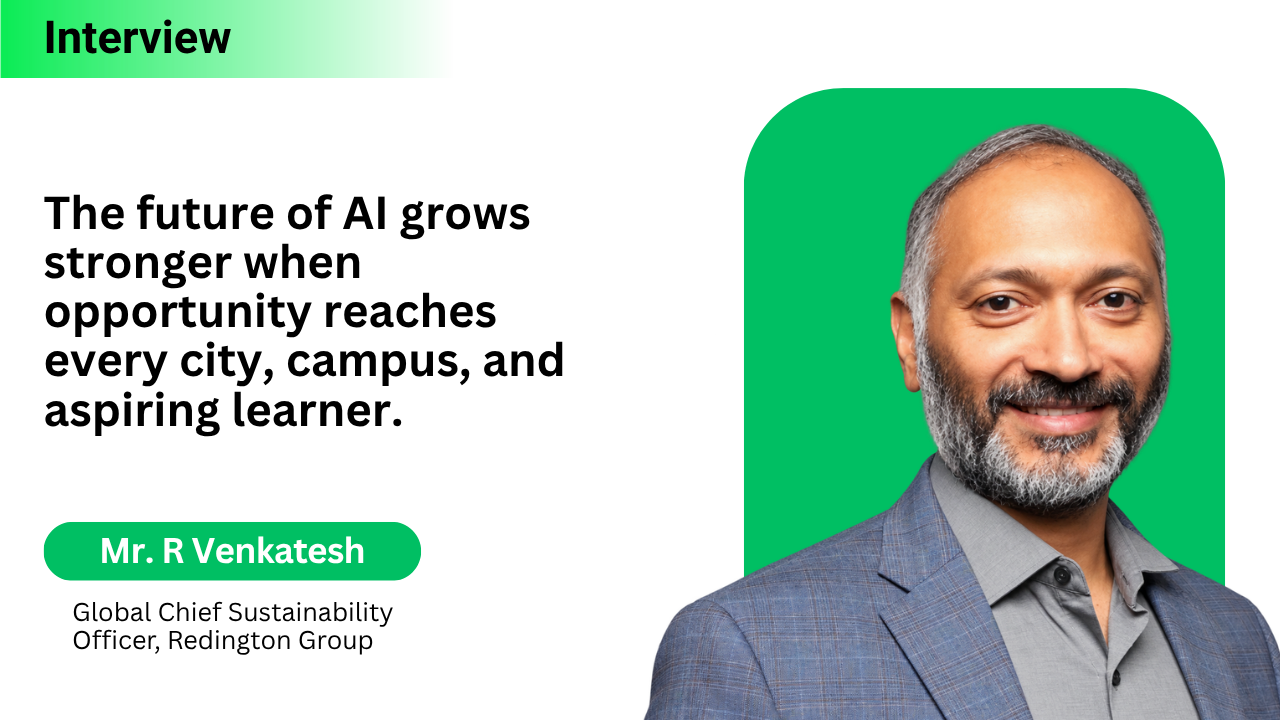
In this conversation, Mr. R Venkatesh, Global Chief Sustainability Officer, Redington Group, discusses how the Foundation is using philanthropy to widen access to advanced AI skills, why institutional capacity matters more than short-term training, and how partnerships with Microsoft and Nirmaan NGO are helping create a scalable talent ecosystem beyond metropolitan India. He also outlines the programme’s focus on responsible AI, measurable employability outcomes and its longer-term ambition to contribute to a more regionally distributed AI workforce.
Scroll down to read the full interview:
Q. As artificial intelligence reshapes industries and economies, what role do you believe corporate philanthropy should play in ensuring that the AI revolution remains inclusive rather than deepening existing socio-economic and regional inequalities?
A. As artificial intelligence transforms industries and economies, corporate philanthropy must move from episodic grants to building inclusive digital infrastructure and long-term skilling ecosystems, particularly for youth who are outside traditional technology hubs. With the AI Learning Centre, Redington Foundation is deliberately creating institutional AI hubs in Tier-2 and Tier-3 cities, combining advanced infrastructure, industry-aligned curricula and structured career pathways so that access to future-ready skills does not depend on being born in a metro.
We see philanthropy as a catalyst that can democratize advanced digital skills, expand AI talent pipelines beyond metropolitan regions, and promote responsible and ethical AI adoption. By empowering young minds from underserved geographies and aligning with the IndiaAI Mission, our goal is to ensure that India’s AI-led economic growth is both inclusive and impactful, rather than reinforcing existing socio-economic and regional divides.
Q. Many CSR initiatives focus on improving access to education, but future employability increasingly depends on emerging technology skills. How is Redington Foundation redefining its approach to education by aligning it with India’s evolving digital economy?
A. Traditional education-focused CSR has often stopped at access or basic digital literacy; our initiative is explicitly designed to bridge the gap between academia and the emerging AI-driven economy. Anchored in academic institutions and extended through a hub-and-spoke model, the AI Learning Centre combines advanced AI infrastructure, structured curriculum pathways, faculty enablement and real-world applications to prepare learners for India’s evolving digital economy.
Learners undergo a blended programme that starts with foundational AI literacy and Python programming and progresses into core AI domains such as machine learning, deep learning, natural language processing and computer vision. This is complemented by exposure to generative AI tools, prompt engineering, responsible AI and capstone projects, with Microsoft-aligned AI and cloud learning content ensuring global relevance and practical orientation.
Q. India’s AI talent conversation is often centred around metropolitan cities. What inspired Redington Foundation to focus on Tier-2 and Tier-3 cities, and what untapped potential do you believe exists within these emerging talent ecosystems?
A. As highlighted in multiple industry reports, India’s next wave of technology-led growth is expected to emerge from Tier-2 and Tier-3 cities. With improving digital infrastructure, a growing skilled talent pool, and rising investments from technology companies and Global Capability Centres (GCCs), these cities are set to become the country’s next innovation hubs. Our market research identified 25 high-potential cities that could drive this next phase of growth.
The AI Learning Centre initiative was conceived as an ambitious step towards democratizing advanced digital skills for youth from Tier 2 and Tier 3 cities across India, rather than concentrating opportunities in a few metros. By locating hubs in cities such as Coimbatore, Indore, Nagpur, Bhubaneswar and Gandhinagar, we enable aspiring learners to access future-ready AI and digital skills without needing to migrate to metropolitan centres.
We believe there is significant untapped potential in these emerging talent ecosystems: young people who are aspirational, academically strong and deeply rooted in their local communities. By building a diverse, job-ready and innovation-driven AI workforce from underserved geographies, we not only broaden India’s talent base but also contribute to more regionally balanced economic growth.
Q. The AI Learning Centre initiative is built on an industry-academia partnership involving Microsoft and Nirmaan NGO. From your perspective, what makes such multi-stakeholder collaborations more effective than standalone CSR interventions in addressing complex workforce challenges?
A. The AI Learning Centre initiative is deliberately structured as a strategic collaboration between Redington Foundation and Microsoft, with Nirmaan NGO as the implementing partner, to create a scalable, inclusive AI skilling ecosystem. This multi-stakeholder model combines philanthropic vision, global technology expertise and grassroots implementation capabilities - anchoring the programme in academic institutions and extending it through a hub-and-spoke model.
Redington Foundation serves as the main anchor partner, monitoring the project at both strategic and operational levels; Microsoft acts as co-funding, knowledge and technology partner; and Nirmaan leads implementation across locations. Together, we integrate advanced AI infrastructure, structured curriculum pathways, faculty enablement and access to career readiness and applied projects, which is difficult to achieve through standalone CSR interventions.
Q. The programme aims to establish permanent AI learning hubs rather than deliver short-term training. How important is institutional capacity building, including faculty development and academic infrastructure, in ensuring that skilling initiatives create long-lasting impact?
A. A core design choice was to establish institutional AI learning hubs rather than offering short-term training, because sustainable impact in skilling comes from strengthening institutional capacity. The programme goes beyond standalone training to build academic infrastructure for AI, reinforce faculty capability through a cascade training model, and embed AI learning into the fabric of participating colleges.
By strengthening faculty enablement, structured pathways and on-campus AI infrastructure, we ensure that colleges can continue to deliver advanced AI and cloud curricula to successive batches of students. This institutional capacity building is what allows us to build a scalable and sustainable pipeline of AI-ready talent from emerging regions, rather than one-off cohorts.
Q. The curriculum combines technical competencies with responsible AI, cloud technologies and real-world projects. How did you determine the balance between cutting-edge technical knowledge and the ethical dimensions of AI, and why is this combination essential for future professionals?
A. The curriculum was consciously designed to balance cutting-edge technical competencies with the ethical dimensions of AI, cloud technologies and real-world projects. Learners progress from foundational AI literacy and Python to advanced domains like machine learning, deep learning, NLP and computer vision, while also gaining exposure to generative AI tools and prompt engineering.
At the same time, the programme also embeds responsible AI and applied AI use cases, along with project-based assessments and capstone projects, so that learners understand both what AI can do and how it should be used. Microsoft-aligned learning content and cloud exposure ensure global relevance and practical orientation, while the emphasis on responsible and ethical AI adoption aligns with the IndiaAI Mission and prepares future professionals to build trustworthy solutions.
Q. The selection process considers students’ interest, academic performance and income levels. How does this framework help ensure that opportunities reach deserving learners while maintaining the quality and outcomes of the programme?
A. To ensure that opportunities reach deserving learners while maintaining programme quality, students are selected based on a combination of interest, academic performance, and income levels. This framework allows us to identify youth who are motivated to pursue AI, have the academic preparedness to benefit from advanced technical content, and come from backgrounds where access to such opportunities is limited.
By bringing together these three dimensions - aspiration, merit and socio-economic need - we create cohorts that are both diverse and capable of successfully completing the rigorous curriculum. This is critical for sustaining high learning standards, strong project outcomes and meaningful employability gains across all participating institutions.
Q. With a target of skilling more than 5,000 students annually through five Hub Colleges and twenty SPOC Colleges, what key performance indicators will Redington Foundation track to evaluate the initiative’s success beyond enrolment numbers? Could you also share the placement, certification or employability targets you have established for the programme?
A. Beyond enrolment numbers, a primary success metric for the initiative is the number of youth who are meaningfully “skilled”. Our partners aim to reach and skill over 5,000 youth every year through the five Hub Colleges and twenty SPOC Colleges. We will therefore track progression through the blended curriculum, completion of capstone projects, engagement with Microsoft-aligned AI and cloud pathways, and participation in structured career and entrepreneurship pathways.
Given the programme’s strong emphasis on employability and entrepreneurship, we also focus on how many learners translate their skills into job readiness, innovation or venture creation, rather than measuring only training hours. As part of the committed outcomes, Nirmaan, our NGO implementation partner, will ensure that at least 70% of students are placed, 100% of students are certified, and retention is tracked for the next three to six months. Overall, our objective is to contribute a steady pipeline of job-ready, globally relevant AI talent from emerging regions.
Q. Can you share how responsibilities are distributed between Redington Foundation, Microsoft and Nirmaan NGO throughout the programme lifecycle, from curriculum design and technology enablement to implementation, monitoring and impact assessment? What governance mechanisms ensure consistency across all participating institutions?
A. On the ground, responsibilities are clearly distributed to leverage each partner’s strengths while ensuring consistent delivery across all institutions. Redington Foundation acts as the main anchor partner, providing strategic direction and monitoring the project from both strategic and operational levels.
Microsoft serves as a co-funding, knowledge, and technology partner, integrating its AI and cloud learning pathways and enabling access to advanced digital infrastructure. Nirmaan NGO functions as the implementing partner across locations, managing day-to-day execution in Hub and SPOC Colleges and ensuring that curriculum, faculty support and learner services are delivered as designed.
We maintain governance through this anchor-and-implementation structure, with Redington Foundation overseeing consistency, Microsoft aligning content and technology standards, and Nirmaan ensuring on-the-ground fidelity to the model across all participating institutions.
Q. If this initiative successfully demonstrates that globally relevant AI talent can emerge from beyond India’s traditional technology hubs, what is Redington Foundation’s long-term vision? Do you foresee expanding the model to additional states, disciplines or emerging technologies, and what scale of impact do you hope to achieve over the next five years?
A. If this initiative demonstrates that globally relevant AI talent can emerge from beyond India’s traditional technology hubs, our long-term vision is to deepen and scale this inclusive talent pipeline in alignment with the IndiaAI Mission. By building a diverse, job-ready and innovation-driven AI workforce from emerging regions, we hope to support India’s vision of becoming a global AI hub.
Over the next five years, we see this model as a blueprint for how academic institutions, technology companies and NGOs can collaboratively expand AI talent pipelines beyond metros, strengthen inclusive digital infrastructure for skilling and promote responsible AI adoption. Any future expansion will be guided by the same principles of equitable access, industry alignment and long-term institutional capacity building that underpin the current AI Learning Centre initiative.





.png)