From Waste to Wealth: How WeWork India’s EcoGram is Building Sustainable Communities
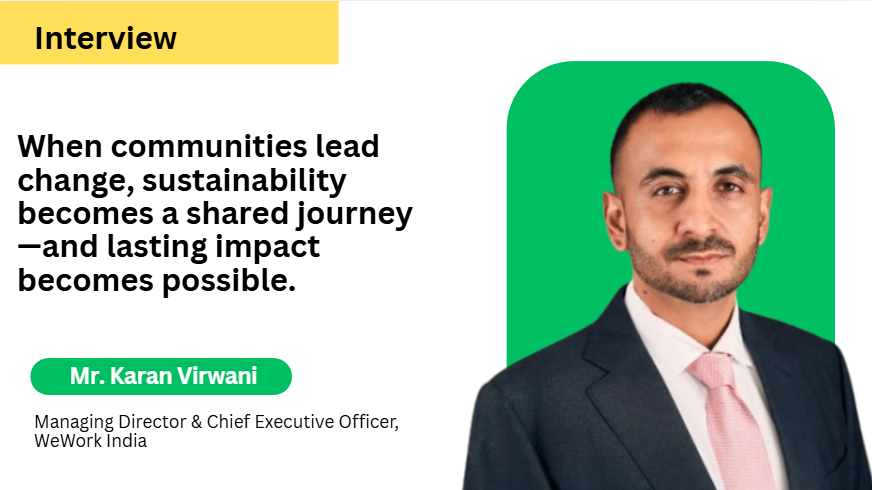
Real change begins when communities are not just part of the solution, but become owners of it. For nearly a decade, WeWork India’s EcoGram initiative has worked toward this idea across 10 villages in North Bengaluru, showing how environmental action can go hand in hand with stronger communities and sustainable livelihoods.
At the heart of this journey is the Tarahunise – Lake & Village Preservation project, which focuses on waste management, water conservation, and women’s empowerment. The initiative has achieved a 96.5% waste segregation rate, processed more than 1,575 metric tonnes of waste, and generated nearly ₹28 lakh in Gram Panchayat revenue, helping create a more financially sustainable waste management system.
In this interview, Karan Virwani, Managing Director & Chief Executive, WeWork India, shares how EcoGram has evolved from lake restoration into a community-led model for long-term environmental and social impact. He discusses the challenges of changing waste management behaviour, creating livelihoods for women, strengthening local governance, and building partnerships that can sustain impact beyond CSR funding.
Scroll down to read more:
Q. Through the EcoGram initiative, your organisation has been working with communities across 10 villages for several years. What were the key gaps or challenges you set out to address through this CSR initiative, and how has that vision evolved over time?
A. Our journey in Bettahalasur Gram Panchayat began with the restoration of Tarahunise Lake, which had deteriorated over the years due to pollution, unmanaged waste and neglect. While restoring the lake was an important first step, it quickly became clear that protecting it in the long term would require addressing the broader environmental challenges across the surrounding villages. Any gains from the restoration would be difficult to sustain, without changes in how waste was managed and without active community participation.
Over time, however, we realised that lasting impact cannot come from infrastructure alone. It requires communities to take ownership of the solution. Rather than treating waste management as a standalone intervention, we adopted a more holistic approach focused on building a cleaner, more sustainable ecosystem. Today, EcoGram focuses not only on waste segregation and processing but also on strengthening community participation, supporting environmental restoration, and improving the long-term sustainability of the programme. The focus is not just on managing waste more effectively, but on creating a system that communities can sustain and build on over time.
The outcomes reflect that shift. The programme has achieved source segregation rates of over 96%, processed more than 1,575 metric tonnes of waste, and generated nearly ₹28 lakh in revenue for the Gram Panchayat, helping recover close to 44% of its operating costs. More importantly, EcoGram demonstrates what is possible when corporates, local governments and communities work together with a shared sense of ownership. Implemented by The Anonymous Indian Charitable Trust with support from WeWork India, Embassy REIT, ANZ, the Gram Panchayat and local residents, the initiative has evolved from addressing an immediate waste management challenge to building a programme that is increasingly sustainable, scalable and driven by strong community participation.
Q. The initiative has recorded a 96.5% waste segregation rate while processing more than 1,575 metric tonnes of waste. What do you think has been the biggest factor behind achieving such high levels of community participation?
A. The biggest factor has been creating a genuine sense of ownership within the community. High segregation rates cannot be achieved through infrastructure alone. They depend on people consistently choosing to segregate waste every day, and that only happens when they trust the system, understand its value, and believe their individual actions make a difference.
From the outset, the programme invested heavily in sustained community engagement through door-to-door outreach, awareness sessions in schools and colleges, and regular interactions across the villages. At the same time, local institutions such as the Gram Panchayat and community steering committees were empowered to lead the initiative, ensuring it became a shared community effort rather than an externally driven programme. Technology has complemented these efforts through the Waste Samaritan App, enabling better monitoring, accountability and service delivery across the villages.
Just as importantly, the community could see tangible outcomes from its participation. Cleaner surroundings, improved waste management, restored public spaces, and livelihood opportunities through initiatives such as tailoring and upcycling reinforced the value of collective action. In our experience, lasting behavioural change happens when communities are not just beneficiaries of a programme, but active partners in designing, driving and sustaining it.
Q. EcoGram has demonstrated how waste management can also generate income for local governance institutions. Could you explain how this model works in practice, how revenue is generated, and why building financially sustainable systems is important for ensuring long-term impact beyond CSR funding?
A. A key objective of EcoGram has always been to build a waste management system that can sustain itself over the long term. While CSR funding is essential to establish the necessary infrastructure, build awareness, and drive behavioural change, lasting impact depends on creating a model that local institutions can eventually own, operate, and strengthen independently. From the outset, we've worked closely with the Gram Panchayat and the EcoGram Steering Committee to build local capacity, strengthen governance, and gradually transition greater ownership of the programme to the community.
In practice, the programme generates revenue through multiple streams. Bulk waste generators such as apartments and commercial establishments pay user fees for waste collection, while the Gram Panchayat collects a solid waste service charge from residents alongside property tax. Additional revenue comes from the sale of segregated recyclable waste and circular economy initiatives such as upcycling post-consumer textile waste into marketable products. By treating waste as a resource rather than a cost, the programme is able to create both environmental and economic value, helping recover nearly half of the programme’s operating costs.
We believe financial sustainability is fundamental to the long-term success of any community initiative. When local governance institutions have the resources, systems, and capabilities to continue operating and improving a programme, its impact extends well beyond the lifecycle of CSR funding. Ultimately, our goal is not to create dependency on CSR, but to help build resilient community systems that can continue delivering value for years to come.
Q. The project has carried out more than 1,000 clean-up drives and transformed several illegal dumping sites. What have been the biggest challenges in bringing about long-term behavioural change in waste management?
A. The biggest challenge is sustaining behaviour change over the long term. Cleaning up a dumping site is relatively straightforward. Preventing it from becoming one again requires continuous community engagement, consistent monitoring, and strong local ownership.
We've found that awareness alone isn't enough. Behaviour change has to be reinforced through a combination of education, incentives and accountability. That's why we've invested in sustained door-to-door outreach, school engagement and festival-led awareness campaigns that encourage sustainable practices. We've also introduced initiatives such as the 'Catch, Click, Cash' campaign, which encouraged residents to report littering, helping build greater community ownership and accountability. At the same time, digital tools like the Waste Samaritan App have strengthened waste generator mapping, QR code-based asset tracking, monitoring and data-driven decision-making, making the system more transparent and efficient. A comprehensive resurvey covering over 4,550 waste generators across the 10 villages has also helped us continuously refine service delivery and route planning based on changing community needs.
One of the biggest lessons for us has been that behaviour change is never a one-time exercise. As communities grow and new households come in, awareness has to be continually reinforced. That's why EcoGram has focused on working closely with schools, women's groups, the Gram Panchayat and local committees to embed responsible waste management into everyday community life. When people see cleaner neighbourhoods, participate in the solution, and experience the impact of their collective efforts, those behaviours become far more likely to endure.
Q. Beyond environmental benefits, has the EcoGram initiative contributed to improvements in public health and sanitation in the project villages? Are there any examples or indicators that illustrate this impact?
A. Yes. While EcoGram was conceived as an environmental initiative, its impact extends well beyond waste management. At its core, the programme is about creating cleaner, safer and healthier communities. Before EcoGram began, waste was often dumped in open spaces or burnt, creating unsanitary conditions and exposing communities to smoke and pollution. By introducing a structured system for waste segregation, collection and scientific processing, the programme has significantly improved sanitation across the project villages. Illegal dumping sites have been cleared, open burning has reduced, and sanitary and reject waste is now managed more safely, helping create cleaner public spaces and a healthier environment for residents.
While we primarily measure environmental indicators, they are closely linked to public health outcomes. Illegal dumping sites have been reclaimed, open burning has reduced significantly, and scientific processing has replaced unmanaged waste disposal. Beyond waste management, EcoGram has also supported environmental restoration through maintenance of local lakes, biodiversity awareness programmes and community participation, all of which contribute to improving the quality of the local environment. For us, the real impact lies in creating communities where clean surroundings become the norm rather than the exception. Better sanitation, stronger environmental awareness and healthier public spaces together lay the foundation for improved quality of life over the long term.
Q. Women's empowerment has been integrated into the EcoGram framework alongside environmental conservation. What specific interventions have been undertaken to create livelihood opportunities for local women, and what impact have these efforts had on their incomes, agency, and the overall success of the project?
A. Women empowerment has always been an integral part of EcoGram because we believe environmental sustainability and community development go hand in hand. Creating cleaner communities is important, but creating opportunities for people, particularly women, to participate in and benefit from that change is what makes the impact sustainable.
One of the key interventions is Threads of Life, a tailoring and skills development programme that combines vocational training with financial literacy, entrepreneurship and life skills. The programme has helped women develop income-generating capabilities, with many going on to earn through garment making or reduce household expenses by stitching for their families. Building on that, Re-Thread transforms post-consumer textile waste into marketable products such as bags, pouches and other lifestyle accessories, creating livelihood opportunities while advancing a circular economy. In FY26 alone, 26 women were part of the Re-Thread collective, over 840 upcycled products were created, and nearly ₹1.2 lakh was paid out as makers' fees - helping convert post-consumer textile waste into value-added products.
Our focus extends beyond livelihoods. Through Prerna, we have also introduced community-based mental wellbeing programmes that help women build confidence, resilience and greater awareness around mental health. What we've consistently seen is that when women gain skills, financial independence and confidence, they become catalysts for change within their families and communities. Their leadership has strengthened community participation, reinforced sustainable practices and played an important role in the long-term success of EcoGram.
Q. Women’s empowerment has been integrated into the EcoGram framework alongside environmental conservation. How have livelihood opportunities for local women contributed to the overall success of the project
A. Providing livelihood opportunities for local women has been one of the strongest catalysts for EcoGram's success. Environmental sustainability is ultimately driven by people, and women have played a pivotal role in embedding responsible waste management practices within their households and communities. By equipping them with skills, economic opportunities and greater agency, the programme has strengthened both community participation and long-term ownership.
Through initiatives such as Threads of Life and Re-Thread, women have developed vocational skills, generated additional sources of income and contributed to a circular economy by transforming post-consumer textile waste into marketable products. These interventions have not only created economic opportunities but also fostered greater confidence, financial independence and community leadership.
One of the biggest lessons from EcoGram has been that environmental and social impact reinforce each other. When women become active participants in creating sustainable livelihoods, they also become influential advocates for responsible waste management and environmental stewardship within their communities. That has played an important role in strengthening community participation and the long-term success of the project.
Q. Collaboration is often critical for long-term community initiatives. How have your partnerships with local communities, Gram Panchayats, implementation partners, and other stakeholders helped strengthen and scale the impact of EcoGram?
A. No single organisation can solve a challenge like waste management in isolation. Lasting change requires communities, local governments, implementation partners and the private sector to work together, each contributing distinct capabilities. That collaborative approach has been fundamental to EcoGram from the very beginning.
TAICT leads programme implementation on the ground, while we provide long-term CSR support. The Gram Panchayat plays a central role in local governance by overseeing service delivery, collecting user charges and working alongside the EcoGram Steering Committee to strengthen accountability and community ownership. Technical partners, recyclers and subject matter experts contribute specialised capabilities across waste processing, environmental restoration, livelihood generation and community wellbeing. This shared governance model has been one of EcoGram's biggest strengths. Rather than creating parallel systems, we've focused on strengthening local institutions and building the capacity needed to sustain the programme over time. As a result, EcoGram has evolved beyond a CSR-funded initiative into a model where governance, financing and community participation are increasingly embedded within the local ecosystem
Q. Based on your experience with EcoGram, what are the key lessons that other organisations can adopt while designing community-led CSR programmes focused on waste management, water conservation, and rural development?
A. One of the biggest lessons from EcoGram is that meaningful community development cannot be delivered to communities, it has to be built with them. Secondly, CSR should focus on building systems, not dependency. While funding is essential to establish infrastructure, drive awareness and build capacity, equal attention must be given to creating models that can eventually sustain themselves through strong local governance, community participation and appropriate revenue mechanisms. That is what enables impact to continue well beyond the lifecycle of CSR funding. Finally, meaningful impact takes time. Infrastructure can be built relatively quickly, but changing behaviour, strengthening institutions and building trust requires sustained engagement over many years. Organisations that combine long-term commitment with strong community ownership are far more likely to create lasting impact.



.png)