From Skilling to Economic Independence: APD’s Vision for Advancing Disability Inclusion
For millions of persons with disabilities, the pathway from education and skilling to economic independence remains fragmented by inaccessible systems, limited employment opportunities and persistent gaps in workplace inclusion. The emerging conversation around the Purple Economy offers a broader lens, positioning disability inclusion not simply as a social responsibility or compliance imperative, but as an opportunity to expand workforce participation, entrepreneurship, innovation and economic growth.
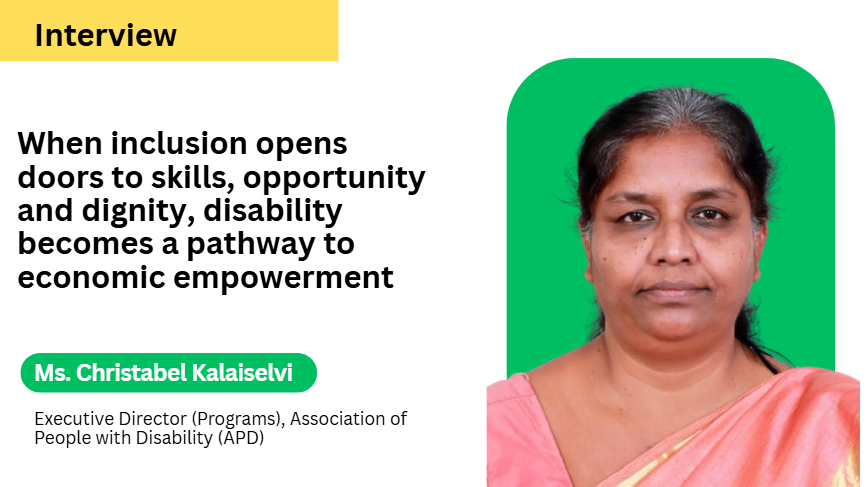
At the heart of this shift is the need to rethink how inclusion is designed across the entire livelihood journey. Ms. Christabel Kalaiselvi, Executive Director (Programs), Association of People with Disability (APD), discusses why training and placement numbers alone are insufficient measures of impact, and makes the case for integrated pathways spanning accessible skilling, employment, entrepreneurship, assistive technology and career progression. Drawing on APD’s experience of working across the disability inclusion ecosystem since 1959, she also highlights the importance of employer partnerships, rural entrepreneurship and measuring outcomes through retention, income growth and long term economic independence.
Scroll down to read the full interview:
Q. As India accelerates its efforts to build a future-ready workforce, how do you assess the progress made in ensuring that young persons with disabilities are included in the country's skilling and employment agenda? Where do you believe the biggest opportunities and gaps lie today?
A. In the last decade, with the passing of the Rights of Persons with Disabilities (RPWD) Act, India has made significant progress in inclusion and accessibility. This has been done through stronger policy frameworks, greater investments in skilling, and increasing conversations around disability-friendly workplaces and hiring practices. However, progress cannot be measured by training numbers alone. What matters is whether young persons with disabilities are able to find meaningful employment and build long-term careers.
This also means recognising that employment is not the only pathway to economic participation. In many rural and semi-urban communities, entrepreneurship, self-employment and locally rooted enterprises can offer equally sustainable livelihoods. Building entrepreneurial skills, improving access to finance and strengthening market linkages should therefore be considered an integral part of India's disability inclusion agenda.
One of the biggest gaps is that education, skilling, recruitment, workplace accessibility and career progression are often treated as separate interventions, when they are in fact interconnected. A break at any stage can limit workforce participation.
India has a real opportunity to recognise persons with disabilities as an integral part of its future workforce. As industries grapple with talent shortages and changing skill demands, disability inclusion should be viewed as a workforce development strategy rather than a parallel social initiative. Building accessible, industry-aligned pathways into employment will be key to unlocking this potential.
Q. The conversation around disability inclusion is increasingly moving beyond welfare towards economic participation. From your perspective, why should disability inclusion be viewed as a strategic economic and CSR priority rather than solely a social responsibility?
A. For a long time, disability has largely been viewed through the lens of welfare. While social protection remains essential, I think we need to start asking a different question, ‘what happens when persons with disabilities are able to participate fully in the economy?’ That's really what the Purple Economy is about. It's about recognising the value that persons with disabilities bring as workers, entrepreneurs, consumers and innovators, and understanding that inclusion benefits not just individuals but society and the economy as a whole.
We often talk about disability inclusion as the right thing to do, and it certainly is. But it is also the smart thing to do. Economies grow when more people are able to participate meaningfully, and businesses benefit from diverse talent, perspectives and innovation.
For CSR, this means moving investments beyond one-time interventions and towards inclusive ecosystems. Accessible skilling, assistive technology, employer sensitisation, entrepreneurship and workplace accessibility create long-term opportunities for economic independence. CSR can also play a catalytic role in strengthening rural entrepreneurship by supporting persons with disabilities to build local enterprises, access markets, adopt digital tools and become job creators within their own communities. Ultimately, disability inclusion should be viewed as an investment in India's workforce and future growth.
Q. Despite greater access to vocational training and supportive policies such as the Rights of Persons with Disabilities Act, the transition from skilling to meaningful employment remains a challenge for many young persons with disabilities. What are the key structural barriers that continue to hinder this journey, and how can different stakeholders work together to address them?
A. While access to skilling has improved, employment outcomes continue to be shaped by systemic barriers. Inaccessible recruitment processes, limited workplace accessibility, transportation challenges, employer misconceptions, and inadequate career progression opportunities continue to affect workforce participation.
We also need skilling programmes to keep pace with how industries are evolving. As AI, automation and digital transformation reshape industries, the concept of ‘future-readiness’ must make its way out of theory and into the real world.
At the same time, we need to recognise that formal employment may not always be the most viable pathway, particularly in rural areas where job opportunities are limited. Strengthening entrepreneurship ecosystems through access to credit, mentoring, business development support and digital platforms can enable persons with disabilities to build sustainable livelihoods closer to home.
Addressing these challenges requires collaboration across the ecosystem. Governments can continue strengthening implementation of inclusive policies, skilling institutions must embed accessibility into programme design, employers need to build inclusive recruitment and workplace practices, and civil society can support both candidates and organisations through this transition.
Q. The concept of the Purple Economy is gaining global recognition for its immense economic potential. How can India leverage this opportunity, and what role do businesses, philanthropic organisations, and CSR initiatives play in unlocking inclusive economic growth through disability inclusion?
A. I see the Purple Economy as a useful way of rethinking disability inclusion. It encourages us to move beyond the narrow, outdated view of disability inclusion as a matter of welfare or compliance, and instead consider it an opportunity to increase participation across the economy.
For India, this means recognising that accessibility drives innovation. Designing products, services, workplaces and public infrastructure that are accessible often benefits a much wider population and creates new opportunities for businesses and entrepreneurs.
Businesses can embed accessibility into their operations and hiring practices, while philanthropy and CSR can help strengthen areas such as accessible skilling, assistive technology, entrepreneurship, research and employer preparedness.We need to build systems where inclusion is part of mainstream economic development instead of something addressed separately. That is how disability inclusion can become a driver of innovation, productivity and sustainable growth.
Q. APD has been working on disability inclusion, rehabilitation, education, and livelihoods for over six decades. Based on your experience, how has the landscape evolved over the years, and what lessons can the broader development sector draw from this journey?
A. The disability inclusion landscape has evolved considerably since 1959, which is when the Association of People with Disability was founded. Earlier, the conversation centred primarily around rehabilitation and welfare. Today, there is greater recognition of disability as an issue of rights, accessibility, and economic participation, supported by stronger policy frameworks and growing awareness across sectors.
If there's one lesson we've learnt over the years, it's that inclusion cannot be achieved through isolated programmes. Education, healthcare, skilling, accessibility, livelihoods and community participation are all interconnected, and meaningful outcomes depend on strengthening each part of that ecosystem. APD’s ‘life-cycle approach’ does precisely this by providing integrated support across every stage of a person's journey. From early intervention and inclusive education to skill development, employment, and independent living, recognising that inclusion is a continuous process rather than a one-time intervention.
Our experience has also shown that livelihood pathways must be adapted to local contexts. While urban employment often focuses on placement opportunities, rural communities require greater emphasis on entrepreneurship, self-employment and community-based enterprises that enable persons with disabilities to earn sustainable incomes without having to migrate.
Another important learning is that persons with disabilities must be active partners in shaping solutions. Programmes, policies, and workplaces are far more effective when they are informed by lived experience. As India looks towards becoming a more inclusive economy, the focus should be on building systems that enable participation by design, rather than removing barriers after they emerge.
Q. APD's Livelihood Programme focuses on enabling persons with disabilities to access sustainable employment. Could you share some insights into the programme's approach, including the interventions that have delivered the most meaningful outcomes and the areas where the ecosystem still requires significant strengthening?
A. At APD, we believe that sustainable livelihoods go beyond facilitating placements. They require preparing individuals for long-term careers.
Our Livelihood Programme adopts a holistic approach, combining career counselling, employability and vocational skills, workplace readiness, placement support and post-placement follow-up. Alongside employment, we also recognise entrepreneurship as an important pathway, particularly in rural areas, by helping individuals build business skills, explore self-employment opportunities and connect with local markets and support ecosystems.
What has made this approach effective is our close engagement with employers, industry partners and training institutions. By working with both jobseekers and employers, we are able to bridge the gap between talent and opportunity while supporting inclusive workplaces.
One thing we've consistently seen is that employment outcomes improve significantly when employers are treated as partners in the inclusion journey rather than just recruiters. Going forward, the ecosystem needs stronger collaboration between industry, skilling institutions, and disability organisations to ensure that training remains aligned with evolving job markets, while creating pathways for career growth, and not just entry-level employment.
Q. From a corporate perspective, many organisations have made commitments towards diversity, equity and inclusion, yet representation of persons with disabilities in the workforce remains limited. What practical steps should companies take to move beyond intent and build genuinely inclusive workplaces with long-term career growth opportunities?
A. Many organisations have made encouraging commitments towards diversity and inclusion, but meaningful change requires embedding disability inclusion across the entire employee lifecycle. Hiring is only one part of the equation.
Companies should ensure accessible hiring processes, invest in accessibility measures, strengthen digital and physical accessibility, sensitise managers, and create mentorship and leadership development opportunities for employees with disabilities. Inclusion should also be reflected in performance management, learning opportunities, and career progression.
I also believe organisations should involve persons with disabilities, while designing policies and workplace solutions. This leads to more practical and sustainable outcomes than making assumptions about accessibility needs.
Ultimately, success should be measured not only by hiring numbers, but by retention, career advancement and employee experience. That is what transforms disability inclusion from a compliance exercise into a genuine business practice.
Q. Could you share some data or impact metrics that reflect APD's contribution towards skilling and livelihood generation for persons with disabilities? Which indicators do you consider most meaningful when evaluating long-term success beyond placement numbers?
A. Over the past two decades , APD has trained over 50,000 young persons with disabilities, enabled around 80%placements, and collaborated with over 600 employers.
These figures are encouraging, but they don't tell the whole story. At APD, we place equal emphasis on indicators such as employment retention, career progression, increased income, workplace inclusion, and long-term economic independence.
Another meaningful measure is employer engagement. When organisations continue to hire persons with disabilities, expand inclusive hiring practices and invest in accessible workplaces, it indicates that disability inclusion is becoming embedded within organisational culture rather than remaining a one-time initiative.
For us, long-term success is reflected in whether persons with disabilities are able to build stable careers, exercise greater financial independence and participate fully in economic and social life.
Q. India's CSR ecosystem is increasingly investing in education, skilling and employability. In your view, where should corporate social investments be directed to create scalable and sustainable employment opportunities for persons with disabilities, and how can impact be measured more effectively?
A. CSR has played an important role in expanding access to education and skilling, but the next phase should focus on strengthening the entire employment ecosystem. This includes investing in accessible training infrastructure, assistive technology, digital accessibility, employer sensitisation, entrepreneurship support, and career transition services.
Equally important is fostering partnerships between government, industry, academic institutions and civil society. Sustainable employment outcomes are more likely when these stakeholders work together to create inclusive pathways from education to work.
Impact measurement should also evolve beyond counting beneficiaries trained or placed. It should include indicators such as retention, income progression, career advancement, employer participation and improvements in workplace accessibility. These metrics provide a more meaningful understanding of whether investments are creating lasting economic participation.
Q. Looking ahead, what policy reforms, ecosystem collaborations or industry commitments do you believe are essential over the next five years to bridge the disability employment gap and enable young persons with disabilities to become active contributors to India's economic growth story?
A. Over the next five years, our focus should shift from creating isolated opportunities to building inclusive systems. Accessibility needs to be embedded into education, skilling, recruitment and workplaces from the outset rather than being treated as an afterthought.
There is also a need for stronger collaboration between government, industry, educational institutions and civil society to ensure that skilling programmes remain aligned with future workforce requirements and emerging sectors. Economic participation grows when accessibility, innovation and workforce development are addressed together rather than in silos.
We also need stronger support for entrepreneurship, particularly in rural and underserved regions. This includes improving access to credit, business mentoring, digital infrastructure and market linkages so that persons with disabilities have the opportunity not only to seek employment but also to build enterprises that contribute to local economic development.
Finally, industry must move beyond commitments towards measurable action by improving accessibility, investing in inclusive leadership pipelines and creating workplaces where persons with disabilities can build long-term careers. If India is to fully realise its demographic and economic potential, disability inclusion must become an integral part of our workforce and growth strategy, and not a parallel conversation.



.png)