From Philanthropy to Sustainable Impact: Building Healthier, Resilient, and Self-Reliant Communities
Meaningful social change rarely comes from one-time interventions. It takes sustained engagement, an understanding of local realities, and a commitment to building the capabilities that enable communities to shape their own futures. As corporate responsibility evolves from traditional philanthropy towards more strategic and measurable approaches, the focus is increasingly shifting towards strengthening community systems, creating opportunities, and building long-term resilience.
For the Alembic Foundation, this evolution is reflected in a broad community development approach spanning healthcare, nutrition, education, livelihoods, women and child development, and environmental sustainability. Its programmes are shaped through community consultations, field assessments, stakeholder inputs, and data, with a focus on addressing genuine local needs. Initiatives such as Suposhan for nutrition, healthcare interventions, large-scale tree plantation and groundwater recharge, and partnerships across government, academia, NGOs, and communities illustrate an approach centred on participation and sustainability.
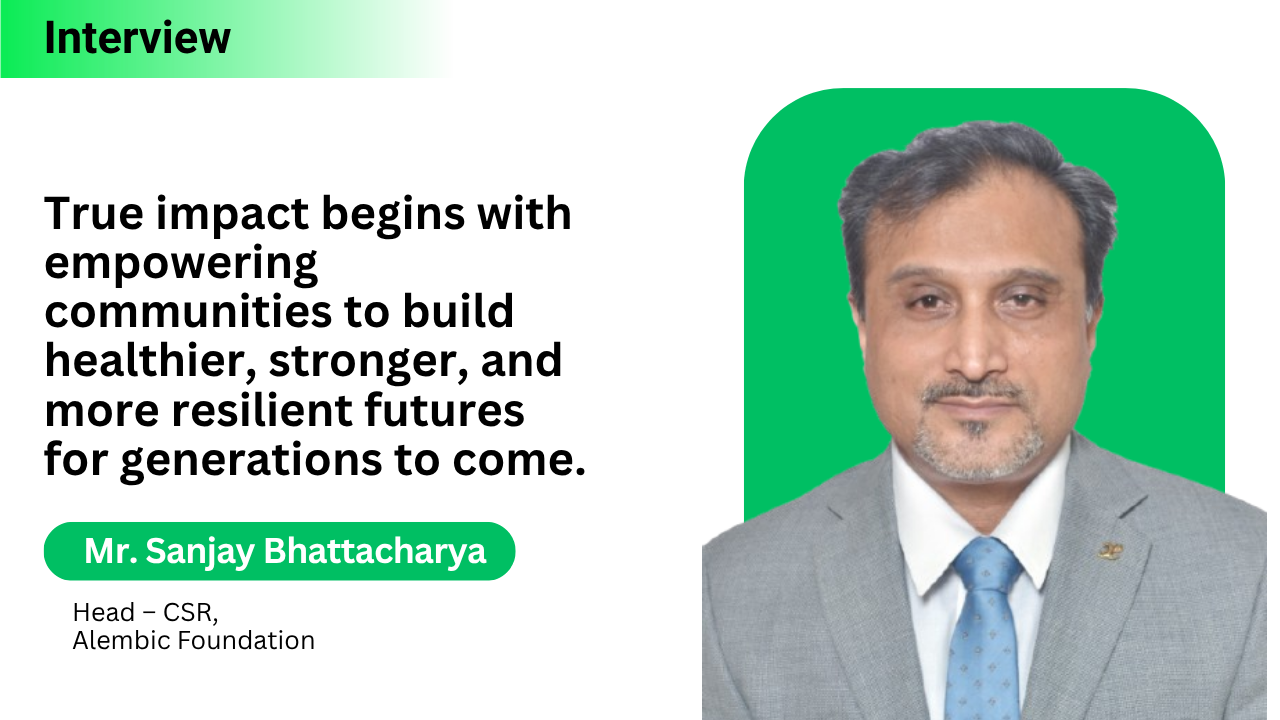
In this exclusive email interview with TheCSRUniverse, Mr. Sanjay Bhattacharya, Head – CSR, Alembic Foundation, discusses the evolution of Alembic's CSR journey and the principles guiding its long-term social impact efforts. The conversation explores nutrition, preventive healthcare, education, livelihoods, environmental sustainability, community partnerships, and the use of Results-Based Management and independent impact assessments to strengthen programme effectiveness. He also shares his perspective on the emerging role of ESG and the Foundation's vision for advancing climate resilience, water security, biodiversity, digital inclusion, employability, and sustainable communities.
Scroll down to read the full interview and explore how long-term, community-led CSR can translate into measurable and lasting change:
Q. As Alembic celebrates 119 years of its journey, how has the company's philosophy of giving back evolved over the decades, and what role does CSR play in Alembic's long-term vision for sustainable community development?
A. Alembic's philosophy of giving back has evolved from philanthropy and welfare-oriented initiatives into a more structured, strategic, and sustainable approach to community development. Over 119 years, the organisation has remained closely connected with the communities around it, while recognising that meaningful social impact requires long-term project-based engagement rather than a one-time intervention.
Today, CSR is an integral part of Alembic's broader vision of inclusive and sustainable growth. Through the Alembic Foundation, our focus is on addressing critical community needs in healthcare, education, nutrition, livelihoods, women's and child development, and environmental sustainability. The objective is not simply to provide support, but to create opportunities, strengthen community systems, and enable people to become more resilient and self-reliant.
Our long-term vision is therefore centred on creating measurable and lasting social value while growing responsibly as an organisation.
Q. Alembic Foundation works across diverse areas including healthcare, nutrition, education, livelihood, women and child development, and environmental sustainability. How do you identify priority areas for intervention and ensure that your programmes address genuine community needs?
A. Our priority areas are drawn from five guiding principles, i.e. alignment with the foundation's Vision and Mission, Global Sustainable Development Goals 2030, National and State Level development priorities, fitment with the framework of the Companies Act 2013 and Community Needs assessment.
At the ground level, our interventions are guided by a combination of community consultations, field-level assessments, local stakeholder inputs, available data, and an understanding of the socio-economic realities of the communities we serve.
We believe that a programme should begin with listening to the community. Our field teams engage with beneficiaries, front-line service delivery institutions like Anganwadi, Ayushman Arogya Mandir, Primary Health Centre, Community Health Centre, Village schools, government representatives’ community groups, local institutions, and other stakeholders to understand existing gaps and identify areas where intervention can create meaningful value.
We also consider factors such as vulnerability, scale of the need, gaps in existing services, potential for long-term impact, and alignment with our CSR priorities. Importantly, we continuously review programmes based on feedback and outcomes. This helps us move from a charity-based approach towards solutions that are relevant, participatory, and sustainable.
Q. The Foundation Day initiatives include serving over 70,000 nutritious meals to school children. Beyond addressing immediate nutritional needs, how do you see such interventions contributing to improved learning outcomes, health, and long-term child development?
A. Malnutrition is a serious issue in our communities; to address it effectively, the Government of India has initiated a program at the national level under the name of ‘Poshan Abhiyan’. Alembic Foundation is committed to eradicating this issue in our neighbourhood communities and has thus taken up a structured project named ‘Suposhan’. Under this project, the foundation has been methodically working for the last four years and has brought down the malnutrition level significantly and is working to achieve the national-level benchmarks by 2028.
Nutrition is not only important for the child’s physical development but also mental and emotional development. Adequate nutrition supports better concentration, energy levels, immunity, IQ, memory retention, and overall well-being, all of which contribute to improved engagement in learning, leading to holistic development of the children of today who are the citizens of tomorrow.
Hence, we also see such initiatives as an opportunity to reinforce the importance of nutrition and healthy eating among children and families. Over the long term, investments in child nutrition can contribute to healthier individuals, better educational outcomes, and stronger human capital for the country.
Q. Environmental sustainability is becoming an integral part of corporate responsibility. How do initiatives such as the plantation of 12,000 trees fit into Alembic's broader environmental strategy, and how do you assess their long-term ecological impact?
A. Planting trees is the first step towards contributing to green cover, biodiversity, carbon sequestration, soil conservation, and improvement in the local environment.
Planting 12,000 trees on the occasion of Foundation Day is part of our larger initiative of planting 1,00,000 trees to create green cover in our neighbourhood community area. The long-term success of this initiative depends on the survival and growth of the trees. Hence, our focus includes species selection appropriate to the local ecosystem, plantation in suitable locations with the needed land preparation, watering and maintenance, community participation, and regular monitoring.
We aim to assess impact through indicators such as tree survival rates, canopy development, biodiversity benefits, improvement in green cover, and community participation. In addition to trees, Alembic CSR Foundation is also working on conservation of water by building groundwater recharge wells. So far, 64 groundwater recharge wells and 2 major water weirs have been constructed, leading to infusing 35 crore litres to ground water annually and a water storage capacity of 9.25 crore litres.
Going forward, we also see opportunities to strengthen environmental programmes through waste management, renewable energy, biodiversity enhancement, and greater awareness of sustainable practices.
Q. Healthcare has always been central to Alembic's identity. How does the Foundation extend this legacy beyond pharmaceuticals to strengthen preventive healthcare, community well-being, and public health awareness?
A. Healthcare is an important part of Alembic’s legacy, and the Foundation extends this commitment beyond treatment to prevention, early identification, awareness, social security and access to quality healthcare, while strengthening the frontline Health Service Delivery System.
The Foundation facilitates community awareness on 6 communicable and 6 non-communicable diseases identified as national priorities. It has also facilitated Ayushman Cards for 100% of the community population around Alembic’s plant operations, while supporting access to Ration Cards for food safety and e-Shram Cards for accident insurance. Alongside its community health centre providing curative services, the Foundation is upgrading government frontline health facilities to National Level Benchmarks.
For the past four years, its nutrition initiatives have focused on reducing malnutrition, anemia and low birth weight, while improving immunisation, antenatal care, institutional deliveries and Anganwadi attendance, resulting in significant positive change in the community.
The Foundation also promotes physical well-being by encouraging fitness as a way of life and nurturing sporting talent through Alembic Sports, engaging 5,500 children from community schools.
Through SEWA (Supporting Enablement and Welfare Action), the Foundation supports 600 vulnerable children requiring care and protection, providing holistic development support through childcare institutions managed by the Foundation and in slum pockets of Vadodara where they reside.
Together, these interventions reflect a broader community development approach, with the ultimate objective of creating healthier, better-informed and more resilient communities equipped to take greater ownership of their well-being.
Q. Successful CSR programmes often depend on strong partnerships. How does Alembic Foundation collaborate with government agencies, NGOs, educational institutions, and local communities to maximise the effectiveness and sustainability of its initiatives?
A. Partnerships are fundamental to achieving breakthroughs, scale and sustainability in CSR, as complex social challenges cannot be addressed by any one organisation alone.
The Alembic Foundation collaborates with government departments, local authorities, academic institutions, NGOs and knowledge partners to leverage specialised expertise and develop solutions for communities.
Key collaborations include Group Foster Care Home and Adoption Centre as successful public-private partnerships with the Government; 12,000-tree plantation with Vadodara Municipal Corporation at its Linear Park along Narmada Canal; the Atmanirbhar Panchayat Project with various panchayat bodies; and partnerships with The M.S. University of Baroda for geohydrological mapping and reducing Anaemia prevalence.
The Foundation has also partnered with UNICEF to pilot Class to Career for secondary and higher secondary students, and BAIF Development Research Foundation for the Cattle Breed Development project to enhance milk production and farmer incomes.
Most importantly, the community itself is a key partner, actively involved in planning, implementation, monitoring and ownership. These partnerships bring together resources, technical expertise, institutional knowledge and community participation, strengthening the effectiveness, reach and sustainability of our programmes.
Q. Measuring social impact has become increasingly important in today's CSR landscape. What frameworks or indicators does Alembic Foundation use to evaluate the effectiveness, scalability, and long-term outcomes of its programmes?
A. We firmly believe in project-based CSR interventions that follow a Results-Based Management approach, rather than in activity- or event-based approaches. Hence, all our projects have set targets to achieve that are monitored regularly through quantitative and qualitative indicators to ensure needed course corrections and timely achievement.
A third-party impact assessment is conducted annually to evaluate the performance of all our major projects. The impact assessment follows the OECD evaluation framework to measure project performance.
To ensure robust evidence-based assessment, the research team employs a multipronged data collection strategy, including semi-structured interviews, case studies, field observations, learning outcome surveys, and focus groups, supplemented by secondary data. Each initiative is qualitatively rated across the five OECD pillars—coherence, relevance, effectiveness, efficiency, and sustainability. To maintain objectivity and minimise researcher bias, findings are subjected to expert-level review and rigorous data triangulation. At times, the Social Return on Investment (SROI) methodology has also been adopted.
The learning generated through impact assessment is considered seriously, as it helps us to identify what is working, what needs improvement, and which models have the potential to be scaled up or replicated in other communities.
Q. Having worked extensively across nutrition, healthcare, education, livelihoods, and community development, what have been some of the biggest challenges in implementing CSR programmes, and what key lessons have shaped Alembic Foundation's approach?
A. One of the most valuable learnings from implementing CSR programmes is the importance of bringing diverse stakeholder perspectives together towards a shared goal, while fostering sustained community participation. Lasting impact is created when communities see value in an intervention and gradually take ownership of it.
We have also learned that social challenges are interconnected and require a holistic approach. For instance, improving a child’s education may also involve addressing nutrition, health, family circumstances and economic vulnerability.
Our experience has reinforced that social development requires a long-term, consistent approach beyond financial-year timelines. Behavioral change, capacity building and community empowerment take time and sustained engagement.
These experiences have strengthened our approach: understanding local contexts, listening to communities, building strong partnerships, investing in capacity, monitoring outcomes, staying flexible and focusing on sustainability rather than short-term numbers. Ultimately, successful CSR is about empowering communities to become self-reliant and reducing dependency.
Q. As businesses increasingly integrate ESG into their corporate strategy, how do you see the relationship between responsible business growth, environmental stewardship, and community development evolving in the years ahead?
A. The distinction between business sustainability and social responsibility is becoming increasingly blurred. Responsible growth today means creating economic value while also considering environmental impact, employee well-being, ethical practices, and the development of communities connected with the business.
ESG provides an opportunity to integrate these considerations into the core decision-making process rather than treating them as separate activities. Environmental stewardship, for example, is not only about tree plantations; it also involves resource efficiency, responsible consumption, waste reduction, water conservation, and climate resilience.
Similarly, community development strengthens the social ecosystem in which businesses operate. In the coming years, I believe companies will increasingly focus on creating shared value—where business growth and positive social and environmental outcomes reinforce each other.
For Alembic, this represents an opportunity to build on a long legacy of responsible engagement and take it forward through a more integrated and measurable sustainability approach.
Q. What is your vision for Alembic Foundation's next phase of social impact, and which emerging social or environmental priorities do you believe will define the Foundation's CSR journey in the coming decade?
A. Our vision for the next phase is to deepen impact, strengthen sustainability, and create models that can be replicated at scale. We want to move beyond addressing immediate needs towards building stronger and more resilient communities.
Over the coming decade, some of the key priorities are likely to include preventive healthcare, child nutrition and education, women's economic empowerment, employability and livelihoods, digital inclusion, climate resilience, water security, biodiversity, and sustainable communities.
We also see significant potential in using technology and data to improve programme delivery, monitoring, and impact measurement. At the same time, the human element will remain central to working closely with communities and understanding their evolving needs.
Ultimately, our aspiration is for the Alembic Foundation to continue building on Alembic's 119-year legacy by creating a social impact that is inclusive, measurable, environmentally responsible, and sustainable across generations. The goal is not merely to do more, but to create bigger and lasting change.




.png)