From Job Fear to Job Opportunity: How Smile Foundation is Using AI to Empower Young India
What if the same AI that is feared for taking away jobs could instead help young people get their first one? India’s skilling ecosystem is beginning to show that AI can be a powerful tool for inclusion, confidence and career opportunity—especially for young people from underserved communities.
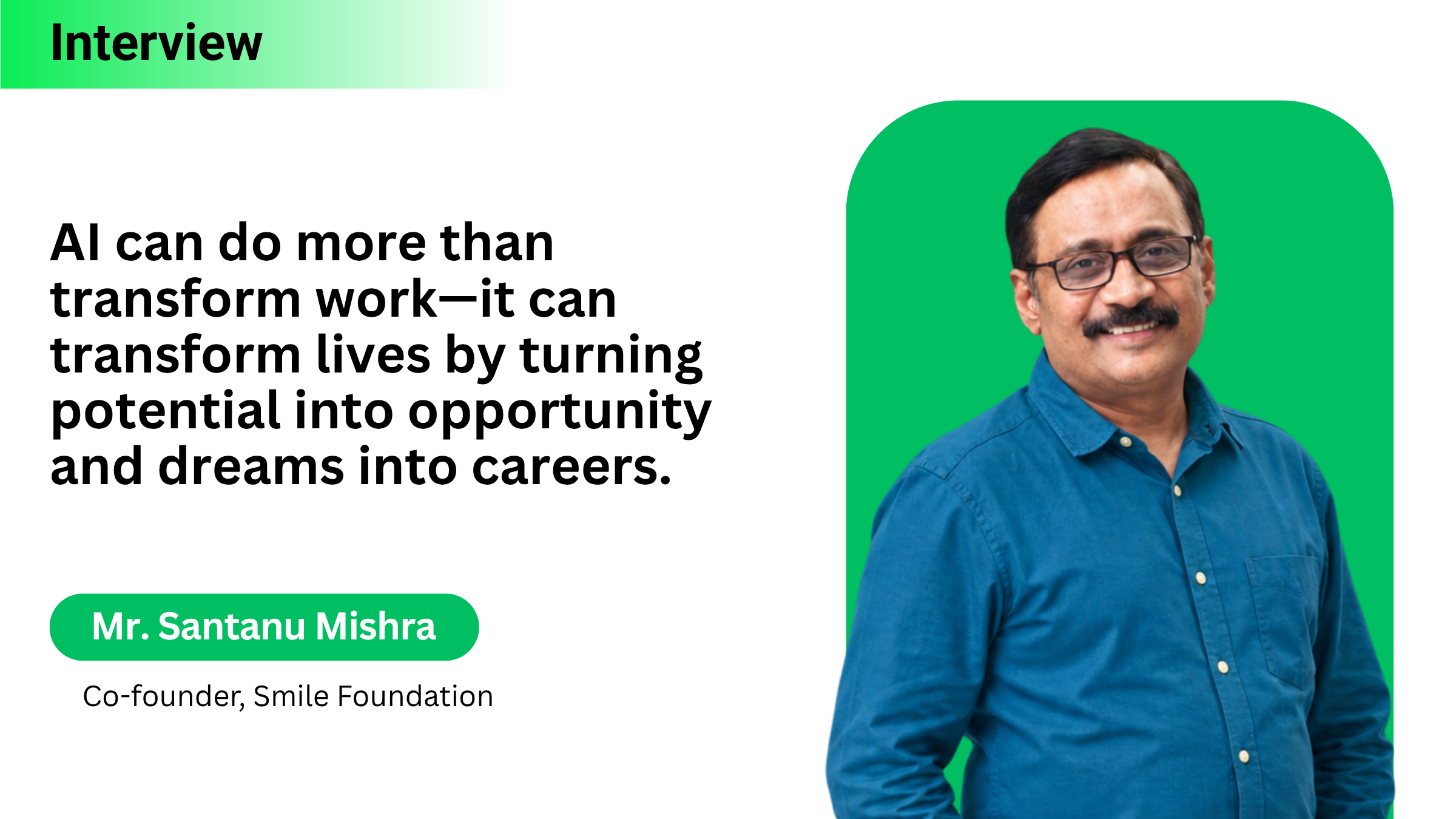
In this interview, Mr. Santanu Mishra, Co-founder, Smile Foundation, discusses how the organisation is using AI to make employability training more personalised and accessible. The conversation explores how tools such as the AI Tutor, AI Career Advisor, AI Interview Coach and AI Trainer Mentor are helping young people understand career options, build communication skills, practise interviews and prepare for the workplace.
Mr. Mishra also shares key learnings from implementing the AI-enabled skilling model across diverse geographies, the role of the Wadhwani Foundation and employer partners, and why India’s skilling ecosystem must move beyond course completion towards employment, retention and career growth. As Smile Foundation plans to reach more than 15,000 youth annually, the interview offers an encouraging perspective on how AI can become an enabler of opportunity rather than simply a force of disruption.
Scroll down to read more:
Q. What was the vision behind introducing AI into Smile Foundation's skilling programme, and what key employability gaps were you aiming to address through this initiative?
A. The idea was to ensure that quality employability assistance became more personalised and accessible to young people who might not have access to mentoring, career counselling, and professional networking. It became clear during our implementation of the Skill Training and Employability Programme (STeP) that there is more to education than learning a skill set – there is a need for instant clarification during class time, help to choose an appropriate profession, repeated practice for interviews and increased self-confidence in communication. AI and technology have made it possible to extend that help beyond classroom boundaries without removing the trainer from the equation. AI Tutor, AI Career Advisor and AI Interview Coach provide learners with room for posing questions and practising on their own while AI Trainer Mentor helps the facilitator to communicate better with his or her students.
Q. Artificial Intelligence is often viewed through the lens of automation and job displacement. Your programme presents a different narrative. How do you see AI strengthening employability, particularly for first-generation job seekers?
AI is not meant to take away all the existing jobs; on the contrary, it will open more doors to accessing the advice that enables one to become part of and move up within the working community. For most first-time employees, the gap is not the lack of skills, but the lack of career advice, interview experience, and a space where they can make errors without being judged for doing so. Our model allows using AI provide advice without any prejudice. This helps students understand certain notions, find occupations that are interesting to them, practice interview questions and get feedback before meeting the employer. These are skills that are important not only now but will still prove useful in the future, regardless of what positions they will hold.
Q. The programme integrates AI-powered tools such as the AI Tutor, AI Career Advisor, AI Interview Coach and AI Trainer Mentor. Which interventions have delivered the most significant outcomes, and what has been the feedback?
A. This is because each of these tools deal with a unique barrier. The feedback from the learners on the Career Advisor and the Interview Coach has been quite good. Through the Career Advisor tool, the young people who are not sure of what to do can discover their strengths and career opportunities that match their interests. The Interview Coach turns this discovery into reality by preparing them through constant practice and feedback from the AI. For instance, one of our beneficiaries Manya gave credit to the AI Tutor and Interview Coach for helping her enhance her communication skills. On the other hand, another beneficiary Nagesh indicated that the Career Advisor and the personal pitch exercise were useful in identifying his strength before venturing into sales. Similarly, the AI Tutor comes handy in providing instant concept clarification while the Trainer Mentor ensures consistency in the class.
Q. With over 10,500 youth trained and more than 7,300 placements achieved, what have been the key factors driving these results?
A. The results have been achieved through the synergy of technology and the robust employability model at the end. During the financial year 2025-26, 10,546 individuals were trained, out of which 7,380 individuals got placements, giving a placement ratio of 70 per cent. This was possible due to market-focused training, continuous effort on communication and workplace behaviour, practice through AI, training support, career counselling, and linkage of placements. Furthermore, the program enables learners to pursue multiple pathways in various entry-level jobs ranging from sales, BPO, data management, retail, marketing, and inventory management. In a recently conducted impact assessment of 50 placed alumni through STeP, 72 per cent of individuals got employed in six months, 94 per cent of individuals believed that training provided them with the skills required in their job, and 80 per cent of surveyed hiring partners were highly satisfied with their preparedness.
Q. Many young people from underserved communities face barriers beyond technical skills, including limited career awareness and confidence. How has AI helped bridge these gaps?
A. Often, the biggest difference is what learners do not see - they do not understand what kind of roles are out there, how their skills can be used, or how to effectively present themselves in front of the employer. AI makes all these expectations clear and attainable for them. With the Career Advisor, learners are allowed to think about their passions and choose from up to three passion areas, after which they get tailored recommendations on roles they might consider pursuing. The Interview Coach offers a risk-free space where learners can hone their answers, communication and personal pitch. The AI Tutor eliminates hesitations of learners during studying, while the trainers still offer all that motivation and context understanding that no technology can give. This is especially important for those who are first-generation job seekers, as they will be able to go to an interview not just with course information but with increased confidence.
Q. The programme is currently being implemented across eight states. What have been the key learnings from implementing an AI-enabled skilling model across diverse geographies and learner groups?
A. The AI-enabler programme specifically is now operational in Karnataka, Delhi, Maharashtra, Telangana, Andhra Pradesh, West Bengal, Odisha and Uttar Pradesh. The most important lesson is that scaling should not compromise on contextual factors. There are differences among learners in terms of language proficiency, proficiency in using digital technologies, educational qualifications, aspirations and experience of formal work environments. While a common digital platform helps to standardise the learning experience, the trainers are required to contextualise the examples, the pace of teaching and the classroom interactions to the ground realities.
Q. How has the partnership with the Wadhwani Foundation, along with employer partners, helped strengthen the programme and enhance its overall impact?
A. Through the collaboration with the Wadhwani Foundation, it has become possible for us to leverage the reach of Smile Foundation in the communities and its expertise in running training centres through an AI-powered employability ecosystem. The digital learning framework of this organisation facilitates personal tutoring, career exploration, interview preparation and trainer assistance, thus providing the learners with the opportunity to get advice even outside the class. Finally, the partners on the employer’s side round up the model by providing us with valuable insights into contemporary entry-level positions, their requirements, as well as the desired skill set. This step is crucial since employability cannot be achieved solely on the basis of the curriculum but through the ongoing dialogue between the learner, trainer and the job market. The ecosystem STeP of Smile Foundation has collaborated with more than 400 corporate employers so far.
Q. As AI continues to reshape the future of work, what changes are needed in India's skilling ecosystem to prepare young people for emerging opportunities?
A. The skilling ecosystem of India has to evolve from assessing completion of courses to assessing the employment, retention and career progression of the participants. The concept of AI literacy will have to be introduced into most sectors. However, it needs to be done while introducing other essential capabilities such as good communication, problem-solving skills, adaptability, professionalism and proper use of technologies. The second change has to be towards the personalisation of the whole process; the young generation needs career guidance according to their individual strengths and local job market realities and not just training modules. In addition, employers need to have a bigger role in the process of curricula development, simulation exercises, internships and assessments to ensure that the skills developed are relevant to the changing jobs of the future. Moreover, trainers will need continuous re-skilling to be able to use AI as a tool and determine which aspects require human involvement.
Q. As the programme expands to reach more than 15,000 youth annually, what priorities will guide its next phase of growth and impact?
A. With the intention of reaching out to more than 15,000 young people each year, our focus will shift to scaling quality as opposed to enrollment. In essence, this will entail enhancing the capacity of trainers, using learner data effectively to ascertain their needs and making sure that the AI systems remain easy, relevant and inclusive in diverse geographies. Our local employer mapping will become even more rigorous so that the training process is based on real-world employment prospects in sectors like sales, BPO, data operations, retail, marketing and other emerging sectors.
Overall, our skilling and upskilling projects are operational in 537 districts (56 aspirational) across 26 states and 3 union territories of India, with partnership with various corporate supporters.





.png)