From Innovation to Impact: How Ashoka University is Building a More Sustainable Campus
What if the campuses that shape tomorrow’s leaders could also become models for a more sustainable tomorrow? As universities rethink how they manage resources, waste, and everyday operations, even overlooked challenges can become opportunities to create meaningful environmental impact.
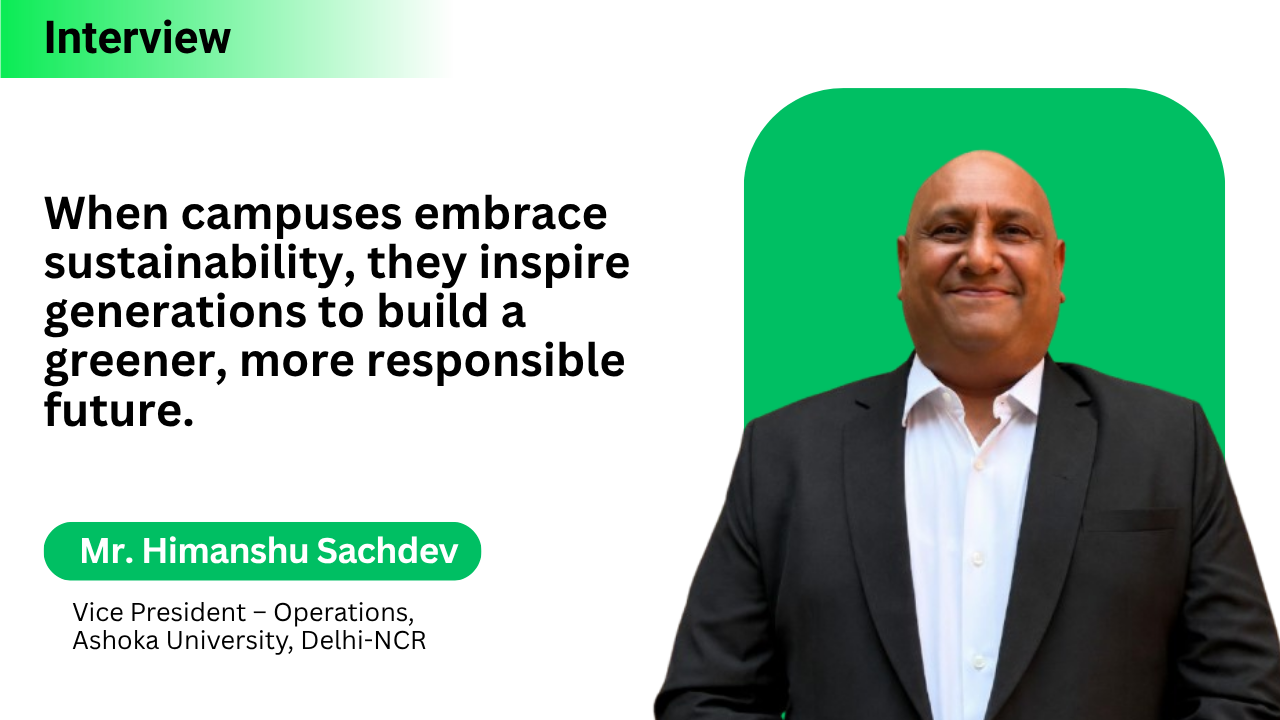
In this interview, Himanshu Sachdev, Vice President – Operations, Ashoka University, Delhi-NCR, shares how the University is advancing its sustainability journey through practical, measurable, and collaborative solutions. He discusses Ashoka University’s recognition as a Sustainability Champion by PadCare and the impact of its menstrual waste recycling initiative, which has recycled 1,307 kg of sanitary waste and conserved 2,797 kg of CO₂e emissions.
The conversation also explores the unique journey of PadCare—from being incubated at Ashoka University to becoming a sustainability partner—and how technology, innovation, and partnerships can help universities build more circular campuses. Sachdev also shares lessons for other institutions, Ashoka’s broader sustainability priorities, and its vision of creating a campus where environmental responsibility is part of everyday life
Scroll down to read more:
Q. Ashoka University has been recognised as a Sustainability Champion by PadCare. What does this recognition mean for the University, and what motivated you to adopt menstrual waste recycling as part of your sustainability efforts?
A. Being recognised as a Sustainability Champion by PadCare is an encouraging milestone in Ashoka University's journey towards building a more sustainable and responsible campus. Sustainability is embedded in many of our operational decisions and menstrual waste recycling was a natural extension of our commitment to reducing our environmental footprint. Traditional disposal methods for sanitary waste contribute significantly to landfill burden and environmental pollution. By partnering with PadCare, we wanted to adopt a solution that promotes responsible disposal, resource recovery and a circular approach to waste management while also encouraging greater awareness around menstrual hygiene and sustainability.
This initiative reflects our belief that even small, often overlooked aspects of campus operations can create meaningful environmental impact when managed thoughtfully. We hope our efforts inspire greater awareness and encourage more institutions to adopt sustainable practices that contribute towards a cleaner and greener future.
Q. The partnership has helped recycle 1,307 kg of sanitary waste and conserve 2,797 kg of CO₂e emissions. How significant are these outcomes in the University's larger sustainability and ESG journey?
A. The impact is both measurable and meaningful. Recycling 1,307 kg of sanitary waste and preventing approximately 2,797 kg of CO₂e emissions demonstrates that sustainable interventions, even in niche areas, can collectively make a significant environmental difference. At Ashoka University, we view sustainability as a continuous journey rather than a series of isolated initiatives. Every resource conserved, every kilogram of waste diverted from landfills and every reduction in carbon emissions contributes to our broader Environmental, Social and Governance (ESG) objectives. While these numbers may represent a specific waste stream, they reflect a much larger institutional mindset, one that prioritises responsible resource management, environmental stewardship and long-term impact. More importantly, this initiative has helped foster awareness and participation among our campus community, encouraging students, faculty, staff and service partners to adopt more sustainable practices in their daily lives.
Our ESG vision is built on integrating sustainability into everyday campus operations. Initiatives such as menstrual waste recycling complement our wider efforts in waste segregation, recycling, water conservation, energy efficiency, and responsible procurement. Together, these actions reinforce Ashoka University's commitment to creating a campus that not only educates future leaders but also leads by example in environmental responsibility.
Q. Menstrual waste remains one of the least addressed waste streams in India. What were some of the key challenges in implementing a scientific recycling system on campus, and how were they addressed?
A. Menstrual waste management is indeed one of the most under-addressed aspects of solid waste management in India, primarily due to limited awareness, social stigma and the lack of scientific disposal mechanisms. Introducing a structured recycling system on a university campus required us to address both operational and behavioural challenges. One of the initial challenges was creating awareness around proper disposal and segregation at the source. We worked closely with PadCare to conduct sensitisation initiatives and ensure that students, staff and housekeeping teams understood the importance of using the designated collection bins correctly. Building this awareness was essential for the success of the programme. Another important aspect was integrating the collection process into our existing waste management system without disrupting day-to-day campus operations. This involved strategically installing collection units, training our housekeeping personnel on safe handling protocols and establishing a reliable collection and recycling schedule in collaboration with PadCare.
Maintaining hygiene, ensuring regulatory compliance and preserving user privacy were also key priorities throughout implementation. By adopting scientifically designed collection systems and partnering with an organisation that specialises in end-to-end menstrual waste recycling, we were able to ensure that the process remained safe, efficient and environmentally responsible. Ultimately, the success of this initiative has been driven by collaboration—between our students, staff, operations team and PadCare. It demonstrates that with the right awareness, infrastructure and partnerships, even traditionally neglected waste streams can be managed sustainably and become an integral part of an institution's broader environmental commitment.
Q. Pad Care’s journey—from being incubated at Ashoka University to now partnering with and recognising the University—reflects a full-circle innovation story. How has this relationship evolved over the years, and what makes it unique?
A. PadCare's journey is a remarkable example of how universities can nurture innovation that eventually creates real-world impact. Seeing PadCare evolve from an incubated startup at Ashoka University into a valued sustainability partner is truly a full-circle moment and one that we are immensely proud of. At Ashoka, we believe that universities are not only centers of academic excellence but also ecosystems where ideas are encouraged, tested and transformed into solutions for pressing societal challenges. PadCare embodies that philosophy. What began as an entrepreneurial idea within our ecosystem has matured into an innovative enterprise that is addressing one of India's most overlooked environmental challenges through science and technology.
What makes this relationship unique is that it has evolved beyond incubation into a genuine partnership built on shared values. Today, Ashoka is not merely supporting an innovation; we are in fact actively implementing it on our campus. This demonstrates our willingness to adopt home-grown, evidence-based solutions and lead by example in translating innovation into meaningful action. Being recognised by PadCare as a Sustainability Champion makes this journey even more special. It signifies a partnership where both organisations have grown together—one by developing a pioneering environmental solution and the other by embracing and scaling that solution within its own operations.
For us, this is more than a sustainability initiative; it reflects the power of collaboration between academia and social entrepreneurship. It reinforces our belief that when institutions create an environment that fosters innovation and are willing to become early adopters of those innovations, they can accelerate meaningful change far beyond the boundaries of the campus. We hope this story inspires other universities to support innovators, partner with emerging enterprises and champion solutions that create lasting social and environmental impact.
Q. Technology and innovation are playing an increasingly important role in sustainability. How do collaborations with organisations like PadCare help educational institutions adopt practical and scalable ESG initiatives?
A. Technology and innovation are becoming indispensable in achieving meaningful sustainability outcomes. While institutions may have strong environmental goals, translating those aspirations into measurable impact requires practical, scalable and scientifically validated solutions. This is where collaborations with organisations like PadCare become invaluable. Such partnerships enable educational institutions to move beyond conventional sustainability practices and address complex environmental challenges with innovative, data-driven solutions. PadCare has transformed a traditionally neglected waste stream into a circular economy model by ensuring that menstrual waste is collected, scientifically processed and recycled in an environmentally responsible manner. This allows institutions like Ashoka University to adopt ESG initiatives that are not only impactful but also measurable and transparent.
Equally important is the educational value of these collaborations. A university campus is a living laboratory where students, faculty and staff can experience sustainability in action. When innovative solutions are embedded into everyday campus operations, they foster awareness, encourage responsible behaviour and inspire future leaders to think differently about environmental stewardship. From an ESG perspective, partnerships like these strengthen all three pillars. Environmentally, they help reduce waste and lower carbon emissions. Socially, they promote dignity, health and awareness around menstrual hygiene while encouraging inclusive and responsible practices. From a governance standpoint, they reinforce transparency, accountability and measurable reporting through credible sustainability metrics.
At Ashoka University, we believe that meaningful sustainability is achieved through collaboration. By working with innovators like PadCare, we can adopt solutions that are practical today, scalable for the future, and capable of delivering measurable environmental and social impact. This collaborative approach not only advances our own ESG journey but also sets an example for how educational institutions can become catalysts for sustainable innovation and responsible leadership.
Q. Could you share how collaborations with your current sustainability partners have strengthened Ashoka University's environmental initiatives and helped enhance their overall impact?
A. At Ashoka University, we firmly believe that sustainability is a shared responsibility. While institutional commitment provides the vision, it is through meaningful partnerships with like-minded organisations that we are able to translate that vision into measurable outcomes. Our sustainability partners bring specialised expertise, innovative technologies and best practices that enable us to strengthen and continuously evolve our environmental initiatives. Our collaboration with PadCare is an excellent example. Together, we have established a scientific menstrual waste recycling system that has diverted over 1,300 kilograms of sanitary waste from landfills while significantly reducing carbon emissions. Beyond the environmental benefits, the initiative has also helped build greater awareness around responsible waste management and menstrual hygiene across our campus community.
Similarly, our partnerships across waste management, recycling, resource conservation and environmental services have helped us adopt a more holistic and data-driven approach to sustainability. Whether it is improving waste segregation, enhancing recycling rates, reducing landfill dependency, conserving natural resources, or promoting responsible operational practices, each collaboration contributes to strengthening our overall ESG framework. What makes these partnerships particularly valuable is that they combine innovation with accountability. They provide measurable impact through data, transparent reporting, and continuous improvement, allowing us to assess outcomes and identify new opportunities for environmental stewardship.
Ultimately, our goal is not simply to implement individual sustainability projects but to cultivate a culture where environmental responsibility is embedded in every aspect of campus life. Strong partnerships enable us to scale our efforts, accelerate innovation and demonstrate that collaborative action is one of the most effective ways to achieve long-term environmental and social impact. We look forward to continuing this journey with partners who share our vision of building a more sustainable future.
Q. Based on your experience, what lessons from this initiative could other universities adopt to build more environmentally responsible and circular campuses?
A. One of the biggest lessons from this initiative is that sustainability does not always require large-scale infrastructure or significant capital investment. Meaningful impact often begins by identifying overlooked challenges and addressing them through innovation, collaboration and a commitment to continuous improvement. For universities, the first step is to view the campus as a living ecosystem where every waste stream, whether it is plastic, paper, food waste, e-waste or menstrual waste, presents an opportunity to adopt circular economy principles. Responsible segregation at source, scientific processing and resource recovery should become integral parts of campus operations rather than isolated sustainability projects.
Another important lesson is the value of partnerships. Educational institutions do not need to develop every solution in-house. Collaborating with purpose-driven organisations and innovative startups enables universities to adopt proven technologies, measure outcomes, and scale initiatives more effectively. Our partnership with PadCare is a strong example of how collaboration can transform an often-overlooked environmental challenge into a measurable sustainability success. Equally critical is building awareness and participation. Infrastructure alone cannot deliver lasting results. Students, faculty, staff and service partners must all understand the purpose behind these initiatives and take collective ownership. When sustainability becomes part of everyday behaviour, it creates a culture of responsibility that extends well beyond the campus.
Finally, institutions should focus on measuring impact. Tracking metrics such as waste diverted from landfills, carbon emissions avoided, water conserved or resources recovered helps demonstrate tangible progress, strengthens ESG reporting, and inspires confidence among stakeholders. Data-driven sustainability also enables institutions to refine their strategies and identify new opportunities for improvement.
At Ashoka University, this initiative has reinforced our belief that building a circular campus is not about one transformative project; it is about consistently integrating sustainable thinking into everyday decisions. If universities embrace innovation, foster collaboration, empower their communities and measure outcomes, they can become powerful catalysts for environmental stewardship and inspire a new generation to lead the transition towards a more sustainable future.
Q. Beyond menstrual waste management, what are some of the key sustainability priorities that Ashoka University is focusing on to strengthen its environmental stewardship?
A. Sustainability at Ashoka University is not driven by a single initiative, it is embedded in the way we design, operate, and continuously improve our campus. Our objective is to build an environmentally responsible institution where sustainability is integrated into everyday decision-making and aligned with our long-term ESG vision. Beyond menstrual waste management, our priorities span several key areas. We are continuously strengthening our waste management ecosystem through source segregation, recycling, composting and responsible disposal of specialised waste streams such as e-waste and hazardous waste. Reducing landfill dependency and promoting circular economy practices remain central to our approach.
We are equally committed to creating a greener campus by preserving and enhancing biodiversity, expanding green spaces and maintaining landscapes that support ecological balance. Sustainable landscaping, efficient irrigation practices and responsible management of natural resources are integral to this effort.
Another important priority is sustainable procurement. We actively encourage the use of environmentally responsible products, engage with vendors who share our sustainability values and integrate ESG considerations into our operational decisions. Partnerships with organisations such as PadCare demonstrate how innovation and collaboration can help us adopt practical solutions that deliver measurable environmental outcomes. Perhaps our greatest strength lies in engaging our campus community. A university has the unique ability to shape behaviours and mindsets. Through awareness campaigns, student-led initiatives, faculty engagement and operational best practices, we strive to make sustainability a shared responsibility rather than the responsibility of a single department.
Looking ahead, our focus is on building a truly data-driven sustainability framework, one that measures environmental impact, strengthens ESG reporting and continuously identifies opportunities to reduce our carbon footprint and improve resource efficiency. Our aspiration is not only to operate a sustainable campus but also to serve as a model for how higher education institutions can lead by example, demonstrating that environmental stewardship, operational excellence and social responsibility can go hand in hand..








.png)