From Ideas to Impact at Scale: Rethinking Innovation for a More Inclusive and Sustainable India
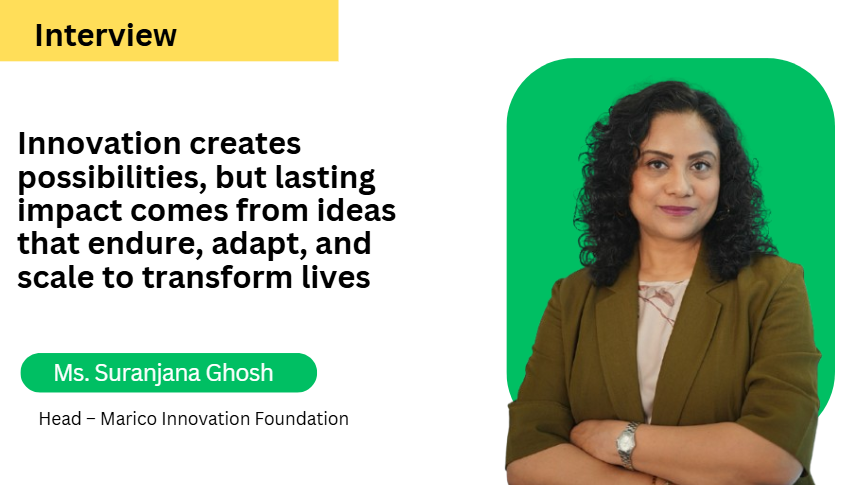
India’s innovation landscape is moving beyond the pursuit of breakthrough ideas towards a more fundamental question: how can solutions move from promising pilots to sustained impact at scale? With over two decades of experience working closely with entrepreneurs and innovators, Marico Innovation Foundation has had a front-row view of this evolution, seeing what enables ideas to endure, adapt and create meaningful value across diverse contexts.
In this interview with TheCSRUniverse, Suranjana Ghosh, Head – Marico Innovation Foundation, reflects on the lessons emerging from this journey and what it takes to build organisations capable of delivering long-term impact. She discusses the barriers that keep innovations from scaling, the role of corporates, government, investors and philanthropy in strengthening the ecosystem, and the sectors where innovation could make the greatest difference, from agriculture and climate resilience to healthcare, water and the circular economy. She also shares her perspective on the qualities that distinguish founders who turn compelling ideas into enduring organisations.
Scroll down for more insights:
Q. Marico Innovation Foundation has spent over two decades supporting innovation in India. Looking back, what have been some of the biggest lessons from this period and how has your understanding of what makes an innovation truly scalable evolved over the years?
A. One of the biggest lessons from our journey has been that innovation, especially the kind that creates meaningful impact, rarely moves in a linear manner. Over the past two decades, we've had the opportunity to work with innovators across sectors, and one thing has become increasingly clear: the founders who build enduring organization's are those who develop a deep understanding of the problem they are solving and remain open to learning, adapting and refining their approach as they grow. An ability to focus on in-depth solving of an issue instead of chasing multiple solutions also helps with building scale.
Our understanding of what it takes to scale an innovation has also evolved. Today, we believe scale is about creating sustained value while remaining relevant as markets, technologies and customer needs evolve. We've also learnt that no innovation scales in isolation. It requires the right ecosystem of mentors, partners, investors and enablers to help promising ideas become solutions that create lasting impact.
Ultimately, there is no single blueprint for building an enduring organization. Every founder's journey is different, but resilience, openness to learning and adaptability consistently distinguish innovations that go on to create meaningful and lasting impact.
Q. Innovation is increasingly being seen as a key driver of social and environmental progress. In your view, what role can innovation and entrepreneurship play in addressing some of India's most pressing development challenges?
A. Many of India's most pressing challenges, whether in agriculture, climate resilience, waste management or livelihoods, are shaped by diverse local realities. Innovation creates impact when entrepreneurs remain closely connected to these realities and develop solutions that are practical, accessible and relevant to the communities they seek to serve.
We've seen this through innovators such as S4S Technologies, which is reducing post-harvest losses while creating sustainable livelihoods, and PadCare Labs, which is building a circular solution for menstrual waste. These innovations demonstrate that it is possible to address pressing societal challenges while creating sustainable economic value.
Entrepreneurs often have lived experiences of the problems they are trying to solve. Their ability to experiment, learn and continuously refine their approach enables them to build solutions that respond to India's evolving needs.
Q. Marico Innovation Foundation has worked with innovators across diverse sectors for nearly two decades. How does the Foundation identify and support innovators, and how does this approach help enable innovation-led solutions for a more sustainable and inclusive India?
A. Our approach begins with understanding the problem an innovator is trying to solve and the depth of their insight into that challenge. While a compelling idea is important, we look for ‘coachable’ founders with a well-tested innovation that is solving a socio-economic or environmental issue at scale. Our experience has shown that a strong idea is only the starting point; building an enduring organisation requires resilience and thoughtful execution.
Our flagship program, Scale-Up, supports founders during this critical stage by providing founder-first mentorship, strategic guidance and access to experienced industry leaders tailored to each venture's needs. Rather than prescribing solutions, we work alongside entrepreneurs because every founder's journey is unique.
Ultimately, our objective is to strengthen founders and the organisations they are building so they can grow with resilience and create meaningful change over time.
Q. Many promising innovations struggle to move beyond the pilot stage. In your experience, what are the biggest barriers to scaling impact in India, and how can different stakeholders help overcome them?
A. A successful pilot is an important milestone, but the real challenge lies in translating proof of concept into sustained, large-scale impact. This requires more than a strong solution. It is supported by access to markets, strategic partnerships and the right support to help innovators expand beyond the pilot stage.
Different stakeholders each have a role to play. Governments can enable adoption through the right support, industry can provide market access and implementation opportunities, while investors and ecosystem organisations can help founders build the capabilities needed to scale. Together, they can help promising innovations move beyond pilots and create lasting impact.
Q. Collaboration is often described as the key to solving complex social and environmental challenges. How can corporates, innovators, philanthropy, research institutions and government work together more effectively to build a stronger innovation ecosystem?
A. The most effective solutions emerge when different stakeholders come together with a shared sense of purpose and a common commitment to solving it. Each stakeholder brings unique strengths from research and entrepreneurship to market expertise, funding and policy support and the real opportunity lies in ensuring these capabilities complement one another as innovations evolve.
Effective collaboration is not simply about bringing stakeholders together; it is about creating the conditions for knowledge, expertise and resources to be shared in ways that accelerate adoption and strengthen promising solutions. When each stakeholder contributes its strengths towards a common objective, innovation can achieve far greater reach and impact.
Q. Which emerging sectors or problem statements do you believe present the greatest opportunities for innovation-led solutions to drive sustainability, inclusion and long-term social impact in India?
A. The next phase of innovation in India will be shaped by solutions that address some of the country's most pressing challenges across agriculture, climate resilience, clean technology, healthcare, water and the circular economy. The greatest opportunities lie at the intersection of sustainability, inclusion and commercial viability, where innovators can create solutions that solve complex problems while achieving scale.
Agriculture will continue to be a significant area of opportunity, particularly in strengthening food systems, reducing post-harvest losses and improving value chains. At the same time, the transition towards a circular economy presents immense potential to improve resource efficiency and recover value from waste through commercially sustainable business models.
What is particularly encouraging is the growing maturity of India's innovation ecosystem. Founders are increasingly taking the time to understand local contexts and build solutions that respond to real needs, creating the foundation for long-term impact.
Q. What inspired the launch of Indian Innovation Icons and how has the initiative evolved over the years to identify, recognize and support innovators addressing some of India's most pressing challenges?
A. Indian Innovation Icons was inspired by Mr. Harsh Mariwala's belief that many of India's most impactful innovators were quietly solving some of the country's most pressing challenges without receiving the visibility and recognition they deserved. Launched in 2006, the initiative was created to identify and celebrate these currently hidden, potentially game-changing innovations while providing them with the credibility and opportunities needed to accelerate their impact. From the beginning, the objective has been to recognize innovations with the potential to create meaningful social, economic and environmental impact at scale.
Over the years, Indian Innovation Icons has evolved alongside India's innovation ecosystem. While recognizing breakthrough innovations remains central to the platform, the emphasis today extends beyond identifying great ideas to supporting innovators on their growth journey through rigorous evaluation, mentorship, networks and opportunities that help accelerate scale. At its core, Indian Innovation Icons continues to reinforce the belief that when innovators solving meaningful problems receive the right recognition and support, they are better positioned to create lasting change.
Q. Having worked closely with innovators and entrepreneurs over the years, what qualities or mindsets have you found to be common among those who successfully turn ideas into impactful organizations?
A. One of the defining qualities we have consistently observed among successful innovators is their willingness to learn. Building an organisation requires founders to make difficult decisions, respond to changing realities and remain deeply committed to the problem they set out to solve. The strongest entrepreneurs actively seek feedback and have the humility to evolve as their ventures grow.
Resilience and discipline are equally important. Innovation rarely follows a predictable path, and setbacks are an inevitable part of the journey. Ultimately, success is rarely determined by the originality of an idea alone. It is built through consistent execution, thoughtful decision-making and a long-term commitment to solving meaningful problems.
Q. As India moves towards becoming a global hub for innovation, what message would you like to share with the next generation of innovators and entrepreneurs?
A. India's innovation journey is entering a defining phase. Across sectors, entrepreneurs are building solutions that have the potential not only to transform industries but also to address challenges that matter to millions of people. This creates a remarkable opportunity for the next generation of innovators.
My message would be simple: spend time understanding the problem before becoming attached to the solution. The strongest ventures are built by founders who question their assumptions and continuously refine their ideas as they grow.
Innovation rarely follows a straight path. It demands patience, discipline and the confidence to keep moving forward even when progress feels slow. India has all the ingredients to become one of the world's leading innovation ecosystems, and the entrepreneurs who will define that future are those who choose meaningful problems and remain committed to solving them with solutions that create long-term value for society.




.png)