From Giving to Engaging: Rethinking Philanthropy for Long-Term Social Impact
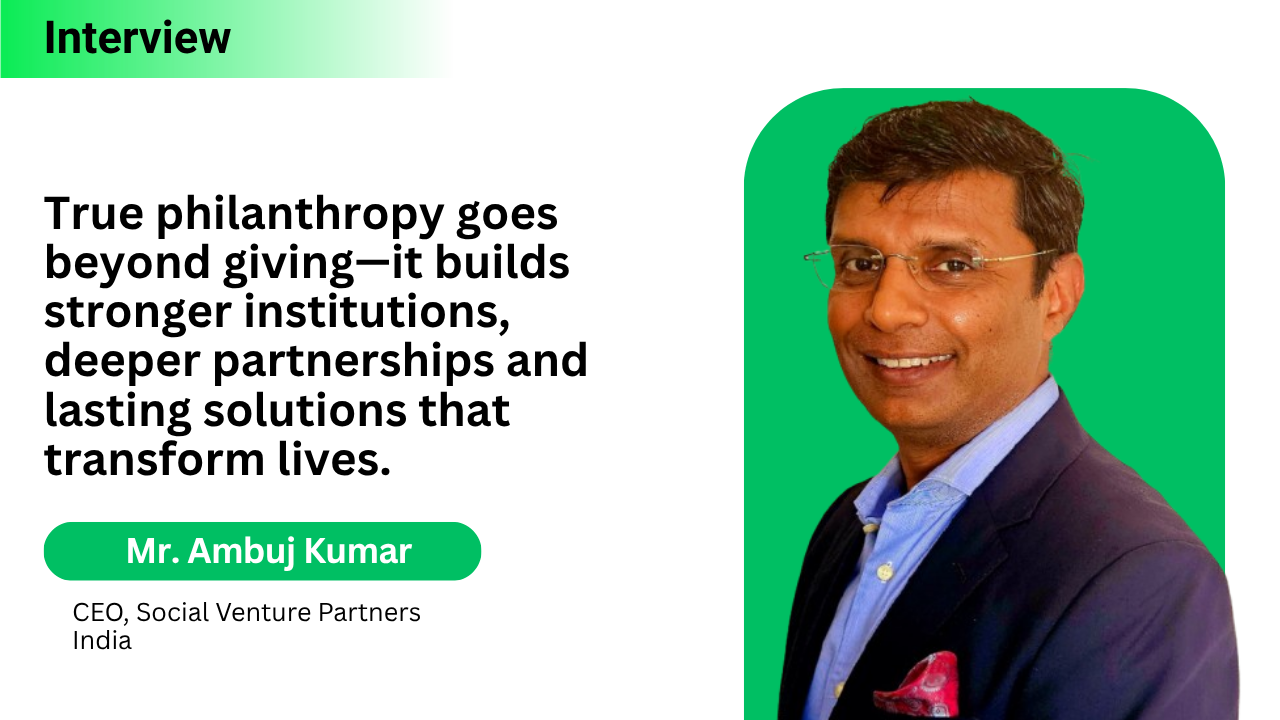
As India’s philanthropy ecosystem evolves, the conversation is increasingly shifting from the volume of giving to the quality and sustainability of impact. While financial support remains essential, lasting social change also depends on strong nonprofit institutions, capable leadership, effective governance and meaningful partnerships that enable solutions to grow. This calls for a more engaged approach to philanthropy, one that brings together resources, expertise, networks and a deeper understanding of community needs.
Social Venture Partners India (SVP India), founded by Ravi Venkatesan, has been working to address this gap through its model of Engaged Philanthropy, which brings together philanthropists and nonprofit leaders to strengthen organisational capacity and create lasting impact. As SVP India enters its next chapter with Ambuj Kumar as its first CEO, the organisation is looking to deepen this approach and expand its community of engaged philanthropists and partners.
In this conversation with TheCSRUniverse, Ambuj Kumar draws on his nearly two decades in international banking and subsequent experience in the social sector to discuss institution-building, collaborative philanthropy, the role of technology and the future of nonprofit-led change in India.
Read the full interview below.
Q. Congratulations on taking over as the first CEO of SVP India. Could you tell us a little about your professional journey and what inspired you to take on this leadership role at this stage of your career?
A. People often see my move from nearly two decades in international banking to the social sector as a significant career shift. For me, it felt less like changing careers and more like bringing together two parts of my journey.
My years at HSBC taught me how strong institutions are built—through governance, strategy and long-term thinking. After returning to India in 2020, I wanted to apply those experiences in a way that created deeper purpose while also being closer to family. It was an opportunity to embrace what I call a portfolio life -investing my time across family, community and meaningful work.
That journey led me to SVP India as a Partner and later to GAME as an Advisor. Spending time with grassroots organisations made me realise that India doesn't lack extraordinary nonprofit leaders; what many organisations need is access to capabilities, networks and long-term champions who can help them grow.
Leading SVP India therefore felt like a natural extension of that journey—an opportunity to strengthen nonprofits, deepen a culture of Engaged Philanthropy, and contribute to a more collaborative social impact ecosystem.
Q. Having worked across different sectors over the years, what convinced you that India's philanthropy ecosystem is at an inflection point today? Where do you see the biggest opportunities for creating long-term social impact?
A. India is witnessing one of the most exciting periods in its development journey. Reports such as Bain & Company's India Philanthropy Report (February 2026) point to unprecedented wealth creation and a growing appetite for strategic philanthropy. At the same time, we're becoming more conscious of the responsibility that comes with that growth. A recent opinion piece by Ashish Dhawan (The Convergence Foundation) and Amit Chandra (A.T.E. Chandra Foundation) highlighted how we are seeing an era of significant expansion in family philanthropy, where a fresh cohort of wealth-building pioneers is increasingly embracing the responsibility of giving as a core tenet of their broader financial and social stewardship.
To me, the biggest opportunity lies in bridging the distance between those who want to contribute and those who are creating meaningful change on the ground.
I often say that India doesn't have a generosity problem - it has a proximity problem. There are thousands of extraordinary grassroots organisations solving complex challenges every day, yet many remain invisible to philanthropists, businesses and even potential volunteers. If we can bridge that gap through stronger partnerships, greater trust and deeper engagement, we can unlock tremendous social value.
I believe the next chapter of Indian philanthropy will not simply be defined by how much we give, but by how intentionally and collaboratively we choose to engage.
Q. SVP India has pioneered the Engaged Philanthropy model in India for over a decade. As you step into this new role, what aspects of the organisation's vision resonate most strongly with you, and how do you hope to build on that foundation?
A. What attracted me to SVP India wasn't just the model - it was the mindset behind it. Traditional philanthropy often ends with writing a cheque; Engaged Philanthropy begins there. It recognises that alongside financial support, nonprofits often need strategic guidance, professional expertise, governance support, introductions, communications and access to networks.
This philosophy resonated deeply with me because institution-building has always been central to how I think about creating long-term value.
Over the past decade, SVP India has built an incredible community of philanthropists who contribute not just capital, but also their time, experience and leadership. My aspiration is to build on this strong foundation by expanding our reach, strengthening our chapters, nurturing more collaborative partnerships and enabling many more nonprofits to become resilient, investment-ready institutions capable of creating sustained impact across India.
Q. Across the development sector, there is increasing recognition that nonprofits require far more than funding to create sustained impact. How is SVP India's Engaged Philanthropy model helping strengthen nonprofit leadership, governance and institutional capacity?
A. One of the biggest lessons I've learnt is that while funding is essential, it is rarely sufficient. Strong organisations are built through capable leadership, effective governance, robust systems and the ability to adapt and grow over time. Unfortunately, these areas often receive far less investment than programme implementation.
At SVP India, we therefore look beyond grants. Our Partners work alongside nonprofit leaders truly as partners - as mentors, coaches and strategic advisors. Depending on the organisation's needs, they may support fundraising, communications, financial planning, technology, HR, governance or organisational strategy. This collaborative approach helps nonprofits build capabilities that remain long after a grant has been utilised.
What's equally inspiring is the transformation we see among our Partners themselves. For many, engaged philanthropy becomes a deeply personal journey. We've had several seasoned Partners go on to serve as CEOs, Board and Advisory Board members of nonprofit organisations, taking on much larger leadership roles within the social sector. It demonstrates that when people engage deeply with a cause, they're often inspired to contribute far beyond financial support.
Ultimately, our goal is not simply to fund projects. It is to strengthen institutions and nurture a community of engaged leaders and lifelong philanthropists.
Q. Many grassroots nonprofits possess deep community knowledge and innovative solutions yet often struggle to gain visibility and long-term support. Why does this gap continue to exist, and what role can platforms like SVP India play in bridging it?
A. Most grassroots leaders spend their days solving problems, not telling stories. Their focus is naturally on serving communities, managing programmes and responding to immediate needs. Building visibility, communicating impact or cultivating donors often becomes secondary—not because it is unimportant, but because there is limited time and capacity.
This is precisely where platforms like SVP India can make a meaningful difference.
By connecting nonprofits with philanthropists, businesses, mentors and ecosystem partners, we help amplify their work, strengthen their institutional capabilities and create opportunities that might otherwise remain inaccessible.
Sometimes, one introduction, one mentor or one partnership can completely change the trajectory of an organisation. Our role is to help make those connections happen - creating a strong multiplier effect.
Q. Fast Pitch has become one of SVP India's flagship initiatives over the years. Could you take us behind the scenes and walk us through how the platform identifies, mentors and prepares high-potential nonprofits before they step onto the stage?
A. Many people see Fast Pitch as a fundraising event. In reality, the event is only the final chapter of a much longer journey which is aimed at further strengthening the capacity and capability building for nonprofits and taking it to the next level.
Every year, hundreds of nonprofits apply through a rigorous selection process. The shortlisted organisations then go through detailed due diligence, mentoring and months of intensive preparation with experienced coaches drawn from our Partner community. Together, they work on far more than a five-minute presentation.
They refine their organisational narrative, strengthen their fundraising proposition, improve communication, build confidence and learn how to engage diverse audiences more effectively.
By the time they step onto the Fast Pitch stage, they are not just better presenters - they are stronger organisations.
That is what makes Fast Pitch unique. It isn't simply about helping nonprofits raise funds on one evening. It is about helping them build the capabilities, confidence and networks that continue creating value long after the applause has ended.
Q. Beyond the funds raised during Fast Pitch, what lasting changes have you observed in participating nonprofits? Could you share a few examples of how the platform has helped organisations strengthen themselves over the long term?
A. Over the years, we've seen participating organizations emerge stronger in many different ways. Some have significantly strengthened their fundraising, others have built better systems, improved governance, enhanced their communications, or gained access to prestigious fellowships and long-term strategic support.
For example, Biome Environmental Trust nearly doubled its fundraising - from ₹2.84 crore to ₹4.18 crore - while also receiving the Indira Priyadarshini Environment Award and securing first place at the FICCI Water Awards 2026. Similarly, Vidyoday Muktangan Parivar grew its fundraising from ₹27 lakh to ₹1.5 crore, expanded its donor base to over 300 supporters, and undertook a communications audit to strengthen how it engages with stakeholders.
What encourages me most, however, is the shift in mindset. Nonprofit leaders begin to see their organizations not just as programme implementers, but as institutions capable of attracting larger partners, building stronger teams and creating sustainable impact.
For us, this is the real measure of success. If Fast Pitch helps an organization become more credible, more resilient and better equipped for long-term growth, its impact extends far beyond a single evening of fundraising.
Q. Collaboration has become central to solving complex social challenges. How do partnerships between philanthropists, businesses, nonprofit organizations and ecosystem enablers help create more sustainable and scalable impact?
A. No single organization, sector or individual can solve today's social challenges alone. The problems are simply too complex. What gives me optimism is that we're increasingly moving away from isolated efforts towards more collaborative and engaged ecosystems. Businesses bring scale and managerial expertise.
Philanthropists bring patient capital and networks. Nonprofits bring deep community understanding. Academia contributes research and innovation. Government creates the enabling environment. When these strengths come together with mutual respect and a shared purpose, the outcomes are far greater than what any one stakeholder could achieve independently.
I often think of SVP India as a bridge. Our role is not to stand at the centre of the ecosystem, but to connect people who may never have otherwise found each other. Sometimes the most meaningful impact begins with a single introduction, a conversation, a shared commitment to solve a problem together - and most importantly, actually engaging and working together towards effectively and successfully solving that problem.
Q. As India's philanthropic ecosystem continues to evolve, how do you see the role of technology, communications and storytelling in helping nonprofits build trust, credibility and stronger relationships with donors and partners?
A. Technology and storytelling are no longer optional capabilities - they are essential to building trust, scale and stronger institutions. Technology enables nonprofits to become more efficient, transparent and data-driven. It helps organizations measure impact, strengthen donor relationships and make better decisions.
At SVP India, we have consciously embraced technology and AI as part of our own organizational journey. From implementing technology-enabled internal systems such as Workhall to improve operational efficiency, to integrating AI into our everyday workflows, we see technology as a powerful enabler of productivity and better decision-making. We've also organised AI workshops and capacity-building sessions for both our team and nonprofit partners, helping them understand how emerging technologies can strengthen fundraising, communications, programme delivery and organizational effectiveness.
At the same time, storytelling remains equally important because people connect with purpose before they connect with programmes. Every nonprofit has remarkable stories of resilience, innovation and transformation. The challenge is often not the absence of impact, but the ability to communicate that impact in a way that inspires trust and action.
Ultimately, people don't invest only in projects - they invest in purpose, leadership and credibility. When nonprofits combine authentic storytelling with strong governance, technology-enabled systems and credible impact measurement, they become far better positioned to build lasting partnerships. I believe organizations like SVP India have an important role to play in helping nonprofits build these capabilities for the future.
Q. As the first CEO of SVP India, what are some of your immediate priorities for the organization over the next three to five years?
A. Our priority is to deepen, not just expand. Of course, we would like to grow our community of engaged philanthropists and support many more nonprofits across India. But equally important is strengthening the quality of engagement within our ecosystem.
We want SVP India to become the platform where philanthropists don't simply contribute resources - they contribute their expertise, networks and leadership. We want nonprofits to see us as long-term partners in institution-building. And we want businesses and ecosystem organizations to view SVP India as a trusted collaborator in creating sustainable social impact.
Ultimately, our aspiration is to help build a culture where engaged philanthropy becomes the norm rather than an exception.
Q. What do you believe will define the next decade of philanthropy in India, and what role do you hope SVP India will play in shaping that future?
A. I believe the next decade will be defined by a shift from transactional giving to transformational partnerships. As India's philanthropic ecosystem matures, we'll move beyond asking, "How much did we give?" to asking, "What lasting change did we help create together?" - or even, "What are we leaving behind for our children?"
We'll see greater emphasis on strengthening nonprofit institutions, investing in leadership, leveraging technology, measuring outcomes and building cross-sector collaborations.
I also believe the next generation of philanthropists will engage differently. They won't be satisfied with simply writing a cheque. They'll want to understand the problem deeply, meet the people creating change, and contribute their own expertise. More importantly, they'll increasingly ask: Can this solution scale? Can it influence systems? Can it improve millions of lives rather than thousands? That shift towards scalable problem-solving will define the future of philanthropy.
That's precisely where I see SVP India playing an important role. We have the opportunity to build one of India's strongest communities of engaged philanthropists—people who don't just support social change, but actively help organisations grow, scale and create lasting impact.
Q. Finally, what message would you like to share with business leaders, philanthropists, CSR professionals and nonprofit leaders who are committed to building a stronger and more collaborative social impact ecosystem in India?
A. India has never had greater potential to create meaningful social impact. We have extraordinary entrepreneurs, businesses, philanthropists and nonprofit leaders - imagine what becomes possible when these strengths come together.
My invitation is simple: don't think of philanthropy as an occasional act of giving. Think of it as an ongoing relationship. One philosophy that has guided me is bringing together the head and the heart. The head helps us think strategically and build solutions that scale; the heart keeps us connected to people and purpose. Lasting social impact needs both.
If each of us chooses to engage a little more deeply - with our time, expertise, networks or resources - I believe we can build not just stronger nonprofits, but stronger communities and a stronger India.



.png)