Beyond Mobility: How Fiserv Is Advancing Inclusion Through Indigenous Innovation
Corporate social responsibility is increasingly moving beyond traditional philanthropy towards solutions that address real-world challenges through innovation, collaboration and measurable impact. For Fiserv, this approach is reflected in its focus on social inclusion and its efforts to make mobility more accessible for injured service personnel and veterans.
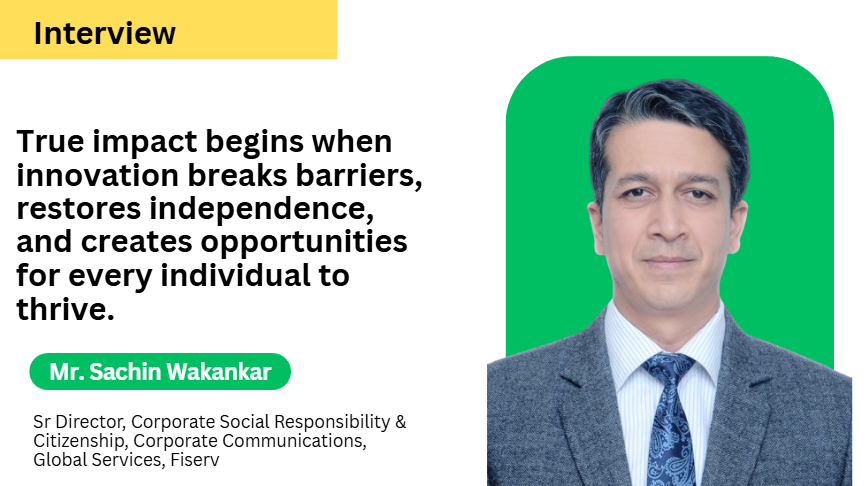
In this exclusive interaction with TheCSRUniverse, Mr. Sachin Wakankar, Sr Director, Corporate Social Responsibility & Citizenship, Corporate Communications, Global Services, Fiserv, discusses the thinking behind the company’s collaboration with IIT Madras’ TTK Centre for Rehabilitation Research and Device Development (R2D2) and Thryv Mobility to support the deployment of the indigenous YD-One, a lightweight, high-performance wheelchair designed for independent mobility beyond conventional clinical settings.
The conversation explores why accessible mobility is an important component of Fiserv’s broader corporate citizenship vision, the role of indigenous innovation in creating sustainable value, and the decision to support the Armed Forces Medical Services. Wakankar also shares how the initiative is being evaluated beyond beneficiary numbers, with emphasis on independence, functional capability, social participation and institutional impact.
The interview further examines the challenges of bringing academia, healthcare, technology innovators and the Armed Forces together, and why Fiserv views this partnership-led model as a potential blueprint for future CSR programmes. He also outlines the company’s plans to scale the initiative and discusses Fiserv India’s wider CSR priorities across education, social inclusion, environmental stewardship, and health and community wellbeing.
Scroll down to read more:
Q. What inspired Fiserv to make accessible mobility and assistive technology a focus area within its CSR strategy, and how does this initiative align with the company's broader corporate citizenship vision?
A. At Fiserv, we believe that meaningful social impact comes from enabling solutions that improve people's quality of life while addressing critical societal needs through sustainable innovation. Accessible mobility is fundamental to independence, dignity, and social participation, making it an important area of intervention within our broader commitment to building more inclusive communities.
Our collaboration with IIT Madras supports the provisioning of indigenous, ultra-lightweight, high-performance wheelchairs for the Armed Forces Medical Services. The initiative addresses a significant gap, as most wheelchairs available today are designed primarily for hospital settings and are often unsuitable for everyday mobility or independent community participation. By supporting access to high-performance mobility solutions, we aim to enhance functional capability, promote greater independence, and improve the overall quality of life for injured service personnel.
Equally important is the focus on indigenous innovation. The initiative enables adoption of a home-grown solution while strengthening rehabilitation capabilities across defence establishments. In FY 2025–26, the project supported the provisioning of 157 wheelchairs, and following its positive impact, the programme has been expanded with approval for 200 additional wheelchairs in FY 2026–27. For us, corporate citizenship is about supporting scalable initiatives that create long-term value. This project reflects this commitment by combining innovation, accessibility, and collaboration to deliver meaningful outcomes for those who have served the nation.
Q. How did the partnership with IIT Madras come together, and what made the TTK R2D2 Centre the right collaborator for this initiative?
A. Creating meaningful and sustainable social impact requires working with institutions that have deep technical expertise and the ability to translate research into solutions that address real-world challenges. This collaboration with IIT Madras reflects Fiserv's broader CSR approach of investing in community partnerships that create long-term, measurable outcomes.
The TTK Centre for Rehabilitation Research and Device Development (R2D2) at IIT Madras, in partnership with Thryv Mobility, developed the YD-One, India's lightest high-performance wheelchair. The solution was created to address a significant gap in mobility, as most wheelchairs available in India are standard hospital-grade models that are heavy, bulky, and intended primarily for clinical settings. In contrast, the YD-One is designed for independent mobility in community and outdoor environments, enabling greater functional independence and social participation.
The initiative also supports the long-term objective of strengthening rehabilitation capabilities across Armed Forces Medical Services by provisioning indigenous, high-performance mobility solutions through a structured implementation model. By combining IIT Madras' research and innovation capabilities with Fiserv's commitment to advancing communities through purposeful CSR investments, the partnership aims to deliver lasting value for injured service personnel and veterans while supporting wider adoption of indigenous assistive technologies.
Q. Why is supporting indigenous innovation important to Fiserv's CSR approach, and how does it create greater value for beneficiaries?
A. Supporting innovative solutions that address real community needs is an important aspect of Fiserv's approach to corporate social responsibility. Our CSR strategy focuses on creating shared value that delivers lasting impact through partnerships and initiatives that strengthen communities while delivering sustainable outcomes.
The collaboration with IIT Madras reflects this approach by supporting an indigenous solution developed to address a critical mobility challenge. The TTK Centre for Rehabilitation Research and Device Development (R2D2), in partnership with Thryv Mobility, developed the YD-One, India's lightest high-performance wheelchair to overcome the limitations of conventional hospital-grade wheelchairs, which are often heavy, bulky and unsuitable for independent mobility outside clinical settings.
By supporting indigenous technology, the initiative aims to improve independent mobility, functional capability and social participation for injured service personnel while strengthening rehabilitation infrastructure across the Armed Forces. At the same time, it promotes, through active demonstration, how home-grown innovation can be deployed at scale to deliver meaningful, long-term value to beneficiaries.
Q. Why did Fiserv choose to support the Armed Forces community through this programme? What impact do you hope it will create for patients undergoing rehabilitation?
A. The Armed Forces community represents individuals who have dedicated themselves to serving the nation, and we believe it is important to support initiatives that can meaningfully improve their quality of life during rehabilitation and beyond. This programme addresses a critical mobility need by providing access to high-performance, ultra-lightweight wheelchairs that enable greater independence and participation in everyday life.
The project responds to a well-defined challenge. Most wheelchairs currently available are standard hospital-grade models that are heavy, bulky, and designed primarily for clinical use. As a result, they often limit independent mobility and restrict participation in community and outdoor environments. By supporting the provisioning of YD-One wheelchairs, the initiative seeks to improve functional capability and provide users with mobility solutions better suited to their daily needs.
The programme will provision 157 wheelchairs across Armed Forces Medical Services, while also strengthening rehabilitation centres through improved equipment availability. Expected impact extends beyond individual users, benefiting families, rehabilitation professionals, hospitals, and the wider defence ecosystem. Following the success of the initiative, the programme has also been expanded for FY 2026–27 with approval for 200 additional wheelchairs. Our aspiration is that every beneficiary gain greater independence, confidence, and opportunity to actively participate in society, making rehabilitation not just about recovery, but about enabling a better quality of life.
Q. How do you measure the success of a CSR initiative like this? Beyond the number of beneficiaries, what impact indicators does Fiserv use to assess long-term outcomes?
A. The success of a CSR initiative extends beyond the number of beneficiaries; it is measured by the meaningful and lasting impact it creates. For this programme, while the provisioning of high-performance wheelchairs is an important milestone, equal emphasis is placed on how these mobility solutions improve the everyday lives of injured service personnel and veterans.
The programme has been designed to improve independent mobility, enhance functional capability, increase social participation and strengthen rehabilitation support across the Armed Forces. These outcomes reflect the broader objective of enabling injured service personnel and veterans to lead more independent and fulfilling lives.
Another importat indicator is the programme's ability to create sustainable institutional impact. By supporting the deployment of indigenous, high-performance mobility solutions across defence rehabilitation centres, the initiative strengthens equipment availability while establishing a scalable model for future provisioning. The approval to expand the programme from 157 wheelchairs in FY 2025–26 to 200 additional wheelchairs in FY 2026–27 further reinforces its long-term value and continued relevance.
Q. What key lessons has Fiserv learned from collaborating with academia, healthcare institutions, and technology innovators on this initiative? Do you see this model as a blueprint for future CSR programmes?
A. One of the key lessons from this initiative is that most impactful CSR programmes are built through collaboration. By bringing together academia, healthcare institutions, technology innovators, and industry, we were able to combine research, user insights, engineering expertise, and scale to deliver a solution that enhances mobility, independence, and dignity for injured servicemen and women. The project also reinforced the importance of co-creating solutions with end users and supporting indigenous innovation to address real-world needs effectively.
We absolutely see this model as a blueprint for future CSR programmes. Complex societal challenges require ecosystem-led solutions, and this initiative demonstrates how partnerships can transform research and innovation into meaningful, scalable impact. Fiserv will continue to support programmes that act as catalyst of collaboration and partnership for good - bringing together technology, innovation, and purpose to create sustainable outcomes for communities and advance inclusive development.
Q. What were the biggest challenges in implementing this initiative, and how did Fiserv overcome them?
A. One of the biggest challenges was bringing together multiple stakeholders - academia, healthcare professionals, technology innovators, and the Armed Forces, around a shared objective while ensuring that the solution met real-world rehabilitation needs. The initiative required close coordination over an extended period to translate research and engineering innovation into a product that could deliver meaningful mobility outcomes for injured servicemen and women. Fiserv addressed this by fostering strong partnerships, aligning stakeholders around a common vision, and supporting a collaborative development process rooted in user needs
Another challenge was ensuring that a highly specialized, indigenously developed innovation could be deployed at scale and create sustained impact. Fiserv overcame this by taking a long-term approach - supporting not only the development and initial handover of wheelchairs but also committing to broader deployment across the defence ecosystem. This focus on partnership, scalability, and measurable outcomes helped transform a promising innovation into a programme capable of improving mobility, independence, and quality of life for a larger number of beneficiaries
Q. Could you share an early beneficiary story or feedback that best illustrates the impact this initiative is creating?
A. Given that the project has only recently entered its delivery phase, it is still early to capture comprehensive end-user beneficiary stories and longitudinal impact data. However, one of the strongest indicators of the initiative’s relevance and potential impact is the fact that Army Hospital (Research & Referral), among India’s premier rehabilitation and medical institutions for Armed Forces personnel, was selected as the pilot recipient. Its adoption of the YD1 wheelchair reflects a clear alignment between a critical rehabilitation need and an innovative mobility solution designed specifically to enhance independence, comfort, and quality of life for users.
More broadly, what gives us confidence in the programme’s potential is its scale and the community it serves. Through the commitment to provide more than 350 wheelchairs across the Armed Forces ecosystem, the initiative has the opportunity to positively impact one of the country’s most deserving communities – service personnel and veterans who have sacrificed immensely in the line of duty. While we look forward to gathering direct beneficiary feedback as the programme progresses, the endorsement of leading rehabilitation experts and institutions, coupled with the continued expansion of the project, reinforces our belief that this initiative can create meaningful and lasting improvements in mobility, dignity, and independence for those who have served the nation.
Q. What are Fiserv's plans to scale this initiative in the coming years? Do you envision expanding it to more healthcare institutions or underserved communities across India?
A. An important factor in scaling this initiative is that it aligns closely with Social Inclusion, one of Fiserv’s global CSR priorities. The positive momentum of this initiative has already resulted in its continuation beyond the initial phase. Following the provisioning of 157 ultra-lightweight, high-performance wheelchairs under the FY 2025–26 programme, approval has been received to support an additional 200 wheelchairs during FY 2026–27, reflecting the programme's continued relevance and expected impact.
The broader vision extends beyond a single beneficiary group. The programme has demonstrated how innovation, accessibility, and strategic partnerships can come together to address mobility challenges in a meaningful and scalable way.
As we look ahead, we see significant potential to expand the learnings, partnerships, and capabilities developed through this initiative to benefit the wider Persons with Disabilities (PwD) community across India. Fiserv already supports programmes focused on social inclusion and works closely with people with locomotor disabilities and para-sports athletes. This provides a strong foundation to explore opportunities where innovative mobility solutions can improve independence, participation, and quality of life for a broader population.
While future expansion will be guided by community needs, stakeholder partnerships, and measurable impact opportunities, we believe initiatives such as this can serve as a powerful model for advancing accessibility and inclusion at scale, helping more individuals lead active, dignified, and empowered lives.
Q. Beyond accessible mobility, what are the key focus areas of Fiserv India's CSR portfolio, and how do they contribute to your long-term social impact vision?
A. At Fiserv, our CSR strategy is centred around creating sustainable, measurable impact across four key pillars such as Education, Social Inclusion, Environmental Stewardship, and Health & Community Wellbeing. These focus areas guide our efforts to address evolving community needs through initiatives that create long-term social value while advancing more inclusive and resilient communities.
Across education, we are working to expand access to future-ready learning through initiatives such as STEM laboratories and scholarships. Our inclusion programmes focus on empowering underserved communities, including women entrepreneurs and veterans, while our environmental initiatives promote resource conservation, biodiversity and sustainable ecosystems. The accessible mobility initiative with IIT Madras complements these efforts by strengthening rehabilitation support and improving quality of life for injured service personnel through innovative assistive technology.
Looking ahead, our vision is to continue building programmes that are scalable, partnership-led and outcome-driven. By combining innovation with community engagement, we aim to create lasting impact that empowers individuals and strengthens communities across India.
Q. Looking ahead, what is your long-term vision for Fiserv's CSR initiatives in India, and what role do partnerships play in achieving that vision?
A. Our long-term vision is to continue creating shared value across our communities through initiatives that are sustainable, scalable and aligned with evolving societal needs. Guided by our focus on Education, Inclusion, Environmental Stewardship and Community Well-being, we aim to create positive impact by investing in programmes that empower individuals and strengthen communities over the long term.
Partnerships are central to achieving this vision. We believe meaningful impact is created by bringing together the strengths of academic institutions, implementation partners, community organisations, technology innovators and beneficiaries. Our collaboration with IIT Madras on the accessible mobility initiative demonstrates how research, indigenous innovation and community investment can come together to address critical rehabilitation needs while delivering measurable social impact. As we look ahead, we will continue to build collaborations that enable innovative solutions to reach more communities, while ensuring every initiative is designed to create sustainable, measurable outcomes and lasting social value.



.png)