Beyond Giving: How Vashi Integrated Solutions is Building CSR for Lasting Impact
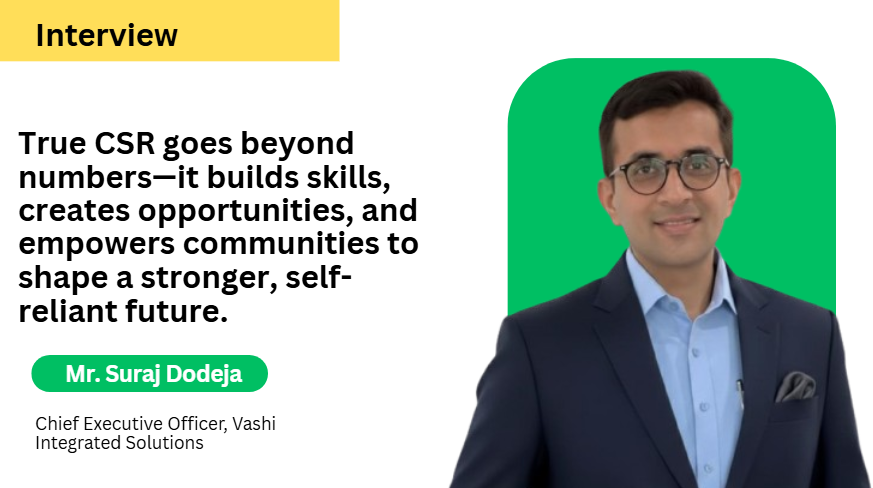
CSR becomes truly meaningful when it moves beyond numbers and creates opportunities that last. For businesses, the real challenge is not only to support communities, but to design programmes that build skills, improve access to education and healthcare, protect the environment, and help people become more self-reliant.
In this interview, Suraj Dodeja, Chief Executive Officer, Vashi Integrated Solutions, discusses how the Vashi Parivaar Foundation is taking a structured and community-focused approach to CSR. He shares how the company’s partnerships with 25+ NGOs across 10+ states are helping address diverse social needs through livelihood development, education, healthcare, environmental sustainability, and community welfare.
The conversation explores how Vashi measures the long-term impact of its programmes, from vocational training and employment to educational support and healthcare interventions. Dodeja also discusses the role of grassroots partnerships, employee participation, and circular economy initiatives in creating sustainable outcomes. At its core, the interview offers insights into how CSR can become part of an organisation’s culture while creating lasting value for communities.
Scroll down to read more:
Q. Vashi Integrated Solutions has adopted a structured approach to CSR across livelihoods, education, healthcare, and sustainability. What are the key gaps or challenges that your CSR efforts are trying to address, and how have these priorities evolved over time?
A. We have a dedicated CSR arm at Vashi Integrated Solutions, the Vashi Parivaar Foundation, which is committed to driving sustainable social impact through focused interventions in education, healthcare, livelihoods, and environmental sustainability. Our objective is not just to address immediate community needs but to create long-term opportunities that empower individuals and strengthen communities. We observed that there is a close relationship between unemployment, interruption in education, and insufficient access to healthcare, which needed sustained solutions. We have adopted and implemented a structured CSR approach, from supporting individual causes to building structured, measurable interventions that address systemic gaps in employability, quality education, accessible healthcare and environmental sustainability. Today we work across 10+ states with 25+ NGO partners, focusing on underserved communities. In one of our healthcare initiatives, we supported a medical unit that provided essential healthcare services to over 800 tribal students in South Gujarat. These partnerships have helped us evolve from addressing immediate needs to building long-term opportunities that empower individuals and strengthen communities.
Q. Livelihood development is one of your key focus areas. Beyond placement numbers, how do you assess whether skill development programmes are creating sustainable livelihood opportunities for young people?
A. Our impact is measured not just by the number of placements but by how well they prepare for long-term employability and economic outcomes. We focus on programmes that are best aligned with industry requirements and market demand, equipping individuals with practical, job-ready skills across sectors such as warehouse logistics, healthcare support and IT. In FY26 alone, we were able to train 448 youth by our skilling initiatives, and we have achieved an 80% placement rate. Through our Bhiwandi Logistics Training Centre and Turbhe Vocational Skills Centre, a number of trainees have also been placed in different warehousing companies. We work closely with our NGO partners to offer guidance and complete support. This helps participants improve their employability, access income opportunities and overcome personal and financial challenges.
Q. Your education initiatives have reached children from Child Welfare Institutions, tribal communities, and nomadic and de-notified communities. What have been some of the key learnings while working with these diverse groups?
A. One of our biggest learnings is that no one-size-fits-all approach to creating impact. Meaningful change comes from understanding the unique needs of every community. Our initiatives reflect this belief, whether it is helping school dropouts return to formal education through Masoom, supporting 1,900+ children to access quality education through Our Children initiative, supporting 600 students from nomadic and de-notified communities with VSSM, strengthening learning opportunities for tribal students through Isha Vidya, or providing educational support for specially-abled students through Jagruti Palak Sanstha. Each intervention has been designed closely with local partners that understand the unique needs of each community.
Q. Healthcare needs often vary across communities. How does Vashi Parivaar Foundation identify the areas where its healthcare interventions can create the greatest impact?
A. At Vashi Parivaar Foundation, our healthcare CSR initiatives are guided by the specific needs of the communities we serve and the insights of our NGO partners working on the ground. Rather than adopting a uniform approach, we identify gaps where timely support can make a meaningful difference, like nutritional supplies for 40 children in the TATA Hospital Pediatric Ward, assistance to 250 patients and families at Sant Gadge Ashram, medical support through a healthcare unit benefiting 800 tribal students in South Gujarat, mental health workshops for girls at Ma Niketan and many more. These need-based approaches ensure our interventions are relevant, targeted and sustainable.
Q. Environmental sustainability is becoming an important part of CSR. Could you tell us about your textile recycling initiative and what role you see circular economy practices playing in corporate social responsibility?
A. In order to promote sustainability and waste reduction, we have partnered with Bombay Recycling Concern, an NGO which is committed to building a circular economy by giving a second life to wearable clothing. As part of the initiative, we collect gently used garments from our employees, then hygienically refurbish, quality-check, and properly label them and distribute them to daily wage labourers and other underprivileged individuals. As a result, in the past two years, 1500+ shirts have been refurbished and reused, helping reduce textile waste while creating a positive social impact. By extending the life of wearable garments, the initiative not only supported vulnerable individuals with essential clothing but also encouraged responsible consumption and environmental sustainability.
Q. Vashi Parivaar Foundation currently works with more than 25 NGO partners across multiple states. How have these collaborations strengthened your programmes, and what have they enabled you to achieve that would have been difficult to accomplish independently?
A. Our collaborations with NGOs have played an essential role and have shaped the way we approach CSR. Working with 25+ NGOs across 10+ states has helped us gain a better understanding of the local challenges from a grassroots level. While we provide vision and source, each partner contributes extensive grassroots knowledge that enables us to identify genuine needs, reach underserved populations, and implement initiatives with greater effectiveness. These collaborations have helped us identify and enabled us to create impact across various sectors such as livelihood development, education, healthcare, environmental sustainability, and community welfare. More importantly, these collaborations have helped us build trust within communities, ensuring our efforts create meaningful outcomes.
Q. CSR today is increasingly expected to deliver measurable and long-term outcomes rather than one-time interventions. How is Vashi Integrated Solutions approaching impact measurement across its different focus areas?
A. For us, impact measurement goes beyond the number of beneficiaries reached. While we closely monitor programme-specific outcomes, such as training completion, our 80% placement success rate in vocational skilling, or students reintegrated into formal education, we also look at the long-term change these interventions create. Our support has enabled beneficiaries to overcome personal and financial hardships to achieve significant milestones. Through industry-relevant training, individuals have secured stable roles in logistics, warehousing, healthcare, and education, which helped many participants secure stable employment and improve their financial stability. Some of the beneficiaries were able to complete their higher education as well. These success stories reflect our commitment to create lasting socio-economic impact.
Equally important is the continuous feedback we receive from our 25+ NGO partners, which helps us tailor our interventions in order to improve programme effectiveness and ensure our CSR efforts continue to deliver measurable, sustainable impact over time.
Q. Based on your experience, what do you believe are the most important factors for designing CSR programmes that create lasting value for both communities and the organisations supporting them?
A. One of the most important lessons for us so far is that CSR cannot operate as a standalone function of business, it has to become part of an organisation's culture. At Vashi, our employees, branches and NGO partners all contribute to our initiatives, creating a shared sense of ownership rather than viewing CSR as a standalone function. We believe that CSR initiatives can have lasting value by listening to communities, partnering with organisations that have deep grassroots expertise, and designing initiatives that build capabilities instead of creating dependency. Measuring outcomes becomes equally important, learning from every initiative and continuously refining our programmes to maximise impact. When communities become stronger and more self-reliant, the impact extends well beyond the duration of any single project, creating value for everyone involved.



.png)