

Beyond Average Learning: What India Must Do Next to Ensure Every Child Learns
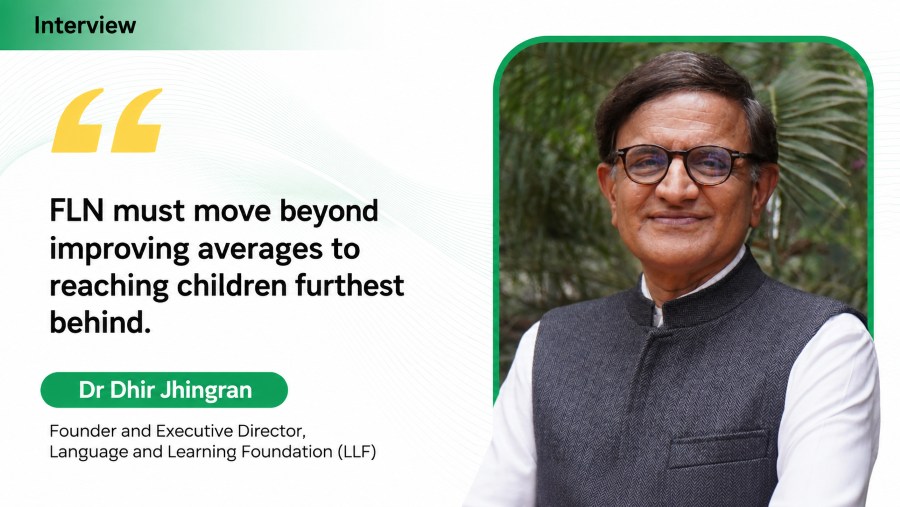
India’s foundational learning agenda has moved from policy intent to a more sustained focus on what happens inside classrooms. Five years into NIPUN Bharat, the challenge is no longer simply to establish foundational literacy and numeracy as a national priority, but to ensure that progress reaches every child, particularly those who remain furthest behind.
In this conversation, Dr Dhir Jhingran, Founder and Executive Director, Language and Learning Foundation (LLF), reflects on what India has achieved, where the gaps persist and what it will take to translate system-level reform into meaningful classroom change. Drawing on three decades in public service and extensive experience in education reform, he discusses teacher capacity, multilingual education, the role of the middle tier, and LLF’s Teaching Learning Practices Survey. He also explores how AI and technology can support teachers, the potential of the Social Stock Exchange for education organisations, and why the next phase of FLN must focus not just on improving averages, but on ensuring that the children furthest behind are learning.
Read the full interview below.
Q. As India completes five years of NIPUN Bharat, what do you see as its most significant achievements so far? Equally, what aspects of the foundational learning agenda still require urgent attention if the mission's goals are to be realised by 2026-27?
A. The NIPUN Bharat Mission has been significant in moving the needle on foundational learning in India. One of its biggest contributions has been that it placed foundational literacy and numeracy at the centre of the national education agenda. Over the last few years, we have seen not only greater attention to children’s learning outcomes, but also a stronger focus on the quality of teaching-learning processes inside classrooms.
At the same time, national surveys such as ASER 2024 and PARAKH 2024 remind us that the task is far from complete. Nearly half of Grade 5 students are still unable to read a Grade 2-level text with comprehension. The challenge is not only about average learning levels improving, but about who is being left behind. Students in the bottom quartile continue to learn very little, and learning levels can vary significantly within the same district, school, or even classroom.
If we continue at the current pace, it could take several more decades to ensure foundational learning for every child. Therefore, the next phase of NIPUN Bharat will require sharper attention to children’s home languages, stronger investment in early childhood education, targeted remediation and catch-up support, and sustained professional development for teachers and the middle-tier cadre. The goal is to ensure that every child, especially the most marginalised, is supported to learn with understanding.
Q. After three decades in public service and leadership roles across government and international education organisations, what convinced you that India needed an institution like LLF? Looking back on this journey, what have been your biggest learnings about driving large-scale education reform through public systems?
A. In my 30 years of working with the government education system at the state and national levels, I came to see its challenges very clearly. The teaching-learning processes in classrooms were often teacher-dominated and failed to actively engage children, give importance to their foundational learning, or even to an understanding of how young children learn. Additionally, I observed that a large number of children study through a language they do not understand when they first join school; therefore, any solution for foundational learning for these disadvantaged students, who have a different language and culture, must include their most familiar languages.
That period helped me identify the scope for improvement and what can be done. For example, continuous professional development of teachers and middle-tier cadre in the education system, better teaching-learning materials for children, especially in their home language, etc. I became convinced that India needed an organisation devoted to foundational learning, one that could ensure the best possible inputs reach teachers, children, and everyone in the education ecosystem. I was equally convinced that change is possible within the government system. It was already happening in small pockets. The task was to make it happen at scale.
That conviction shaped how we built Language and Learning Foundation. From the outset, we chose to work with the government system rather than around it, because it is the government that carries the mandate and the accountability for improving children's learning at scale. We committed to solutions that could be implemented at that scale, and to placing teachers at the centre as the real agents of change in the classroom.
Looking back on the journey, my biggest learnings are about what it truly takes to drive reform through public systems. The first is that reform needs a shared vision, one that runs unbroken from the head of the state education department all the way down to the individual primary school teacher. Too often that thread is missing. Second, a vision is not enough without a road map to realise it. Reform needs a three- to five-year plan, worked out in detail with activities, timelines, and costings, and then carried through consistently.
Third, it is vital to identify the champions of change, the teachers, block education officers, and master trainers who have genuinely internalised the new practice, and to bring them to the front. Fourth is the value of dialogue and consultation whenever a large-scale, fundamental change is introduced. In my experience, the programmes that engaged teachers first, through genuine consultation before implementation, saw far better adoption in schools and proved far more successful.
And finally, we must be patient. Education change is inherently complex. It is a vast system with countless stakeholders, and it does not yield quick results. The discipline lies in being realistic about which changes to expect, and when, rather than always reaching for immediate outcomes.
Q. LLF has consciously chosen to work through government systems rather than create parallel delivery models. What does it take to build genuine ownership of reforms within public education systems, and what are the biggest barriers to sustaining change at scale?
A. Sustainable reform in foundational learning cannot happen through parallel delivery models; if the system itself doesn't develop the capacity to design, deliver, and adapt effective FLN practice, any gains made through external support are contingent on that support continuing. That is why LLF has consistently chosen to work inside government systems, co-creating materials through state resource groups, building the capacity of state institutions and middle-tier functionaries, and embedding ourselves in the routine processes of state institutions rather than operating alongside them.
Building genuine ownership often takes longer and is less legible than running a programme directly; it requires an investment in processes and people. The payoff is that the capacity to repeat and adapt the process stays within the system.
The biggest barriers to sustaining change at scale are not primarily technical. The most significant structural challenge is leadership instability; each transition risks resetting priorities and losing the relational trust that makes genuine co-creation possible. The second is the form-over-function problem: systems under reform pressure, and the external partners working with them, consistently face incentives to demonstrate visible compliance rather than genuine capability development. A third, often underestimated, is the middle tier, the connective tissue between policy intent and classroom reality. When block and district functionaries aren't functioning as active vehicles for academic support, reform stalls between the state level and the classroom.
What LLF has learned is that these barriers have to be factored into how system strengthening work is designed from the outset and not only treated as implementation risks to manage once a programme is underway. Building relationships and institutional knowledge at multiple levels of the system, not just with senior leadership; being explicit about what is non-negotiable in programme design so that transitions don't reset core commitments; investing in processes that outlast individuals; and building the capacity of the middle tier to deliver strong mentoring and instructional leadership to teachers.
Q. Teacher capacity remains central to improving foundational learning outcomes. In your view, what needs to change in teacher professional development and academic support systems to translate training into stronger classroom practice and better learning outcomes?
A. Teachers are working in complex classrooms, often with children at very different learning levels, in multigrade settings, and sometimes in contexts where the teacher may not share the children’s home language. Training must therefore go beyond content delivery. It needs to help teachers use children’s home languages meaningfully, support children who are falling behind, and create classrooms where every child gets opportunities to participate.
The second shift is to strengthen the bridge between training and classroom practice through middle-tier academic leadership. Teachers need practical materials, peer learning opportunities, mentoring, and regular feedback from academic support structures at the cluster, block, and district levels.
Better classroom practice requires sustained professional development and a strong middle-tier cadre that can observe classrooms, support teachers, and lead instructional improvement over time.
Q. LLF's Teaching Learning Practices Survey (TLPS) 2025 has brought unprecedented attention to what happens inside early-grade classrooms. What are the most important insights emerging from the survey, and how can they help shape the next phase of FLN reforms?
A. TLPS 2025 is a timely study that reflects the progress made under the NIPUN Bharat Mission as well as where the next set of improvements must come from. For instance, only about one-third of classrooms created opportunities for children to speak freely and engage openly. Similarly, while 73% of teachers knew the home languages of children in their classrooms, only 9% used these languages consistently to support participation and comprehension.
The survey points to the need for a clear shift from teacher-centred practices to more learner-centred classrooms, where children are encouraged to think, speak, question, write independently, and connect learning with their own experiences. This will require teacher professional development to move beyond isolated training events and become more continuous, supported by peer learning, digital resources, and strong on-site academic mentoring.
TLPS also highlights the need for stronger multilingual policies, dedicated support for multigrade teaching, and a continued policy commitment to FLN beyond 2026–27, extending support to Grades 3–5 and deepening the vision of foundational learning beyond basic skill acquisition.
Q. You have long advocated multilingual education as a foundation for equitable learning. How can policymakers balance children's home languages, effective learning, and growing aspirations around English without compromising any of these goals?
A. I think we need to move away from the idea that this is a choice between home languages and English. It isn't. Every parent wants their child to learn English because they associate it with opportunity, and those aspirations are completely understandable. At the same time, we cannot ignore how children actually learn. A child who enters school speaking Gondi, Santhali, or any other home language cannot be expected to immediately learn new concepts in an unfamiliar language.
At LLF, we have seen that when teachers use children's home languages as a resource, children participate more, understand better, and build stronger foundations in reading, writing, and mathematics. The home language is the bridge that helps children reach academic success. Once that foundation is strong, learning additional languages becomes much easier.
The real policy challenge, therefore, is not deciding which language to prioritise, but designing an education system where languages work together. We need an additive multilingual approach or language maintenance model that values children's home languages, strengthens proficiency in the State language or medium of instruction, and systematically builds English over time. Research as well as our experience across diverse classrooms shows that strong literacy in one language supports learning in another.
So, investing in multilingual education is not about lowering aspirations for English; it is about giving children the best chance of becoming confident multilingual learners. If we truly want equitable learning outcomes, we must ensure that no child is forced to choose between understanding today's lesson and preparing for tomorrow's opportunities. They deserve both.
Q. As education systems increasingly explore the use of technology and AI, how do you see these tools contributing to foundational literacy and numeracy? What opportunities excite you the most, and where should educators exercise caution to ensure technology strengthens rather than replaces good teaching?
A. Technology and AI can make a significant contribution to foundational literacy and numeracy when they are designed to solve real problems faced by teachers and education systems. At LLF, our approach is guided by a clear principle: technology should augment teachers, not replace them. We see the greatest potential in teacher-facing solutions that strengthen classroom practice, reduce administrative burden, and enable faster, evidence-based action. This includes AI-enabled oral reading and worksheet assessments that can quickly identify learning gaps and support targeted remediation; multilingual tools that help teachers communicate and teach more effectively in children’s home languages; and AI-powered classroom support that can provide teachers with contextual guidance, resources, and pedagogical support when they need it.
We are particularly excited by the potential of voice-based and multilingual AI solutions that can work in low-connectivity settings and extend high-quality support to teachers and children who have historically been underserved by mainstream technologies.
At the same time, we need to be thoughtful about where and how technology is used, particularly in the foundational years. For young children, learning is deeply social and depends on conversation, play, relationships, and meaningful interaction with teachers and peers.
Technology should therefore strengthen these interactions rather than displace them. The key risks are not only excessive screen exposure, but also adopting tools that are poorly aligned with pedagogy, insensitive to linguistic and cultural contexts, or used without adequate attention to accuracy, privacy, bias, and human judgment.
The opportunity before us is not simply to put more technology into classrooms, but to build responsible, contextually grounded tools that give teachers better insights, reduce routine workload, and help them spend more time doing what matters most: understanding, engaging, and supporting every child.
Q. As the social sector explores new avenues for mobilising capital, how do you view the potential of the Social Stock Exchange for organisations working in foundational learning? What would encourage greater participation from the education sector?
A. The Social Stock Exchange marks an important evolution in how India funds social impact, moving capital toward organisations that can demonstrate real, measurable outcomes. For foundational learning, this is a meaningful opportunity as FLN work increasingly has the data infrastructure, like assessments, government dashboards, and third-party evaluations, to furnish the evidence and accountability needed for SSE. Organisations like ours, working embedded within government systems, could use the SSE to access outcome-linked capital that complements our public-system partnerships.
A few things would help bring more of the education sector in. First, co-developing FLN-specific outcome metrics such as foundational skill milestones, change in teaching and learning practices, or system-strengthening indicators, rather than applying generic social-impact benchmarks that don't capture how learning actually improves.
Second, simplifying the social audit and listing process for smaller, high-impact organisations that may not have large compliance teams, perhaps through an aggregator or pooled-listing structure for similar-sized NGOs.
And third, building sector familiarity through capacity-building support and a few credible early listings, as once education organisations see peers navigate the SSE successfully, participation will follow naturally.
Q. India has made foundational learning a national priority, yet learning poverty remains a significant challenge. If you were to identify one major shift that policymakers, practitioners, and funders must collectively make over the next five years, what would it be, and why?
A. The one major shift we need over the next five years is to move from measuring average learning to measuring distributed learning. The question can no longer be only whether a state, district, or programme is improving on average. We must ask which children are improving, how far they have moved, and whether the children at the very bottom of the learning distribution are moving at all. Average scores can rise while tribal districts stagnate, while children from marginalised communities remain behind, or while girls and multilingual learners continue to face barriers that are not visible in aggregate data.
This shift matters because what we measure determines what we reward, fund, and prioritise. For policymakers, it means making equity central to FLN accountability frameworks, with outcomes disaggregated by gender, social group, home language, geography, and other forms of marginalisation. For practitioners, it means strengthening diagnostic teaching, classroom inclusion, multilingual pedagogy, and academic support that asks not just what is being taught, but who is participating and who remains silent. For funders, it means asking for evidence of progress among the children furthest behind, not only overall gains.
If India wants to address learning poverty meaningfully, the next phase of FLN must be able to reach the children who are left behind.





.png)