Ambuja Foundation: Advancing Rural Disability Inclusion
For children with intellectual and developmental disabilities, access to timely therapy, inclusive education and opportunities for independent living can still depend heavily on geography. In rural communities, limited specialised services, delayed identification and persistent social stigma often compound these barriers, making inclusion as much a community challenge as a developmental one. The evolving role of CSR is therefore increasingly centred on building ecosystems that connect specialised care with education, family support, livelihoods and social acceptance.
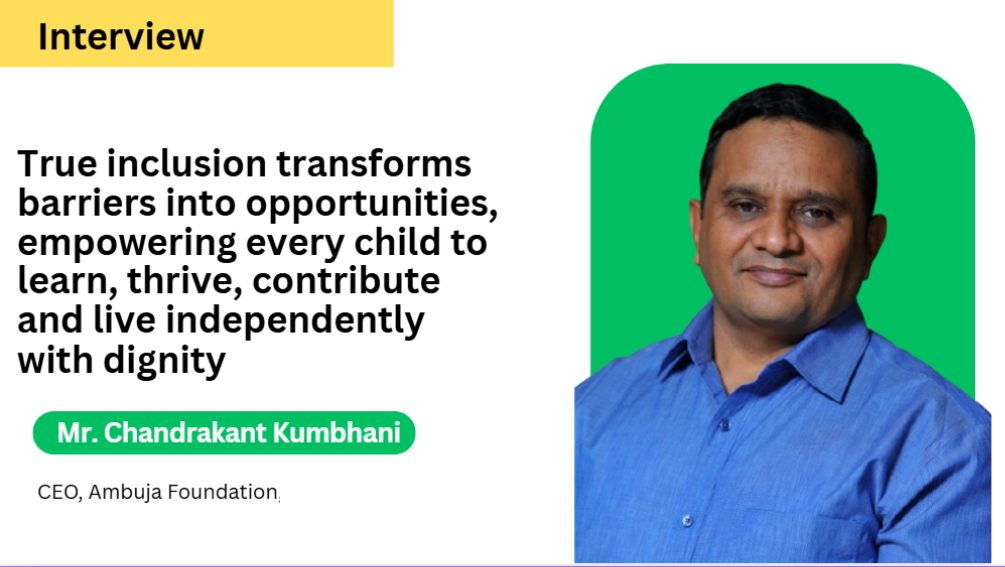
At Ambuja Foundation, this approach has taken shape through Ambuja Manovikas Kendra in Ropar, Punjab, which has evolved over 27 years from a special education initiative into a holistic model encompassing early intervention, therapy, vocational training, family counselling and community outreach. In this conversation, Mr. Chandrakant Kumbhani, CEO, Ambuja Foundation, discusses how sustained community engagement, specialised interventions such as sensory integration, and partnerships across government, healthcare and philanthropy can help move disability inclusion beyond institutional support towards lasting independence and participation. He also reflects on the measurable outcomes emerging from the Foundation’s work and the potential to take proven models of rural inclusion to underserved communities across the country.
Scroll down to read the full interview:
Q. Ambuja Foundation has spent nearly three decades working towards rural transformation across diverse thematic areas. How do you ensure that disability inclusion and developmental support for children with special needs remain integral to your broader vision of sustainable rural development rather than being treated as standalone welfare initiatives?
A. Disability inclusion has never been a standalone welfare initiative at Ambuja Foundation—it is integral to our vision of building inclusive, resilient and prosperous rural communities. We believe that sustainable development can only be achieved when every individual, regardless of ability, has the opportunity to participate fully in community life and realise their potential.
This philosophy is reflected across all our programmes. Whether we are working with farmers, women entrepreneurs, youth or community institutions, we strive to create awareness, remove barriers to participation and promote equal opportunities for persons with disabilities. Inclusion is not simply about providing specialised services; it is about fostering acceptance, dignity and participation within families and communities.
Our work at Ambuja Manovikas Kendra (AMK) in Ropar, Punjab supported by Ambuja Cements/Adani Cement, is a natural extension of this approach. For the past 27 years, AMK has provided specialised education, therapeutic support and vocational training for children and young people with intellectual and developmental disabilities. More importantly, it has worked to change community perceptions—helping families recognise the abilities rather than the limitations of their children, while creating pathways for education, livelihoods and greater independence.
This commitment to inclusion extends beyond AMK. Across our Skill and Entrepreneurship Development Institutes (SEDIs), we actively ensure that youth with disabilities are not overlooked and have equitable access to vocational training and employment opportunities. To date, 354 young persons with disabilities have completed SEDI training, with some now employed or running successful enterprises, earning sustainable livelihoods and contributing to their families' incomes. Their achievements demonstrate that, when barriers are removed and opportunities are created, disability is never a barrier to success.
Ultimately, our objective is the same across every programme we implement: to ensure that no one is left behind. By empowering every member of the community to contribute meaningfully, we strengthen families, build more inclusive societies and create the foundations for truly sustainable rural development.
Q. There is growing recognition that CSR must move beyond infrastructure creation to enabling long-term social outcomes. How does Ambuja Foundation define success when investing in interventions that improve quality of life and social inclusion for children with developmental disabilities?
A. At Ambuja Foundation, we define success not simply by the services we provide, but by the lasting social change we create. For children with developmental disabilities, success means building confidence, independence and inclusion—within families, schools and the wider community.
One integral element of Ambuja Foundation's work in building sustainable communities is creating community ownership. Changing people's attitudes and encouraging them to take ownership is one of the Foundation's greatest achievements. If people don't change, you only change circumstances and resources. But when people change, there is transformation. This philosophy has always remained at the core of Ambuja Foundation's vision and work.
Over the years, we have established a vibrant network of community volunteers—including Sakhis (frontline health workers), Balmitras, Adolescent Peer Educators, Women Leaders and Model Farmers—who have become trusted voices within their communities. Their presence has fostered deep trust, enabling them to influence attitudes, shift mindsets and inspire meaningful behavioural change.
These local champions are not only messengers of health and development but also role models who embody the very practices they promote. As a result, communities become more receptive, adopting healthier behaviours and more inclusive attitudes. When it comes to changing mindsets and breaking the stigma surrounding children with special needs, these community leaders play a vital role in encouraging acceptance and inclusion.
One AMK student illustrates this transformation. Born with an intellectual disability and bilateral claw hand and foot deformities, he faced deep social stigma from an early age. Local people shied away from him, speaking in hushed tones and making hurtful comments such as, "What a burden for the family," and, "How can they manage his behaviour?"
In 2015, at the age of 14, he enrolled at AMK, where he received regular therapy to strengthen his fine motor skills, improve his communication and develop essential life skills such as personal hygiene, grooming, eating independently and social interaction. He made remarkable progress and became increasingly confident and independent in managing his daily life.
After graduating from AMK, he joined the Skill Development & Rehabilitation Centre-cum-Production Centre, where he learnt vocational skills and, importantly, how to ride a cycle. Recognising his potential, AMK mobilised the local community to help him establish a cycle-rickshaw delivery service. A local donor came forward to purchase the rickshaw, while businesses in the area were encouraged to support the initiative.
A local kirana store partnered with him by taking orders on his behalf, and he soon began delivering groceries to homes, bags of cement to construction sites, seeds to farmers during sowing season, and catering materials for local functions. Today, he covers around 15 kilometres each day across six to seven villages, confidently navigating the roads and earning approximately ₹8,000–10,000 per month.
For us, this is what success looks like—not simply providing therapy or education, but helping a young person move from social exclusion to independence, meaningful employment and acceptance within the community.
Q. Children with autism and other developmental disabilities often face significant gaps in access to specialised therapeutic services, particularly in rural India. From your perspective, what systemic challenges still need to be addressed, and how can CSR complement public healthcare and education systems in bridging these gaps?
A. AMK is based in Ropar, Punjab, and is one of the very few schools dedicated to children with intellectual and developmental disabilities in a rural setting. Typically, schools and therapeutic services for children with special needs are concentrated in urban or semi-urban areas, leaving rural families with limited access. For many, the long distances involved result in delayed intervention, worsening conditions and, in some cases, children receiving no support at all. There is a pressing need to establish more centres like AMK across rural India.
Awareness of developmental disabilities and therapeutic interventions also remains very limited in rural communities. Many families are unaware that early intervention can significantly improve a child's development, behaviour and independence. Stigma and social attitudes often lead parents to hide their children, seeing them as a burden rather than recognising their potential. To address this, AMK conducts door-to-door awareness campaigns, educating families about intellectual disabilities, neurodivergence and autism, while encouraging openness, acceptance and early intervention.
Another critical gap is the lack of early screening and referral systems within rural schools and anganwadis. In our early years, most children enrolled at AMK were over the age of 10, by which time valuable opportunities for early intervention had already been lost. We therefore began working closely with schools and anganwadis to identify children with developmental disabilities from as early as four years of age. By engaging directly with parents, we have encouraged earlier enrolment, enabling timely therapeutic support and improving long-term developmental outcomes.
CSR can play a vital role in complementing government efforts by supporting specialised infrastructure, therapeutic services, early screening programmes, community awareness initiatives and capacity building for teachers, frontline workers and caregivers. While government systems provide the essential framework for healthcare and education, CSR can help bridge critical gaps by introducing innovation, expanding access in underserved rural areas and demonstrating models that can later be scaled through public systems.
Through these efforts, AMK has not only provided education and therapy but has also created a pathway for awareness, acceptance and inclusion within rural communities—transforming lives that might otherwise remain hidden in silence.
Q. Ambuja Manovikas Kendra has been supporting differently abled children for over 25 years. How has the Foundation’s understanding of inclusive education and rehabilitation evolved over this journey, and what key learnings have shaped your current approach?
A. Over the past 25 years, our understanding of inclusive education and rehabilitation has evolved significantly. What began as a special education programme has grown into a holistic model that recognises that every child has unique abilities, and that meaningful progress requires support not only for the child, but also for their family and community.
AMK's journey began in 1999 with a simple mission: to provide special education training for children with special needs. But due to lack of awareness and non-acceptance among parents, the majority of children enrolled were in the age group of 8-10 years, resulting in delayed intervention and rehabilitation. However, as we engaged more deeply with communities and welcomed children with a wider range of intellectual and developmental disabilities, we recognised the need to broaden our approach and continuously adapt our services to meet their evolving needs.
As younger children under the age group of 3-6 years began enrolling, we introduced Early Intervention programmes to support development during the most critical years of childhood. They are provided with therapy services particularly physiotherapy, based on medical recommendation and individual needs. For children in the age group of 6-8 years, we developed experiential learning and foundational literacy programmes to strengthen their educational journey. During our community outreach, we identified children who were unable to walk or travel to the centre, leading to the introduction of home-based rehabilitation services. Recognising that parents are the most important partners in a child's development, we also established parental training and counselling programmes to help families better understand, support and actively participate in their child's progress.
The COVID-19 pandemic brought new challenges, including a significant increase in the number of children with autism enrolling at AMK. In response, we introduced specialised Sensory Integration and Therapeutic Services to better support their sensory, behavioural and developmental needs.
Today, AMK has evolved into a holistic centre that extends far beyond education. We provide a behaviour modification program, physiotherapy, speech therapy, aquatic service, sensory integration, extracurricular activities, life-skills education, sports training and participation, pre-vocational and skill development rehabilitation and parent counselling—creating a comprehensive ecosystem that enables children with intellectual and developmental disabilities to reach their full potential.
Our greatest learning has been that inclusion is not achieved through education alone. It requires early intervention, multidisciplinary support, family engagement and community acceptance. When these elements come together, children are given the opportunity not just to learn, but to thrive.
Q. The Sensory Integration Room introduces specialised therapeutic interventions within a rural setting. What motivated the Foundation to invest in this facility, and how do you envision it changing the developmental journey of children with autism and other neurodevelopmental conditions?
A. Over the years, we have seen a significant increase in the number of children with autism and other neurodevelopmental conditions enrolling at AMK. While our existing therapeutic services were helping these children make progress, we recognised that many also had complex sensory processing challenges that required more specialised interventions. This motivated us to establish a dedicated Sensory Integration Room, bringing advanced therapeutic support to a rural setting where such facilities are rarely available.
A Sensory Integration Room acts as both a therapeutic tool and a developmental accelerator, helping children regulate their sensory experiences, improve attention through multi-functional activities and focus, and develop greater independence. It is designed to support children with autism, intellectual disabilities, ADHD, cerebral palsy, Down syndrome and other neurodevelopmental conditions who experience sensory processing difficulties. By providing a safe, structured and controlled environment, the room helps children better manage their responses to sound, light, touch, movement and other sensory inputs, leading to improvements in emotional regulation, behaviour and communication.
One student with Autism Spectrum Disorder (Level 1), initially struggled with limited eye contact, low emotional responsiveness, difficulty expressing his needs, restlessness, sensory sensitivities and poor attention.
Through the Sensory Integration Unit, he received structured, individualised therapy that combined graded sensory activities, movement-based exercises and play-based learning to improve sensory regulation, communication and social interaction.
Over approximately two years, he has shown remarkable progress. He is now far more tolerant of sounds, textures and movement, can remain engaged in activities for longer periods, and has become calmer and more focused. His eye contact and interaction with peers have improved significantly, he now responds consistently to his name, and his communication has progressed from limited expression to using gestures and simple words. His attention span and participation in structured activities have also improved considerably.
For us, the Sensory Integration Room is about much more than specialised equipment. It is about giving children the opportunity to communicate more effectively, participate more fully in everyday life, and develop the confidence and independence to reach their full potential.
Q. Beyond the sophisticated equipment, the initiative also integrates structured learning tools, sensory engagement materials, and outdoor therapeutic spaces. How important is this holistic ecosystem in improving communication, self-regulation, motor skills, and everyday functional independence among children?
A. The holistic ecosystem is fundamental to a child's development because no single intervention can meet the complex and evolving needs of children with intellectual and developmental disabilities. Meaningful progress is achieved when therapy, education, life skills, family support and community inclusion work together to reinforce one another.
When a child is diagnosed with a developmental disability, the impact extends beyond the child to the entire family. Parents often experience a range of emotions, while siblings are also affected as family attention naturally shifts towards the child's additional needs. Our focus is therefore not only on the child's development, but on supporting the whole family and enabling every child to become as independent and confident as possible.
We follow a holistic, step-by-step approach throughout a child's developmental journey. Early Intervention programmes support children from birth to six years in achieving delayed developmental milestones. Our Special Education programme provides stimulating, well-equipped classrooms tailored to each child's individual learning needs. Through our Therapeutic Centre, children receive physiotherapy, occupational therapy, speech therapy and behaviour modification to strengthen communication, mobility and daily functioning.
Learning extends far beyond the classroom. Through sport, music, art and yoga, children develop confidence, teamwork and social skills, with many of our students going on to represent India and win medals at the Special Olympics World Games. We also focus on life skills that enable children to become more independent in their daily lives, while our Skill Development and Rehabilitation Centre provides vocational training that prepares young persons with disabilities for meaningful livelihoods.
Recognising that development does not happen only within the school environment, we also provide home-based rehabilitation services for children who cannot travel to AMK and offer counselling, training and ongoing support to parents so they can actively reinforce their child's progress at home.
Ultimately, it is the combination of these interventions—not any single programme or piece of equipment—that enables children to improve their communication, self-regulation, motor skills and everyday functional independence. Over the past 27 years, this holistic approach has helped hundreds of children discover their abilities, build confidence and lead more independent and fulfilling lives.
Q. Families of children with autism often require as much support as the children themselves. How does Ambuja Manovikas Kendra engage parents and caregivers to ensure that therapeutic progress within the centre translates into meaningful improvements at home and in the community?
A. Therapeutic progress cannot be achieved through classroom or clinical interventions alone. Children spend far more time at home than they do at the centre, which is why parents and caregivers are central to every stage of the therapeutic journey. We firmly believe that when families are equipped with the knowledge, confidence and practical skills to support their child, progress is faster, more consistent and more sustainable.
We have seen first-hand how profoundly a child's diagnosis affects the entire family. Parents often experience heightened stress, anxiety and emotional exhaustion as they navigate the daily challenges of caring for a child with intellectual and developmental disabilities. The financial burden of therapy, specialised care and medical treatment can add further pressure.
At AMK, we therefore provide a comprehensive range of counselling and support services to help parents build resilience, develop coping mechanisms and become active partners in their child's development. This includes regular parent training programmes, counselling sessions with rehabilitation psychologists and therapists, parent-teacher meetings, emotional support, exposure visits and guidance on the latest developments in the disability sector.
Recognising that many families are unable to travel regularly to the centre, we also provide home-based rehabilitation services for children with severe intellectual disabilities. Our outreach teams support motor and language development, behaviour modification, socialisation within the family and community, and provide parents with practical guidance, weekly home-based activity plans and advice on medical interventions. We also conduct disability awareness programmes in rural communities and help families access government entitlements, including disability certificates.
By empowering parents and caregivers alongside their children, we ensure that therapeutic progress continues beyond the walls of AMK. This continuity between the centre, the home and the community is one of the most important factors in helping children become more confident, independent and socially included.
Q. Could you share some measurable outcomes from this initiative? Specifically, how many children have benefitted so far, what assessment parameters are used to evaluate therapeutic progress, and what improvements have you observed in developmental milestones or functional abilities?
A. Children at AMK are assessed using nationally recognised assessment tools, enabling our special educators and therapists to develop individualised education and therapy plans based on each child's specific developmental needs. Progress is continuously monitored through behavioural observation, functional assessments and regular reviews, allowing interventions to be adapted as children develop and achieve new milestones.
Over the past 27 years, AMK has delivered measurable outcomes at both the individual and community level. To date:
About 600 students have received education and therapeutic services at AMK.
32 students have successfully completed their matriculation through the National Institute of Open Schooling (NIOS).
More than 4,000 parents and siblings have received counselling and family support.
More than 2000 linkages to Govt. benefits & schemes
108 young persons with disabilities have graduated from the Skill Development & Rehabilitation Centre, with 40 establishing successful enterprises or securing sustainable livelihoods.
More than 41,000 people have been sensitised on disability awareness and social inclusion through community outreach programmes.
11 Athletes participated at World Special Olympics won 14 Medals
Beyond these numbers, the most meaningful outcomes are reflected in the confidence, independence and achievements of our students. Priya Devi, who represented India in basketball, was honoured by the Government of Punjab as the 'Best Female Sportsperson with Disability' after winning a silver medal at the Special Olympics World Games. Similarly, Ms Paramjeet Kaur, a graduate of AMK's Skill Development & Rehabilitation Centre, received the 'Best Female Self-Employed Person with Disability' award from the Government of Punjab, recognising her journey towards economic independence.
Sport and cultural activities are central to AMK's philosophy of holistic development, helping children build confidence, teamwork and leadership alongside their therapeutic and educational progress. This approach has enabled AMK to become a 18-time champion at the Punjab State Special Olympics, with students regularly representing India at the Special Olympics World Games and bringing home international medals. The school has also won the Overall Championship at the Punjab State Level Cultural Competition – Umang for six consecutive years, reflecting the creativity, confidence and determination of its students.
These achievements demonstrate that, with the right support, children with intellectual and developmental disabilities can thrive academically, socially, culturally and professionally.
Q. Looking ahead, does Ambuja Foundation plan to replicate the Sensory Integration Room model across other geographies or integrate similar specialised interventions within its rural development programmes? What role do partnerships with governments, healthcare institutions, and philanthropic organisations play in scaling inclusive developmental support across India?
A. Over the past 25 years, Ambuja Manovikas Kendra has evolved into a comprehensive model of inclusive education, therapy and rehabilitation for children with intellectual and developmental disabilities. We believe this model has strong potential to be replicated in other rural geographies, and it is certainly something we would consider where the right partnerships, local ecosystem and long-term investment are in place to support its successful implementation.
Scaling such a model cannot be achieved by any one organisation alone. It requires strong partnerships that bring together policy, practice and innovation. Governments provide the enabling policy framework and access to welfare schemes, healthcare institutions contribute specialised clinical expertise and emerging therapeutic approaches, while CSR and philanthropic organisations provide the resources needed to pilot innovative models, expand access and strengthen service delivery in underserved rural areas.
These partnerships are already central to AMK's work. Government support enables children to access disability certifications, UDID and Aadhaar cards, pension schemes and the Niramaya Health Insurance Scheme. Last year alone, around 50 students were supported in accessing these entitlements. Healthcare institutions help ensure continuity of care by providing specialist therapeutic services and access to the latest interventions and technologies. Meanwhile, CSR and philanthropic partners make it possible to invest in specialised facilities such as the Sensory Integration Room, introduce new therapeutic services and demonstrate models that can ultimately be replicated more widely.
Our vision is not simply to expand a programme, but to demonstrate that high-quality developmental support should not be limited by geography. With the right partnerships and a shared commitment to inclusion, we believe many more children with intellectual and developmental disabilities in rural India can be given the opportunity to learn, grow and lead independent, fulfilling lives.

.png)