How a Carbon Market Works End-to-End

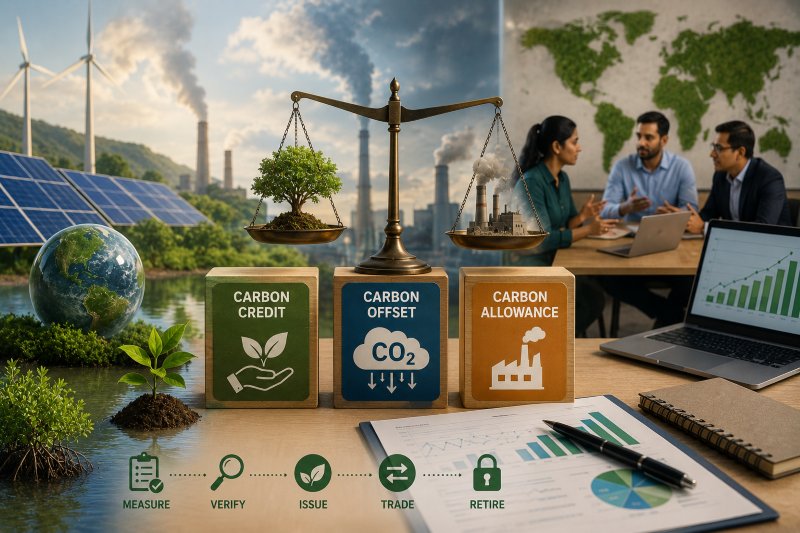
A carbon market works through a chain of project development, measurement, verification, issuance, trading, retirement, and claims, with each stage determining whether a carbon unit becomes credible, traceable, and usable.
Understanding the Carbon Market Process
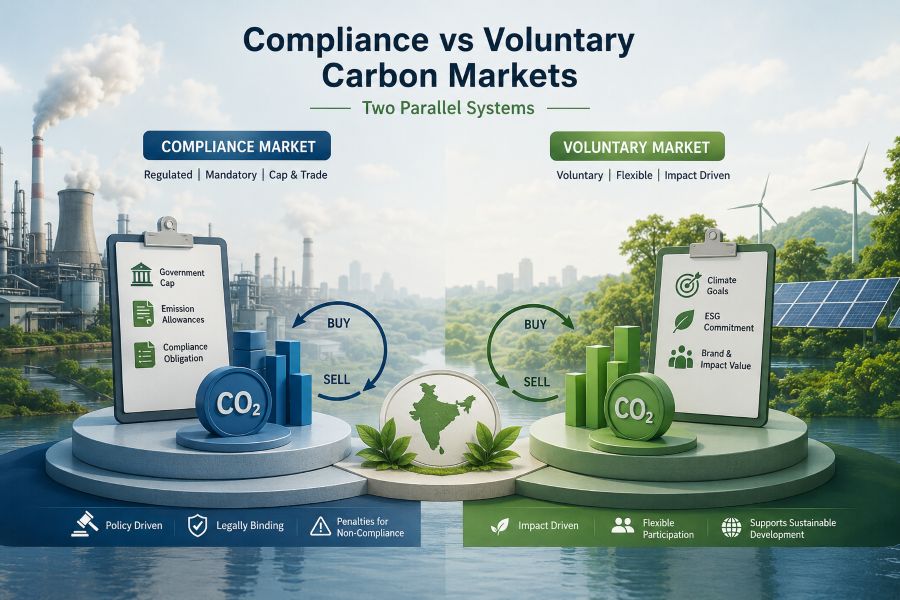
A company may announce that it has financed a mangrove restoration project, a waste operator may seek credits from landfill methane recovery, and an industrial buyer may later retire those credits to support a climate claim. What looks simple from the outside is actually the final result of a long technical and administrative process. A carbon market is not just a place where units are bought and sold; it is a full chain of project design, validation, monitoring, verification, issuance, transfer, retirement, and disclosure. The sequence described below primarily applies to project based carbon credits in voluntary and offset markets. Compliance markets, where regulated entities use allowances or other compliance units, follow a different process.
Why this process matters
Understanding the end-to-end process matters because carbon markets are increasingly relevant to a wider set of actors than just sustainability specialists. Businesses need to know how credits become real and usable. CSR teams, NGOs, social enterprises, and development practitioners need to understand how community projects could potentially access climate finance. Project developers need to know what determines whether a mitigation activity can actually become a tradable carbon unit.
For Indian readers, this is especially relevant because the country is now operationalising an offset mechanism under its Carbon Credit Trading Scheme with approved methodologies covering areas such as renewable energy, industrial energy efficiency, landfill methane recovery, household and small-farm methane recovery, and mangrove afforestation and reforestation.
The process at a glance
The carbon-market chain can be understood as a sequence of linked stages. The table below summarises the main steps and why each one matters.
|
Stage |
What happens |
Why it matters |
|
1. Project idea and methodology |
Identify a mitigation activity and match it to an approved methodology |
Determines whether the project can enter the carbon market at all |
|
2. Documentation and registration |
Prepare project documents and obtain programme acceptance |
Creates formal entry into the carbon-crediting system |
|
3. Monitoring and verification |
Collect performance data and undergo independent checking |
Tests whether claimed reductions or removals are real and measurable |
|
4. Issuance and registry entry |
Convert verified results into tradable units recorded in a registry |
Creates traceability and prevents confusion over ownership and status |
|
5. Trading and transfer |
Sell or transfer units through bilateral or market channels |
Links project output to buyers and price discovery |
|
6. Retirement |
Permanently remove the unit from circulation |
Ensures the credit cannot be reused or sold again |
|
7. Claims and disclosure |
Use retired credits in reporting or climate-related communication |
Affects transparency, integrity, and public trust |
Step 1: Project identification and methodology selection
Most project-based carbon market activity begins with a specific intervention that can reduce, avoid, or remove greenhouse-gas emissions. This may include renewable energy, methane capture, waste management, afforestation, clean cooking, or industrial efficiency. At this stage, the developer must determine whether the activity fits an approved methodology and whether its climate impact can be measured in a consistent and verifiable way.
This step is critical because the methodology defines the baseline, boundaries, calculations, monitoring rules, and evidence requirements for the project. In India, the approved offset methodologies now include categories such as renewable electricity, industrial energy efficiency and fuel switching, landfill methane recovery, methane recovery from livestock and manure management at households and small farms, and mangrove afforestation and reforestation.
Step 2: Project documentation, validation and registration
Once a methodology has been selected, the developer prepares the project documentation. This usually includes the project boundary, baseline assumptions, monitoring plan, emissions calculations, and supporting evidence. The documentation is then reviewed and, where required, validated by an independent validation and verification body under the relevant standard or programme.
If the review is successful, the project is registered. Registration means the project has been formally accepted into the system, but it does not yet mean credits exist. The project still has to implement activities and produce verified results before any units can be issued.
Step 3: Monitoring, reporting and verification
After registration, the project enters the implementation and monitoring stage. The developer collects the data required by the methodology over time. Depending on the project, this may involve electricity generation, methane captured, hectares restored, fuel displaced, or other activity-specific indicators.
That information is compiled into monitoring reports and submitted for independent verification. Verification is one of the most important safeguards in the market because it tests whether the claimed reductions or removals are supported by evidence and are consistent with the approved methodology.
Step 4: Issuance and registry entry
If verification is successful, the verified climate benefit can be converted into tradable units and issued in a registry. Registries matter because they create traceability: they record project details, serial numbers, issuance, ownership, transfer, and retirement status.
This is why registries are central to market integrity. For example, Verra describes its registry as the central repository for project information and units, and notes that issuance, retirement, and transfer all occur through registry accounts. Without such systems, it would be much harder to avoid duplication, confusion, or double counting.
Step 5: Trading, transfer and price discovery
Once units are issued, they may be transferred or sold through different channels. Some credits are sold directly from project developers to end buyers, while others move through brokers, platforms, or secondary-market transactions. At this stage, market value is shaped not just by volume, but by project type, methodology, geography, co-benefits, buyer demand, and perceived integrity.
This means that two carbon credits representing the same quantity of emissions may still command different prices. A buyer may value one credit more highly because it is linked to a nature-based project with community benefits, or because the methodology and verification process are seen as more robust.
Step 6: Retirement and final use
A carbon credit is not fully used when it is merely purchased. It reaches its final market stage when it is retired. Retirement means the unit is permanently taken out of circulation so it cannot be sold or used again. This links the credit to a final purpose, such as a climate claim, a reporting disclosure, or another recognised use.
For readers outside the technical carbon world, retirement is one of the most important concepts to understand. A purchased credit that is not retired remains an owned asset. A retired credit is one that has been permanently removed from circulation and can no longer be transferred or used again.
Step 7: Claims, disclosure and credibility
The final stage of the process is about how credits are used and communicated. Once a credit is retired, a buyer may refer to it in reporting, mitigation statements, or other climate-related disclosures. This is where the credibility of a carbon market extends beyond measurement and into governance, transparency, and public trust.
That is why integrity concerns increasingly matter. Readers are right to ask not only whether a project was verified, but also whether the resulting climate claim is fair, transparent, and proportionate. In practice, the end of the carbon-market chain is not retirement alone; it is retirement plus responsible use.
Social-sector and India relevance
This end-to-end process is especially relevant for CSR teams, NGOs, community organisations, and social enterprises because many climate-mitigation projects overlap with development practice. Waste management, rural energy access, small-farm methane recovery, afforestation, mangrove restoration, and similar interventions may all intersect with carbon-market mechanisms if they are designed, monitored, and verified properly.
In India, the operationalisation of the offset mechanism suggests that project-based participation is becoming more practical over time. For businesses, this may create new opportunities in voluntary climate action and supply-chain interventions. For development actors, it may create access to climate finance, but only where project design, community engagement, benefit-sharing, and compliance with methodology requirements are strong enough.
Practical examples
Consider a landfill operator that installs methane recovery infrastructure. It first needs an approved methodology, then project registration, monitored performance data, independent verification, issuance into a registry, and finally a buyer willing to purchase and retire the resulting credits. The credit does not appear at the end of one engineering intervention alone; it emerges through the full chain.
Or consider a mangrove restoration project linked to community livelihoods. Even if the ecological work is meaningful, it only becomes part of the carbon market if baseline assumptions, carbon-stock measurement, monitoring, verification, and registry procedures are handled correctly. This is why project quality and market process are inseparable.
Why the full chain matters
A carbon market should therefore be understood as a system rather than a transaction. Every step, from methodology choice to retirement, affects whether a carbon unit is credible and whether the climate finance attached to it is justified.
For Indian readers, the practical takeaway is that carbon markets are becoming more relevant across business, climate policy, and development practice, but participation depends on understanding the process in full rather than focusing only on the final act of buying or selling credits.
Key takeaways
- A carbon market is a full process chain, not just a trading platform.
- Methodologies, validation, monitoring, verification, issuance, registry entry, trading, retirement, and claims all affect credibility.
- Registries are essential because they track ownership, serial numbers, transfers, and retirement status.
- Retirement is the step that permanently removes a credit from circulation and links it to a final use.
- The process is relevant not only to businesses but also to CSR teams, NGOs, social enterprises, and community projects seeking climate finance.
- India’s offset mechanism is making project-based carbon-market participation more concrete across areas such as renewable energy, methane recovery, and afforestation.
Related articles
Carbon Credits, Offsets and Allowances: Clearing the Jargon
Compliance vs Voluntary Carbon Markets: Two Parallel Systems