
Compliance vs Voluntary Carbon Markets: Two Parallel Systems
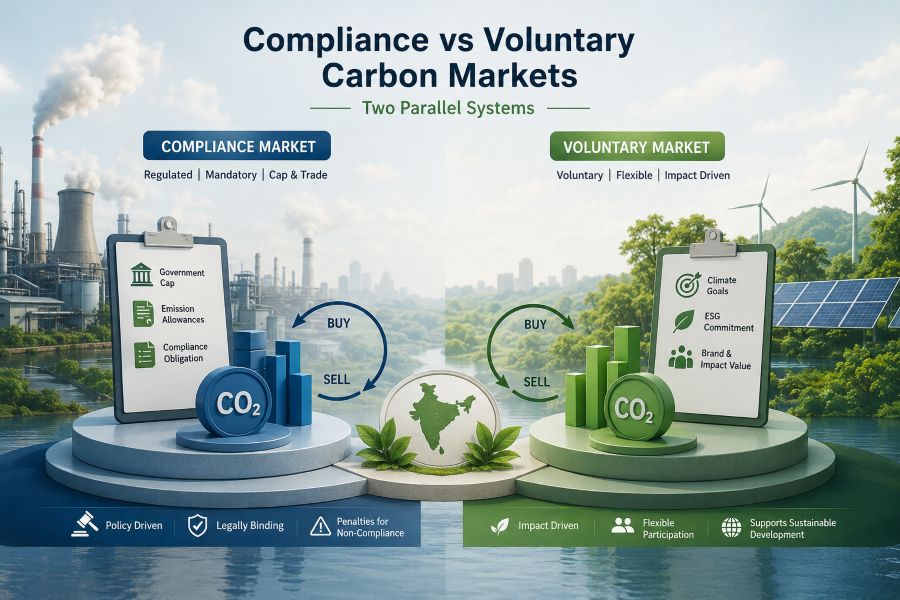
Compliance and voluntary carbon markets are two distinct systems for pricing and trading carbon, and understanding how each works is essential for interpreting policy, climate finance, business strategy, and development opportunities in India.
Understanding Compliance and Voluntary Carbon Markets
A steel plant covered by a regulated emissions system may need to buy allowances or other compliance units to meet a legal target, while a company funding a mangrove restoration or clean-cooking project may buy carbon credits voluntarily to support a climate commitment. Both activities sit within the wider world of carbon markets, but they operate under different rules, involve different participants, and serve different purposes. Understanding the difference matters not only for sustainability teams, but also for CSR professionals, NGOs, social enterprises, foundations, and development practitioners who increasingly encounter carbon finance in project design, partnerships, and reporting.
Why this distinction matters
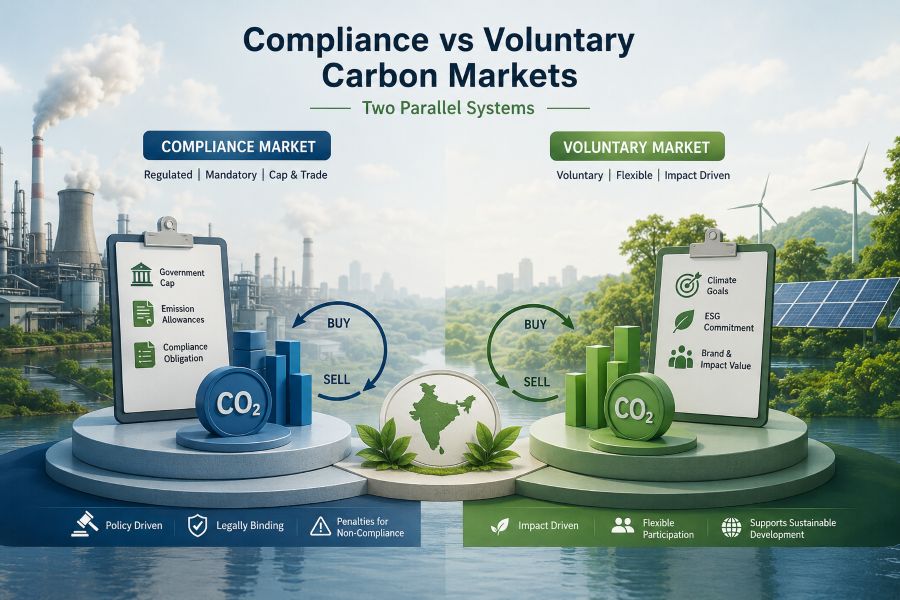
The distinction matters because the phrase “carbon market” is often used loosely even though it refers to two different institutional systems. Compliance markets are created through law and are designed to help governments achieve public climate targets. Voluntary markets operate outside direct legal obligations and are driven by organisations that choose to finance mitigation projects or use credits within broader climate strategies.
For many readers, the practical question is not just how these markets work, but why they matter. The answer is that they influence industrial costs, corporate climate claims, climate-finance flows, and the ability of mitigation projects to attract funding. That makes them relevant not only to policy specialists, but also to organisations working on rural livelihoods, waste, natural-resource management, community resilience, and low-carbon development.
Compliance vs Voluntary Markets at a Glance
The table below summarises the main differences between compliance and voluntary carbon markets.
|
Dimension |
Compliance market |
Voluntary market |
|
Purpose |
Meet legal or regulatory emissions obligations |
Finance mitigation projects or support voluntary climate strategies |
|
Participants |
Regulators and covered entities such as industrial firms or utilities |
Project developers, corporate buyers, investors, NGOs, standards bodies, and intermediaries |
|
Main instrument |
Allowances or regulated compliance units |
Project-based carbon credits |
|
Regulation |
Created and enforced by governments or regulators |
Governed mainly through standards, registries, verification, and market integrity frameworks |
|
Use case |
Legal compliance with caps, benchmarks, or emissions-intensity targets |
Climate finance, mitigation support, voluntary procurement, and climate claims |
|
Typical examples |
Emissions trading systems, baseline-and-credit schemes, industrial compliance markets |
Afforestation, clean cooking, waste methane, agriculture, renewable energy, and community-linked projects |
Compliance markets: structure and logic
Compliance carbon markets are created by governments through law or regulation. Their purpose is to help achieve public climate goals by requiring covered entities to meet emissions caps, limits, or performance benchmarks. Participation is mandatory for the entities included in the system.
One common model is cap-and-trade, in which the regulator sets an overall cap and creates allowances that can be traded among covered entities. Another model is a baseline-and-credit or performance-based system, where firms are measured against an emissions-intensity target or benchmark. India’s emerging market framework is especially relevant here because it is based on an intensity-oriented design rather than a classic absolute cap structure.
Voluntary markets: structure and internal layers
Voluntary carbon markets are used by organisations that choose to buy credits outside direct legal obligations. They are often linked to corporate climate strategies, climate-finance initiatives, supply-chain interventions, or project-based mitigation programmes.
Within voluntary markets, there are several layers. Credits may come from avoided or reduced emissions, such as waste methane capture or improved efficiency, or from removals such as afforestation and ecosystem restoration. The market also includes nature-based and technology-based projects, along with primary markets where credits are first issued and secondary markets where they are later traded.
Practical examples
A compliance-market example is a covered industrial company that receives or purchases allowances and must surrender the required units at the end of a compliance cycle. If it reduces emissions more efficiently than required, it may need fewer units or benefit from trading opportunities within the system.
A voluntary-market example is a project developer working on landfill methane recovery, mangrove restoration, renewable energy, sustainable agriculture, or clean cooking who seeks credit issuance under an approved methodology and sells those credits to a company or buyer interested in financing climate action. A corporate buyer in the voluntary market may then retire those credits in connection with a climate target or mitigation claim.
Development and social-sector relevance
Voluntary carbon markets are particularly relevant for the social sector because they can create an additional source of finance for projects that also generate development benefits. In India, the government has approved methodologies under the Offset Mechanism for activities such as renewable energy, industrial energy efficiency, landfill methane recovery, green hydrogen, and mangrove afforestation and reforestation. Beyond these, the broader Indian and international carbon-market landscape has also engaged with community-linked areas such as sustainable agriculture, rural energy access, and clean cooking.
For CSR programmes, NGOs, social enterprises, and community organisations, this opens both opportunity and complexity. Carbon finance may support project viability, livelihoods, or ecosystem restoration, but access can be limited by MRV costs, methodological complexity, verification requirements, and the need for strong community participation and benefit-sharing.
Integrity and credibility in voluntary markets
Voluntary carbon markets are under increasing scrutiny around credit quality, transparency, and climate claims. Integrity debates often focus on whether credited reductions are truly additional, whether they are robustly quantified, whether they risk reversal, and whether the same reduction could be counted more than once.
This is why institutions such as the Integrity Council for the Voluntary Carbon Market have developed the Core Carbon Principles as a benchmark for high-integrity credits. For readers outside the policy world, the practical takeaway is simple: not all credits are equal, and the credibility of a voluntary-market claim depends heavily on the quality of the underlying project, the verification process, and the transparency of how the credit is used.
What this means in India
In India, the growth of both compliance and voluntary markets could have practical effects over the next few years. Businesses may face stronger emissions-accounting and performance expectations under the Carbon Credit Trading Scheme, while also exploring voluntary project development, procurement, or climate-finance partnerships.
For NGOs, foundations, CSR initiatives, and project developers, a growing market could create pathways to finance activities such as afforestation, waste management, agriculture-linked mitigation, and rural energy solutions. At the same time, success will depend on policy clarity, strong registries, credible methodologies, transparent governance, and the ability of local institutions to participate effectively in carbon-market mechanisms.
How the two systems connect
Although compliance and voluntary markets are distinct, they increasingly influence each other through policy design, investor expectations, and debates around climate integrity. Governments are paying closer attention to how voluntary credits interact with domestic climate strategies and how claims made by private actors relate to national accounting.
For that reason, the two systems should be seen as parallel rather than isolated. Together, they shape how carbon is priced, how mitigation is financed, and how businesses and projects communicate climate performance.
Key takeaways
- Compliance markets are created by regulation and are mandatory for covered entities.
- Voluntary markets are used by buyers and project developers outside direct legal compliance obligations.
- A side-by-side understanding of purpose, participants, instruments, and use cases helps readers distinguish the two systems clearly.
- Voluntary carbon markets can be relevant to CSR, NGOs, social enterprises, and community-development projects in areas such as afforestation, sustainable agriculture, waste management, clean cooking, and rural energy access.
- Integrity and credibility are now central issues in voluntary carbon markets, especially around verification, transparency, additionality, and claims.
- In India, both markets are becoming more important for businesses, project developers, and community-linked climate-finance opportunities.
Related articles