What Is Social Stock Exchange (SSE)
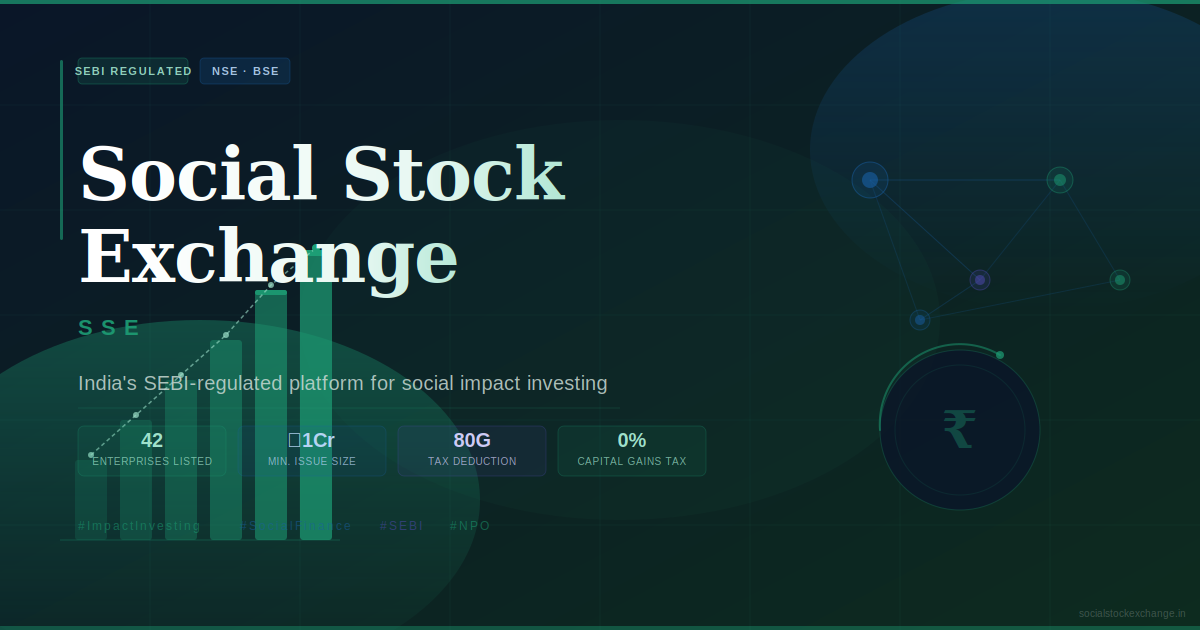
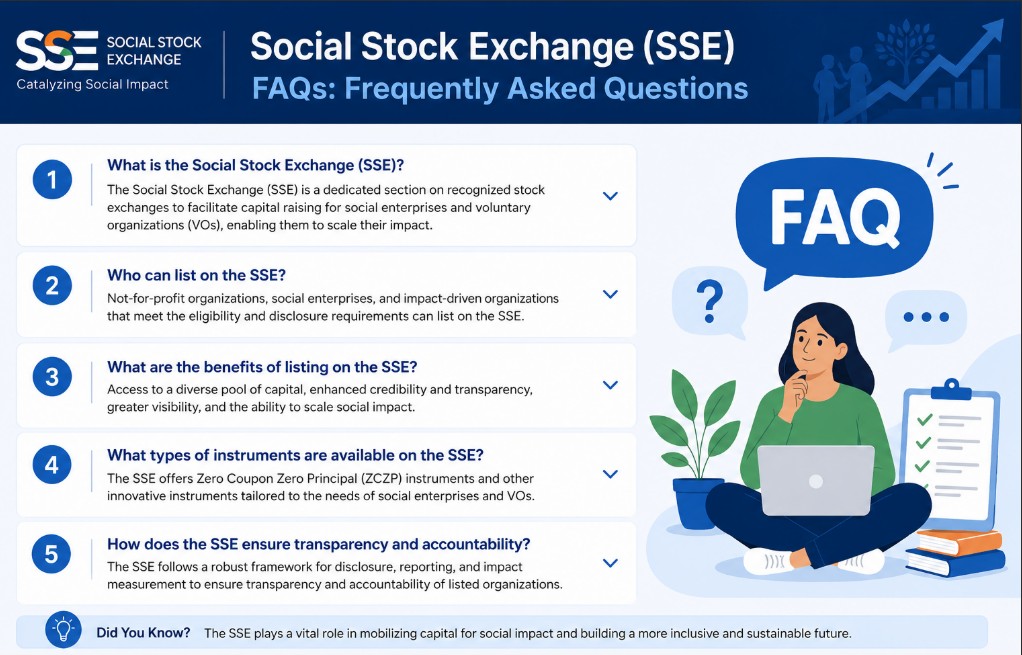
The Social Stock Exchange (SSE) is a SEBI-regulated electronic fundraising platform that enables Not-for-Profit Organisations (NPOs) and For-Profit Social Enterprises (FPEs) to register and raise capital through India's recognised stock exchanges — the NSE and BSE. Launched following the Union Budget 2019–20, the SSE bridges the financing gap between impact investors and social enterprises working on India's most pressing development challenges.
Introduction: Why India Created a Social Stock Exchange
India is on a mission to become a USD 5 trillion economy — yet millions of its citizens remain underserved. While corporate CSR funds and government grants have long been the primary lifeline for social enterprises, these channels are insufficient, inconsistent, and often inaccessible to smaller organisations.
The Social Stock Exchange was introduced to change this. Announced by the Finance Minister in the Union Budget Speech of 2019–20, the SSE is a pioneering initiative that brings capital markets into the service of social impact. It gives credible social enterprises a transparent, regulated, and scalable platform to raise funds — and gives investors a structured, accountable way to put their money to work for good.
SSE KEY FACTS AT A GLANCE
- Announced: Union Budget 2019–20
- Regulated by: Securities and Exchange Board of India (SEBI)
- Operational on: NSE (National Stock Exchange) and BSE
- Registered entities (Sep 2023): 18 on NSE + 24 on BSE = 42 total
- Governing body: SSE Governing Council at each exchange
- Key regulation: SEBI (ICDR) Third Amendment Regulations, 2022 — Regulation 292E
What Is the Social Stock Exchange?
The Social Stock Exchange (SSE) is a separate, dedicated segment within India's existing stock exchange infrastructure. It serves as a structured marketplace — or meeting ground — between social enterprises seeking capital and investors, donors, and corporates looking to fund measurable social impact.
Unlike a traditional stock exchange where companies list shares to generate profit for shareholders, the SSE is built around social return. Entities listed on the SSE commit to measurable impact goals, regular social impact reporting, and accountability structures — making it a performance-based philanthropy platform as much as a financial one.
How the SSE Works — Step by Step
- Step 1: A social enterprise (NPO or FPE) registers on NSE or BSE's SSE segment.
- Step 2: It submits initial disclosures — governance, legal standing, and financial information.
- Step 3: If it wishes to raise funds, it issues a fundraising instrument (e.g., ZCZP bonds or mutual fund units).
- Step 4: Investors subscribe through the exchange — just as they would buy securities.
- Step 5: The enterprise delivers on its project, reports social impact annually, and discloses any material changes within 7 days.
Who Can Register or List on the SSE?
Any social enterprise — whether a non-profit or a for-profit entity — that can demonstrate its primacy of social intent is eligible to register or list on the SSE. SEBI defines two categories:
|
Organisation Type |
Definition |
Registration Required? |
Fundraising Instrument |
|
Not-for-Profit Organisation (NPO) |
Trusts, charitable societies, Section 8 Companies |
Yes — NGO Darpan registration mandatory |
ZCZP Instruments, Mutual Funds |
|
For-Profit Social Enterprise (FPE) |
A company or body corporate with primacy of social intent |
Not required — follows existing SEBI equity/debt listing rules |
Equity, Debt Securities, Social Impact Funds, Mutual Funds |
SSE Eligibility: The 67% Rule
To qualify as a Social Enterprise, an entity must satisfy all three of the following conditions across its immediately preceding three-year average:
- Revenue: At least 67% of revenues come from eligible activities to the target population.
- Expenditure: At least 67% of expenditures are incurred for eligible activities to the target population.
- Beneficiaries: At least 67% of total customers or beneficiaries belong to the target population.
Note: Corporate foundations, political or religious organisations, professional/trade associations, and infrastructure companies (except affordable housing) are not eligible to register on the SSE.
What Activities Are Eligible Under the SSE?
Social enterprises must be engaged in at least one of the 17 SEBI-identified eligible activity categories. These span India's most critical development priorities:
|
Sector |
Examples of Eligible Activities |
|
Poverty, Hunger and Malnutrition |
Food security programs, livelihood support, rural welfare |
|
Education and Employability |
Schools, vocational training, digital literacy |
|
Gender Equality and Women Empowerment |
Women's SHGs, anti-trafficking programs |
|
Healthcare and WASH |
Primary health, maternal care, clean water and sanitation |
|
Environment and Climate |
Sustainability programs, disaster management, waste management |
|
Financial Inclusion |
Microfinance, rural banking, digitisation of payments |
|
National Heritage, Art and Culture |
Preservation of traditional art forms, cultural institutions |
Fundraising Instruments Available on the SSE
SSE Zero Coupon Zero Principal (ZCZP) Instrument
The ZCZP is the SSE's most innovative fundraising tool — available exclusively to registered NPOs. Key features:
- Pays zero interest (zero coupon) and returns zero principal on maturity.
- Investors receive a social return — measurable impact created by the funded project.
- Issued in dematerialised (demat) form only.
- Minimum issue size: Rs 1 crore. Minimum application size: Rs 2 lakh.
- Minimum subscription threshold: 75% of the issue size (funds refunded if below 75%).
- Exempt from Securities Transaction Tax (STT) and Capital Gains Tax.
- An NPO can issue multiple ZCZP instruments — one per project.
Other Instruments
- Social Impact Funds (AIFs): SEBI-registered Alternative Investment Funds investing in SSE-listed enterprises.
- Mutual Funds: Retail investors can access SSE through SEBI-approved mutual fund structures.
- Equity and Debt (FPEs): For-profit social enterprises follow standard equity/debt listing routes on NSE/BSE.
SSE Benefits of the Social Stock Exchange
SSE For Social Enterprises
- Access to a wider pool of institutional and retail investors.
- Improved credibility and market visibility through SEBI regulation.
- Capacity Building Fund (CBF) support — Rs 100 crore corpus housed at NABARD.
- Structured accountability frameworks that improve project management.
SSE For Investors — Tax Benefits at a Glance
|
Tax Benefit |
Who It Applies To |
Details |
|
Section 80G Deduction |
All investors in NPO-listed instruments |
Investments in SSE-listed NPO securities are fully tax-deductible. |
|
100% Tax Exemption |
First-time retail investors |
Up to Rs 1 lakh on investments in SSE Mutual Fund structures. |
|
STT Exemption |
All ZCZP investors |
Zero Securities Transaction Tax on ZCZP instruments. |
|
Capital Gains Tax Exemption |
All SSE investors |
No capital gains tax on SSE investments. |
|
CSR Deductibility |
Corporates |
CSR contributions to SSE-listed NPOs count as allowable CSR expenditure and are deductible from taxable income. |
Who Is Already Listed in SSE? Notable Registered Entities
As of September 2023, a total of 42 social enterprises had registered across both exchanges:
|
NSE-Registered Entities |
BSE-Registered Entities |
|
Ekalavya Foundation |
Green Age |
|
Samvedna Development Society |
People's Rural Education Movement |
|
Gramalaya Trust |
ISAP India Foundation |
|
Opportunity Foundation Trust |
Akhand Jyoti Foundation |
|
Development Management Foundation |
Shramik Bharti |
SSE Compliance and Reporting Requirements
SEBI mandates two layers of disclosure for all SSE-registered entities:
Initial Disclosures (at the time of registration or listing):
- General information about the organisation, its mission and governance structure.
- Legal registrations, audited financial statements, and funding history.
- Social Impact Scorecard: target segment, scale of reach, intensity of impact.
Continuous Disclosures (ongoing obligations):
- Annual Social Impact Report — mandatory for all listed entities.
- Annual Social Audit conducted by a SEBI-recognised Social Auditor (ICAI-registered + NISM-certified).
- Material event disclosures within 7 days of any event affecting project outcomes (NPOs only).
- Full compliance with SEBI (LODR) Regulations 2015, even if no funds are raised.
SSE FAQs (Frequently Asked Questions)
Question 01: Can foreign investors invest through the SSE?
Answer: No. Currently, only Indian investors — institutional or retail — are permitted to invest through the SSE. FIIs, FPIs, and NRIs are not allowed to invest in NPO fundraising on the SSE.
Question 02: Can an NPO registered on SSE choose not to raise funds?
Answer: Yes. An NPO can register on the SSE purely for credibility and visibility benefits without actively raising funds. It must, however, continue all applicable SEBI LODR compliance and disclosure obligations.
Question 03: Does investing through SSE qualify as CSR spend for companies?
Answer: Yes. Corporate contributions to NPOs listed on the SSE count towards a company's mandatory CSR expenditure under Schedule VII of the Companies Act. CSR capital can also function as an outcome funder in Development Impact Bond structures on the SSE.
Question 04: What happens if a ZCZP issue is under-subscribed?
Answer: If subscriptions fall below 75% of the issue size, all funds are refunded to investors. If subscriptions are between 75% and 100%, the NPO must disclose how the shortfall will be addressed and the potential impact on project outcomes.
Conclusion: The Future of Social Finance in India
India's Social Stock Exchange is a landmark innovation at the intersection of capital markets and social development. By providing small and mid-sized NPOs and social enterprises with a regulated, transparent, and scalable fundraising channel, the SSE has the potential to unlock billions of rupees in impact capital that was previously inaccessible.
For social enterprises, registration on the SSE signals credibility, attracts institutional investors, and builds the accountability structures needed for long-term growth. For investors — whether retail, corporate, or institutional — the SSE offers a unique way to make their money count, backed by SEBI-mandated impact reporting and compelling tax incentives.
As India's SSE matures and broadens access to retail investors, it is poised to become one of the most significant social finance platforms in the developing world.
SSE KEY TAKEAWAYS
- SSE is a SEBI-regulated platform on NSE and BSE for social enterprise fundraising.
- Both NPOs and For-Profit Social Enterprises can register; NPOs can also issue ZCZP instruments.
- Investors benefit from Section 80G deductions, zero STT, zero capital gains tax, and up to 100% exemption on retail SSE MF investments.
- The 67% revenue/expenditure/beneficiary rule is the key eligibility test for social enterprises.
- Annual social audits and LODR compliance are mandatory for all registered entities.
- As of September 2023, 42 entities are registered across the NSE and BSE.
Sources: SEBI (ICDR) Third Amendment Regulations, 2022 | NSE SSE Brochure | KPMG — Decoding Social Stock Exchange (2022) | NSE Social Stock Exchange FAQs